The flower
NCERT Class 11 Biology Chapter 5 Section 5.5
Quick answer
A typical flower has calyx, corolla, androecium and gynoecium on the thalamus. NCERT distinguishes hypogynous, perigynous and epigynous flowers; its “half inferior” label for perigyny differs from botanical usage when the ovary is free inside the floral cup. Aestivation describes sepals or petals in the bud, placentation describes ovule arrangement, and one compound pistil can contain several fused carpels.
With your textbook
NCERT Biology (Class 11), Chapter 5 “Morphology of Flowering Plants”, Section 5.5 “The Flower”, pages 62–65.
Open the official NCERT chapter (PDF, 3.4 MB, ncert.nic.in) (opens in a new tab)
Checked against the 2026-27 reprint on .
What is a flower?
The flower
The flower is the reproductive unit in the angiosperms.
NCERT Biology (Class 11), Section 5.5, page 62
- A flower is meant for sexual reproduction (page 62).
- A typical flower has four kinds of whorls arranged on the thalamus (receptacle), the swollen end of the stalk or pedicel: calyx, corolla, androecium and gynoecium.
- Calyx and corolla are accessory organs; androecium and gynoecium are reproductive organs (page 62).
In plain words: a flower is a modified, condensed shoot (NCERT page 61) that carries the plant’s sex organs. Its outer two whorls, sepals and petals, protect the bud and attract pollinators; its inner two whorls, stamens and carpels, make pollen and ovules. The flower is what makes angiosperms the flowering plants.
Describing a flower
- Perianth: in some flowers, such as lily, calyx and corolla are not distinct and are together called the perianth (page 62).
- Bisexual or unisexual: a flower with both androecium and gynoecium is bisexual; one with only stamens or only carpels is unisexual.
- Symmetry: actinomorphic (radial), with several planes through the centre giving matching halves (NCERT says “any radial plane”, an idealised description), as in mustard, datura and chilli; zygomorphic (bilateral) when only one particular vertical plane does, as in pea, gulmohur, bean and Cassia; asymmetric (irregular) when no vertical plane does, as in canna (page 62).
- Number of parts: trimerous, tetramerous or pentamerous when the floral appendages are in multiples of 3, 4 or 5.
- Bracts: flowers with bracts, reduced leaves at the base of the pedicel, are bracteate; those without are ebracteate (page 62).
When a flower has both androecium and gynoecium, it is bisexual.
NCERT Biology (Class 11), Section 5.5, page 62
Position of the ovary
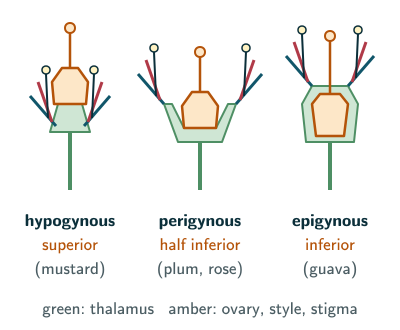
Based on where the calyx, corolla and androecium sit on the thalamus with respect to the ovary, flowers are hypogynous, perigynous or epigynous (page 63).
In the hypogynous flower the gynoecium occupies the highest position while the other parts are situated below it.
NCERT Biology (Class 11), Section 5.5, page 63
- Hypogynous: the ovary is superior, as in mustard, china rose and brinjal.
- Perigynous: the gynoecium is central and the other parts arise on the rim of a surrounding floral cup, as in plum, rose and peach. NCERT calls this ovary half inferior. Beyond NCERT, the NSW Flora glossary distinguishes a free ovary inside a perigynous cup as superior: a surrounding cup alone does not mean the ovary is partly fused to it.
- Epigynous: the margin of the thalamus grows upward, encloses the ovary completely and fuses with it, and the other parts arise above the ovary; the ovary is inferior, as in guava, cucumber and the ray florets of sunflower (page 63).
Parts of a flower
Each flower normally has four floral whorls: calyx, corolla, androecium and gynoecium (page 63).
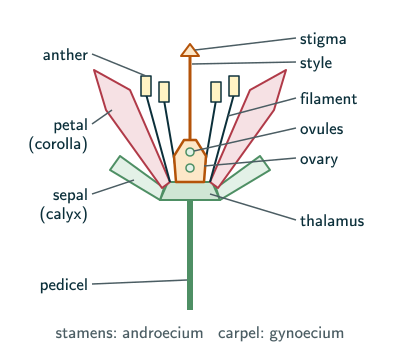
- Calyx: the outermost whorl; its members are sepals. Sepals are generally green and leaf-like and protect the flower in the bud stage. The calyx may be gamosepalous (sepals united) or polysepalous (sepals free).
- Corolla: made of petals, usually brightly coloured to attract insects for pollination. It may be gamopetalous (petals united) or polypetalous (petals free), and tubular, bell-shaped, funnel-shaped or wheel-shaped (page 63).
Aestivation
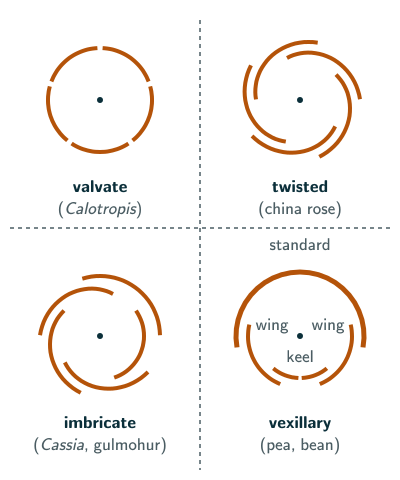
The mode of arrangement of sepals or petals in floral bud with respect to the other members of the same whorl is known as aestivation.
NCERT Biology (Class 11), Section 5.5.1, page 63
NCERT describes four main types (page 64):
- Valvate: the sepals or petals just touch one another at the margin without overlapping, as in Calotropis.
- Twisted: one margin of each appendage overlaps the next one, and so on, as in china rose, lady’s finger and cotton.
- Imbricate: the margins overlap one another but not in any particular direction, as in Cassia and gulmohur.
- Vexillary (papilionaceous): in pea and bean the five petals are arranged so that the largest, the standard, overlaps the two lateral wings, which in turn overlap the two smallest anterior petals, the keel.
Androecium
The androecium is made of stamens. Each stamen, the male reproductive organ, has a stalk, the filament, and an anther. Each anther is usually bilobed, each lobe has two chambers, the pollen-sacs, and pollen grains are produced in the pollen-sacs (page 64).
A sterile stamen is called staminode.
NCERT Biology (Class 11), Section 5.5.1, page 64
- Epipetalous: stamens attached to the petals, as in brinjal; epiphyllous when attached to the perianth, as in lily.
- Polyandrous: stamens free.
- Monadelphous: united into one bundle, as in china rose; diadelphous, two bundles, as in pea; polyadelphous, more than two bundles, as in Citrus.
- The filaments may vary in length within a flower, as in Salvia and mustard (page 64).
NCERT prints the one-bundle term as “monoadelphous” (page 64); the standard spelling is monadelphous.
Gynoecium and placentation
The gynoecium is the female reproductive part, made of one or more carpels. A carpel has three parts: the stigma, the style and the ovary (page 65).
- The ovary is the enlarged basal part; the style is the elongated tube that connects it to the stigma, which is usually at the tip of the style and receives the pollen grains.
- Each ovary bears one or more ovules on a flattened, cushion-like placenta.
- When there is more than one carpel, they may be free, apocarpous (lotus, rose), or fused, syncarpous (mustard, tomato).
- After fertilisation, the ovules develop into seeds and the ovary matures into a fruit (page 65).
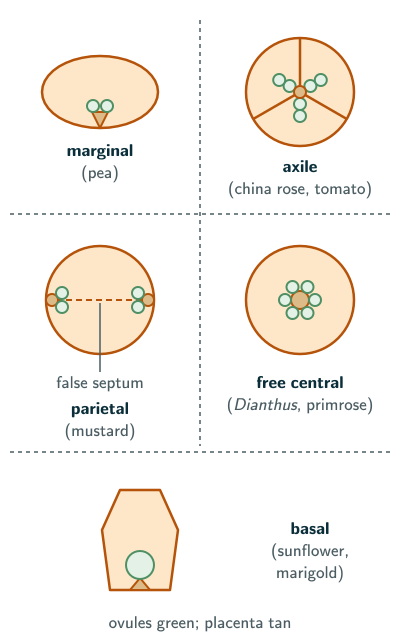
The arrangement of ovules within the ovary is known as placentation.
NCERT Biology (Class 11), Section 5.5.1, page 65
- Marginal: the placenta forms a ridge along the ventral suture and the ovules are borne on it in two rows, as in pea.
- Axile: the placenta is axial and the ovules are attached to it in a multilocular ovary, as in china rose, tomato and lemon.
- Parietal: the ovules develop on the inner wall (peripheral part) of a one-chambered ovary, as in mustard and Argemone; in mustard the ovary becomes two-chambered by a false septum.
- Free central: the ovules are borne on a central axis and septa are absent, as in Dianthus and primrose.
- Basal: the placenta develops at the base of the ovary with a single ovule, as in sunflower and marigold (page 65).
NCERT’s list of types (page 65) names “central” as well as “free central” but describes only the five above, and the same paragraph misprints the word placentation. Its sentence on parietal placentation also reads as if Argemone has the false septum, but NCERT’s own Figure 5.12 (c) shows a one-chambered ovary with ovules on several wall placentae and no septum; the false septum is mustard’s.
Solved examples
Example 1: Seven terms (NCERT Exercise Q3)
Define aestivation, placentation, actinomorphic, zygomorphic, superior ovary, perigynous flower and epipetalous stamen.
Answer:
- Aestivation: the arrangement of sepals or petals in a floral bud with respect to the other members of the same whorl, e.g. twisted in china rose.
- Placentation: the arrangement of ovules within the ovary, e.g. marginal in pea.
- Actinomorphic: radially symmetrical, with several planes through the centre producing matching halves, e.g. mustard; NCERT describes this as “any radial plane”.
- Zygomorphic: divisible into two similar halves only in one particular vertical plane, e.g. pea.
- Superior ovary: the ovary of a hypogynous flower, highest on the thalamus with the other parts below it, e.g. mustard.
- Perigynous flower: gynoecium in the centre and the other parts on the rim of the thalamus at almost the same level; NCERT calls the ovary half inferior, e.g. rose; botanical usage distinguishes a free superior ovary inside a perigynous cup.
- Epipetalous stamen: a stamen attached to a petal, e.g. brinjal.
(NCERT pages 62–65.)
Example 2: Apocarpous and syncarpous (NCERT Exercise Q4)
Differentiate between apocarpous and syncarpous ovary.
Answer: both terms apply only when a flower has more than one carpel.
- Apocarpous: the carpels are free, as in lotus and rose.
- Syncarpous: the carpels are fused, as in mustard and tomato.
(NCERT page 65.)
Example 3: Types of placentation (NCERT Exercise Q7)
Describe the various types of placentation found in flowering plants.
Answer: placentation is the arrangement of ovules within the ovary. NCERT describes five types: marginal (ovules in two rows on a ridge along the ventral suture: pea); axile (axial placenta in a multilocular ovary: china rose, tomato, lemon); parietal (ovules on the inner wall of a one-chambered ovary: mustard, Argemone; in mustard a false septum makes it two-chambered); free central (ovules on a central axis, no septa: Dianthus, primrose); basal (single ovule on a basal placenta: sunflower, marigold) (NCERT page 65).
Example 4: Parts of a typical flower (NCERT Exercise Q8)
What is a flower? Describe the parts of a typical angiosperm flower.
Answer: the flower is the reproductive unit of angiosperms, meant for sexual reproduction. Four whorls sit on the thalamus (receptacle), the swollen end of the pedicel:
- Calyx: sepals, usually green, which protect the bud; gamosepalous or polysepalous.
- Corolla: petals, usually brightly coloured, which attract insects; gamopetalous or polypetalous. In lily, calyx and corolla are not distinct and form a perianth.
- Androecium: stamens, each a filament and an anther; the anther is usually bilobed, with two pollen-sacs per lobe, where the pollen grains form.
- Gynoecium: carpels, each a stigma, a style and an ovary bearing ovules on a placenta.
Calyx and corolla are accessory organs; androecium and gynoecium are reproductive organs (NCERT pages 62–65).
Example 5: Floral members and the thalamus (NCERT Exercise Q10)
Describe the arrangement of floral members in relation to their insertion on the thalamus.
Answer: in hypogynous flowers the gynoecium is highest and the other parts are below it (superior ovary: mustard, china rose, brinjal); in perigynous flowers the other parts are on the rim of the thalamus at almost the ovary’s level (NCERT’s “half inferior”: plum, rose, peach; see the botanical distinction above); in epigynous flowers the thalamus encloses and fuses with the ovary and the other parts arise above it (inferior: guava, cucumber, ray florets of sunflower) (NCERT page 63).
Example 6: Pea and china rose
Compare the corolla aestivation and the stamens of pea and china rose.
Answer: pea has vexillary aestivation and diadelphous stamens (two bundles); china rose has twisted aestivation and monadelphous stamens (one bundle) (NCERT page 64).
Common mistakes to avoid
Common mistake
Calling a perigynous ovary inferior
NCERT describes its perigynous examples as half inferior and its epigynous examples as inferior. In botanical terminology, perigyny alone does not make an ovary half inferior: look for fusion to the surrounding cup, rather than just its height.
Common mistake
Mixing up twisted and imbricate
Twisted: each petal overlaps the next one way round. Imbricate: margins overlap in no particular direction.
Common mistake
Thinking the anther has two pollen-sacs
An anther is usually bilobed, and each lobe has two pollen-sacs: four in all.
Common mistake
Giving *Cassia* or gulmohur vexillary aestivation
Cassia and gulmohur are zygomorphic like pea, but NCERT gives them imbricate aestivation; vexillary is pea and bean (pages 62 and 64).
Common mistake
Calling lily stamens epipetalous
Lily has a perianth, so its stamens are epiphyllous; brinjal’s are epipetalous (page 64).
Common mistake
Giving mustard axile placentation
Mustard has parietal placentation with a false septum; china rose, tomato and lemon have axile.
Quick revision summary
- The flower is the reproductive unit of angiosperms: calyx, corolla (accessory), androecium, gynoecium (reproductive) on the thalamus.
- Symmetry: actinomorphic (mustard, datura, chilli), zygomorphic (pea, gulmohur, bean, Cassia), asymmetric (canna).
- NCERT’s ovary categories: superior/hypogynous, “half inferior”/perigynous, inferior/epigynous. In botanical usage a free ovary inside a perigynous cup is superior.
- Aestivation: valvate (Calotropis), twisted (china rose), imbricate (Cassia), vexillary (pea, bean).
- Stamens: epipetalous (brinjal), epiphyllous (lily); monadelphous (china rose), diadelphous (pea), polyadelphous (Citrus); staminode sterile.
- Carpels apocarpous (lotus, rose) or syncarpous (mustard, tomato); placentation marginal, axile, parietal, free central, basal.
Formula sheet
- whorls: calyx, corolla, androecium, gynoecium on the thalamus
- NCERT: hypogynous superior; perigynous “half inferior”; epigynous inferior (see botanical caveat)
- aestivation: valvate, twisted, imbricate, vexillary
- stamens in bundles: monadelphous 1, diadelphous 2, polyadelphous more than 2
- carpel: stigma, style, ovary (ovules on a placenta)
- placentation: marginal, axile, parietal, free central, basal
Questions students ask
Is aestivation in flowers the same as aestivation in animals?
No, aestivation in flowers and aestivation in animals are different things that share a name. In a flower, aestivation is the mode of arrangement of sepals or petals in a floral bud with respect to the other members of the same whorl, such as valvate or twisted (NCERT Section 5.5.1), while in animals it is summer sleep: in peak summer the frog shelters in a deep burrow to protect itself from extreme heat (NCERT Section 7.2, page 80; see the frog).
What is the difference between androecium and gynoecium?
The androecium is the male reproductive whorl of a flower, made of stamens, each a filament and an anther in which pollen grains are produced, while the gynoecium is the female reproductive whorl, made of one or more carpels, each with a stigma, a style and an ovary bearing ovules (NCERT pages 64–65). The androecium lies just inside the corolla and the gynoecium at the centre of the flower, and after fertilisation the ovary matures into a fruit and its ovules into seeds. The androecium is the whole whorl and a stamen one unit of it, just as a carpel is one unit of the gynoecium.
Is a pistil the same as a carpel?
Not always. A simple pistil consists of one carpel; a compound pistil consists of two or more fused carpels. NCERT Class 12 Figure 1.7 calls the fused structure in Papaver a multicarpellary, syncarpous pistil (page 9), so one pistil does not necessarily mean one carpel. Apocarpous flowers have separate carpels, each forming a simple pistil; syncarpous flowers have fused carpels. The gynoecium is always the whole female whorl, all the carpels of the flower together.
Practice questions
Try each question first, then open the answer to check your working.
-
Q1. What is a perianth? Give an example.
Show answerHide answer
Calyx and corolla that are not distinct from each other, as in lily (NCERT page 62).
-
Q2. Name the three groups of petals in vexillary aestivation.
Show answerHide answer
The standard (largest), two wings and two keel petals (NCERT page 64).
-
Q3. Which flower does NCERT give as asymmetric?
Show answerHide answer
Canna (NCERT page 62).
-
Q4. What is a staminode?
Show answerHide answer
A sterile stamen (NCERT page 64).