Family Compositae (Asteraceae)
Beyond NCERT In the NEET syllabus; the Class 11 book has no section for it.
Quick answer
Compositae (Asteraceae) bears flower heads called capitula; a typical sunflower head has sterile ray florets and bisexual disc florets, while other members have different combinations. Fertile florets typically have syngenesious anthers and an inferior ovary with one basal ovule, producing a cypsela. The calyx may form a pappus or be absent; a disc-floret formula is ⊕ ⚥ K pappus C(5) A(5) G(2), with C–A adhesion and G overlined.
The family Compositae
Compositae (Asteraceae)
Compositae, also called Asteraceae, is the sunflower family of dicotyledons, and one of the largest families of flowering plants. What looks like a single sunflower is really a capitulum: a head of many small flowers (florets) on a common receptacle.
- The calyx is reduced to a pappus of hairs or scales, or is absent.
- The anthers are fused into a tube while the filaments stay free: syngenesious stamens.
- The ovary is inferior, with one basal ovule, and the fruit is a cypsela.
The 2026–27 NCERT book describes only the family Solanaceae, while the NEET (UG) 2026 syllabus lists Compositae in Unit 2. NCERT does use sunflower and marigold as examples in Chapter 5 (pages 61, 63 and 65), and those lines are cited below. Everything else is beyond the 2026–27 NCERT text.
Vegetative characters
- Habit: mostly herbs, some shrubs; some, such as lettuce, have a milky latex.
- Leaves: alternate or opposite, exstipulate; simple, but sometimes deeply divided or compound (marigold, dahlia). NCERT gives sunflower as an example of alternate phyllotaxy (page 61).
Capitulum: ray and disc florets
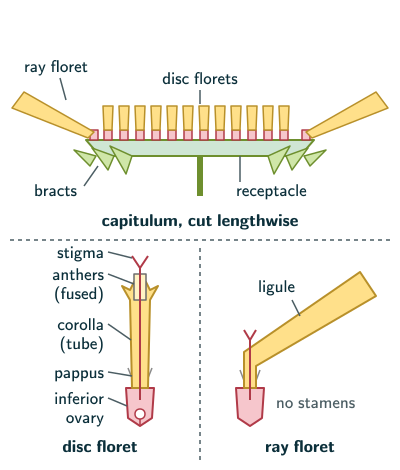
- Inflorescence: a capitulum (head), a racemose inflorescence. Many florets sit on a broad receptacle, ringed below by involucral bracts.
- Ray florets, at the margin, have a strap-shaped corolla (ligule); they are zygomorphic and usually female or sterile: sterile in sunflower, female in marigold.
- Disc florets, in a typical sunflower head, have a tubular corolla and are actinomorphic and bisexual. The family also includes unisexual florets and heads; NSW Flora records this wider variation.
- Not every head has both kinds: lettuce heads have only strap-shaped florets, and these are bisexual; Ageratum heads have only tubular florets.
- The florets open from the margin inwards. This is the centripetal order that acropetal succession takes on a flat axis.
Pappus and syngenesious stamens
- Calyx: reduced to a pappus of hairs, bristles or scales. In many members (dandelion, Tridax) the persistent hairy pappus carries the fruit on the wind; in sunflower it is two small scales that fall early; in some it is absent.
- Corolla: five petals, united: tubular in disc florets, strap-shaped in ray florets.
- Androecium: five stamens, epipetalous, syngenesious: the anthers are united into a tube round the style, while the filaments are free.
Inferior ovary, basal placentation and the cypsela
- Gynoecium: two fused carpels (bicarpellary, syncarpous); the ovary is inferior and one-chambered, with a single ovule. The style ends in a two-lobed stigma.
- Inferior ovary: NCERT gives the ray florets of sunflower among its epigynous flowers, with an inferior ovary (page 63).
- Basal placentation:
In basal placentation, the placenta develops at the base of ovary and a single ovule is attached to it, as in sunflower, marigold.
NCERT Biology (Class 11), Section 5.5.1, page 65
- Fruit: a cypsela, a one-seeded, dry, indehiscent fruit from an inferior ovary of two fused carpels, often crowned by the pappus. What we call sunflower “seeds” are these fruits.
Floral formula
Beyond the NCERT text, for a disc floret: ⊕ ⚥ Kpappus C(5) A(5) G(2), with a line over C and A and a line above the G.
- ⊕ ⚥: actinomorphic and bisexual.
- Kpappus: the calyx reduced to a pappus.
- C(5): five united petals.
- A(5): five stamens, their anthers united (syngenesious); the line over C and A shows that they are epipetalous.
- G(2) with a line above: two fused carpels in an inferior ovary.
A ray floret is written % ♀ Kpappus C(5) A0 G(2), with a line above the G: zygomorphic, female, no stamens, as in marigold. In sunflower the ray florets are sterile (neuter); only its disc florets set fruit.
Economic importance
| Plant | Use |
|---|---|
| Sunflower (Helianthus annuus) | oil from its fruits |
| Safflower (Carthamus tinctorius) | oil from its fruits |
| Lettuce (Lactuca sativa) | leaves eaten as salad |
Marigold, Chrysanthemum and dahlia are grown as ornamentals.
Solved examples
Example 1: Spot the family
A “flower” turns out to be a head of many small florets on a flat receptacle, ringed by bracts, the outer ones strap-shaped and the inner ones tubular. Name the family and the inflorescence.
Answer: Compositae (Asteraceae); the inflorescence is a capitulum.
Example 2: Syngenesious
What does “syngenesious” mean, and how is it different from monadelphous?
Answer: syngenesious stamens have their anthers united and their filaments free (Compositae). Monadelphous stamens have their filaments united into one bundle (NCERT page 64, china rose).
Example 3: Sunflower in NCERT
Which three features of sunflower does NCERT use as examples in Chapter 5?
Answer: its leaves are alternate (page 61); its ray florets are epigynous, with an inferior ovary (page 63); and its placentation is basal, with a single ovule (page 65).
Example 4: Reading the formula
In ⊕ ⚥ Kpappus C(5) A(5) G(2), with a line above the G, what do Kpappus and the line above the G tell you?
Answer: the calyx is reduced to a pappus, and the ovary is inferior (a line above G marks an inferior ovary, NCERT page 67).
Example 5: What is a sunflower seed?
Is a sunflower “seed” a seed or a fruit?
Answer: a fruit, a cypsela: one-seeded, dry, indehiscent, from an inferior ovary of two fused carpels. In school terminology an achene is contrasted as a similar dry fruit from a superior ovary. Some floras, including NSW Flora, use “achene” broadly for the Asteraceae fruit too; “cypsela” makes its inferior-ovary origin explicit.
Common mistakes to avoid
Common mistake
Calling a sunflower one flower
It is a capitulum of many florets: ray florets at the margin and disc florets in the centre.
Common mistake
Writing the Compositae ovary as superior
It is inferior, written with a line above the G (NCERT page 63 gives sunflower ray florets as epigynous).
Common mistake
Calling the pappus a petal
The pappus is the reduced calyx, of hairs or scales.
Quick revision summary
- Compositae (Asteraceae), the sunflower family: mostly herbs; leaves simple, exstipulate; some with latex.
- Inflorescence a capitulum: florets on a receptacle ringed by involucral bracts; ray florets (ligulate, zygomorphic) at the margin, disc florets (tubular, actinomorphic, bisexual) in the centre; opening centripetally.
- Calyx a pappus; corolla 5 united; stamens 5, epipetalous, syngenesious (anthers united, filaments free).
- Ovary inferior, bicarpellary, one-chambered, one basal ovule (NCERT: sunflower, marigold); fruit a cypsela.
- Disc floret formula: ⊕ ⚥ Kpappus C(5) A(5) G(2), line over C and A, line above the G.
- Uses: sunflower and safflower (oil), lettuce (salad); marigold and Chrysanthemum (ornamental).
Formula sheet
- Compositae: sunflower family (Asteraceae); inflorescence capitulum
- ray florets: strap-shaped; disc florets: tubular
- calyx: pappus; stamens: syngenesious (anthers united)
- ovary inferior, basal placentation, one ovule; fruit cypsela
- disc floret: ⊕ ⚥ K pappus C(5) A(5) G(2), line over C and A, line above G
- uses: sunflower and safflower oil, lettuce salad
Questions students ask
Are Asteraceae and Compositae the same family?
Yes, Asteraceae and Compositae are two names for the same family, the sunflower family. Compositae is the old descriptive name, from the composite head, the capitulum, that looks like one flower but is made of many florets, and the botanical code still allows it because of its long use; Asteraceae is the regular name, formed from the genus Aster. The NEET (UG) 2026 syllabus lists the family as ‘compositae’.
What is the difference between Malvaceae and Asteraceae?
Malvaceae and Asteraceae differ in inflorescence, calyx, stamens and ovary: china rose bears solitary flowers with an epicalyx and a calyx of five united sepals, while sunflower bears a capitulum of many small florets ringed by bracts, each floret’s calyx reduced to a pappus. Malvaceae has many monadelphous stamens, and Asteraceae five syngenesious ones. The Malvaceae ovary is superior, with five fused carpels and axile placentation in china rose, and usually forms a capsule; the Asteraceae ovary is inferior, with two fused carpels and one basal ovule, and forms a cypsela.
Why is Compositae called the most advanced family of dicots?
“Most advanced” is an older classification label, not a modern biological ranking. Compositae has specialised features: its flowers are specialised in many ways at once: tiny florets packed into a capitulum work together as one large flower for visiting insects, the anthers form a tube through which the growing style pushes the pollen out, the ovary is inferior with a single ovule, and in many members the pappus carries the one-seeded fruit on the wind. The ranking comes from older systems, such as Engler and Prantl’s, which placed Compositae last among the dicots; modern classifications treat it as one of the largest families of flowering plants without calling any family the most advanced.
Practice questions
Try each question first, then open the answer to check your working.
-
Q1. What ring of structures surrounds a capitulum from below?
Show answerHide answer
The involucre of bracts.
-
Q2. Which placentation does NCERT give for marigold?
Show answerHide answer
Basal (NCERT page 65).
-
Q3. Name two members of Compositae grown for oil.
Show answerHide answer
Sunflower and safflower.
-
Q4. Is a capitulum a racemose or a cymose inflorescence?
Show answerHide answer
Racemose.