The leaf
NCERT Class 11 Biology Chapter 5 Section 5.3
Quick answer
A leaf is a lateral, generally flattened structure borne on the stem at a node, with a bud in its axil; it has a leaf base, a petiole and a lamina with veins and is the main organ of photosynthesis. Venation is reticulate in most dicots and parallel in most monocots, and a leaf is compound when its incisions reach the midrib, pinnately as in neem or palmately as in silk cotton. Phyllotaxy, the arrangement of leaves, is alternate, opposite or whorled.
With your textbook
NCERT Biology (Class 11), Chapter 5 “Morphology of Flowering Plants”, Section 5.3 “The Leaf”, pages 59–61.
Open the official NCERT chapter (PDF, 3.4 MB, ncert.nic.in) (opens in a new tab)
Checked against the 2026-27 reprint on .
What is a leaf?
The leaf
The leaf is a lateral, generally flattened structure borne on the stem.
NCERT Biology (Class 11), Section 5.3, page 59
- A leaf develops at a node and bears a bud in its axil; the axillary bud later develops into a branch.
- Leaves originate from shoot apical meristems and are arranged in an acropetal order (page 59).
- A leaf is a lateral outgrowth of the stem that develops exogenously at the node (NCERT Summary, page 69; NCERT spells it “exogeneously”).
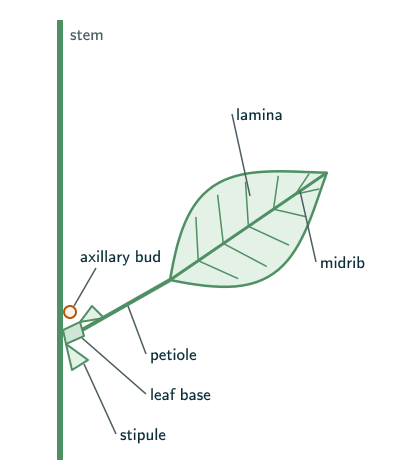
- A typical leaf has three main parts: leaf base, petiole and lamina (page 60).
They are the most important vegetative organs for photosynthesis.
NCERT Biology (Class 11), Section 5.3, page 59
In plain words: a typical foliage leaf is a flat green side-organ of the stem that makes food. Leaves form at the growing tip of the shoot, and the youngest are nearest the tip (acropetal order). A useful identification feature is an axillary bud at the leaf base, though a tiny or dormant bud may be difficult to see. The axil is the angle between the leaf and the stem. Leaves changed for climbing, defence, storage or catching insects are on the page on modifications of the leaf.
Parts of a leaf
NCERT names three main parts (page 60):
- Leaf base: attaches the leaf to the stem and may bear two small, lateral, leaf-like stipules. In some leguminous plants the leaf base becomes swollen; this is called the pulvinus.
- Petiole: helps hold the blade to light. Long, thin, flexible petioles let leaf blades flutter in the wind, which cools the leaf and brings fresh air to its surface.
- Lamina (leaf blade): the green, expanded part with veins and veinlets. Usually there is a prominent middle vein, the midrib. The shape, margin, apex, surface and extent of incision of the lamina vary between leaves.
In monocotyledons, the leaf base expands into a sheath covering the stem partially or wholly.
NCERT Biology (Class 11), Section 5.3, page 60
Veins provide rigidity to the leaf blade and act as channels of transport for water, minerals and food materials.
NCERT Biology (Class 11), Section 5.3, page 60
Beyond the NCERT Biology text: wind sweeping over a fluttering blade carries heat away from its surface; this is forced convection.
Venation
The arrangement of veins and the veinlets in the lamina of leaf is termed as venation.
NCERT Biology (Class 11), Section 5.3.1, page 60
- Reticulate venation: the veinlets form a network; leaves of dicotyledonous plants generally have it. Its veins vary in thickness, so a vertical section of a dicot leaf shows vascular bundles of different sizes (NCERT Chapter 6, page 77).
- Parallel venation: the veins run parallel to each other within the lamina; it is the characteristic of most monocotyledons (page 60).
Beyond the NCERT Biology text: NCERT’s “generally” and “most” matter: Calophyllum, a dicot, has parallel venation; Smilax, a monocot, has reticulate venation.
Simple and compound leaves
- Simple leaf: the lamina is entire, or its incisions do not touch the midrib.
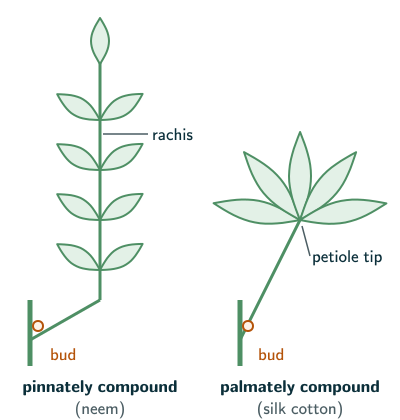
- Compound leaf: the incisions reach the midrib, breaking the lamina into a number of leaflets (page 60).
A bud is present in the axil of petiole in both simple and compound leaves, but not in the axil of leaflets of the compound leaf.
NCERT Biology (Class 11), Section 5.3.2, page 60
This is how you tell a compound leaf from a branch bearing simple leaves: the bud is at the base of the whole compound leaf, and none at its leaflets.
- Pinnately compound: the leaflets are on a common axis, the rachis, which represents the midrib of the leaf, as in neem.
- Palmately compound: the leaflets are attached at a common point, the tip of the petiole, as in silk cotton (pages 60–61).
Phyllotaxy
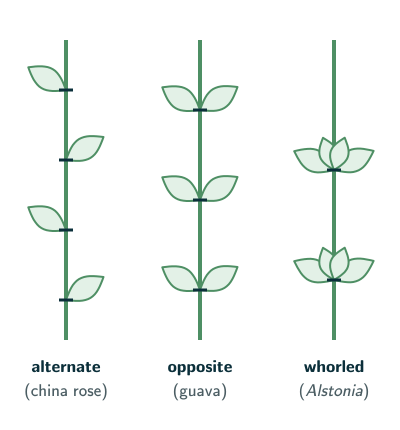
Phyllotaxy is the pattern of arrangement of leaves on the stem or branch.
NCERT Biology (Class 11), Section 5.3.3, page 61
NCERT describes three types (page 61):
- Alternate: a single leaf arises at each node, in alternate manner, as in china rose, mustard and sunflower.
- Opposite: a pair of leaves arises at each node, opposite each other, as in Calotropis and guava.
- Whorled: more than two leaves arise at a node and form a whorl, as in Alstonia.
Beyond the NCERT Biology text: opposite pairs may be decussate, successive pairs at right angles, or superposed, one above another. Do not memorise guava as a universal superposed example: the Indian Institute of Science’s Digital Flora of Eastern Ghats describes guava as opposite and decussate. NCERT itself requires only the opposite category for both guava and Calotropis.
Solved examples
Example 1: Pinnate or palmate? (NCERT Exercise Q1)
How is a pinnately compound leaf different from a palmately compound leaf?
Answer: in a pinnately compound leaf the leaflets are on a common axis, the rachis, which represents the midrib, as in neem; in a palmately compound leaf the leaflets are attached at a common point, the tip of the petiole, as in silk cotton (NCERT pages 60–61). A palmately compound leaf has no rachis. In both, the only bud is in the axil of the petiole (page 60).
Example 2: Types of phyllotaxy (NCERT Exercise Q2)
Explain with suitable examples the different types of phyllotaxy.
Answer: phyllotaxy is the pattern of arrangement of leaves on the stem or branch, usually of three types: alternate, one leaf at each node in alternate manner (china rose, mustard, sunflower); opposite, a pair of leaves at each node opposite each other (Calotropis, guava); whorled, more than two leaves at a node forming a whorl (Alstonia) (NCERT page 61).
Example 3: Leaflet or leaf?
A green flat structure has no bud in its axil, but the stalk that bears it and several others has a bud at its base. Is the structure a leaf or a leaflet?
Answer: a leaflet of a compound leaf: a bud is present in the axil of the petiole of a leaf, but not in the axil of a leaflet (NCERT page 60).
Example 4: Sheath and pulvinus
What do the leaf bases of monocotyledons and of some leguminous plants become?
Answer: in monocotyledons the leaf base expands into a sheath covering the stem partially or wholly; in some leguminous plants it becomes swollen, forming the pulvinus (NCERT page 60).
Example 5: Why veins matter
Give two functions of the veins of a leaf.
Answer: they provide rigidity to the leaf blade, and they act as channels of transport for water, minerals and food materials (NCERT page 60).
Example 6: Simple despite the cuts
A leaf’s lamina is deeply cut, but no cut reaches the midrib. Is the leaf simple or compound?
Answer: simple: a leaf is compound only when the incisions reach the midrib and break the lamina into leaflets (NCERT page 60).
Common mistakes to avoid
Common mistake
Taking leaflets for leaves
Leaflets have no bud in their axils; only the whole compound leaf has a bud, in the axil of its petiole.
Common mistake
Calling any deeply cut leaf compound
In NCERT’s description, incisions reach the midrib and divide the blade into distinct leaflets. Use that separation and the bud-at-whole-leaf-base test together, including for palmately compound leaves.
Common mistake
Mixing up rachis and petiole
The rachis is the axis bearing the leaflets of a pinnately compound leaf and represents the midrib; the petiole is the stalk below the lamina.
Common mistake
Giving guava alternate phyllotaxy
Guava and Calotropis have opposite phyllotaxy; china rose, mustard and sunflower have alternate.
Quick revision summary
- The leaf is a lateral, generally flattened outgrowth of the stem, developed exogenously at a node, with a bud in its axil; leaves arise from the shoot apical meristem in acropetal order and are the main photosynthetic organs.
- Parts: leaf base (stipules; sheath in monocots; pulvinus in some legumes), petiole, lamina with midrib, veins and veinlets.
- Venation: reticulate (most dicots) or parallel (most monocots).
- Simple leaf: incisions do not reach the midrib; compound leaf: leaflets; pinnate (rachis, neem) or palmate (petiole tip, silk cotton).
- Phyllotaxy: alternate (china rose, mustard, sunflower), opposite (Calotropis, guava), whorled (Alstonia).
Formula sheet
- leaf parts: leaf base, petiole, lamina
- reticulate venation: veinlets in a network (most dicots)
- parallel venation: veins parallel (most monocots)
- compound leaf: incisions reach the midrib; bud in petiole axil only
- pinnate: leaflets on a rachis; palmate: leaflets at the petiole tip
- phyllotaxy: alternate, opposite, whorled
Questions students ask
How do you tell a compound leaf from a branch with simple leaves?
A compound leaf has a bud only in the axil of its petiole and none in the axils of its leaflets, while a branch bearing simple leaves has a bud in the axil of every leaf (NCERT page 60). A branch has stem nodes and internodes and usually a terminal bud, whereas a leaf rachis does not bear normal stem nodes with axillary buds. Apparent orientation in one plane is not a reliable test: leaves and leaflets can both change position (beyond the NCERT text). The same bud test separates a palmately compound leaf, as in silk cotton, from a whorl of simple leaves at one node, as in Alstonia.
What is the difference between pinnate and palmate venation?
In pinnate (unicostate) venation a leaf has a single midrib from which the other veins branch along its length, while in palmate (multicostate) venation several main veins spread out from the tip of the petiole. Both patterns occur in reticulate and in parallel venation: mango has pinnate reticulate venation and castor palmate reticulate, while banana has pinnate parallel venation, its veins running side by side from the midrib to the margin, and the fan palm palmate parallel. NCERT describes only reticulate and parallel venation (NCERT Section 5.3.1), so these subtypes are beyond the NCERT text.
What is the difference between phyllotaxy and venation?
Phyllotaxy is the pattern of arrangement of leaves on the stem or branch, while venation is the arrangement of veins and veinlets in the lamina of a leaf (NCERT Sections 5.3.3 and 5.3.1). Phyllotaxy is seen on the shoot (alternate, opposite, whorled) and venation inside each blade (reticulate, parallel). NCERT uses the same idea for flowers: inflorescence is the arrangement of flowers on the floral axis, aestivation of sepals or petals in a bud, and placentation of ovules within the ovary.
How does phyllotaxy help a plant?
Phyllotaxy helps a plant by spacing its leaves around the stem so that they shade one another less and each leaf gets light for photosynthesis, the job for which NCERT calls leaves the most important vegetative organs (page 59). The petiole adds to this by holding the blade to light (NCERT page 60). This light-capturing role is the usual explanation of phyllotaxy, beyond the NCERT text; how well particular leaf patterns capture light is still being studied.
Practice questions
Try each question first, then open the answer to check your working.
-
Q1. What are stipules?
Show answerHide answer
Two lateral, small, leaf-like structures that the leaf base may bear (NCERT page 60).
-
Q2. What does the rachis of a pinnately compound leaf represent?
Show answerHide answer
The midrib of the leaf (NCERT page 61).
-
Q3. Name the phyllotaxy of Alstonia.
Show answerHide answer
Whorled (NCERT page 61).
-
Q4. Why are long, thin, flexible petioles useful?
Show answerHide answer
They let the leaf blades flutter in the wind, which cools the leaf and brings fresh air to its surface (NCERT page 60).