Modifications of root
Beyond NCERT In the NEET syllabus; the Class 11 book has no section for it.
Quick answer
Roots can be modified for storage, mechanical support and respiration. Carrot has a storage tap root and sweet potato storage adventitious roots; banyan has prop roots from branches, while maize and sugarcane have stilt roots from lower stem nodes. Upward-growing pneumatophores in some mangroves provide oxygen to roots in waterlogged soil; turnip’s swollen storage organ also includes hypocotyl.
How roots are modified
Modifications of root
The roots in some plants get modified for storage of food, mechanical support and respiration.
NCERT Biology (Class 11), Chapter 5, Summary, page 69
Standard examples (beyond the 2026–27 NCERT text):
- Storage: swollen roots that store food, such as the tap root of carrot and the adventitious roots of sweet potato.
- Mechanical support: prop roots of the banyan tree and stilt roots of maize and sugarcane.
- Respiration: pneumatophores of mangroves such as Avicennia, which grow up out of swampy soil.
The 2026–27 NCERT chapter states this in its Summary but no longer describes the modifications in its text, while the NEET (UG) 2026 syllabus lists “Morphology and modifications” in Unit 2. This page gives the standard examples; apart from the cited NCERT lines, everything here is beyond the 2026–27 NCERT text.
In plain words: a root normally absorbs water and minerals and anchors the plant (NCERT page 58). In some plants it also takes on an extra job and changes shape to do it: it swells to store food, grows into a pillar or prop to hold the plant up, or grows upwards out of waterlogged mud to reach air.
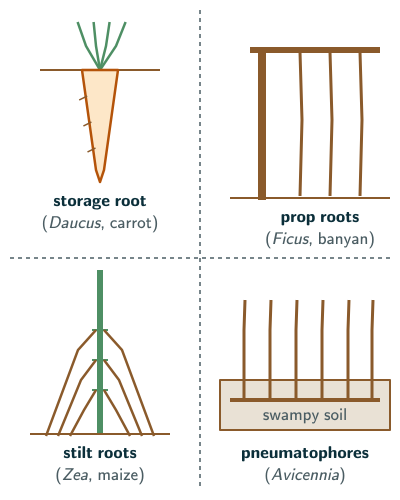
Storage roots
Some roots swell with stored food (beyond the 2026–27 NCERT text):
- Tap-root storage examples include carrot, radish and turnip. Their storage organs need not consist entirely of root: the swollen hypocotyl also contributes, especially in turnip. A developmental study, What makes turnips (2019), distinguishes this hypocotyl contribution from root tissue.
- Adventitious roots swell in sweet potato; the tubers are roots that arise from the stem, not from the radicle.
NCERT lists storing reserve food material among the main functions of the root system (page 58); in storage roots this function becomes the main one.
Prop roots and stilt roots
Both kinds give mechanical support, and both are adventitious roots: they arise from the stem, a part of the plant other than the radicle (NCERT page 58 defines adventitious roots this way and names the banyan tree).
- Prop roots: in the banyan tree, roots hang down from the large branches, reach the soil and thicken into pillars that hold the branches up (beyond the 2026–27 NCERT text).
- Stilt roots: in maize and sugarcane, supporting roots grow out of the lower nodes of the stem and enter the soil at a slant, bracing the stem (beyond the 2026–27 NCERT text).
Pneumatophores
Plants such as Avicennia grow in swampy areas, in mud that is waterlogged and short of oxygen. Many of their roots come out of the ground and grow vertically upwards; these pneumatophores help the roots get oxygen for respiration (beyond the 2026–27 NCERT text).
Because they grow upwards, against gravity, pneumatophores are negatively geotropic; air enters them through small pores called lenticels. Avicennia is the classic example (beyond the 2026–27 NCERT text). The National University of Singapore’s Guide to Mangroves of Singapore distinguishes these upward roots from the prop/stilt roots of Rhizophora, which descend from its trunk and branches and also help aeration. Older NCERT editions used Rhizophora in the pneumatophore passage; recognise that wording when a question explicitly asks for it, while retaining the botanical distinction.
Beyond the NCERT Biology text: waterlogged mud holds little oxygen because water fills the air spaces between soil particles, and oxygen dissolves only sparingly in water and diffuses through it slowly; how much oxygen water can hold depends on the partial pressure of oxygen above it, as Henry’s law describes.
Solved examples
Example 1: Name the modification
Name the modification and its function: (a) the swollen root of a carrot; (b) roots hanging from banyan branches into the soil; (c) roots from the lower nodes of a maize stem; (d) upward-growing roots of Avicennia.
Answer: (a) storage tap root, storing food; (b) prop roots, for mechanical support; (c) stilt roots, for mechanical support; (d) pneumatophores, for respiration (the three functions in NCERT’s Summary, page 69; the examples are beyond the 2026–27 NCERT text).
Example 2: Tap or adventitious?
Carrot and sweet potato both store food in roots. How do their storage roots differ?
Answer: the carrot stores food in its tap root, which grows from the radicle; the sweet potato stores food in adventitious roots, which grow from the stem (beyond the 2026–27 NCERT text; the root types are defined on NCERT page 58).
Example 3: Why upward roots?
Why do some roots of mangrove plants grow upwards instead of down into the soil?
Answer: they grow in swampy, waterlogged soil that is short of oxygen; the upward-growing pneumatophores help the roots get oxygen for respiration (beyond the 2026–27 NCERT text).
Example 4: Are prop roots adventitious?
Are the prop roots of the banyan tree adventitious roots? Explain.
Answer: yes. Adventitious roots arise from parts of the plant other than the radicle, and NCERT names the banyan tree as an example (page 58); its prop roots grow from the branches (beyond the 2026–27 NCERT text).
Example 5: Stilt or prop?
Both maize and banyan have supporting roots. Which are stilt roots and which are prop roots?
Answer: maize has stilt roots, from the lower nodes of the stem; the banyan tree has prop roots, hanging from its branches (beyond the 2026–27 NCERT text).
Example 6: Linking to root functions
NCERT lists four main functions of the root system. Which of them does each modification on this page emphasise?
Answer: storage roots emphasise storing reserve food material; prop and stilt roots emphasise providing a proper anchorage to the plant parts (NCERT page 58), here as mechanical support. Pneumatophores serve respiration, which the Summary adds as a third reason for modification (page 69).
Common mistakes to avoid
Common mistake
Calling the potato a root
The potato is an underground stem: NCERT’s description of family Solanaceae notes the “underground stem in potato” (page 68). Carrot and sweet potato have storage roots; turnip’s swollen storage organ also includes hypocotyl.
Common mistake
Calling all storage roots tap roots
Carrot illustrates a storage tap root, whereas sweet potato stores food in adventitious roots. Turnip is traditionally grouped with tap-root modifications, although its swollen hypocotyl contributes substantially.
Common mistake
Mixing up prop roots and stilt roots
Prop roots hang from branches (banyan); stilt roots grow from the lower nodes of the stem (maize, sugarcane).
Common mistake
Missing the specialised function of pneumatophores
Pneumatophores provide an exposed route for gas exchange in oxygen-poor mud. This is their diagnostic function; the plant’s wider root system also absorbs water and minerals.
Quick revision summary
- NCERT’s Summary: roots in some plants are modified for storage of food, mechanical support and respiration (page 69).
- Storage: tap root of carrot; adventitious roots of sweet potato; turnip also has a swollen hypocotyl.
- Support: prop roots of the banyan tree (from branches); stilt roots of maize and sugarcane (from lower stem nodes).
- Respiration: pneumatophores of mangroves such as Avicennia, growing vertically up out of swampy soil.
- The potato is a stem, not a root (NCERT page 68).
Formula sheet
- storage: carrot (tap root); sweet potato (adventitious roots); turnip includes hypocotyl
- prop roots: hang from branches into soil (banyan)
- stilt roots: from lower stem nodes (maize, sugarcane)
- pneumatophores: grow vertically up from swampy soil; oxygen for respiration
Questions students ask
Is modification of root deleted for NEET 2026?
No, modification of root is not deleted for NEET (UG) 2026: Unit 2 of its Biology syllabus lists ‘Morphology and modifications’, so storage roots, prop and stilt roots and pneumatophores can still be asked. What changed is the NCERT book: the 2026–27 Class 11 text no longer describes root modifications and keeps only one line in the Chapter 5 Summary, that roots in some plants get modified ‘for storage of food, mechanical support and respiration’ (NCERT page 69).
What is the difference between pneumatophores and prop roots?
Pneumatophores grow vertically upwards out of swampy, waterlogged soil and help the roots of mangroves such as Avicennia get oxygen for respiration, while prop roots grow downwards from the branches into the soil and hold the branches up, as in the banyan tree. So the two differ both in the direction they grow and in their job, respiration against mechanical support (beyond the 2026–27 NCERT text, whose Summary names only the jobs, page 69).
Are potato and sweet potato homologous or analogous?
Potato and sweet potato are analogous organs: NCERT Class 12 Biology gives ‘Sweet potato (root modification) and potato (stem modification)’ as an example of analogy (Evolution, page 115). Both store food underground, but the sweet potato is a swollen adventitious root while the potato is a stem whose eyes are nodes bearing buds, the mark used for telling a stem from a root. Analogous organs are different structures that do the same job, a result of what NCERT calls convergent evolution.
Practice questions
Try each question first, then open the answer to check your working.
-
Q1. For which three purposes does NCERT say roots get modified?
Show answerHide answer
Storage of food, mechanical support and respiration (NCERT Summary, page 69).
-
Q2. Name two plants with stilt roots.
Show answerHide answer
Maize and sugarcane (beyond the 2026–27 NCERT text).
-
Q3. In which kind of habitat do plants with pneumatophores grow?
Show answerHide answer
Swampy areas, in waterlogged soil that is short of oxygen (beyond the 2026–27 NCERT text).
-
Q4. How is turnip traditionally classified, and is its entire swollen organ root tissue?
Show answerHide answer
Traditionally with storage tap-root modifications, but the swollen organ also contains hypocotyl tissue; it should not be described as entirely primary root (beyond the 2026–27 NCERT text).