The seed
NCERT Class 11 Biology Chapter 5 Section 5.7
Quick answer
After fertilisation ovules develop into seeds, each a seed coat and an embryo with an embryonal axis (radicle and plumule) and one or two cotyledons. A dicot seed such as gram has a seed coat of testa and tegmen, a hilum and a micropyle, and two fleshy cotyledons. In maize the seed coat is fused with the fruit wall, the bulky endosperm stores food, and the embryo has a scutellum, a coleoptile and a coleorhiza.
With your textbook
NCERT Biology (Class 11), Chapter 5 “Morphology of Flowering Plants”, Section 5.7 “The Seed”, pages 66–67.
Open the official NCERT chapter (PDF, 3.4 MB, ncert.nic.in) (opens in a new tab)
Checked against the 2026-27 reprint on .
What is a seed?
The seed
The ovules after fertilisation, develop into seeds.
NCERT Biology (Class 11), Section 5.7, page 66
- A seed is made up of a seed coat and an embryo (page 66).
- The embryo has an embryonal axis and one cotyledon, as in wheat and maize, or two, as in gram and pea (page 66).
- The radicle and the plumule are at the two ends of the embryonal axis (page 66).
In plain words: a seed is a baby plant packed with food inside a protective coat. The embryo’s radicle will become the root and its plumule the shoot; the food sits in the cotyledons or in a separate tissue, the endosperm. The number of cotyledons is the basis of the split between dicotyledons and monocotyledons.
NCERT’s first sentence on the embryo (page 66) lists “a radicle, an embryonal axis” and the cotyledons, but not the plumule. Its next section gives the fuller picture: the radicle and the plumule are the two ends of the embryonal axis.
Structure of a dicotyledonous seed
The outermost covering of a seed is the seed coat.
NCERT Biology (Class 11), Section 5.7.1, page 66
- Seed coat: two layers, the outer testa and the inner tegmen.
- Hilum: a scar on the seed coat, where the developing seed was attached to the fruit.
- Micropyle: a small pore above the hilum, that is, just beyond one end of it, as drawn below.
- Embryo: an embryonal axis and two cotyledons, which are often fleshy and full of reserve food materials (page 66).
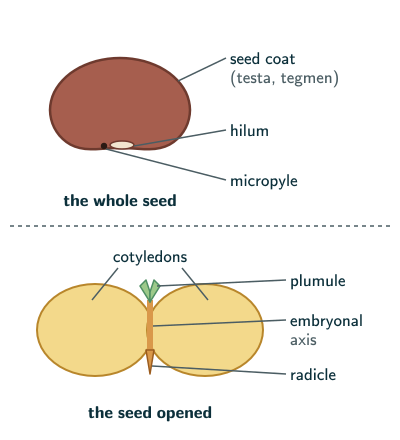
NCERT Class 12 Biology adds that the micropyle lets oxygen and water into the seed during germination, and that the integuments of the ovule harden into the tough seed coat (Section 1.4.3, page 20). Beyond the NCERT text: the testa comes from the outer integument and the tegmen from the inner one.
Endospermic and non-endospermic seeds
- Endospermic: in some seeds, such as castor, the endosperm formed as a result of double fertilisation is a food-storing tissue.
- Non-endospermic: in bean, gram and pea, the endosperm is not present in mature seeds; NCERT also calls these seeds non-endospermous (page 66).
- Monocotyledonous seeds are generally endospermic, but some, as in orchids, are non-endospermic (page 66).
NCERT Class 12 Biology uses another pair of names (Section 1.4.3, page 20). Albuminous seeds keep part of the endosperm, as in wheat, maize, barley and castor. Non-albuminous seeds have none left, because the developing embryo uses it all up, as in pea and groundnut. In a few seeds, such as black pepper and beet, a remnant of the nucellus also persists; this is the perisperm. The same page writes “non-albuminous or ex-albuminous” where it means albuminous or non-albuminous: ex-albuminous is another name for non-albuminous.
Structure of a monocotyledonous seed
In the seeds of cereals such as maize, the seed coat is membranous and generally fused with the fruit wall (pages 66–67).
The endosperm is bulky and stores food.
NCERT Biology (Class 11), Section 5.7.2, page 67
- Aleurone layer: a proteinous layer, the outer covering of the endosperm.
- Embryo: small, in a groove at one end of the endosperm. It has one large, shield-shaped cotyledon, the scutellum, and a short axis with a plumule and a radicle.
- Coleoptile and coleorhiza: the plumule is enclosed in a sheath called the coleoptile, and the radicle in one called the coleorhiza (page 67).
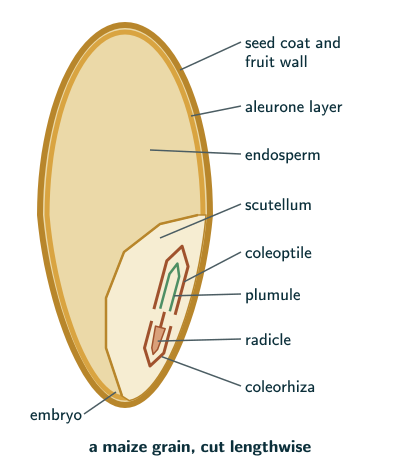
NCERT’s sentence on the aleurone layer (page 67) is muddled: it says the outer covering of the endosperm “separates the embryo by a proteinous layer called aleurone layer”. Read it this way: the aleurone layer is the proteinous outer layer of the endosperm, just under the seed coat and fruit wall, where NCERT Figure 5.15 labels it; the figure also draws a similar banded layer, unlabelled, along the boundary between the endosperm and the scutellum. In an NCERT-worded question, “the proteinous layer that separates the embryo” is the aleurone layer. Beyond the NCERT text: in the grain itself, the aleurone layer lies only on the outside of the endosperm, as the figure on this page draws it; the layer that touches the endosperm from the embryo’s side is the surface layer (epithelium) of the scutellum.
Beyond the NCERT text: because its seed coat is fused with the fruit wall, a maize “seed” is strictly a one-seeded fruit, called a caryopsis.
Solved examples
Example 1: Labelled diagrams (NCERT Exercise Q5)
Which labels must a diagram of (i) a gram seed and (ii) a V.S. of a maize seed carry?
Answer: (i) gram seed: seed coat (testa and tegmen), hilum, micropyle, and inside it two cotyledons with the embryonal axis, plumule and radicle (NCERT page 66). (ii) V.S. of a maize seed: seed coat and fruit wall (fused), aleurone layer, endosperm, and the embryo, labelled as a whole and in its parts: scutellum, coleoptile, plumule, radicle and coleorhiza (NCERT Figure 5.15, page 67). The two figures on this page show both.
Example 2: Hilum and micropyle
How do the hilum and the micropyle differ?
Answer: the hilum is a scar on the seed coat, where the developing seed was attached to the fruit; the micropyle is a small pore above the hilum (NCERT page 66).
Example 3: Where is the food?
Where is the food stored in a castor seed and in a gram seed?
Answer: in castor, in the endosperm, so the seed is endospermic; in gram, the endosperm is not present in the mature seed, and the food is in the fleshy cotyledons (NCERT page 66).
Example 4: The proteinous layer
In maize, which proteinous layer does NCERT say separates the embryo, and where does it lie?
Answer: the aleurone layer, the outer covering of the endosperm (NCERT page 67), just under the fused seed coat and fruit wall.
Example 5: Dicot and monocot seeds compared
Compare a gram seed with a maize seed.
Answer:
| Feature | Gram | Maize |
|---|---|---|
| Cotyledons | two, fleshy | one: the scutellum |
| Endosperm | absent when mature | bulky, stores food |
| Seed coat | testa and tegmen | fused with the fruit wall |
| Sheaths | none | coleoptile, coleorhiza |
(NCERT pages 66–67.)
Example 6: Albuminous or not
Sort these seeds as albuminous or non-albuminous: wheat, pea, castor, groundnut.
Answer: albuminous: wheat and castor; non-albuminous: pea and groundnut (NCERT Class 12 Biology, page 20).
Common mistakes to avoid
Common mistake
Calling the scutellum the endosperm
The scutellum is the single, shield-shaped cotyledon of the maize embryo; the endosperm is the bulky food store beside it.
Common mistake
Swapping coleoptile and coleorhiza
Coleoptile: the sheath over the plumule. Coleorhiza: the sheath over the radicle.
Common mistake
Calling every monocot seed endospermic
Monocot seeds are generally endospermic, but orchid seeds are non-endospermic.
Common mistake
Putting the aleurone layer in the seed coat or the embryo
The aleurone layer is part of the endosperm: its proteinous outer layer, just under the fused seed coat and fruit wall.
Quick revision summary
- Ovules develop into seeds after fertilisation; a seed is a seed coat and an embryo (embryonal axis with radicle and plumule, and one or two cotyledons).
- Dicot seed (gram, bean, pea): seed coat of testa and tegmen; hilum, a scar; micropyle, a pore above it; two fleshy cotyledons.
- Endospermic: castor; non-endospermic: bean, gram, pea. Monocot seeds are generally endospermic; orchids are not.
- Maize: seed coat fused with the fruit wall; bulky endosperm with an aleurone layer outside; scutellum; plumule in the coleoptile, radicle in the coleorhiza.
- Class 12 names: albuminous (wheat, maize, barley, castor), non-albuminous (pea, groundnut), perisperm (black pepper, beet).
Formula sheet
- seed: seed coat and embryo
- seed coat: testa (outer), tegmen (inner)
- embryo: embryonal axis (radicle, plumule) and cotyledons
- endospermic: castor; non-endospermic: bean, gram, pea
- maize: scutellum; coleoptile (plumule), coleorhiza (radicle)
- aleurone layer: proteinous outer layer of the endosperm
Questions students ask
What is the ploidy of the scutellum?
The scutellum is diploid (2n), because it is the single cotyledon of the grass-family embryo, and the embryo develops from the zygote, the diploid cell formed by syngamy (NCERT Class 12 Biology, pages 18–19). The endosperm beside it, including its proteinous outer aleurone layer, is triploid (3n), because it develops from the primary endosperm cell formed by triple fusion. So in a maize grain the scutellum, plumule and radicle are 2n, the endosperm and aleurone layer 3n, and the fused seed coat and fruit wall, tissues of the parent plant, 2n.
What is the difference between endosperm and perisperm?
The endosperm is a food-storing tissue that develops from the primary endosperm cell after double fertilisation and is triploid (3n), while the perisperm is the residual, persistent nucellus of the ovule, found in only a few seeds such as black pepper and beet (NCERT Class 12 Biology, pages 18–20). The endosperm is new tissue formed after fertilisation, as in castor and maize, while the perisperm is older tissue of the parent plant, diploid (2n), present in the ovule before fertilisation and not used up.
What is the difference between pericarp and perisperm?
The pericarp is the wall of the fruit, developed from the wall of the ovary, while the perisperm is the residual, persistent nucellus found in a few seeds, such as black pepper and beet (NCERT Class 12 Biology, page 20). So the pericarp surrounds the seeds as part of the fruit, and the perisperm lies inside a seed as a remnant of the ovule’s own tissue. NCERT Class 12 Biology asks for this comparison in its Chapter 1 exercises (question 13).
Are albuminous and endospermic seeds the same?
Yes, albuminous and endospermic seeds are the same: NCERT Class 11 calls a seed endospermic when its endosperm is a food-storing tissue, as in castor (page 66), and NCERT Class 12 Biology calls a seed albuminous when it retains part of the endosperm, again with castor as an example (page 20). In the same way non-endospermic and non-albuminous, or ex-albuminous, name seeds without endosperm when mature, as in pea, whose developing embryo uses it up.
Practice questions
Try each question first, then open the answer to check your working.
-
Q1. Name the two layers of the seed coat.
Show answerHide answer
The outer testa and the inner tegmen (NCERT page 66).
-
Q2. Name two plants with one cotyledon and two with two cotyledons, as given by NCERT.
Show answerHide answer
One: wheat and maize. Two: gram and pea (NCERT page 66).
-
Q3. Where is the embryo of maize situated?
Show answerHide answer
In a groove at one end of the endosperm (NCERT page 67).
-
Q4. What is the perisperm, and in which seeds does it occur?
Show answerHide answer
The residual, persistent nucellus, as in black pepper and beet (NCERT Class 12 Biology, page 20).