Seed germination: conditions and types
Beyond NCERT In the NEET syllabus; the Class 11 book has no section for it.
Quick answer
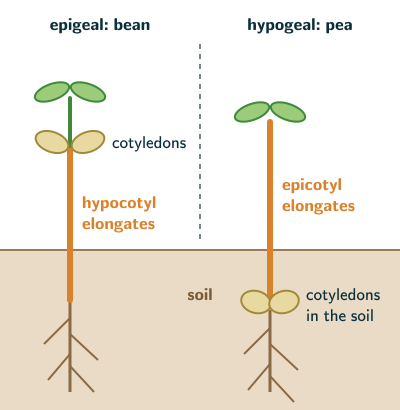
Seed germination resumes embryo growth when a viable, non-dormant seed has suitable moisture, oxygen and temperature; light requirements vary. In common bean, the hypocotyl lifts the cotyledons above soil (epigeal), while in pea the epicotyl grows and the cotyledons remain below (hypogeal). The radicle usually emerges first, and seed reserves support early seedling growth.
Seed germination
Seed germination
Seed germination is the resumption of growth by a viable embryo inside a seed. In the usual physiological account it culminates in radicle emergence; subsequent growth establishes the seedling (beyond NCERT: Bewley, The Plant Cell, 1997). NCERT puts it at the very start of a plant’s growth:
The first step in the process of plant growth is seed germination. The seed germinates when favourable conditions for growth exist in the environment.
NCERT Biology (Class 11), Chapter 13, Introduction, page 166
In plain words: a seed is a baby plant packed for travel, with a lunch box of stored food and the lights turned almost off. For a viable, non-dormant seed, suitable water, air and temperature allow it to resume growth: the root pushes out first to anchor it and drink, then the shoot climbs towards the light, living on the packed food until its own leaves can make more.
The 2026–27 NCERT book has no section on seed germination, but the NEET (UG) 2026 syllabus lists it in Unit 4. NCERT touches on it in several places: the opening of Chapter 13 and its Figure 13.1 (bean), the conditions for growth (page 171) and the plant growth regulators (pages 177–178) later in the chapter, the seed structure in Chapter 5, and the seed in Class 12 Chapter 1. Those lines are cited below; the rest is marked as beyond the NCERT text, with its source.
Conditions for seed germination
- A viable, non-dormant seed germinates when its species-specific favourable conditions exist. In their absence, it does not germinate but goes into a period of suspended growth or rest; “Once favourable conditions return, the seeds resume metabolic activities and growth takes place” (NCERT Class 11, page 166).
- NCERT names the favourable conditions: adequate moisture, oxygen and suitable temperature; the embryo may instead enter a state of inactivity called dormancy (NCERT Class 12, Section 1.4.3, page 20).
- Water: NCERT describes a mature seed as relatively dry, with 10–15 per cent moisture by mass and slowed metabolism (Class 12, page 20). The micropyle, a small pore in the seed coat, lets in oxygen and water during germination (page 20; see the dicot seed). Beyond the NCERT text, initial uptake of water is called imbibition (Shipunov, Introduction to Botany, section 7.5.1, public domain).
- Oxygen: “Oxygen helps in releasing metabolic energy essential for growth activities” (NCERT Class 11, Section 13.1.5, page 171): the growing embryo gets its energy by aerobic respiration.
- Temperature: every plant has an optimum temperature range for growth (page 171).
- Light: NCERT notes that extrinsic factors such as temperature and light control events such as dormancy and seed germination through plant growth regulators (page 178).
Plant growth regulators also take part (NCERT Section 13.4, pages 177–178):
- Abscisic acid (ABA) inhibits seed germination and induces dormancy, which helps seeds withstand desiccation.
- Ethylene breaks seed and bud dormancy and initiates germination in peanut seeds.
- ABA acts, in most situations, as an antagonist to gibberellins (page 178).
Epigeal and hypogeal germination
Seedlings differ in which part of the embryonal axis elongates first. In the embryo, the epicotyl is the part of the axis above the cotyledons, ending in the plumule, and the hypocotyl is the part below them, ending in the radicle (NCERT Class 12, page 19).
| Feature | Epigeal | Hypogeal |
|---|---|---|
| Elongating axis in bean or pea | hypocotyl (bean) | epicotyl (pea) |
| Cotyledons | carried above the soil | stay in the soil |
| Examples | bean, castor | pea, gram, maize |
- Epigeal germination: the hypocotyl elongates and the cotyledons come up above the ground. NCERT’s Figure 13.1, “Germination and seedling development in bean” (page 167), shows this: the hypocotyl carries the cotyledons above the soil line.
- Hypogeal germination in pea: the epicotyl elongates and the cotyledons stay below the ground, as in pea; maize is hypogeal too, though its shoot comes up inside the coleoptile (see below).
Beyond the NCERT text, the US rules for seed testing classify these examples (US Federal Seed Act rules, 7 CFR 201.56). Garden and field beans and castor are epigeal: the hypocotyl carries the cotyledons above the soil surface (201.56-6 and 201.56-10). Pea and chickpea (gram) are hypogeal: the cotyledons stay within the seed coat beneath the soil surface while the epicotyl carries the shoot up (201.56-6); corn (maize) is hypogeal too (201.56-5). Armarego-Marriott and colleagues also name pea as a hypogeal germinating plant (Journal of Experimental Botany, 2020). Not every bean is epigeal: the same rules list broad bean and runner bean as hypogeal, so the bean meant here is the common bean, the one in NCERT’s Figure 13.1. Nor is every monocot hypogeal: onion is epigeal (201.56-7), though there the cotyledon itself, not the hypocotyl, grows up through the soil.
Seedling development
- The root comes first. Beyond the NCERT text, the radicle swells and usually emerges first; imbibition and metabolic changes precede this visible emergence (Shipunov, Introduction to Botany, section 7.5.1).
- The shoot comes up hooked. In epigeal dicots such as bean, the hypocotyl comes up first, bent like a hook. Beyond the NCERT text, such an apical hook is typical of seedlings growing in darkness, and it straightens once the seedling is exposed to light (Armarego-Marriott and colleagues, Journal of Experimental Botany, 2020). NCERT’s Figure 13.1 shows the bean sequence: the youngest seedling is arched at the hypocotyl in the soil, and the next, with its cotyledons above the soil line, is still bent above them at a point labelled “Epicotyl hook” (page 167). NCERT notes that ethylene causes apical hook formation in dicot seedlings (page 177).
- Monocots such as maize: the plumule and radicle are enclosed in sheaths, the coleoptile and the coleorhiza (NCERT Class 11, Section 5.7.2, page 67; see the monocot seed). Beyond the NCERT text, in maize the coleoptile, with the first leaves inside it, elongates and pushes through the soil surface, while the scutellum, the grain’s cotyledon, stays inside the seed (US Federal Seed Act rules, 7 CFR 201.56-5).
- Food for the seedling: the seedling lives on the seed’s stored food. NCERT notes that the cotyledons are generally thick and swollen with stored food (as in legumes), and that endosperm may persist in the seed, as in castor and coconut, to be used up during germination (Class 12, pages 19–20). Seeds’ food reserves nourish young seedlings “until they are capable of photosynthesis on their own” (Class 12, page 22). Beyond the NCERT text, after imbibition, enzymes in the seed break stored starch down into sugars, which the embryo uses (Shipunov, Introduction to Botany, section 7.5.1).
Solved examples
Example 1: Dry seeds in a tin
Seeds stored in a dry, sealed tin stay alive for months but do not germinate. Why?
Answer: they lack water. A mature seed holds only 10–15 per cent moisture by mass, and germination needs adequate moisture, along with oxygen and a suitable temperature (NCERT Class 12, page 20); without water, the water-dependent processes of germination cannot proceed normally. This describes dry-storable seeds; neither that moisture percentage nor months of dry storage applies to every species.
Example 2: Under water
Seeds soaked and left under a thick layer of water in a closed jar often fail to germinate, though they have water and warmth. Which condition is missing?
Answer: oxygen may become limiting as the submerged seeds consume it; being under water does not by itself prove that no oxygen remains. The embryo normally needs oxygen for efficient energy release by aerobic respiration (NCERT Class 11, page 171; Class 12, page 20).
Example 3: Epigeal or hypogeal?
In a pea seedling, the cotyledons stay below the soil while the shoot rises above it. Which type of germination is this, and which part has elongated?
Answer: hypogeal germination; the epicotyl has elongated, as in pea; maize is hypogeal too, but its shoot comes up inside the coleoptile (beyond the NCERT text; US Federal Seed Act rules, 7 CFR 201.56-6 and 201.56-5; Armarego-Marriott and colleagues, Journal of Experimental Botany, 2020).
Example 4: Breaking dormancy
Which plant growth regulator would you use to (a) break the dormancy of peanut seeds, and (b) keep seeds dormant?
Answer: (a) ethylene, which breaks seed dormancy and initiates germination in peanut seeds; (b) abscisic acid, which inhibits seed germination and induces dormancy (NCERT pages 177–178).
Example 5: Very old seeds
NCERT reports a lupine seed, Lupinus arcticus, that germinated after an estimated 10 000 years of dormancy, and a viable 2000-year-old date palm seed. Which property of seeds do these records show?
Answer: seed longevity: how long seeds retain viability, the capacity to remain alive and potentially germinate. Viability varies greatly: some seeds lose it within a few months, while others live for several years or even hundreds of years (NCERT Class 12, page 22). Beyond the NCERT text, later radiocarbon dating showed that the lupine plants had grown from modern seeds, so the 10 000-year record no longer stands (Zazula and others, New Phytologist, 2009).
Common mistakes to avoid
Common mistake
Saying all seeds need light to germinate
NCERT’s basic list is adequate moisture, oxygen and a suitable temperature (Class 12, page 20). This does not show that light is irrelevant: some seeds require light, others germinate better in darkness, and others are less sensitive. Standard tests use light when required for the species (TNAU Agritech Portal, “Seed testing”).
Common mistake
Swapping coleoptile and coleorhiza
The coleoptile sheathes the plumule (shoot); the coleorhiza sheathes the radicle (root) (NCERT Class 11, page 67).
Common mistake
Thinking a dormant seed only lacks water
NCERT’s favourable conditions are adequate moisture, oxygen and a suitable temperature (Class 12, page 20), but a dormant seed may still not germinate when it has them. NCERT notes that ABA induces dormancy (page 178).
Common mistake
Mixing up the elongating part
In common bean’s epigeal germination the hypocotyl lifts the cotyledons; in pea’s hypogeal germination the epicotyl elongates while the cotyledons stay in the soil (NCERT Figure 13.1; beyond the NCERT text, US Federal Seed Act rules, 7 CFR 201.56-6).
Quick revision summary
- Seed germination is the first step in plant growth; it happens only when conditions are favourable, otherwise the seed rests in suspended growth. A dormant seed may not germinate even when they are favourable (seed coat, inhibitors, ABA).
- Conditions: adequate moisture, oxygen and a suitable temperature (NCERT); light for some seeds. Water enters first (imbibition); gibberellins promote germination, ABA inhibits it, and ethylene breaks dormancy.
- Epigeal: hypocotyl elongates, cotyledons above the soil (bean). Hypogeal: cotyledons in the soil (pea, maize); in pea the epicotyl elongates.
- The radicle comes out first; in maize the coleorhiza and coleoptile sheathe radicle and plumule; the seedling lives on stored food until it can photosynthesise.
Formula sheet
- conditions: adequate moisture, oxygen, suitable temperature
- epigeal: hypocotyl elongates; cotyledons above the soil (bean)
- hypogeal: cotyledons in the soil (pea, maize); epicotyl elongates in pea
- coleoptile: sheath of the plumule; coleorhiza: sheath of the radicle
- abscisic acid inhibits germination; ethylene breaks seed dormancy
Questions students ask
Are seed germination and seed dormancy in the NEET 2026 syllabus?
Seed germination is in the NEET (UG) 2026 syllabus: Biology Unit 4, Plant Physiology, lists ‘Plant growth and development: Seed germination; …’, though the 2026–27 NCERT book has no section on it. Seed dormancy is not named in the syllabus, but NCERT teaches it under the growth regulators that the same line lists, ‘auxin, gibberellin, cytokinin, ethylene, ABA’: abscisic acid induces dormancy and ethylene breaks seed and bud dormancy (NCERT Class 11, pages 177–178). NCERT Class 12 also mentions dormancy with the seed (page 20), which Unit 6 covers as ‘Development of seed and formation of fruit’.
What is the difference between seed dormancy and quiescence?
A quiescent seed is a non-dormant seed that does not germinate only because conditions such as water are missing, and it germinates once they are favourable, while a dormant seed fails to germinate even under favourable conditions (beyond the NCERT text: Gerna and others, mSystems, 2025; Bewley, The Plant Cell, 1997). NCERT does not use the word quiescence: it says a seed without favourable conditions goes into a period of suspended growth or rest and grows once they return (NCERT Class 11, page 166), and its Class 12 book calls the inactive state of the mature embryo dormancy (page 20).
Do all monocot seeds show hypogeal germination?
No, monocot seeds do not all show hypogeal germination: maize is hypogeal, its cotyledon (the scutellum) staying inside the grain in the soil while the shoot pushes up, but onion is epigeal, its single cotyledon arching out of the soil in a tight loop (beyond the NCERT text: US Federal Seed Act rules, 7 CFR 201.56-5 and 201.56-7). Dicots vary in the same way: bean is epigeal, as NCERT Figure 13.1 (page 167) shows, but pea is hypogeal (beyond the NCERT text: Armarego-Marriott and others, Journal of Experimental Botany, 2020). So whether germination is epigeal or hypogeal is a feature of each species and does not follow the monocot–dicot divide.
What is the formula for seed germination percentage?
Seed germination percentage is the number of seeds that germinate divided by the number of seeds tested, multiplied by 100: if 46 of 50 seeds germinate, it is 46 ÷ 50 × 100 = 92 per cent (beyond the NCERT text, which gives no such formula). In standard seed testing, only seeds that produce normal seedlings are counted, its stated standard uses at least 400 seeds, arranged as 4 × 100, 8 × 50 or 16 × 25 according to seed and container size, with the final percentage rounded to the nearest whole number (TNAU Agritech Portal, ‘Seed testing’, following the International Seed Testing Association rules). The percentage shows how well a seed lot can produce normal plants under favourable conditions.
Practice questions
Try each question first, then open the answer to check your working.
-
Q1. Name the three favourable conditions NCERT gives for a seed to germinate.
Show answerHide answer
Adequate moisture, oxygen and suitable temperature (NCERT Class 12, page 20).
-
Q2. Which part of the embryonal axis lifts the cotyledons in the epigeal germination of common bean?
Show answerHide answer
The hypocotyl, which carries the cotyledons above the soil (NCERT Figure 13.1, page 167).
-
Q3. Through which pore in the seed coat do oxygen and water enter during germination?
Show answerHide answer
The micropyle (NCERT Class 12, page 20).