Development in plants: sequence and plasticity
NCERT Class 11 Biology Chapter 13 Section 13.3
Quick answer
Development includes growth, differentiation and other changes through a plant’s life; embryogenesis begins before seed germination. NCERT’s post-germination account follows growth and maturation through senescence. Plasticity includes changes in structure with environment or life stage, such as different leaf forms, under intrinsic and extrinsic control.
With your textbook
NCERT Biology (Class 11), Chapter 13 “Plant Growth and Development”, Section 13.3 “Development”, pages 172–174.
Open the official NCERT chapter (PDF, 1.9 MB, ncert.nic.in) (opens in a new tab)
Checked against the 2026-27 reprint on .
Development
Development
Development is a term that includes all changes that an organism goes through during its life cycle from germination of the seed to senescence.
NCERT Biology (Class 11), Section 13.3, page 172
The quoted definition describes the seed-to-senescence course used in this chapter. Development also includes embryogenesis before germination: NCERT’s Introduction explicitly starts the mature plant’s development from the zygote (page 166). Germination resumes embryo growth; it does not create the embryo.
Broadly, development is the sum of growth and differentiation (NCERT pages 166 and 174).
In plain words: growth makes a plant bigger and differentiation gives its cells jobs; development is the whole life story that the two write together, from a seed sprouting to a mature plant and, finally, its old age and death.
Sequence of developmental process in a plant cell
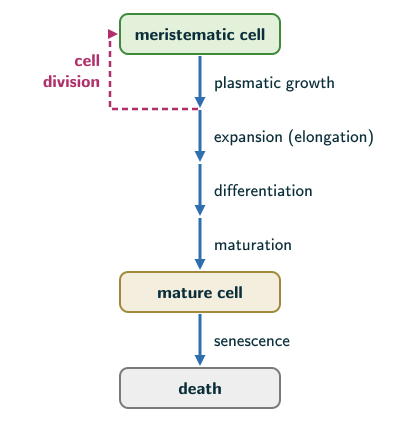
NCERT Figure 13.8 (page 173) shows the sequence for a single cell of a higher plant, and NCERT says the same applies to tissues and organs (page 172):
- A meristematic cell goes through plasmatic growth; by cell division, some of its products remain meristematic cells.
- Expansion (elongation), differentiation and maturation follow, giving a mature cell.
- Through senescence, the mature cell finally reaches death.
Plasticity and heterophylly
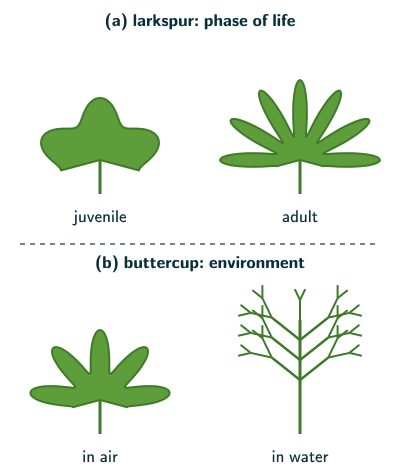
- “Plants follow different pathways in response to environment or phases of life to form different kinds of structures. This ability is called plasticity” (NCERT page 173).
- Heterophylly, the presence of differently shaped leaves on the same plant, is an example of plasticity (page 173). It comes in two kinds:
- with the phase of life: in cotton, coriander and larkspur, the leaves of the juvenile plant differ in shape from those of the mature plant;
- with the environment: in buttercup, the leaves produced in air differ in shape from those produced in water.
Intrinsic and extrinsic factors
Development in plants, both growth and differentiation, is under the control of two sets of factors (NCERT page 174):
| Factors | Kind | Examples |
|---|---|---|
| Intrinsic | intracellular | genetic |
| Intrinsic | intercellular | chemicals such as plant growth regulators |
| Extrinsic | external | light, temperature, water, oxygen, nutrition |
NCERT adds that many extrinsic factors, such as temperature and light, control growth and development through plant growth regulators (page 178).
Solved examples
Example 1: Which kind of heterophylly?
Say whether each is heterophylly due to the phase of life or due to the environment: (a) the juvenile leaves of coriander differ from its adult leaves; (b) buttercup leaves under water differ from those in air.
Answer: (a) phase of life; (b) environment. Both are examples of plasticity (NCERT page 173).
Example 2: Sorting the factors
Classify as intrinsic (intracellular or intercellular) or extrinsic: (a) the genes of the plant, (b) auxin, (c) day length, (d) soil nitrogen.
Answer: (a) intrinsic, intracellular (genetic); (b) intrinsic, intercellular (a plant growth regulator); (c) extrinsic (light); (d) extrinsic (nutrition) (NCERT page 174).
Example 3: Putting the steps in order
Arrange in the order of NCERT Figure 13.8: maturation, plasmatic growth, senescence, expansion, differentiation.
Answer: plasmatic growth → expansion (elongation) → differentiation → maturation → (mature cell) → senescence (NCERT page 173).
Example 4: Development defined (from NCERT Exercise 1)
Define development, and say how it is related to growth and differentiation.
Answer: development includes all the changes an organism goes through during its life cycle, from germination of the seed to senescence (NCERT page 172). It is broadly the sum of growth and differentiation, and in plants both are under the control of intrinsic and extrinsic factors (page 174).
Common mistakes to avoid
Common mistake
Treating development as growth alone
Development is the sum of growth and differentiation, and runs from germination to senescence (NCERT pages 172 and 174).
Common mistake
Calling every heterophylly an effect of the environment
In cotton, coriander and larkspur, heterophylly comes with the phase of life (juvenile against mature); only in buttercup does NCERT tie it to the environment, air against water (page 173).
Common mistake
Calling plant growth regulators extrinsic factors
Plant growth regulators are intrinsic, intercellular factors; light, temperature, water, oxygen and nutrition are extrinsic (NCERT page 174).
Quick revision summary
- NCERT’s seed-to-senescence account describes development after germination; embryonic development precedes it. Broadly, development is the sum of growth and differentiation.
- A plant cell develops through plasmatic growth, expansion, differentiation and maturation into a mature cell, then senescence and death (NCERT Figure 13.8).
- Plasticity is the ability to form different structures in response to environment or phase of life; heterophylly is an example (cotton, coriander, larkspur; buttercup in air and water).
- Intrinsic factors: intracellular (genetic) and intercellular (plant growth regulators); extrinsic: light, temperature, water, oxygen, nutrition.
Formula sheet
- development = growth + differentiation
- meristematic cell → plasmatic growth → expansion → differentiation → maturation → mature cell → senescence → death
- plasticity: different structures for environment or phase of life
- intrinsic: genetic, plant growth regulators; extrinsic: light, temperature, water, oxygen, nutrition
Questions students ask
What is the difference between growth and development in plants?
Growth is an irreversible permanent increase in size of an organ, its parts or a cell, while development includes all the changes an organism goes through in its life cycle, from germination of the seed to senescence (NCERT pages 167 and 172). Development is broadly the sum of growth and differentiation, so it covers changes in kind as well as in size: the expansion of a leaf is growth, a meristem cell maturing into a tracheary element is differentiation, and both are part of development (page 174). Growth is measured as a quantity, such as fresh weight, length or cell number (page 168), while development is, in NCERT’s words, a precise and highly ordered succession of events (page 166).
What are the stages of plant development?
The post-embryonic sequence discussed here runs from seed germination through the seedling, the plantlet and the mature plant to senescence and, eventually, death (NCERT pages 166 and 172). In its vegetative phase the plant forms roots, leaves and branches, and only then, as NCERT notes, does it flower and form fruits and seeds (page 166). A single cell goes through its own sequence, plasmatic growth, expansion, differentiation and maturation, then senescence and death, shown in NCERT Figure 13.8 (page 173).
Is plasticity in plants the same as phenotypic plasticity?
Plasticity in NCERT is wider than phenotypic plasticity as researchers use the term: NCERT counts different structures formed in response to the environment or to phases of life (NCERT page 173). Beyond the NCERT text, research papers call environment-induced changes of leaf form, such as air versus submerged leaves, heterophylly, a kind of phenotypic plasticity; a change with the phase of life, as between the juvenile and mature leaves of cotton, coriander and larkspur, is heteroblasty (Nakayama, Journal of Plant Research, 2024; Zotz and others, The Botanical Review, 2011). NCERT calls both heterophylly and both plasticity, so answer NCERT questions that way.
Practice questions
Try each question first, then open the answer to check your working.
-
Q1. What is plasticity in plants?
Show answerHide answer
The ability of plants to follow different pathways in response to environment or phases of life to form different kinds of structures (NCERT page 173).
-
Q2. Name three plants in which juvenile and mature leaves differ in shape.
Show answerHide answer
Cotton, coriander and larkspur (NCERT page 173).
-
Q3. Name two intrinsic factors that control development.
Show answerHide answer
Intracellular (genetic) factors and intercellular factors, chemicals such as plant growth regulators (NCERT page 174).