Differentiation, dedifferentiation and redifferentiation
NCERT Class 11 Biology Chapter 13 Section 13.2
Quick answer
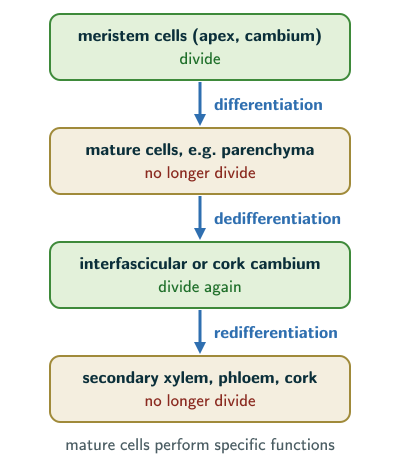
Differentiation is the maturation of cells from meristems to perform specific functions; a tracheary element, for example, loses its protoplasm and builds a strong lignocellulosic wall. In dedifferentiation, living differentiated cells such as parenchyma regain the capacity to divide, forming interfascicular cambium and cork cambium. Their products again stop dividing and mature: this is redifferentiation.
With your textbook
NCERT Biology (Class 11), Chapter 13 “Plant Growth and Development”, Section 13.2 “Differentiation, Dedifferentiation and Redifferentiation”, page 172.
Open the official NCERT chapter (PDF, 1.9 MB, ncert.nic.in) (opens in a new tab)
Checked against the 2026-27 reprint on .
Differentiation, dedifferentiation and redifferentiation
Differentiation
The cells derived from root apical and shoot-apical meristems and cambium differentiate and mature to perform specific functions. This act leading to maturation is termed as differentiation.
NCERT Biology (Class 11), Section 13.2, page 172
In plain words: a meristem is like a training school that keeps turning out new recruits. Each recruit then specialises for one job (carrying water, storing food, protecting the surface) and usually stops dividing. Plants have an unusual trick, though: some specialised cells can go back to school, start dividing again, and train a fresh batch for new jobs.
Differentiation of tracheary elements
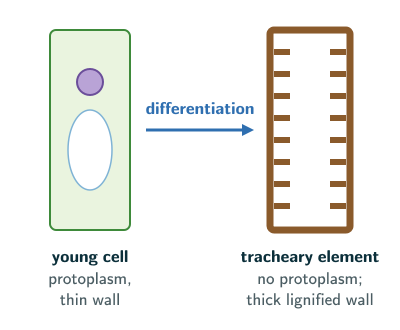
- During differentiation, cells undergo few to major structural changes in both their cell walls and their protoplasm (NCERT page 172).
- For example, to form a tracheary element (a water-conducting cell of the xylem), the cells lose their protoplasm. They also develop a very strong, elastic, lignocellulosic secondary cell wall, to carry water over long distances even under extreme tension (page 172).
- NCERT asks you to correlate anatomical features with the functions they perform (page 172): here, the empty lumen and the strong wall are exactly what a water pipe under tension needs.
Dedifferentiation: interfascicular and cork cambium
The living differentiated cells, that by now have lost the capacity to divide can regain the capacity of division under certain conditions. This phenomenon is termed as dedifferentiation.
NCERT Biology (Class 11), Section 13.2, page 172
- NCERT’s example: the formation of the meristems interfascicular cambium and cork cambium from fully differentiated parenchyma cells (page 172).
- The cork cambium is a lateral meristem; the interfascicular cambium joins the cambium strips inside the vascular bundles to complete the ring of vascular cambium, the other lateral meristem. Vascular cambium and cork cambium cause secondary growth, the increase in girth of dicotyledons and gymnosperms (NCERT page 168; the ring is beyond the NCERT text: Shipunov, Introduction to Botany, section 7.1).
Redifferentiation
- The meristems formed by dedifferentiation divide and produce cells that once again lose the capacity to divide but mature to perform specific functions: they are redifferentiated (NCERT page 172).
- NCERT asks you to list the tissues of a woody dicotyledonous plant that are products of redifferentiation (page 172). NCERT notes that the cambium forms secondary xylem and secondary phloem (Chapter 6, page 73). Beyond the NCERT text, the vascular cambium adds the secondary xylem on its inner side and the secondary phloem on its outer side, and the cork cambium (phellogen) forms cork (phellem) and phelloderm, which together with it make up the periderm (Shipunov, Introduction to Botany, section 7.1, public domain). These are redifferentiated tissues.
NCERT’s two further questions (page 172) can be answered from these definitions (reasoned answers):
- A plant tumour is an abnormal proliferating growth. Lack of normal organisation can accompany it; the definition does not require every cell to remain completely undifferentiated.
- Parenchyma cells made to divide in plant tissue culture are dedifferentiated. Under suitable culture conditions, their proliferating product can be a callus, “a mass of undifferentiated cells” (NCERT Section 13.4.2, page 175).
Beyond this textbook description, a callus need not be completely unorganised or produced by reversing every mature cell to a blank state. Sugimoto, Jiao and Meyerowitz found that hormone-induced Arabidopsis callus from several organs followed a root-development programme and resembled a root meristem (Developmental Cell, 2010). NCERT’s “undifferentiated mass” is a useful introductory description, not a universal cellular mechanism.
Open differentiation
- NCERT calls growth in plants open (page 172), and says differentiation is open too, “because cells/tissues arising out of the same meristem have different structures at maturity” (page 172).
- The final structure of a cell or tissue also depends on its position. Cells produced toward the root tip, on the root-cap side of the root apical meristem, differentiate as root-cap cells, while those pushed to the periphery mature as epidermis (page 172).
When NCERT recalls Section 13.1.1 here, it says growth in plants “can be indeterminate or determinate” (page 172), but Section 13.1.1 itself only says that plant growth is generally indeterminate, the open form of growth (page 167). Take open growth to mean the meristems keep adding new cells throughout the plant’s life, even though some organs, such as leaves, flowers and fruits, stop at a limited size (NCERT page 166).
Solved examples
Example 1: Name the process
Name the process in each case: (a) a parenchyma cell of the cortex starts dividing to form cork cambium; (b) a cell from the shoot apical meristem matures into a tracheary element; (c) cork cambium produces cork cells that stop dividing.
Answer: (a) dedifferentiation; (b) differentiation; (c) redifferentiation (NCERT page 172).
Example 2: Why a tracheary element is dead
Why does a tracheary element lose its protoplasm as it differentiates?
Answer: it is built to carry water over long distances, even under extreme tension. With the protoplasm gone and a strong, elastic lignocellulosic secondary wall in place, the cell becomes an open, sturdy pipe (NCERT page 172).
Example 3: Open differentiation (NCERT Exercise 6)
“Both growth and differentiation in higher plants are open.” Comment.
Answer: growth is open because meristems keep adding new cells to the plant body throughout its life (NCERT page 167). Differentiation is open because cells arising from the same meristem reach different structures at maturity, depending partly on their position: cells produced on the root-cap side of the root apical meristem become root-cap cells, while those pushed to the periphery become epidermis (page 172). Differentiated cells can even divide again (dedifferentiation) and mature once more (redifferentiation).
Example 4: If differentiation stopped (NCERT Exercise 10b)
What would be expected to happen if dividing cells stop differentiating?
Answer: the cells would keep dividing without maturing into tissues that perform specific functions, so no proper roots, stems or leaves would form; the result would be a shapeless mass of undifferentiated cells, like a callus (a reasoned answer from NCERT pages 172 and 175).
Example 5: Definitions (from NCERT Exercise 1)
Define differentiation, dedifferentiation, redifferentiation and determinate growth.
Answer: differentiation: the maturation of cells from meristems to perform specific functions. Dedifferentiation: living differentiated cells regaining the capacity to divide. Redifferentiation: the products of such divisions again losing the capacity to divide and maturing to perform specific functions (NCERT page 172). Determinate growth: growth that stops at a limited size, as in leaves, flowers and fruits, which have limited dimensions (NCERT page 166), unlike the indeterminate growth of the plant body.
Common mistakes to avoid
Common mistake
Thinking dedifferentiated cells come from meristems
Dedifferentiation starts from living, fully differentiated cells, such as parenchyma, that had lost the capacity to divide (NCERT page 172).
Common mistake
Calling the cork cambium a primary meristem
The cork cambium and interfascicular cambium arise later, by dedifferentiation of parenchyma; the cork cambium is a lateral meristem, and the interfascicular cambium becomes part of the vascular cambium (NCERT pages 168 and 172).
Common mistake
Forgetting position in differentiation
Cells from the same meristem mature differently by position: toward the root cap as root-cap cells, at the periphery as epidermis (NCERT page 172).
Quick revision summary
- Differentiation: cells from apical meristems and cambium mature to perform specific functions, with changes in wall and protoplasm; a tracheary element loses its protoplasm and builds a strong lignocellulosic secondary wall.
- Dedifferentiation: living differentiated cells regain the capacity to divide, as when parenchyma forms interfascicular cambium and cork cambium.
- Redifferentiation: the products of these meristems lose the capacity to divide again and mature to perform specific functions.
- Differentiation in plants is open: cells from the same meristem mature differently, partly by their position.
Formula sheet
- differentiation: meristem-derived cell → specialised mature cell
- dedifferentiation: mature living cell → divides again (interfascicular cambium, cork cambium)
- redifferentiation: products of the new meristem → mature cells again
- tracheary element: loses protoplasm; lignocellulosic secondary wall
Questions students ask
Are tracheids and tracheary elements the same?
No, tracheids and tracheary elements are not the same: tracheary element is the general name for the water-conducting cells of the xylem, which are of two kinds, tracheids and vessel elements, both dead at maturity (beyond the NCERT text: Encyclopaedia Britannica, ‘Angiosperm’, on the vascular tissue). So every tracheid is a tracheary element, and so is every vessel element.
What role do dedifferentiation and redifferentiation play in plant tissue culture?
In an appropriate plant tissue-culture system, responsive cells of a cut plant part can produce a callus, a mass of undifferentiated cells (NCERT asks this on page 172; callus, page 175), and callus cells can then redifferentiate into shoots and roots (beyond the NCERT text). Skoog and co-workers found that tobacco callus proliferated only with auxin plus a source of the cytokinesis-promoting substance later named kinetin (page 175). Skoog and Miller (1957) found the ratio decisive: high cytokinin with low auxin gives shoots, high auxin with low cytokinin gives roots (beyond the NCERT text: Melnyk, Quantitative Plant Biology, 2023).
Are tracheary elements formed by differentiation or redifferentiation?
A tracheary element is formed by differentiation in NCERT’s own example, maturing from a cell derived from an apical meristem or the cambium as it loses its protoplasm and builds a lignocellulosic secondary wall (NCERT page 172). Its formation counts as redifferentiation only when the cell comes from a meristem that itself arose by dedifferentiation, such as the interfascicular cambium formed from parenchyma, whose products once again lose the capacity to divide and mature (page 172). That is why the tracheids and vessels of a woody dicot’s secondary xylem, which the cambium forms (NCERT Chapter 6, page 73), are usually counted among the products of redifferentiation.
Is the vascular cambium of a dicot stem formed by dedifferentiation?
No, only part of a dicot stem’s vascular cambium forms by dedifferentiation: the interfascicular cambium, which arises from fully differentiated parenchyma cells (NCERT page 172). The cambium inside each vascular bundle is already present between the xylem and phloem, which is why NCERT calls these bundles open, able to form secondary xylem and phloem (NCERT Chapter 6, page 73). Beyond the NCERT text, it comes from the middle layer of the procambium, whose outer and inner layers become the primary phloem and xylem, and the two kinds of cambium join into the ring of vascular cambium (Shipunov, Introduction to Botany, sections 5.4 and 7.1).
Practice questions
Try each question first, then open the answer to check your working.
-
Q1. Give NCERT’s example of dedifferentiation.
Show answerHide answer
The formation of interfascicular cambium and cork cambium from fully differentiated parenchyma cells (NCERT page 172).
-
Q2. What kind of secondary wall does a tracheary element develop?
Show answerHide answer
A very strong, elastic, lignocellulosic secondary cell wall (NCERT page 172).
-
Q3. Cells pushed to the periphery near the root apex mature into which tissue?
Show answerHide answer
Epidermis; cells produced on the root-cap side of the root apical meristem become root-cap cells (NCERT page 172).