Growth in plants: phases, rates and curves
NCERT Class 11 Biology Chapter 13 Section 13.1
Quick answer
Growth is a permanent increase in size associated with metabolism; plant meristems generally keep adding cells. Along a root tip, the phases are meristematic, elongation and maturation. Constant arithmetic growth gives a straight line, whereas exponential growth can form the middle part of a sigmoid curve when initial lag and later resource limits are included.
With your textbook
NCERT Biology (Class 11), Chapter 13 “Plant Growth and Development”, Section 13.1 “Growth”, pages 167–171.
Open the official NCERT chapter (PDF, 1.9 MB, ncert.nic.in) (opens in a new tab)
Checked against the 2026-27 reprint on .
Growth
Growth
Growth can be defined as an irreversible permanent increase in size of an organ or its parts or even of an individual cell.
NCERT Biology (Class 11), Section 13.1, page 167
Growth is generally accompanied by metabolic processes, both anabolic and catabolic, that use energy; so the expansion of a leaf is growth (NCERT page 167).
In plain words: growth is a one-way increase that the living cell pays for. The growth component of a leaf’s expansion is permanent, though the leaf can still shrink temporarily as it loses water; not every change in its fresh size is growth. NCERT asks about a piece of wood that swells in water: by this definition it is not growth, because the swelling is reversible (the wood shrinks again as it dries) and no metabolism is involved (a reasoned answer from the definition).
Plant growth generally is indeterminate
- Plants keep the capacity for unlimited growth throughout their life, because of meristems at certain places in their body (NCERT Section 13.1.1, page 167).
- Meristem cells can divide and self-perpetuate; their products soon lose the capacity to divide, and such cells make up the plant body (page 167).
- “This form of growth wherein new cells are always being added to the plant body by the activity of the meristem is called the open form of growth” (page 167).
- NCERT notes that the leaves, flowers and fruits of a tree “not only have limited dimensions but also appear and fall periodically” (page 166). Their growth is limited, or determinate, unlike the open growth of the plant body as a whole (reasoned from page 166). NCERT later recalls this section as saying that growth in plants is open, “i.e., it can be indeterminate or determinate” (page 172); Section 13.1.1 itself describes only the indeterminate, open form.
Primary and secondary growth
- The root apical meristem and the shoot apical meristem are responsible for the primary growth of plants, and mainly lengthen the plant along its axis (NCERT pages 167–168); NCERT’s Summary adds that the intercalary meristem sometimes contributes to this elongation too (page 178).
- In dicotyledonous plants and gymnosperms, the lateral meristems, the vascular cambium and the cork-cambium, appear later in life. They increase the girth of the organs in which they are active: this is secondary growth (page 168, NCERT Figure 13.2).
Growth is measurable
- At the cellular level, growth is mainly an increase in the amount of protoplasm. Since that is hard to measure directly, one measures a quantity more or less proportional to it (NCERT Section 13.1.2, page 168).
- The parameters include increase in fresh weight, dry weight, length, area, volume and cell number (page 168). Fresh weight also varies with hydration, so compare like conditions; dry weight avoids that particular source of variation.
- Different parts show growth in different ways (page 168):
- a single maize root apical meristem can give rise to more than 17 500 new cells per hour: growth as an increase in cell number;
- cells in a watermelon may increase in size by up to 350 000 times: growth as an increase in cell size;
- a pollen tube grows in length;
- a dorsiventral leaf grows in surface area.
Phases of growth
NCERT divides the period of growth into three phases, seen along a root or shoot tip (Section 13.1.3, pages 168–169):
- Meristematic phase: the constantly dividing cells at the root apex and the shoot apex. They are rich in protoplasm and have large, conspicuous nuclei; their cell walls are primary, thin and cellulosic, with abundant plasmodesmatal connections.
- Phase of elongation: the cells just next to the meristematic zone, away from the tip. They show increased vacuolation, cell enlargement and new cell wall deposition.
- Phase of maturation: further from the apex. The cells reach their maximal size in wall thickening and protoplasmic modifications; most of the tissues and cell types you have studied are in this phase.
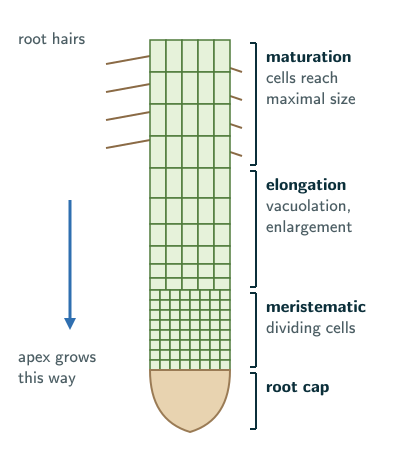
NCERT Figure 13.3 finds the zone of elongation by the parallel line technique: lines drawn at equal spacing near a young root’s tip spread apart unequally as it grows, and its caption notes that “Zones A, B, C, D immediately behind the apex have elongated most” (page 168).
Growth rates
“The increased growth per unit time is termed as growth rate” (NCERT Section 13.1.4, page 169). The increase may be arithmetic or geometric (page 170).
Arithmetic and geometric growth
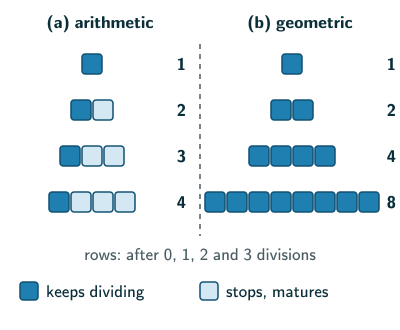
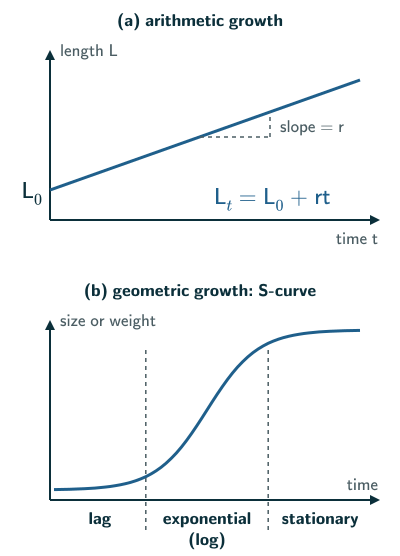
Arithmetic growth. After each mitotic division, only one daughter cell continues to divide, while the other differentiates and matures. Its simplest example is a root elongating at a constant rate: length plotted against time gives a straight line (NCERT page 170, Figure 13.5):
where Lt is the length at time t, L0 the length at time zero, and r the growth rate, the elongation per unit time (page 170).
Geometric growth. Here both daughter cells keep the ability to divide and continue to do so. Growth is slow at first (the lag phase), then rises rapidly at an exponential rate (the log or exponential phase); with a limited supply of nutrients it slows down to a stationary phase (page 170). The exponential growth is expressed as (page 170):
where W1 is the final size (weight, height, number and so on), W0 the initial size, r the growth rate, t the time of growth and e the base of natural logarithms. Here r is the relative growth rate, a measure of the plant’s ability to produce new plant material, called the efficiency index; so the final size W1 depends on the initial size W0 (page 170).
Sigmoid growth curve
- With an initial lag, an exponential phase and later resource limitation, size against time can give a sigmoid or S-curve (NCERT page 170, Figure 13.6). Unrestricted exponential growth alone gives a continuously rising J-shaped curve; the exponential equation does not describe the final plateau.
- “A sigmoid curve is a characteristic of living organism growing in a natural environment. It is typical for all cells, tissues and organs of a plant” (page 170). The caption of NCERT Figure 13.6 is more cautious: the idealised curve is “typical of cells in culture, and many higher plants and plant organs” (page 170).
- NCERT asks what curve a tree with seasonal activity would show. A reasoned answer: cumulative size rises in successive growing seasons, with slower growth or plateaus between them; it does not reset to its original size each season. An individual season may approximate a sigmoid increment.
NCERT’s chapter Summary names “three principle phases of growth – the lag, the log and the senescent phase” (page 178). This mixes two things. In the body, the three phases of growth are meristematic, elongation and maturation, seen along a root or shoot tip (Section 13.1.3, page 168); lag, log and stationary are the phases of the S-curve, growth plotted over time (page 170). The Summary’s third phase also does not match Figure 13.6, which has a stationary phase, and the word should be “principal”. For “phases of growth”, answer meristematic, elongation and maturation; for the S-curve, lag, log (exponential) and stationary.
Absolute and relative growth rates
- Absolute growth rate: the measurement and comparison of total growth per unit time (NCERT page 171).
- Relative growth rate: the growth of the given system per unit time expressed on a common basis, for example per unit initial parameter (page 171).
- In NCERT Figure 13.7, two leaves of different sizes, A and B, have each “increased their area by 5 cm in a given time” (page 171): the same absolute growth. NCERT asks which has the higher relative growth rate: the smaller leaf, because the same increase is a far larger fraction of its starting area (Example 3 works this through with its own numbers).
Beyond the NCERT comparison: the initial-size-normalised average, ΔW/(WΔt), is not the same as the constant exponential coefficient r for a large finite change. Rearranging W = We gives r = ln(W/W)/t, with units of inverse time. Use the first convention for Example 3’s initial-area comparison and the logarithmic one when fitting exponential growth (Hoffmann and Poorter, Annals of Botany, 2002).
Conditions for growth
NCERT lists the conditions for growth (Section 13.1.5, page 171):
- Water: plant cells grow in size by cell enlargement, which needs water; turgidity of cells helps in extension growth, so growth is closely linked to the plant’s water status. Water is also the medium for the enzymatic activities of growth.
- Oxygen: helps release the metabolic energy essential for growth activities, by aerobic respiration.
- Nutrients (macro and micro essential elements): needed to build protoplasm and support metabolism. NCERT also calls them a source of energy here, but mineral ions are not the plant’s respiratory fuel: organic substrates supply that energy (NCERT Chapter 12, page 154); light supplies photosynthetic energy (Chapter 11). This distinction is also made in Oregon State University Extension’s Environmental factors affecting plant growth.
- Temperature: every plant has an optimum temperature range for its growth; any deviation from it could be detrimental to its survival.
- Light and gravity: environmental signals that also affect certain phases or stages of growth.
Solved examples
Example 1: Arithmetic growth of a root
A root 4 cm long elongates at a constant rate of 0.5 cm per day. How long is it after 6 days?
Answer: Lt = L0 + rt = 4 + 0.5 × 6 = 7 cm (NCERT page 170).
Example 2: Exponential growth
A seedling of mass W0 = 10 g grows exponentially with r = 0.2 per day. Find its mass after 5 days. (Take e = 2.718.)
Answer: rt = 0.2 × 5 = 1, so W1 = W0ert = 10 × 2.718 ≈ 27.2 g (NCERT page 170).
Example 3: Absolute and relative growth rates
In one week, leaf A grows from 2 cm to 7 cm and leaf B from 20 cm to 25 cm. Compare their absolute and relative growth rates.
Answer: both grow by 5 cm per week, so their absolute growth rates are equal. Relative to the initial area, A grows by 5 ÷ 2 = 2.5 cm per cm per week and B by 5 ÷ 20 = 0.25 cm per cm per week: A’s relative growth rate is 10 times B’s (definitions from NCERT page 171).
Example 4: Cells from a maize root tip
A maize root apical meristem can give rise to more than 17 500 new cells per hour (NCERT page 168). If that rate is sustained for 24 hours, how many new cells is that in a day?
Answer: more than 17 500 × 24 = 420 000 cells a day.
Example 5: Ten divisions
Starting from one cell, how many cells are there after 10 rounds of division in (a) arithmetic and (b) geometric growth?
Answer: (a) one new cell is added per round, so 1 + 10 = 11 cells; (b) the number doubles each round, so 2 = 1024 cells (NCERT page 170).
Example 6: One parameter is not enough (NCERT Exercise 2)
Why is not any one parameter good enough to demonstrate growth throughout the life of a flowering plant?
Answer: growth shows up differently in different parts and stages. In a root apical meristem it is an increase in cell number; in a watermelon, an increase in cell size; in a pollen tube, length; in a dorsiventral leaf, surface area (NCERT page 168). Growth also changes character with the phase: in the meristematic phase it is mainly cell division, in the elongation phase mainly cell enlargement, and in maturation mainly wall thickening and protoplasmic change (pages 168–169). So each part and stage needs the parameter that suits it, such as fresh or dry weight, length, area, volume or cell number, and no single one covers the whole life of the plant.
Common mistakes to avoid
Common mistake
Calling any increase in size growth
Growth is irreversible and comes with metabolism; the swelling of wood in water is reversible and is not growth (NCERT page 167).
Common mistake
Letting both daughter cells divide in arithmetic growth
In arithmetic growth only one daughter cell keeps dividing; in geometric growth both do (NCERT page 170).
Common mistake
Equating absolute and relative growth rates
Two leaves with the same absolute increase in area can have very different relative growth rates; the smaller one grows faster relative to its size (NCERT page 171).
Common mistake
Mixing the two sets of three phases
Meristematic, elongation and maturation are the phases of growth along a tip (page 168); lag, log (exponential) and stationary are the phases of the S-curve (page 170). The Summary’s “senescent phase” (page 178) matches neither.
Quick revision summary
- Growth is an irreversible permanent increase in size, with metabolism. Plant growth is generally indeterminate (open), because meristems keep adding cells.
- Apical meristems give primary growth (length); vascular and cork cambium give secondary growth (girth) in dicots and gymnosperms.
- Growth is measured by fresh or dry weight, length, area, volume or cell number; phases along a tip are meristematic, elongation and maturation.
- Arithmetic growth: Lt = L0 + rt, a straight line. Geometric growth is exponential in its log phase, W1 = W0ert; with a lag and later resource limitation, the overall course can be an S-curve with lag, log (exponential) and stationary phases.
- Absolute growth rate is total growth per unit time; relative growth rate is growth per unit time per unit initial size. Conditions: water, oxygen, nutrients, suitable temperature, light and gravity.
Formula sheet
- arithmetic growth: Lt = L0 + rt
- geometric growth: W1 = W0ert, r = relative growth rate (efficiency index)
- growth rate = increased growth per unit time
- relative growth rate = growth per unit time ÷ initial size
- S-curve: lag → log (exponential) → stationary
- phases of growth: meristematic → elongation → maturation
Questions students ask
What is the formula for plant growth rate?
Plant growth rate is the increased growth per unit time (NCERT page 169): absolute growth rate is total growth per unit time, and relative growth rate is that growth per unit time divided by the initial size (page 171). A shoot that grows from 12 cm to 15 cm in 2 days has an absolute growth rate of 3 ÷ 2 = 1.5 cm per day and a relative growth rate of 1.5 ÷ 12 = 0.125 cm per cm per day. That calculation uses initial size as the common basis; it is not the exact exponential coefficient ln(15/12)/2. For size against time, NCERT gives Lt = L0 + rt for arithmetic growth, with r the elongation per unit time, and W1 = W0ert for geometric growth, with r the relative growth rate or efficiency index (page 170).
Is root elongation arithmetic or geometric growth?
Root elongation at a constant rate is arithmetic growth, NCERT’s simplest example of it: after each mitotic division only one daughter cell keeps dividing, and length plotted against time gives a straight line, Lt = L0 + rt (NCERT page 170). A root 3.5 cm long that elongates by 0.3 cm a day, for instance, is 3.5 + 0.3 × 8 = 5.9 cm long after 8 days. Growth in which both daughter cells keep dividing, slow at first and then exponential, is geometric instead; NCERT Figure 13.4 (c) shows an embryo growing geometrically at first and arithmetically later (page 169).
What is the difference between exponential growth and the sigmoid growth curve?
Exponential growth is only one part of the sigmoid growth curve: it is the log phase, in which both daughter cells keep dividing and size rises as W1 = W0ert, while the sigmoid or S-curve describes the course with a lag and eventual resource limitation (NCERT page 170). The S-curve starts with a slow lag phase, rises steeply in the log (exponential) phase and then levels off in a stationary phase, because with a limited nutrient supply growth slows down (page 170). Growth that stayed exponential would keep curving upwards; the stationary phase is what bends it into an S.
How is growth in plants different from growth in animals?
NCERT contrasts generally open plant growth with the definite adult growth pattern of animals: plants retain the capacity for unlimited growth throughout their life, because meristems at certain places in the body keep adding new cells (NCERT Chapter 13, page 167). Animals, by contrast, follow a definite growth pattern and grow into adults that have a definite shape and size (NCERT Chapter 2, Section 2.5, page 19). This is a broad textbook comparison, not a claim that every animal stops growing at one fixed adult size. Not every plant organ keeps growing, either: the leaves, flowers and fruits of a tree have limited dimensions (Chapter 13, page 166).
Practice questions
Try each question first, then open the answer to check your working.
-
Q1. What is the open form of growth?
Show answerHide answer
Growth in which new cells are always being added to the plant body by the activity of the meristem (NCERT page 167).
-
Q2. Which meristems cause secondary growth, and in which plants?
Show answerHide answer
The lateral meristems, vascular cambium and cork-cambium, in dicotyledonous plants and gymnosperms (NCERT page 168).
-
Q3. Name the three phases of the sigmoid growth curve.
Show answerHide answer
Lag, log (exponential) and stationary (NCERT page 170).