Aerobic respiration: Krebs’ cycle and ETS
NCERT Class 11 Biology Chapter 12 Section 12.4
Quick answer
After glycolysis, pyruvate oxidation and the TCA cycle in mitochondria supply CO, NADH and FADH. Electrons enter the inner-membrane respiratory chain through complex I or II and ultimately reduce O to water. Proton movement drives ATP synthase, which by NCERT’s count makes 3 ATP per NADH and 2 per FADH.
With your textbook
NCERT Biology (Class 11), Chapter 12 “Respiration in Plants”, Section 12.4 “Aerobic Respiration”, pages 158–161.
Open the official NCERT chapter (PDF, 1.7 MB, ncert.nic.in) (opens in a new tab)
Checked against the 2026-27 reprint on .
Aerobic respiration
Aerobic respiration
Aerobic respiration completely oxidises organic substances in the presence of oxygen, releasing CO, water and a large amount of energy. In eukaryotes it takes place in the mitochondria, in two parts: the complete oxidation of pyruvate by the stepwise removal of all the hydrogen atoms, leaving three molecules of CO, and the passing on of the electrons removed as part of the hydrogen atoms to molecular O with simultaneous synthesis of ATP (NCERT page 158).
What is interesting to note is that the first process takes place in the matrix of the mitochondria while the second process is located on the inner membrane of the mitochondria.
NCERT Biology (Class 11), Section 12.4, page 158
In plain words: glycolysis only cuts glucose in half. In the mitochondria, the halves are taken apart completely. The matrix strips off every hydrogen atom and loads it, as electrons, onto carrier molecules (NADH and FADH), releasing the carbon as CO. The inner membrane then cashes in those carriers: it passes the electrons down a chain to oxygen and uses the energy to make most of the cell’s ATP.
Pyruvate to acetyl CoA
- For aerobic respiration, pyruvate, the final product of glycolysis, is transported from the cytoplasm into the mitochondria (NCERT page 158).
- In the mitochondrial matrix, pyruvate undergoes oxidative decarboxylation by a complex set of reactions catalysed by pyruvic dehydrogenase, which need several coenzymes, including NAD and coenzyme A (page 158):
pyruvic acid + CoA + NAD → acetyl CoA + CO + NADH + H (pyruvate dehydrogenase, with Mg)
- One glucose gives two pyruvic acid molecules, so this step makes two NADH per glucose (page 158).
- Acetyl CoA then enters the tricarboxylic acid (TCA) cycle, more commonly called the Krebs’ cycle after Hans Krebs, who first worked it out (page 158).
The tricarboxylic acid cycle
The cycle (NCERT pages 158–159):
- The acetyl group condenses with oxaloacetic acid (OAA) and water to give citric acid, catalysed by citrate synthase; a molecule of CoA is released.
- Citrate is isomerised to isocitrate.
- Two successive decarboxylations follow, giving α-ketoglutaric acid and then succinyl-CoA.
- Succinyl-CoA is oxidised, in the remaining steps, back to OAA, so the cycle continues. When succinyl-CoA becomes succinic acid, a molecule of GTP is made: this is substrate-level phosphorylation. In a coupled reaction, GTP gives its phosphate to ADP, making ATP.
In each turn, NAD is reduced to NADH + H at three points and FAD to FADH at one point. To keep the cycle running, OAA must be continually replenished, and NAD and FAD must be regenerated from NADH and FADH (page 159).
NCERT’s Figure 12.3 goes from succinic acid straight to malic acid (page 159). Beyond the NCERT text, there is an intermediate: succinate dehydrogenase converts succinate to fumarate, and fumarase then converts fumarate to malate (MedlinePlus Genetics, US National Library of Medicine, SDHA gene; FH gene).
NCERT writes the oxidised form of FAD as “FAD” (page 159). NCERT’s own summary equation for this phase balances in charge only if the oxidised form carries no charge, so read it as FAD, which is reduced to FADH (reasoned from NCERT’s equation, page 159).
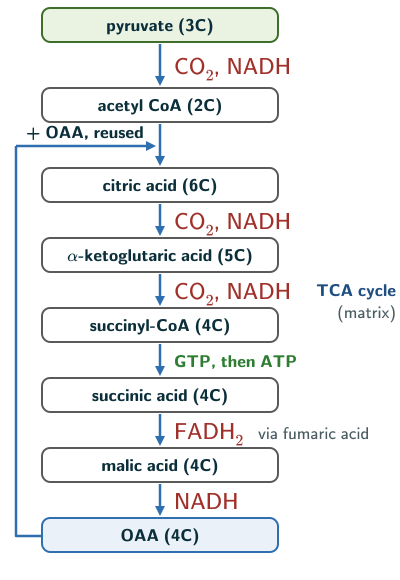
NCERT’s summary equation for this phase, per pyruvic acid (page 159), with FAD for NCERT’s FAD:
pyruvic acid + 4NAD + FAD + 2HO + ADP + Pi → 3CO + 4NADH + 4H + FADH + ATP (mitochondrial matrix)
So, for one glucose, the conversion of pyruvate to acetyl CoA and the TCA cycle release CO and make 8 NADH + H, 2 FADH and just 2 ATP. Oxygen has not yet appeared, and neither has the promised large number of ATP (NCERT page 159).
Electron transport system and oxidative phosphorylation
- The energy stored in NADH + H and FADH is released when they are oxidised through the electron transport system (ETS) and the electrons are passed to O, forming water. The ETS is in the inner mitochondrial membrane (NCERT page 159).
- Complex I, NADH dehydrogenase, oxidises NADH from the matrix and passes the electrons to ubiquinone, inside the membrane. Ubiquinone also receives reducing equivalents from FADH through complex II, generated when succinate is oxidised in the TCA cycle (NCERT page 160).
- Reduced ubiquinone (ubiquinol) passes its electrons through the cytochrome bc complex (complex III) to cytochrome c, a small protein on the outer surface of the inner membrane that acts as a mobile carrier between complexes III and IV (page 160).
- Complex IV, cytochrome c oxidase, contains cytochromes a and a and two copper centres (page 160).
- As the electrons pass through complexes I, III and IV, protons are moved out of the matrix into the intermembrane space: NCERT Figure 12.4 shows 4, 4 and 2 H; complex II moves none. This proton gradient drives ATP synthase. NCERT’s photosynthesis chapter notes that in respiration protons accumulate in the intermembrane space of the mitochondria (NCERT Chapter 11, page 140).
- As the electrons pass through complexes I to IV, the flow is coupled to ATP synthase (complex V), which makes ATP from ADP and inorganic phosphate. Oxidation of one NADH gives 3 ATP; one FADH gives 2 ATP (page 160).
- Oxygen acts only at the end, as the final hydrogen acceptor, but it is vital, since it drives the whole process by removing hydrogen from the system (page 160).
- In photophosphorylation, light energy builds the proton gradient; in respiration, the energy of oxidation-reduction does, so the process is called oxidative phosphorylation (page 160).
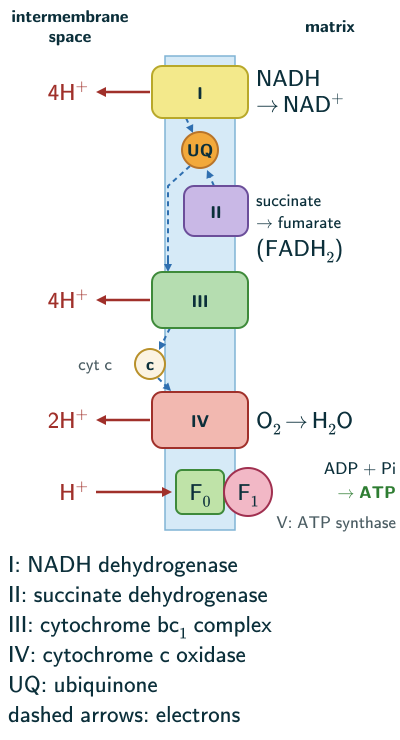
Beyond the NCERT text: the observed yields are closer to about 2.5 ATP per NADH and 1.5 per FADH (Wikipedia, “Citric acid cycle”, facts in our words), but NCERT uses 3 and 2; give NCERT’s values in NEET answers.
ATP synthase: F and F
- ATP synthase (complex V) has two major parts, F and F (NCERT page 161).
- F, the headpiece, is a peripheral membrane protein complex and contains the site for synthesis of ATP from ADP and inorganic phosphate (page 161).
- F is an integral membrane protein complex that forms the channel through which protons cross the inner membrane (page 161).
- The passage of protons through F is coupled to the catalytic site of F. For each ATP produced, 4 H pass through F, from the intermembrane space to the matrix, down the electrochemical proton gradient (page 161).
Beyond the NCERT text: the number of protons per ATP depends on the ring of c subunits in F, which turns as protons pass. Wikipedia’s article “Cellular respiration” gives 8 c subunits in vertebrates; with 3 ATP made per turn, that is about 8 ÷ 3 ≈ 2.7 H through the synthase per ATP, and about one more H is spent moving ADP, phosphate and ATP across the inner membrane (facts in our words). In NEET answers, use NCERT’s 4 H per ATP.
The mechanism is the chemiosmotic one you met in photosynthesis, where the chloroplast’s own ATP synthase has parts called CF and CF (NCERT Chapter 11, page 142); there, protons flow from the thylakoid lumen to the stroma. For the membranes and matrix, see mitochondria.
Solved examples
Example 1: Products of pyruvate oxidation and the TCA cycle per glucose
Using NCERT’s summary equation per pyruvic acid, find the CO, NADH, FADH and ATP made from one glucose in the mitochondrial matrix.
Answer: one glucose gives 2 pyruvic acid, so double the per-pyruvate figures: CO = 2 × 3 = 6; NADH = 2 × 4 = 8; FADH = 2 × 1 = 2; ATP = 2 × 1 = 2. The 6 CO carry all 6 carbons of the glucose (NCERT pages 158–159). Beyond the NCERT text, this is a net balance: the CO released in one turn of the cycle comes from carbons that were in oxaloacetate, and the carbons brought in by acetyl CoA leave only in later turns (Wikipedia, “Citric acid cycle”, facts in our words).
Example 2: ATP from the carriers
Using NCERT’s values, how many ATP does the ETS make from the 8 NADH and 2 FADH of Example 1?
Answer: 8 × 3 + 2 × 2 = 24 + 4 = 28 ATP (NCERT page 160). Add the 2 ATP of the TCA cycle: 30 ATP from the mitochondrial steps of one glucose. With glycolysis’s net 2 ATP and its 2 NADH (2 × 3 = 6, on NCERT’s assumption that they enter the mitochondria), the total is NCERT’s 38 (Section 12.5, page 161).
Example 3: Protons and ATP
NCERT Figure 12.4 shows complexes I, III and IV moving 4, 4 and 2 H into the intermembrane space, and NCERT says 4 H pass through F for each ATP (page 161). On these numbers, how many ATP can one NADH and one FADH give?
Answer: electrons from NADH pass complexes I, III and IV: 4 + 4 + 2 = 10 H, and 10 ÷ 4 = 2.5 ATP. Electrons from FADH enter through complex II, after complex I, so only III and IV pump: 4 + 2 = 6 H, and 6 ÷ 4 = 1.5 ATP. This is why FADH gives less ATP than NADH (reasoned from NCERT Figure 12.4 and page 161), and the results equal the newer values in the note above. NCERT’s text uses 3 and 2 (page 160); use those in NEET answers.
Example 4: Why oxygen matters
Oxygen is used only at the very end of aerobic respiration. Why, then, does the whole process stop without it?
Answer: oxygen is the final hydrogen acceptor. It removes hydrogen (electrons) from the end of the chain, and without it the carriers stay reduced, so electrons cannot flow, the chain makes no ATP, and NAD and FAD are not regenerated for the TCA cycle (NCERT pages 159–160). Glycolysis can still make its ATP if fermentation reoxidises NADH to NAD (reasoned from NCERT pages 156–157).
Example 5: Main steps and where (NCERT Exercise 4)
What are the main steps in aerobic respiration? Where does it take place?
Answer: after glycolysis in the cytoplasm (NCERT page 155), pyruvate enters the mitochondria. There, (1) the complete oxidation of pyruvate, by the stepwise removal of all its hydrogen atoms, leaves three molecules of CO: this is the conversion to acetyl CoA and the TCA cycle, in the mitochondrial matrix; and (2) the electrons removed with the hydrogen atoms pass to O while ATP is made: the electron transport system and ATP synthase, on the inner mitochondrial membrane (NCERT page 158).
Common mistakes to avoid
Common mistake
Putting the Krebs’ cycle on the inner membrane
The TCA cycle runs in the mitochondrial matrix; the electron transport system is on the inner membrane (NCERT page 158). The one link: the oxidation of succinate, which gives FADH, is done by complex II in the inner membrane, labelled succinate dehydrogenase in NCERT Figure 12.4 (page 160).
Common mistake
Using oxygen in the TCA cycle
The TCA cycle releases CO and reduces NAD and FAD without using O; oxygen acts only at the end of the ETS (NCERT pages 159–160).
Common mistake
Swapping F and F
F is the proton channel in the membrane; F is the headpiece with the ATP-making site (NCERT page 161).
Common mistake
Missing the one ATP made directly in the cycle
Succinyl-CoA → succinic acid makes GTP, then ATP, by substrate-level phosphorylation; this is the only ATP the TCA cycle makes directly (NCERT page 159).
Quick revision summary
- Pyruvate enters the mitochondria; pyruvate dehydrogenase (with NAD, CoA, Mg) turns it into acetyl CoA, CO and NADH + H in the matrix.
- TCA (Krebs’) cycle in the matrix: acetyl CoA + OAA → citric acid (citrate synthase) → isocitrate → α-ketoglutaric acid → succinyl-CoA → succinic acid (GTP, then ATP) → … → OAA; 3 NADH and 1 FADH per turn.
- Per glucose, pyruvate → acetyl CoA and TCA: 6 CO, 8 NADH, 2 FADH, 2 ATP.
- ETS on the inner membrane: complex I (NADH dehydrogenase) → ubiquinone (also from FADH via complex II) → complex III (cytochrome bc) → cytochrome c → complex IV (cytochrome c oxidase) → O, the final hydrogen acceptor; NADH gives 3 ATP, FADH 2 ATP: oxidative phosphorylation.
- ATP synthase: F channel in the membrane, F headpiece makes ATP; 4 H per ATP, intermembrane space to matrix.
Formula sheet
- pyruvic acid + CoA + NAD → acetyl CoA + CO + NADH + H
- per glucose (matrix): 6 CO, 8 NADH, 2 FADH, 2 ATP
- NADH → 3 ATP; FADH → 2 ATP
- 4 H through F per ATP
Questions students ask
Why is the Krebs’ cycle also called the TCA cycle and the citric acid cycle?
The Krebs’ cycle, the tricarboxylic acid (TCA) cycle and the citric acid cycle are three names for one cycle: NCERT calls it the tricarboxylic acid cycle, “more commonly called as Krebs’ cycle after the scientist Hans Krebs who first elucidated it” (page 158). It is the citric acid cycle because citric acid is the first compound the cycle makes (NCERT page 158), and NCERT Figure 12.3 is titled “The Citric acid cycle” (page 159). Beyond the NCERT text, “tricarboxylic” refers to citric acid and isocitric acid, each of which carries three carboxyl (–COOH) groups, as their chemical names, propane-1,2,3-tricarboxylic acids with one hydroxyl group, show.
How many times does the Krebs’ cycle turn for one glucose molecule?
The Krebs’ cycle turns twice for each glucose molecule: glycolysis splits glucose into two pyruvic acid molecules, and each gives one acetyl CoA, which enters the cycle (NCERT pages 155 and 158). Each turn has two decarboxylations, releasing 2 CO, reduces NAD at three points and, in NCERT’s words, FAD (strictly FAD) at one, and makes one GTP (pages 158–159), so the two turns give 4 CO, 6 NADH + H, 2 FADH and 2 ATP. The Calvin cycle, by contrast, turns six times to build one glucose, once for each CO fixed (NCERT Chapter 11, page 145; the Calvin cycle).
What is the difference between the Krebs’ cycle and the electron transport chain?
The Krebs’ cycle and the electron transport chain are successive stages of aerobic respiration in different parts of the mitochondrion: the cycle, in the matrix, oxidises acetyl CoA, releasing CO and loading its hydrogen onto NAD and FAD (NCERT’s FAD), while the electron transport system (NCERT’s name for the chain), in the inner membrane, takes the electrons from NADH + H and FADH and passes them to O, forming water (NCERT pages 158–159). The cycle uses no O itself and makes just one ATP, from GTP, per turn by substrate-level phosphorylation, whereas the chain’s electron flow is coupled to ATP synthase, which makes 3 ATP per NADH and 2 per FADH by NCERT’s count (pages 159–160).
What is the difference between the electron transport chain and oxidative phosphorylation?
The electron transport chain and oxidative phosphorylation are linked parts of one process: the chain (NCERT’s ETS) passes electrons from NADH + H and FADH to O, and oxidative phosphorylation is the making of ATP by ATP synthase, driven by the proton gradient this electron flow builds (NCERT pages 159–161). It is called oxidative because the energy of oxidation-reduction, not light as in photophosphorylation, builds it (page 160); the mechanism is the chemiosmotic hypothesis.
Is the link reaction part of the Krebs’ cycle?
No, the link reaction is a separate step just before the Krebs’ cycle: in the mitochondrial matrix, each pyruvic acid from glycolysis undergoes oxidative decarboxylation to acetyl CoA, giving off one CO and forming one NADH + H, and only the acetyl CoA enters the cycle (NCERT page 158). It is an oxidative decarboxylation because pyruvic acid both loses carbon as CO and gives up hydrogen to NAD, and it makes no ATP directly. NCERT includes the step in its Figure 12.3 but does not use the name, which comes from the way the step links glycolysis in the cytoplasm to the cycle in the matrix.
Which chapter is the Krebs’ cycle in, and is it in the NEET syllabus?
The Krebs’ cycle is in NCERT Biology Class 11, Chapter 12, Respiration in Plants, Section 12.4.1, “Tricarboxylic Acid Cycle” (pages 158–159), and it is in the NEET (UG) 2026 syllabus, whose Unit 4, Plant Physiology, lists “Cellular respiration-glycolysis, fermentation (anaerobic), TCA cycle and electron transport system (aerobic)”. The same unit also lists “Energy relations - Number of ATP molecules generated”, which is NCERT’s respiratory balance sheet.
Practice questions
Try each question first, then open the answer to check your working.
-
Q1. Which enzyme catalyses the conversion of pyruvate to acetyl CoA?
Show answerHide answer
Pyruvic (pyruvate) dehydrogenase (NCERT page 158).
-
Q2. With which compound does the acetyl group condense at the start of the TCA cycle, and what is formed?
Show answerHide answer
Oxaloacetic acid (OAA), with water; citric acid is formed, by citrate synthase (NCERT page 158).
-
Q3. What is the final hydrogen acceptor in aerobic respiration?
Show answerHide answer
Oxygen (NCERT page 160); NCERT’s Summary also calls O the ultimate acceptor of electrons, reduced to water (page 165).