Electron transport and photophosphorylation
NCERT Class 11 Biology Chapter 11 Section 11.6
Quick answer
In the Z scheme, light excites electrons at PS II; they pass downhill through cytochromes to PS I, are excited again, and reduce NADP to NADPH, while water split at PS II replaces them and releases O. Non-cyclic photophosphorylation uses both photosystems and makes ATP and NADPH; cyclic uses PS I alone and makes only ATP. Protons pumped into the thylakoid lumen flow back through the CF channel of ATP synthase, and CF makes ATP.
With your textbook
NCERT Biology (Class 11), Chapter 11 “Photosynthesis in Higher Plants”, Section 11.6 “The Electron Transport”, pages 138–142.
Open the official NCERT chapter (PDF, 2.7 MB, ncert.nic.in) (opens in a new tab)
Checked against the 2026-27 reprint on .
Electron transport in the light reaction
Electron transport and chemiosmosis
Light-excited electrons flow from water through PS II and PS I to NADP. On the way, the flow builds a proton gradient across the thylakoid membrane, and that gradient drives the synthesis of ATP (NCERT pages 138–142). NCERT sums up what this needs:
Chemiosmosis requires a membrane, a proton pump, a proton gradient and ATP synthase.
NCERT Biology (Class 11), Section 11.6.3, page 142
In plain words: think of a water wheel. Light pumps electrons uphill twice, at PS II and at PS I. As they run downhill between the two, their energy pushes protons into the thylakoid, like water filling a raised tank. The protons flow back out through ATP synthase, and as they do they turn it, like water turning a wheel, to make ATP. At the end of the run, the electrons are loaded onto NADP to make NADPH.
The Z scheme
- In PS II, the reaction centre chlorophyll a absorbs 680 nm red light, and its electrons become excited, raised to a higher energy. An electron acceptor picks them up and passes them to an electron transport system of cytochromes (NCERT pages 138–139).
- This movement is downhill on an oxidation-reduction (redox potential) scale. The electrons are not used up; they are passed on to PS I (page 139).
- At the same time, electrons in the reaction centre of PS I are excited by 700 nm red light and transferred to another acceptor. From there they move downhill again to NADP, reducing it to NADPH + H (page 139).
- The whole path, from PS II uphill to the acceptor, down the transport chain to PS I, up again and finally down to NADP, is the Z scheme, named for its shape, which appears when all the carriers are placed in sequence on a redox potential scale (page 139).
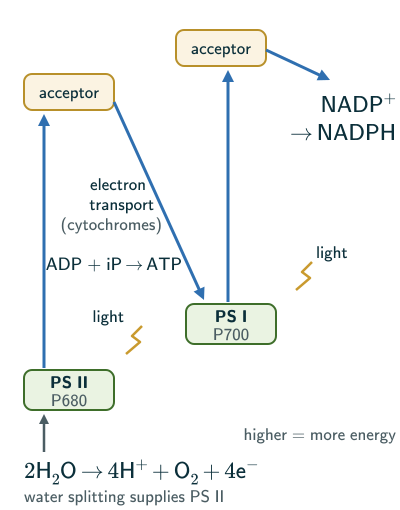
Three NCERT wordings need care. Page 139 calls NADP “energy-rich”, but NADP is the oxidised, low-energy form: it is NADPH, made when NADP takes up the electrons, that carries the energy used in the stroma. Page 139 also gives PS I’s acceptor “a greater redox potential”: read it against the light-excited reaction centre. Beyond the NCERT text: light excites P700, making it a strong reducing agent with a very negative redox potential, and the acceptors it passes the electron on to, such as ferredoxin, have a higher redox potential, a greater affinity for electrons, so that step runs downhill and the light supplies the uphill step; on the Z, carriers drawn higher hold electrons at higher energy (Wikipedia, “P700”, facts in our words). And the chapter Summary says the electrons go “finally to NAD forming NADH” (page 151), while the text and NCERT Figure 11.5 have them reduce NADP to NADPH (page 139). NADP and NADPH are right.
Splitting of water
- The electrons that leave PS II must be replaced. They come from the splitting of water, which is associated with PS II: water is split into 2H, [O] and electrons, and this creates oxygen, one of the net products of photosynthesis (NCERT page 139).
- The electrons that PS I gives away are replaced by electrons from PS II (page 139).
- The overall equation is 2HO → 4H + O + 4e (page 139).
- The water splitting complex of PS II lies on the inner side of the thylakoid membrane (page 139), so the protons from water are released into the lumen (NCERT page 140).
Cyclic and non-cyclic photophosphorylation
- The making of ATP by cells, in mitochondria and chloroplasts, is phosphorylation. Photophosphorylation is the synthesis of ATP from ADP and inorganic phosphate in the presence of light (NCERT pages 139–140).
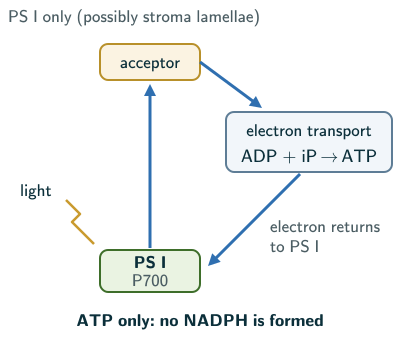
- Non-cyclic photophosphorylation: the two photosystems work in series, first PS II and then PS I, connected by the electron transport chain of the Z scheme. Both ATP and NADPH + H are made (page 140).
- Cyclic photophosphorylation: only PS I is functional. The excited electron does not pass on to NADP but is cycled back to the PS I complex through the electron transport chain, so only ATP is made, and no NADPH + H (page 140).
- A possible location of the cyclic flow is the stroma lamellae: NCERT says the grana membranes have both PS I and PS II, but the stroma lamellae lack PS II as well as the NADP reductase enzyme (page 140; see the chloroplast).
- Cyclic photophosphorylation also occurs when only light of wavelengths beyond 680 nm is available for excitation (page 140).
Chemiosmotic hypothesis
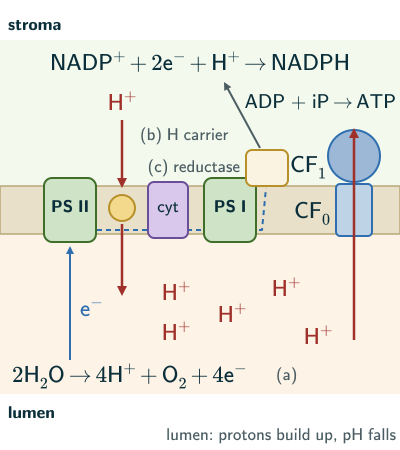
The chemiosmotic hypothesis explains how ATP is made in the chloroplast. As in respiration, ATP synthesis is linked to a proton gradient across a membrane, here the thylakoid membrane. The difference is that in the chloroplast protons accumulate inside, in the lumen, whereas in respiration they accumulate in the intermembrane space of the mitochondria (NCERT page 140).
Three steps build the gradient (NCERT pages 140–141):
- (a) Water splitting happens on the inner side of the membrane, so its protons accumulate in the lumen.
- (b) The H carrier: the primary acceptor of electrons, on the outer side of the membrane, passes its electron not to an electron carrier but to an H carrier. This carrier takes a proton from the stroma along with the electron, and releases the proton into the lumen when it hands the electron on.
- (c) NADP reductase, on the stroma side, uses protons from the stroma to reduce NADP to NADPH + H.
So protons decrease in the stroma and accumulate in the lumen. This creates a proton gradient across the thylakoid membrane, and a measurable decrease in pH in the lumen (page 141).
NCERT Figure 11.7 (page 141) names the carriers: plastoquinone (PQ), the H carrier, between PS II and the cytochrome b6f complex; plastocyanin (PC), between cytochrome b6f and PS I; and ferredoxin (Fd) and FNR, the NADP reductase, on the stroma side of PS I.
ATP synthase in the thylakoid membrane
- The gradient is broken down as protons move back across the membrane to the stroma, through the transmembrane channel of the CF part of ATP synthase, an enzyme (NCERT pages 141–142).
- CF is embedded in the thylakoid membrane and forms a channel for the facilitated diffusion of protons. CF protrudes on the outer surface of the membrane, the side that faces the stroma (page 142).
- The breakdown of the gradient provides enough energy to cause a conformational change in CF, which makes the enzyme synthesise several molecules of ATP (page 142).
- NCERT’s chapter Summary calls the channel the “F0 part of the ATPase enzyme” (page 151). F and F are the names NCERT uses for the mitochondrial ATP synthase (NCERT Section 12.4.2, page 161); in the chloroplast they are CF and CF.
- Along with NADPH, this ATP is used immediately in the stroma, in the reactions that fix CO and make sugars (page 142).
Solved examples
Example 1: Protons and oxygen from water (NCERT page 139)
The water splitting complex lies on the inner side of the thylakoid membrane. Where are the protons and O it forms likely to be released: in the lumen, or on the outer side?
Answer: in the lumen. NCERT confirms that the protons from water splitting accumulate within the lumen of the thylakoids (page 140). The O is also formed on the lumen side; it then diffuses out of the chloroplast (page 142).
Example 2: Cyclic against non-cyclic (NCERT Exercise 9b)
Compare cyclic and non-cyclic photophosphorylation.
Answer:
| Feature | Non-cyclic | Cyclic |
|---|---|---|
| Uses | PS II, then PS I | PS I only |
| Electrons | water to NADP | back to PS I |
| Products | ATP and NADPH + H | ATP only |
| O released | yes (water split) | no |
| Site | grana lamellae (PS I and PS II) | stroma lamellae (possible) |
| Light | 680 and 700 nm | also beyond 680 nm alone |
(NCERT pages 139–140. NCERT gives only the possible site of the cyclic flow; the non-cyclic site follows from its note that grana lamellae have both photosystems. No O is released in the cyclic flow because water splitting belongs to PS II, which is not used. Beyond the NCERT text, PS I is in fact mostly in the unstacked stroma lamellae and the outer layers of the grana, while PS II is mostly in the stacked grana (Wikipedia, “Thylakoid”, facts in our words); for NEET, keep NCERT’s statement that the grana have both PS I and PS II and the stroma lamellae lack PS II (page 140).)
Example 3: Counting electrons
How many electrons does splitting two molecules of water release, and how many NADP can they reduce?
Answer: 2HO → 4H + O + 4e releases 4 electrons (NCERT page 139). Beyond the NCERT text, each NADP takes 2 electrons to become NADPH, so 4 electrons reduce 2 NADP: one O is released for every 2 NADPH formed.
Example 4: Why the lumen turns acidic
Give the three reasons why protons build up in the thylakoid lumen.
Answer: (a) water is split on the inner side of the membrane, releasing protons into the lumen; (b) the H carrier takes protons from the stroma and releases them into the lumen; (c) NADP reductase removes protons from the stroma side. Steps (a) and (b) add lumen protons; step (c) removes stromal protons and strengthens the difference. Increased lumen proton concentration means a lower lumen pH (NCERT pages 140–141).
Example 5: No NADPH in the stroma lamellae
Why would electron flow in the stroma lamellae, NCERT’s possible site of cyclic flow, make ATP but no NADPH?
Answer: NCERT says the stroma lamellae lack PS II and the NADP reductase enzyme, so the excited electron from PS I is not passed to NADP; it cycles back to PS I through the transport chain, making only ATP (NCERT page 140).
Common mistakes to avoid
Common mistake
Taking the oxygen from PS I
Water splitting, and so O release, is associated with PS II (NCERT page 139).
Common mistake
Expecting NADPH from cyclic flow
Cyclic photophosphorylation makes only ATP; the electron returns to PS I instead of reducing NADP (NCERT page 140).
Common mistake
Putting the protons in the stroma
In the chloroplast, protons accumulate in the lumen; in mitochondria they accumulate in the intermembrane space (NCERT page 140).
Common mistake
Swapping CF and CF
CF is the proton channel in the membrane; CF faces the stroma and changes shape to make ATP (NCERT page 142).
Quick revision summary
- Z scheme: PS II (680 nm) excites electrons to an acceptor; they run downhill through cytochromes to PS I; PS I (700 nm) excites them again; they reduce NADP to NADPH + H.
- Water splitting at PS II replaces its electrons: 2HO → 4H + O + 4e; PS II replaces the electrons of PS I.
- Non-cyclic photophosphorylation uses PS II and PS I and makes ATP and NADPH; cyclic uses PS I only, possibly in the stroma lamellae, and makes only ATP.
- Chemiosmosis: protons accumulate in the lumen (water splitting, the H carrier, NADP reductase); they flow back through CF of ATP synthase, and CF makes ATP.
Formula sheet
- water splitting at PS II: 2HO → 4H + O + 4e
- non-cyclic: PS II → PS I; ATP and NADPH
- cyclic: PS I only; ATP only
- ATP synthase: CF proton channel, CF makes ATP
Questions students ask
Is the Z scheme the same as non-cyclic photophosphorylation?
The Z scheme and non-cyclic photophosphorylation describe the same electron flow from two sides: the Z scheme is the path the electrons take, from PS II uphill to an acceptor, down the electron transport chain to PS I, up again and finally down to NADP, while non-cyclic photophosphorylation is the ATP synthesis that this flow drives, with NADPH + H made as well (NCERT pages 139–140). The flow is called non-cyclic because the electrons do not come back: they come from water split at PS II and end on NADP. The name Z scheme comes from the shape the path takes when all the carriers are placed in sequence on a redox potential scale (NCERT page 139).
Why do plants need cyclic photophosphorylation if it makes no NADPH?
Plants need cyclic photophosphorylation for extra ATP: the Calvin cycle uses 3 ATP but only 2 NADPH for every CO fixed, and NCERT suggests that the cyclic flow, which makes ATP but no NADPH, probably takes place to meet this difference (NCERT page 145). Cyclic flow cannot replace the non-cyclic flow, though: it reduces no NADP, and without NADPH the Calvin cycle cannot reduce PGA to sugar (NCERT pages 140 and 144).
How is photophosphorylation different from oxidative phosphorylation?
Photophosphorylation and oxidative phosphorylation both make ATP with an ATP synthase driven by a proton gradient, but light energy builds the gradient in photophosphorylation and the energy of oxidation-reduction in oxidative phosphorylation (NCERT Chapter 12, page 160). Photophosphorylation works across the thylakoid membrane, with protons collecting in the lumen; oxidative phosphorylation across the inner mitochondrial membrane, into the intermembrane space (NCERT page 140). In non-cyclic flow electrons go from water to NADP; in mitochondria, from NADH and FADH to O, forming water (NCERT page 139; Chapter 12, page 159).
Who proposed the chemiosmotic hypothesis?
The chemiosmotic hypothesis was proposed by the British biochemist Peter Mitchell in 1961, to explain how electron transport is coupled to ATP synthesis, and he received the Nobel Prize in Chemistry in 1978 for it (beyond the NCERT text, which does not name him; Mitchell, Nature, 1961; NobelPrize.org). NCERT applies the hypothesis to the chloroplast: protons build up in the thylakoid lumen, and their flow back to the stroma through ATP synthase provides the energy to make ATP (NCERT pages 140–142).
What is the difference between photolysis and photophosphorylation?
Photolysis and photophosphorylation are two different events of the light reaction: photolysis is the light-driven splitting of water at PS II, 2HO → 4H + O + 4e, which replaces PS II’s electrons and releases oxygen, while photophosphorylation is the synthesis of ATP from ADP and inorganic phosphate in the presence of light (NCERT pages 139–140). NCERT’s text calls photolysis simply the splitting of water. The two are linked, because the protons released by splitting water on the inner side of the thylakoid membrane add to the gradient that drives ATP synthase (NCERT page 140).
Practice questions
Try each question first, then open the answer to check your working.
-
Q1. With which photosystem is the splitting of water associated?
Show answerHide answer
Photosystem II (NCERT page 139).
-
Q2. Name the electron carriers between PS II and PS I in the Z scheme.
Show answerHide answer
An electron transport system, which NCERT’s text describes as cytochromes (page 139). NCERT Figure 11.7 names the carriers plastoquinone, the cytochrome b6f complex and plastocyanin (page 141).
-
Q3. Which part of ATP synthase faces the stroma?
Show answerHide answer
CF (NCERT page 142).