Light reaction of photosynthesis
NCERT Class 11 Biology Chapter 11 Section 11.5
Quick answer
Light reactions include light absorption, water splitting, oxygen release and formation of ATP and NADPH. Antenna pigments transfer excitation energy to reaction centres: P700 in PS I and P680 in PS II, each a single chlorophyll a molecule in NCERT’s account (page 138). PS II precedes PS I in non-cyclic electron flow; the numbering follows discovery order.
With your textbook
NCERT Biology (Class 11), Chapter 11 “Photosynthesis in Higher Plants”, Section 11.5 “What is Light Reaction?”, page 138.
Open the official NCERT chapter (PDF, 2.7 MB, ncert.nic.in) (opens in a new tab)
Checked against the 2026-27 reprint on .
The light reaction
Light reaction
The first phase of photosynthesis, which uses light directly. NCERT describes it this way:
Light reactions or the ‘Photochemical’ phase include light absorption, water splitting, oxygen release, and the formation of high-energy chemical intermediates, ATP and NADPH.
NCERT Biology (Class 11), Section 11.5, page 138
In plain words: the light reaction is the solar panel of the chloroplast. Hundreds of pigment molecules act like a dish that collects light and funnels its energy to one special chlorophyll a molecule. That molecule fires off an energised electron, and the energy of the electron flow is then stored in ATP and NADPH for the sugar-making phase.
The photochemical phase
- The light reaction, or photochemical phase, includes four events: light absorption, water splitting, oxygen release, and the formation of the high-energy chemical intermediates ATP and NADPH (NCERT page 138).
- Several protein complexes take part in the process (page 138).
- Its products are ATP, NADPH and O. The O diffuses out of the chloroplast, while ATP and NADPH drive the synthesis of sugars (NCERT Section 11.7, page 142).
The light reaction runs on the membrane system of the chloroplast, the grana and stroma lamellae (NCERT Section 11.3, page 136; for the thylakoid membranes, see plastids).
Light harvesting complexes
- The pigments are organised into two discrete photochemical light harvesting complexes (LHC), within Photosystem I (PS I) and Photosystem II (PS II) (page 138).
- Each LHC is made up of hundreds of pigment molecules bound to proteins (page 138).
- In each photosystem, all the pigments except one molecule of chlorophyll a form a light harvesting system, also called the antenna. By absorbing different wavelengths of light, these pigments make photosynthesis more efficient (page 138).
- The single chlorophyll a molecule left forms the reaction centre (page 138).
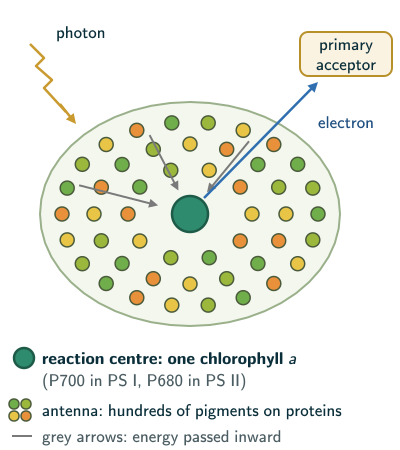
The antenna includes the other chlorophyll a molecules as well as the accessory pigments, chlorophyll b, the xanthophylls and the carotenoids, which absorb light and pass the energy on to chlorophyll a (NCERT Sections 11.4 and 11.5, page 138).
Photosystems I and II: P700 and P680
The reaction centre is different in the two photosystems (NCERT page 138):
| Photosystem | Reaction centre | Peak |
|---|---|---|
| PS I | P700 | 700 nm |
| PS II | P680 | 680 nm |
- The number in each name is the wavelength of the absorption peak: P700 absorbs best at 700 nm and P680 at 680 nm, both red light (NCERT pages 138–139).
- The photosystems are named in the sequence of their discovery, not in the sequence in which they work. In non-cyclic electron flow they work in series, first PS II and then PS I, along the Z scheme (NCERT pages 138 and 140).
- Both reaction centres are chlorophyll a; chlorophyll b and the other pigments belong to the antenna (page 138).
Beyond the NCERT text: NCERT’s “single chlorophyll a molecule” is a simplification. Wikipedia’s articles “P680” and “P700” describe each reaction centre as a special pair of two chlorophyll molecules (in P700, chlorophyll a and chlorophyll a′) that behaves as a single molecule. For NEET, keep NCERT’s wording.
Solved examples
Example 1: Why is PS I numbered first?
PS II acts before PS I in the light reaction. Why, then, is the other one called Photosystem I?
Answer: the photosystems are named in the sequence of their discovery, not in the sequence in which they function: PS I was discovered first (NCERT page 138), but in the light reaction PS II works first and passes electrons on to PS I (NCERT page 140).
Example 2: Reading the names
Which reaction centre absorbs the longer wavelength, and what do the numbers in P680 and P700 mean?
Answer: the numbers are the wavelengths of the absorption peaks, in nanometres: P680 absorbs best at 680 nm and P700 at 700 nm. So P700, of PS I, absorbs the longer wavelength; both are red light (NCERT pages 138–139).
Example 3: Why hundreds of pigments?
Why does a photosystem need an antenna of hundreds of pigment molecules when only one chlorophyll a forms the reaction centre?
Answer: the antenna pigments absorb different wavelengths of light and pass the energy to the reaction centre, so the photosystem catches far more light, over a wider range of wavelengths, than one molecule could. This makes photosynthesis more efficient (NCERT page 138).
Example 4: Products of the light reaction
Name the products of the light reaction and say what happens to each.
Answer: ATP, NADPH and O. The O diffuses out of the chloroplast; ATP and NADPH are used in the stroma to drive the synthesis of sugars (NCERT page 142).
Common mistakes to avoid
Common mistake
Matching P680 with PS I
P700 is the reaction centre of PS I and P680 that of PS II (NCERT page 138).
Common mistake
Thinking the numbers give the order of action
The photosystems are numbered by order of discovery; PS II acts first (NCERT pages 138 and 140).
Common mistake
Leaving chlorophyll a out of the antenna
The antenna is all the pigments except one molecule of chlorophyll a, so it contains other chlorophyll a molecules besides the accessory pigments (NCERT page 138).
Common mistake
Making chlorophyll b the reaction centre
Both reaction centres are chlorophyll a; the other pigments form the antenna (NCERT page 138).
Quick revision summary
- The light reaction (photochemical phase) covers light absorption, water splitting, oxygen release and the formation of ATP and NADPH; its products are ATP, NADPH and O.
- Pigments form two light harvesting complexes, in PS I and PS II, each of hundreds of pigment molecules bound to proteins.
- In each photosystem, all the pigments except one chlorophyll a form the antenna; that one chlorophyll a is the reaction centre.
- PS I has P700 (peak at 700 nm); PS II has P680 (peak at 680 nm). The names follow the order of discovery; PS II acts first.
Formula sheet
- light reaction products: ATP, NADPH, O
- PS I reaction centre: P700 (700 nm)
- PS II reaction centre: P680 (680 nm)
- antenna: all pigments except one chlorophyll a
Questions students ask
What is the difference between PS I and PS II?
Photosystem I (PS I) has the reaction centre P700, which absorbs best at 700 nm, while Photosystem II (PS II) has P680, which absorbs best at 680 nm (NCERT pages 138–139). In the light reaction PS II acts first and is linked with the splitting of water, which releases O, while the electrons leaving PS I go on to reduce NADP to NADPH (NCERT page 139). PS I can also work alone, in cyclic photophosphorylation, which makes ATP but no NADPH, and the stroma lamellae, which lack PS II, have PS I only (NCERT page 140).
What is the difference between the light harvesting complex and the reaction centre?
The light harvesting complex gathers light, while the reaction centre uses it: the complex is made of hundreds of pigment molecules bound to proteins, and the reaction centre is the one chlorophyll a molecule that receives their energy and gives up an excited electron to the primary acceptor (NCERT page 138). NCERT says each photosystem has all its pigments “(except one molecule of chlorophyll a) forming a light harvesting system also called antennae”, and that “The single chlorophyll a molecule forms the reaction centre”. Beyond the NCERT text, each reaction centre is a chlorophyll pair acting as one (Wikipedia, “P680” and “P700”, facts in our words); for NEET, use NCERT’s one molecule.
Why do plants need two photosystems?
Plants need two photosystems because, beyond the NCERT text, the redox gap from water to NADP is too large for one photosystem to bridge with the energy it can store from one photon, so PS II and PS I work in series and each electron is lifted twice, once at each (Caffarri and others, Current Protein and Peptide Science, 2014). NCERT states the arrangement without the reason: the two photosystems work in series, first PS II and then PS I, and both ATP and NADPH are made (page 140). How the electrons pass from one to the other is the Z scheme.
What is the Emerson enhancement effect?
The Emerson enhancement effect is the rise in the rate of photosynthesis when far-red light, beyond about 680 nm, is given together with light of a shorter wavelength: the rate with both beams is greater than the sum of the rates with each alone (beyond the NCERT text; Emerson, Chalmers and Cederstrand, 1957, in Chlorella). It followed the red drop, the sharp fall in the efficiency (quantum yield) of photosynthesis in far-red light alone, though chlorophyll a still absorbs it (Emerson and Lewis, 1943), and both were explained by two pigment systems, now PS I and PS II, working in series (Govindjee, Photosynthetica, 2023). NCERT does not describe it.
Where does the light reaction take place?
The light reaction takes place in the membrane system of the chloroplast, the grana and the stroma lamellae, which as a whole traps light energy and makes ATP and NADPH (NCERT page 136); the ATP and NADPH are then used in the stroma to make sugar. The pigments sit in these thylakoid membranes, bound to proteins in the light harvesting complexes of PS I and PS II (NCERT page 138).
Practice questions
Try each question first, then open the answer to check your working.
-
Q1. What is the reaction centre of Photosystem II called?
Show answerHide answer
P680 (NCERT page 138).
-
Q2. What is the light harvesting system of a photosystem also called?
Show answerHide answer
The antenna (NCERT page 138).
-
Q3. What are the two high-energy chemical intermediates formed in the light reaction?
Show answerHide answer
ATP and NADPH (NCERT page 138).