Early experiments on photosynthesis
NCERT Class 11 Biology Chapter 11 Section 11.2
Quick answer
Priestley found that a mint plant restores air that a candle or a mouse has damaged, and Ingenhousz showed that this needs sunlight and that only green parts give out oxygen. Sachs showed that green parts make glucose, stored as starch, and Engelmann’s prism and aerobic bacteria gave the first action spectrum, with peaks in blue and red light. Van Niel inferred that the oxygen comes from water, giving 6CO + 12HO → CHO + 6HO + 6O.
With your textbook
NCERT Biology (Class 11), Chapter 11 “Photosynthesis in Higher Plants”, Section 11.2 “Early Experiments”, pages 134–136.
Open the official NCERT chapter (PDF, 2.7 MB, ncert.nic.in) (opens in a new tab)
Checked against the 2026-27 reprint on .
Early experiments on photosynthesis
Early experiments
A series of simple experiments, from Joseph Priestley’s bell jars to Cornelius van Niel’s studies of bacteria, gradually built up our understanding of photosynthesis (NCERT page 134). Priestley’s hypothesis, from the first of them:
Plants restore to the air whatever breathing animals and burning candles remove.
NCERT Biology (Class 11), Section 11.2, page 134
In plain words: each experiment answered one question. Priestley showed that plants “repair” air; Ingenhousz showed that they need sunlight to do it and that only green parts give out oxygen; Sachs showed that the green parts make glucose and store it as starch; Engelmann showed which colours of light work best; and van Niel inferred that the oxygen comes from water, not from carbon dioxide, which isotope experiments later proved.
Priestley’s experiment
Joseph Priestley (1733–1804) performed a series of experiments that revealed the essential role of air in the growth of green plants; he also discovered oxygen, in 1774 (NCERT page 134).
- A candle burning in a closed space, a bell jar, soon goes out, and a mouse in a closed space soon suffocates. Priestley concluded that a burning candle or a breathing animal somehow damages the air (page 134).
- NCERT depicts a mint plant restoring the air so that it supports a mouse or burning candle (page 134). In Priestley’s own account, the plant was left in the altered air for days before the air was tested again; this does not mean a plant keeps a candle burning indefinitely in a sealed jar.
- His hypothesis: plants restore to the air whatever breathing animals and burning candles remove (page 134).
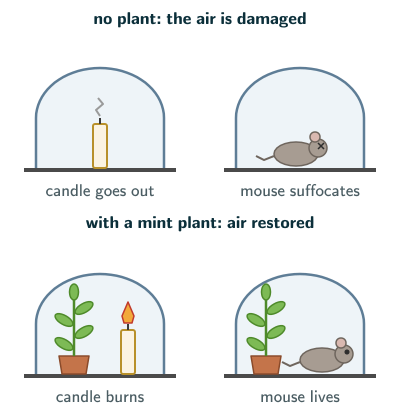
The date. NCERT places these experiments “in 1770” (page 134). Priestley’s own account dates his mint experiments to the summer of 1771: a mouse test begun about the beginning of August 1771, and a candle test begun on 17 August 1771 (Experiments and Observations on Different Kinds of Air, Volume I, 1774). He reported them to the Royal Society in 1772 (Philosophical Transactions, volume 62). In an NCERT-based question, 1770 is the year printed.
Ingenhousz and sunlight
Jan Ingenhousz (1730–1799) used a set-up like Priestley’s, placed once in the dark and once in sunlight, and showed that sunlight is essential for the plant process that purifies air fouled by burning candles or breathing animals (NCERT page 134).
In a second experiment, with an aquatic plant, he saw that in bright sunlight small bubbles formed around the green parts, while in the dark they did not. He later identified the bubbles as oxygen, and so showed that only the green parts of plants can release oxygen (page 134).
Sachs and Engelmann
Julius von Sachs (1832–1897) provided evidence that glucose is produced when plants grow, and that it is usually stored as starch. His later studies showed that the green substance in plants, chlorophyll, is located in special bodies, later called chloroplasts, within plant cells, and that the green parts of plants are where glucose is made (NCERT page 135).
NCERT dates Sachs’s evidence to “about 1854” (page 135). That is too early: Sachs’s papers showing that starch forms in the chlorophyll grains in light appeared in 1862 and 1864, when he stained leaves with iodine and showed that masked parts made no starch (Sachs, Botanische Zeitung, 1862 and 1864; Hangarter and Gest, Photosynthesis Research, 2004; Encyclopaedia Britannica, “Julius von Sachs”). The NCERT fact to remember is the finding, not the year.
T. W. Engelmann (1843–1909) split light into its spectral components with a prism and shone it on a green alga, Cladophora, placed in a suspension of aerobic bacteria. The bacteria gather where O is given out, so they mark the sites of oxygen evolution. They accumulated mainly in the blue and red regions of the split spectrum: this was the first action spectrum of photosynthesis, and it roughly resembles the absorption spectra of chlorophyll a and b (NCERT page 135).
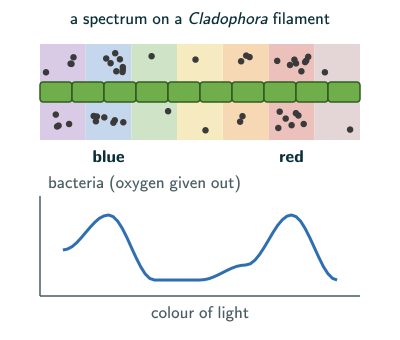
An action spectrum shows how well each colour (wavelength) of light drives photosynthesis; an absorption spectrum shows how much light of each colour a pigment absorbs. NCERT compares the two in Section 11.4.
Van Niel: water as the source of oxygen
By the middle of the nineteenth century, it was known that plants use light energy to make carbohydrates from CO and water. The empirical equation for oxygen-evolving organisms was (NCERT page 135):
CO + HO → [CHO] + O (in light)
where [CHO] represents a carbohydrate, for example glucose, a six-carbon sugar.
The microbiologist Cornelius van Niel (1897–1985), from his studies of purple and green bacteria, showed that photosynthesis is essentially a light-dependent reaction in which hydrogen from a suitable oxidisable compound reduces carbon dioxide to carbohydrates (page 135):
2HA + CO → 2A + CHO + HO (in light)
- In green plants, HO is the hydrogen donor, and it is oxidised to O (page 135).
- In purple and green sulphur bacteria, HS is the hydrogen donor, and the “oxidation” product is sulphur or sulphate, depending on the organism, not O (page 135).
- So van Niel inferred that the O given out by green plants comes from HO, not from carbon dioxide (page 135).
NCERT says this was later proved by “radioisotopic techniques” (page 135). Beyond the NCERT text: the classic experiment, by Samuel Ruben, Merle Randall, Martin Kamen and James L. Hyde (Journal of the American Chemical Society, 1941), used the green alga Chlorella and heavy oxygen, O, which is a stable isotope and not radioactive: it is traced by its extra mass, not by radioactivity. When the water supplied carried extra O, the oxygen given out carried it too; when only the CO (supplied as bicarbonate) carried it, the oxygen did not. “Isotope techniques” is the accurate phrase.
The overall equation
The correct equation for the overall process of photosynthesis is (NCERT page 135):
6CO + 12HO → CHO + 6HO + 6O (in light)
where CHO is glucose, and the O released comes from water. This is not a single reaction but a summary of a multistep process (NCERT pages 135–136).
Why 12 molecules of water, when 6 would balance the net equation? Keep water oxidation and carbon reduction separate in the bookkeeping (our reasoning, from NCERT’s equation on page 135):
| Formal half-reaction | Balance |
|---|---|
| Water oxidation | 12HO → 6O + 24H + 24e |
| Carbon reduction | 6CO + 24H + 24e → CHO + 6HO |
Adding these gives NCERT’s overall equation. Cancelling 6HO gives the equally valid net equation, 6CO + 6HO → CHO + 6O. Net consumption is not the gross water-splitting requirement. These equations balance atoms and charge; they do not by themselves establish where individual atoms went. NCERT says the O given out comes from water, as was later proved by using radioisotopic techniques (page 135); beyond the NCERT text, the classic experiment is the 1941 O work of Ruben and colleagues described above (Journal of the American Chemical Society, 1941). The half-reactions are formal balances, not a literal atom-by-atom tracer map.
Solved examples
Example 1: Why twelve waters? (NCERT page 136)
Explain why twelve molecules of water are used as substrate in the overall equation.
Answer: all the O given out comes from water. Six O hold 12 oxygen atoms, and each HO supplies one, so 12 HO must be split. The formal carbon-reduction half-reaction produces 6 HO, giving a net consumption of 6 HO when the two halves are combined. This is stoichiometric bookkeeping, not proof of individual oxygen-atom destinations. Check: carbon 6 = 6; hydrogen 24 = 12 + 12; oxygen 12 + 12 = 6 + 6 + 12 (NCERT page 135).
Example 2: Relighting the candle (NCERT page 134)
Priestley had to rekindle the candle to test whether it burns after a few days. How could you light it without disturbing the set-up?
Answer: NCERT leaves this open (page 134). Any method that adds heat but no air would do; for example, focus sunlight through a lens onto the wick, or heat a wire sealed into the jar, touching the wick, with an electric current. Opening the jar would let in fresh air and spoil the test.
Example 3: Reading Engelmann’s experiment
Why did Engelmann use aerobic bacteria, and what did their crowding in blue and red light show?
Answer: aerobic bacteria move towards oxygen, so they gather where the alga gives out the most O. Crowding in blue and red light showed that these colours drive photosynthesis best: the first action spectrum, roughly resembling the absorption spectra of chlorophyll a and b (NCERT page 135).
Example 4: Van Niel’s equation for a sulphur bacterium
Write van Niel’s general equation with HS as the hydrogen donor, and check that it balances.
Answer: put A = S: 2HS + CO → 2S + CHO + HO (in light). Hydrogen 4 = 2 + 2; sulphur 2 = 2; carbon 1 = 1; oxygen 2 = 1 + 1. Sulphur, not oxygen, is formed (NCERT page 135; some of these bacteria form sulphate instead).
Example 5: Who showed what?
Match each scientist with the finding: Priestley, Ingenhousz, Sachs, Engelmann, van Niel.
Answer:
| Scientist | Finding |
|---|---|
| Priestley | plants restore air damaged by candles and animals |
| Ingenhousz | sunlight is essential; only green parts give out oxygen |
| Sachs | green parts make glucose, stored as starch |
| Engelmann | blue and red light work best: the first action spectrum |
| van Niel | inferred that the oxygen comes from water, not CO |
(NCERT pages 134–135.)
Common mistakes to avoid
Common mistake
Saying the oxygen comes from CO
The evolved O comes from water (NCERT page 135). The balanced overall equation alone cannot trace the destinations of individual atoms; isotope experiments provide that evidence.
Common mistake
Giving Priestley the credit for light
Priestley showed that plants restore air; it was Ingenhousz who showed that sunlight is essential and that only the green parts release oxygen (NCERT page 134).
Common mistake
Mixing up Engelmann’s set-up
Engelmann used a green alga, Cladophora, and aerobic bacteria, which gather where oxygen is given out; watch for options that swap in Spirogyra or anaerobic bacteria (NCERT page 135).
Common mistake
Calling O radioactive
The heavy oxygen used to prove that the oxygen comes from water, O, is a stable isotope, detected by its mass (beyond the NCERT text).
Quick revision summary
- Priestley (bell jar, candle, mouse, mint): plants restore to the air what breathing animals and burning candles remove; he also discovered oxygen in 1774.
- Ingenhousz: sunlight is essential; in bright sunlight an aquatic plant forms oxygen bubbles around its green parts only.
- Sachs: the green parts make glucose, usually stored as starch; chlorophyll lies in chloroplasts.
- Engelmann (prism, Cladophora, aerobic bacteria): bacteria crowd in blue and red light, the first action spectrum.
- Van Niel (purple and green bacteria): hydrogen from an oxidisable compound reduces CO; in plants the donor is water, so the O comes from water.
- Overall: 6CO + 12HO → CHO + 6HO + 6O in light, a summary of many steps.
Formula sheet
- empirical: CO + HO → [CHO] + O (light)
- van Niel: 2HA + CO → 2A + CHO + HO (light)
- overall: 6CO + 12HO → CHO + 6HO + 6O
- O comes from HO, not CO
Questions students ask
Who discovered photosynthesis?
No single scientist discovered photosynthesis: NCERT describes a series of “simple experiments that led to a gradual development in our understanding of photosynthesis”, from Joseph Priestley’s bell jars to Cornelius van Niel’s bacteria (page 134). Jan Ingenhousz is often credited with the discovery, because he showed that sunlight is essential for the plant process that purifies air and that only the green parts of plants release oxygen (NCERT page 134); beyond the NCERT text, he published this in 1779, in Experiments upon Vegetables. Sachs, Engelmann and van Niel then added glucose and starch, the best colours of light, and water as the source of the oxygen (NCERT page 135).
Why did the candle keep burning and the mouse live in Priestley’s bell jar with a plant?
The plant, photosynthesising in light, restored oxygen to air previously altered by combustion or breathing. Priestley tested the air again after allowing the mint to grow for days; NCERT’s simplified picture should not imply an indefinitely burning candle or unlimited survival in a sealed jar. Priestley himself concluded only that plants restore to the air whatever breathing animals and burning candles remove (NCERT page 134), and he could not yet name the gas: NCERT notes that he discovered oxygen later, in 1774 (page 134). The need for light was shown by Ingenhousz, whose similar set-up purified the air in sunlight but not in the dark (NCERT page 134).
What did Engelmann’s experiment with Spirogyra show?
Engelmann’s experiment with Spirogyra showed that the chloroplast is the part of the cell that gives out oxygen in photosynthesis: he lit tiny parts of its cells, in which the chloroplasts fill only part of each cell, with a very thin ray of light, and the bacteria gathered only where a chloroplast was lit (beyond the NCERT text; Hangarter and Gest, Photosynthesis Research, 2004). It is a different experiment from the one NCERT describes, in which light split by a prism fell on Cladophora and aerobic bacteria traced the first action spectrum (NCERT page 135). So for the action spectrum, the alga is Cladophora.
Which equation of photosynthesis is correct, the one with 6 or with 12 molecules of water?
The correct equation for photosynthesis, as NCERT gives it, is the one with 12 molecules of water: 6CO + 12HO → CHO + 6HO + 6O, in light (page 135). The shorter 6CO + 6HO → CHO + 6O, seen in many books, is also balanced, being the same equation with 6 HO cancelled from both sides, but it hides the fact that all the O released comes from water. Write NCERT’s form in a Class 11 answer, and remember that neither is a single reaction: each sums up a multistep process (NCERT pages 135–136).
Are the early experiments on photosynthesis in the NEET syllabus?
The early experiments on photosynthesis are not named in the NEET (UG) 2026 syllabus, whose Biology Unit 4, Plant Physiology, lists “Photosynthesis as a means of Autotrophic nutrition; Site of photosynthesis take place; pigments involved in Photosynthesis (Elementary idea); Photochemical and biosynthetic phases of photosynthesis; Cyclic and non cyclic and photophosphorylation; Chemiosmotic hypothesis; Photorespiration C3 and C4 pathways; Factors affecting photosynthesis.” They are part of the NCERT Class 11 course, Section 11.2, and two of their results return in listed topics: the action spectrum, under pigments, and water as the source of the O, in the photochemical phase.
Practice questions
Try each question first, then open the answer to check your working.
-
Q1. Which plant did Priestley place in the bell jar with the candle and the mouse?
Show answerHide answer
A mint plant (NCERT page 134).
-
Q2. What did Engelmann use to detect the sites of O evolution along the alga?
Show answerHide answer
Aerobic bacteria, which accumulated where oxygen was given out (NCERT page 135).
-
Q3. In green plants, what is the hydrogen donor, and what is it oxidised to?
Show answerHide answer
Water; it is oxidised to O (NCERT page 135).