Photorespiration
NCERT Class 11 Biology Chapter 11 Section 11.9
Quick answer
Photorespiration begins when RuBisCO oxygenates RuBP, producing one 3-PGA and one 2-carbon phosphoglycolate. Recycling phosphoglycolate recovers some carbon but releases CO and consumes energy, reducing net carbon gain. C plants concentrate CO around RuBisCO, so photorespiration does not occur in them (NCERT page 147); beyond the NCERT text, it is strongly suppressed rather than wholly absent.
With your textbook
NCERT Biology (Class 11), Chapter 11 “Photosynthesis in Higher Plants”, Section 11.9 “Photorespiration”, pages 147–148.
Open the official NCERT chapter (PDF, 2.7 MB, ncert.nic.in) (opens in a new tab)
Checked against the 2026-27 reprint on .
Photorespiration
Photorespiration
In C plants, RuBisCO sometimes binds O instead of CO. RuBP then forms one molecule of phosphoglycerate and one of phosphoglycolate, and this starts a pathway called photorespiration, which fixes no carbon and makes no sugar (NCERT page 147). NCERT sums up its cost:
In the photorespiratory pathway, there is neither synthesis of sugars, nor of ATP.
NCERT Biology (Class 11), Section 11.9, page 147
In plain words: RuBisCO is a slightly confused enzyme. It is meant to grab CO, but its active site can also grab O. Every time it grabs O, the plant loses carbon it had already fixed and spends energy cleaning up. C plants avoid this by flooding RuBisCO with CO, so O rarely gets a turn.
RuBisCO as carboxylase and oxygenase
- In the first CO fixation step of the Calvin pathway, RuBisCO combines RuBP with CO to form 2 molecules of 3-PGA: RuBP + CO → 2 × 3-PGA (NCERT page 147).
- RuBisCO is the most abundant enzyme in the world (page 147).
- Its active site can bind both CO and O, hence its name, ribulose bisphosphate carboxylase-oxygenase (page 147).
- RuBisCO has a much greater affinity for CO than for O: when the two are present in nearly equal amounts, it binds CO far more often (NCERT page 147 words this as “a much greater affinity for CO when the CO: O is nearly equal”). The binding is competitive: the relative concentrations of O and CO decide which one binds (page 147). In air, O far outnumbers CO (159 against 0.3 mm Hg; NCERT Chapter 14, Table 14.1, page 187), which is why some O still binds in C plants.
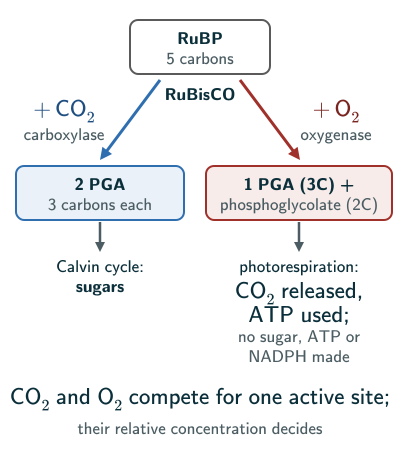
Photorespiration in C plants
- In C plants some O does bind to RuBisCO, so CO fixation is decreased (NCERT page 147).
- Instead of forming 2 molecules of PGA, RuBP binds O to form one phosphoglycerate and one phosphoglycolate (a 2-carbon compound), in the pathway called photorespiration (page 147).
- In this pathway there is neither synthesis of sugars nor of ATP; instead, CO is released and ATP is used. No ATP or NADPH is made (page 147).
NCERT says that “The biological function of photorespiration is not known yet” (page 147). Beyond the NCERT text, one role is now clear: the pathway recycles phosphoglycolate, a toxic compound, back to phosphoglycerate, which lets plants thrive in air rich in oxygen, though at a considerable cost in carbon and energy (Bauwe, Hagemann and Fernie, Trends in Plant Science, 2010). Whether it brings other benefits is still studied.
Beyond the NCERT text: photorespiration passes its products between three organelles, the chloroplast, the peroxisome and the mitochondrion; in the mitochondria two molecules of glycine give one of serine and release one CO (Wikipedia, “Photorespiration”, facts in our words). So the CO of photorespiration is released in the mitochondria. Glycerate made in the peroxisome then returns to the chloroplast and becomes 3-PGA again (Wikipedia, “Photorespiration”, facts in our words).
No photorespiration in C plants
- In C plants photorespiration does not occur, because they have a mechanism that increases the concentration of CO at the enzyme site: the C acid from the mesophyll is broken down in the bundle sheath cells to release CO (NCERT page 147).
- This high CO concentration ensures that RuBisCO works as a carboxylase, with its oxygenase activity kept to a minimum (page 147).
- Lacking photorespiration, C plants have better productivity and yields; they also tolerate higher temperatures (page 147).
Beyond the NCERT text, “does not occur” is a simplification: Wikipedia’s article “C4 carbon fixation” says C photosynthesis reduces, or suppresses, photorespiration by concentrating CO round RuBisCO (facts in our words). For exams, NCERT’s wording stands.
C and C plants compared
NCERT’s Table 11.1 asks you to compare C and C plants (page 148). The structural and biochemical rows, from NCERT pages 142–150:
| Feature | C | C |
|---|---|---|
| Calvin cycle in | mesophyll | bundle sheath |
| First carboxylation in | mesophyll | mesophyll |
| Cells fixing CO | one: mesophyll | two: mesophyll, bundle sheath |
| CO acceptor | RuBP (5C) | PEP (3C) |
| First product | PGA (3C) | OAA (4C) |
| Has RuBisCO? | yes | yes |
| RuBisCO in | mesophyll | bundle sheath |
| PEPcase in photosynthesis? | no | yes, in mesophyll |
| CO fixation in high light | low (below C) | high |
| Temperature optimum | 20–25°C | 30–40°C |
And photorespiration under different conditions:
| Photorespiration at | C | C |
|---|---|---|
| low light | negligible | negligible |
| high light | high | negligible |
| low CO | high | negligible |
| high CO | negligible | negligible |
Notes on the rows: the temperature ranges are two of the three NCERT offers as choices, assigned using its statement that C plants respond to higher temperatures while C plants have a much lower optimum (NCERT page 150). For NCERT’s row “Does the plant have PEP Case?”, write no for C plants and yes for C plants, in the sense of PEPcase used in photosynthesis. Beyond the NCERT text, C plants do carry some PEPcase, which also fixes CO (as bicarbonate, into OAA), but for jobs other than photosynthesis, such as refilling the Krebs’ cycle (Wikipedia, “Phosphoenolpyruvate carboxylase”, facts in our words). Examples: C, maize and sorghum (NCERT page 145); C, tomato and bell pepper (NCERT page 150), and wheat and rice (beyond the NCERT text). The photorespiration rows follow from competitive binding and from RuBP supply. RuBisCO can work only as fast as RuBP is regenerated, using ATP and NADPH from the light reaction (NCERT pages 142–144), so in dim light both its reactions, and with them photorespiration, are slow. In bright light RuBisCO works fast and draws down the CO inside the leaf, so in C plants more O binds; high CO outcompetes O and makes photorespiration negligible. Beyond the NCERT text, warmth also stimulates photorespiration in C plants: at higher temperatures RuBisCO tells CO and O apart less well (Wikipedia, “Photorespiration”, facts in our words), one reason C plants do better in heat. C plants keep CO high at RuBisCO, so their photorespiration stays negligible in every row.
Solved examples
Example 1: More carboxylation in C plants (NCERT Exercise 4)
RuBisCO acts both as a carboxylase and as an oxygenase. Why does it carry out more carboxylation in C plants?
Answer: CO and O compete for RuBisCO’s active site, and their relative concentrations decide which binds. In C plants, C acids from the mesophyll release CO inside the bundle sheath cells, where RuBisCO is, raising the CO concentration there. So CO wins, RuBisCO works as a carboxylase, and its oxygenase activity is minimised (NCERT page 147).
Example 2: Counting the carbons
Show the carbon bookkeeping of RuBisCO’s two reactions.
Answer: carboxylase: RuBP (5 carbons) + CO (1) = 6 carbons = 2 PGA × 3. Oxygenase: RuBP (5) + O (no carbon) = 5 carbons = 1 phosphoglycerate (3) + 1 phosphoglycolate (2). The oxygenase reaction fixes no carbon at all, and the phosphoglycolate route then releases CO (NCERT page 147).
Example 3: Why so much RuBisCO? (NCERT page 147)
NCERT asks why RuBisCO is the most abundant enzyme in the world. Suggest a reason.
Answer: NCERT leaves this open. Beyond the NCERT text: almost all carbon fixation on land runs through RuBisCO, and RuBisCO is a slow enzyme. Even at its best, at 25°C, an active site fixes only about 3 CO per second. In the wild, averaged over nights, shade, cold, drought and photorespiration, a land plant’s RuBisCO manages about 1 per cent of that, about one CO every half-minute (0.03 per second). So leaves need a great deal of it: RuBisCO makes up about 3 per cent of the dry mass of leaves (Bar-On and Milo, Proceedings of the National Academy of Sciences, 2019).
Example 4: What the plant loses
List what photorespiration produces and what it uses, according to NCERT.
Answer: it produces no sugar, no ATP and no NADPH; it releases CO and uses ATP (NCERT page 147).
Common mistakes to avoid
Common mistake
Thinking RuBisCO prefers O
RuBisCO has a much greater affinity for CO than for O (NCERT page 147). It still binds O in C plants because air holds far more O than CO (reasoned from NCERT page 147 and Chapter 14, Table 14.1, page 187).
Common mistake
Saying photorespiration makes ATP
Photorespiration uses ATP and makes neither ATP nor NADPH (NCERT page 147).
Common mistake
Thinking C plants have no RuBisCO
They have RuBisCO, in the bundle sheath cells; it is their mesophyll cells that lack it (NCERT pages 146–147).
Quick revision summary
- RuBisCO, the most abundant enzyme in the world, binds CO or O at the same active site; the binding is competitive, set by their relative concentrations.
- With O, RuBP gives one phosphoglycerate and one 2-carbon phosphoglycolate: photorespiration, in C plants, which makes no sugar, ATP or NADPH, releases CO and uses ATP.
- C plants concentrate CO at RuBisCO in the bundle sheath, so RuBisCO acts as a carboxylase and photorespiration does not occur (NCERT page 147); productivity is higher.
- NCERT’s Table 11.1 compares C and C plants: cells, acceptors, products, enzymes, light, CO and temperature.
Formula sheet
- carboxylase: RuBP + CO → 2 × 3-PGA
- oxygenase: RuBP + O → phosphoglycerate + phosphoglycolate (2C)
- photorespiration: no sugar, ATP or NADPH; CO released, ATP used
- C: high CO at RuBisCO, no photorespiration
Questions students ask
Why is photorespiration called a wasteful process?
Photorespiration is called wasteful because it spends energy to lose carbon: NCERT’s summary calls it “a wasteful oxygenation reaction”, since it fixes no CO and makes no sugar, ATP or NADPH, yet releases CO and uses ATP (NCERT pages 147 and 151). Beyond the NCERT text, the loss can be counted: one CO is released for every two O that RuBisCO adds to RuBP (Shi and Bloom, Plants, 2021), so of the 4 carbons in two phosphoglycolates, 1 is lost and 3 return to the Calvin cycle as phosphoglycerate, at a further cost in ATP.
Why is photorespiration called the C cycle, and is it in the NEET syllabus?
Photorespiration is called the C cycle because it begins with a 2-carbon compound, the phosphoglycolate that RuBP forms, with one phosphoglycerate, when RuBisCO binds O (NCERT page 147); the name, like its other name, the oxidative photosynthetic carbon cycle (Wikipedia, “Photorespiration”, facts in our words), is beyond the NCERT text, which calls it the photorespiratory pathway. Photorespiration is in the NEET (UG) 2026 syllabus, whose Unit 4 lists “Photorespiration C3 and C4 pathways”, but the syllabus does not name the C cycle. NCERT’s account is the core to learn: RuBisCO’s oxygenase reaction, phosphoglycolate, the release of CO with the use of ATP, and why C plants avoid it.
What is the difference between photorespiration and respiration?
Photorespiration and respiration both take up O and give out CO, but respiration releases energy and photorespiration costs it: respiration oxidises food in the cytoplasm and mitochondria and traps the energy as ATP (NCERT Chapter 12, page 154), while photorespiration makes no ATP and uses it (NCERT page 147). Photorespiration, which starts when RuBisCO binds O in C plants, needs light, since its RuBP comes from a Calvin cycle run on the light reaction’s ATP and NADPH (NCERT pages 142–147); respiration goes on in all living cells, green or not (NCERT Chapter 12, page 153). Beyond the NCERT text, photorespiration passes through peroxisomes and mitochondria, but is a separate pathway.
What is the difference between RuBisCO and PEPcase?
RuBisCO and PEPcase are the two CO-fixing enzymes of photosynthesis: RuBisCO adds CO to the 5-carbon RuBP to give two molecules of 3-PGA, while PEPcase adds it to the 3-carbon PEP to give the 4-carbon OAA, in the mesophyll cells of C plants (NCERT pages 143 and 146–147). The difference that matters for photorespiration is that RuBisCO’s active site can also bind O, while O does not interfere with PEPcase (beyond the NCERT text; Wikipedia, “C4 carbon fixation”, facts in our words). So the C mesophyll captures CO without that loss and hands it to RuBisCO in the bundle sheath at a high concentration.
Does photorespiration have any use for the plant?
Photorespiration has no function that NCERT recognises: it says “The biological function of photorespiration is not known yet” (NCERT page 147), and that is the answer to give in exams. Beyond the NCERT text, one role is now clear: the pathway is a salvage route that turns phosphoglycolate, which is toxic to the plant, back into phosphoglycerate for the Calvin cycle, so C plants could not grow in normal air without it (Bauwe, Hagemann and Fernie, Trends in Plant Science, 2010). Other benefits, such as protection in very strong light, are still being studied.
Practice questions
Try each question first, then open the answer to check your working.
-
Q1. Which two molecules compete for the active site of RuBisCO?
Show answerHide answer
CO and O (NCERT page 147).
-
Q2. How many carbon atoms does phosphoglycolate have?
Show answerHide answer
Two (NCERT page 147).
-
Q3. In which group of plants does photorespiration occur, according to NCERT?
Show answerHide answer
In C plants; it does not occur in C plants (NCERT page 147).