Photosynthetic pigments
NCERT Class 11 Biology Chapter 11 Section 11.4
Quick answer
NCERT describes four main leaf-pigment bands: chlorophyll a, chlorophyll b, xanthophylls and carotenoids; xanthophylls are themselves a class of carotenoids. Chlorophyll a is the chief pigment, absorbing strongly in blue and red light. Accessory pigments widen light absorption and protect against photo-oxidation; the action spectrum measures photosynthetic activity rather than absorption by one pigment.
With your textbook
NCERT Biology (Class 11), Chapter 11 “Photosynthesis in Higher Plants”, Section 11.4 “How Many Types of Pigments Are Involved in Photosynthesis?”, pages 137–138.
Open the official NCERT chapter (PDF, 2.7 MB, ncert.nic.in) (opens in a new tab)
Checked against the 2026-27 reprint on .
Pigments in photosynthesis
Photosynthetic pigments
Pigments are substances that can absorb light at specific wavelengths. NCERT groups the principal photosynthetic pigments of a green leaf into four chromatogram labels: chlorophyll a, chlorophyll b, xanthophylls and carotenoids (NCERT page 137). Of these, chlorophyll a does the main work:
Hence, we can conclude that chlorophyll a is the chief pigment associated with photosynthesis.
NCERT Biology (Class 11), Section 11.4, page 137
In plain words: a leaf is a team of light-catchers. Chlorophyll a is the captain, catching mostly blue and red light. The other pigments catch colours that chlorophyll a misses and pass the energy on to it, and they also shield it from damage by too much light.
Paper chromatography of leaf pigments
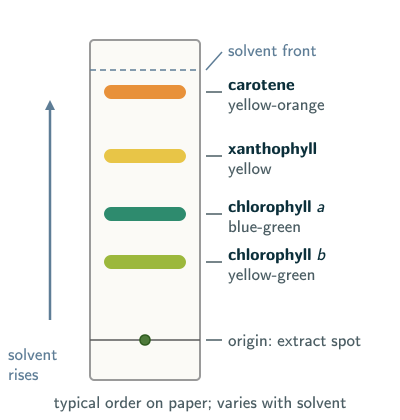
Leaves show many shades of green, even on the same plant. To see why, the leaf pigments can be separated by paper chromatography. NCERT describes four main pigment bands or groups, rather than four individual chemical species (page 137):
| Pigment | Colour in the chromatogram |
|---|---|
| chlorophyll a | bright or blue green |
| chlorophyll b | yellow green |
| xanthophylls | yellow |
| carotenoids | yellow to yellow-orange |
A note on the names: the carotenoids are a family with two classes, the carotenes and the xanthophylls (Science in School, 2019); NCERT itself lists “carotenoid pigments like carotene, xanthophylls and others” (Chapter 8, page 97). So the xanthophylls are themselves carotenoids, and the yellow-orange band that NCERT calls “carotenoids” is the carotene band. In an NCERT-based question, use NCERT’s four names.
How the separation works, beyond the NCERT text: a spot of leaf extract is placed on a pencil line near the bottom of a paper strip, and the lower end of the strip is dipped in a solvent, such as petroleum ether and acetone (9:1), with the spot kept above the solvent surface. As the solvent rises, each pigment is carried up at its own speed, so the pigments separate into bands. On a typical paper chromatogram the order from the top is carotene, xanthophyll, chlorophyll a and chlorophyll b (Mohanlal Sukhadia University, Udaipur, practical notes); on silica thin-layer plates the xanthophylls run below the chlorophylls (Science in School, 2019), so the order depends on the paper or plate and the solvent. These flammable solvents require a supervised laboratory set-up away from ignition sources.
Absorption spectrum and action spectrum
- An absorption spectrum shows how much light of each wavelength a pigment absorbs. NCERT Figure 11.3a gives the absorption spectra of chlorophyll a, chlorophyll b and the carotenoids (page 137).
- An action spectrum shows the rate of photosynthesis, measured by the release of O, at each wavelength (NCERT Figure 11.3b, page 137).
- Chlorophyll a absorbs most in the blue and the red regions, and these are also the wavelengths with the higher rates of photosynthesis. That is why chlorophyll a is taken to be the chief pigment (page 137).
- But the two spectra do not overlap one-to-one (NCERT Figure 11.3c). Most photosynthesis takes place in the blue and red regions, yet some takes place at the other wavelengths of the visible spectrum too (page 138).
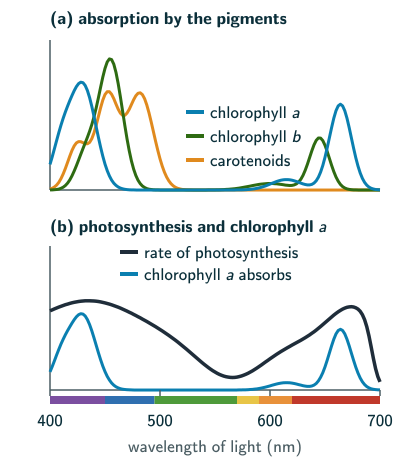
Beyond the NCERT text: in NCERT Figure 11.3c photosynthesis falls away steeply above about 680 nm, although chlorophyll a still absorbs some light there. Measured per unit of light absorbed (the quantum yield), photosynthesis drops sharply in this far-red light; this is called the red drop (Emerson and Lewis, American Journal of Botany, 1943). NCERT notes that cyclic photophosphorylation also occurs when only light beyond 680 nm is available (Section 11.6.2, page 140).
Chlorophyll a and accessory pigments
Chlorophyll is the major pigment responsible for trapping light. The other pigments of the thylakoids, chlorophyll b, xanthophylls and carotenoids, are called accessory pigments (NCERT page 138; for the thylakoids, see plastids). They:
- absorb light and transfer the energy to chlorophyll a;
- let the plant use a wider range of wavelengths of the incoming light for photosynthesis; and
- protect chlorophyll a from photo-oxidation (page 138).
In each photosystem the reaction centre is a single chlorophyll a molecule in NCERT’s account (beyond the NCERT text, a pair of chlorophyll a molecules, as the light reaction topic explains), and all the other pigments form the light-harvesting antenna. The reaction-centre chlorophyll a absorbs at 680 nm in PS II (P680) and at 700 nm in PS I (P700), a little beyond the red peak in NCERT Figure 11.3a (NCERT Section 11.5, page 138).
This is why the action spectrum is broader than the absorption spectrum of chlorophyll a alone: light absorbed by the accessory pigments, for example in the blue-green region where the carotenoids absorb strongly, still drives photosynthesis.
Why leaves look green, beyond the NCERT text: the chlorophylls absorb red and blue light strongly and green light much less (NCERT Figure 11.3a), so more of the green light is reflected, and green is the colour that reaches our eyes (Science in School, 2019).
Solved examples
Example 1: Reading NCERT Figure 11.3a (NCERT page 137)
At which wavelength (colour of light) does chlorophyll a show maximum absorption? Does it show another absorption peak, and where?
Answer: read from the graph, chlorophyll a has its highest peak in the blue-violet, a little above 420 nm, and a second, lower peak in the red, at about 665 nm: “the blue and the red regions” (page 137).
Example 2: One-to-one overlap? (NCERT page 137)
Is there a complete one-to-one overlap between the absorption spectrum of chlorophyll a and the action spectrum of photosynthesis?
Answer: no. Photosynthesis is highest in the blue and red regions, where chlorophyll a absorbs most, but it also takes place at wavelengths that chlorophyll a absorbs poorly. The accessory pigments absorb that light and transfer the energy to chlorophyll a (NCERT pages 137–138).
Example 3: The most abundant plant pigment (NCERT page 137)
NCERT asks you to guess the most abundant plant pigment in the world. What is the usual answer, and why?
Answer: NCERT leaves the question open. The usual answer is chlorophyll a. It is the chief pigment of photosynthesis (page 137), and it is found in every green plant, in all three classes of algae and in the cyanobacteria, whereas among the algae NCERT lists chlorophyll b only for the green algae (NCERT Chapter 3, Table 3.1, page 27; Chapter 2, page 13).
Example 4: Rf values (beyond the NCERT text)
On a paper chromatogram the solvent travels 10.0 cm. The carotene band moves 9.5 cm and the chlorophyll b band 4.0 cm. Find their Rf values. (Rf, the retention factor, is the distance moved by a pigment divided by the distance moved by the solvent.)
Answer: carotene: 9.5 ÷ 10.0 = 0.95; chlorophyll b: 4.0 ÷ 10.0 = 0.40. The larger the Rf, the farther up the paper the pigment travels. The numbers here are illustrative.
Example 5: Two jobs of the accessory pigments
Give two ways in which accessory pigments help photosynthesis.
Answer: they let a wider range of wavelengths be used, by absorbing light and passing the energy to chlorophyll a, and they protect chlorophyll a from photo-oxidation (NCERT page 138).
Common mistakes to avoid
Common mistake
Mixing up the two spectra
The absorption spectrum is about a pigment (how much light it absorbs); the action spectrum is about the process (how fast photosynthesis runs) at each wavelength (NCERT page 137).
Common mistake
Saying no photosynthesis happens in green light
NCERT’s schematic shows a lower rate in the green region, not zero (page 138). This is not a universal ranking for intact leaves: experiments found that additional green light can drive photosynthesis efficiently in strong white light because it penetrates deeper into the leaf (Terashima and others, Plant and Cell Physiology, 2009).
Common mistake
Thinking accessory pigments work on their own
They pass the energy they absorb to chlorophyll a; chlorophyll a remains the chief pigment (NCERT pages 137–138).
Quick revision summary
- Pigments absorb light at specific wavelengths; NCERT’s paper chromatogram describes four main labels: chlorophyll a (blue green), chlorophyll b (yellow green), xanthophylls (yellow) and carotenoids (yellow to yellow-orange).
- Chlorophyll a absorbs most in the blue and red regions, where photosynthesis is also highest, so it is the chief pigment.
- The action spectrum and the chlorophyll a absorption spectrum do not overlap one-to-one: some photosynthesis happens at other wavelengths.
- Accessory pigments (chlorophyll b, xanthophylls, carotenoids) absorb light, pass the energy to chlorophyll a, widen the usable wavelengths and protect chlorophyll a from photo-oxidation.
Formula sheet
- chief pigment: chlorophyll a
- accessory pigments: chlorophyll b, xanthophylls, carotenoids
- chlorophyll a absorbs most: blue and red
- Rf = distance moved by pigment ÷ distance moved by solvent
Questions students ask
What is the difference between chlorophyll a and chlorophyll b?
Chlorophyll a is the chief pigment of photosynthesis, while chlorophyll b is an accessory pigment that absorbs light and transfers the energy to chlorophyll a (NCERT pages 137–138). In a paper chromatogram chlorophyll a is bright or blue green and chlorophyll b yellow green, and only chlorophyll a forms the reaction centres, P700 and P680 (NCERT pages 137–138). Chemically, beyond the NCERT text, they differ in one side group: chlorophyll b has a formyl group (–CHO) where chlorophyll a has a methyl group (–CH) (Schliep and others, Plant, Cell & Environment, 2013), which makes chlorophyll b more polar, so it runs below chlorophyll a on a typical paper chromatogram.
What is the difference between carotenoids, carotenes and xanthophylls?
Carotenoids are a family of yellow, orange or red pigments with two classes: the carotenes, which are hydrocarbons, made of carbon and hydrogen only, and the xanthophylls, which are oxygenated derivatives (beyond the NCERT text; Petibon and Wiesenberg, Frontiers in Plant Science, 2022). So the xanthophylls are themselves carotenoids, and when NCERT’s leaf chromatogram lists xanthophylls (yellow) and carotenoids (yellow to yellow-orange) separately, its “carotenoids” band is the carotenes (page 137). Both kinds are accessory pigments: they absorb light that chlorophyll a absorbs poorly, pass the energy to it and protect it from photo-oxidation (NCERT page 138).
How do accessory pigments protect chlorophyll a from photo-oxidation?
Accessory pigments, chiefly the carotenoids, protect chlorophyll a from photo-oxidation by taking away excess light energy before it can do harm; NCERT states only that they “protect chlorophyll a from photo-oxidation” (page 138). Beyond the NCERT text, in strong light an excited chlorophyll that cannot pass its energy on can turn into a long-lived triplet state, which hands its energy to oxygen and forms singlet oxygen, a highly reactive form that destroys pigments and damages the thylakoid membranes. Carotenoids quench this triplet chlorophyll and also scavenge singlet oxygen, losing the energy harmlessly as heat (Young, Physiologia Plantarum, 1991).
Where are the photosynthetic pigments located in a chloroplast?
The photosynthetic pigments are located in the thylakoid membranes of the chloroplast: NCERT says chlorophyll pigments are present in the thylakoids (Chapter 8, page 98) and calls chlorophyll b, xanthophylls and carotenoids “thylakoid pigments” (page 138). There they are bound to proteins in two light harvesting complexes, within Photosystem I and Photosystem II (NCERT page 138; see light harvesting complexes). Cyanobacteria have no chloroplasts. NCERT Chapter 8 calls pigment-containing prokaryotic membranes chromatophores (page 91); modern cyanobacterial terminology usually calls their photosynthetic membranes thylakoids. Do not equate them with mesosomes, the historical structures discussed in the prokaryotic-cell lesson.
Practice questions
Try each question first, then open the answer to check your working.
-
Q1. What colour is chlorophyll b in a chromatogram of leaf pigments?
Show answerHide answer
Yellow green (NCERT page 137).
-
Q2. What does an action spectrum of photosynthesis plot against wavelength?
Show answerHide answer
The rate of photosynthesis, measured by O release (NCERT Figure 11.3b, page 137).
-
Q3. Name the accessory pigments.
Show answerHide answer
Chlorophyll b, xanthophylls and carotenoids (NCERT page 138).