Factors affecting photosynthesis
NCERT Class 11 Biology Chapter 11 Section 11.10
Quick answer
Photosynthesis depends on light, CO, temperature, water and internal features such as leaf structure and chlorophyll. In Blackman’s limiting-factor model, improving the most restrictive factor raises the rate until another factor limits it. NCERT’s light and CO saturation figures are simplified reference values; actual responses depend on species and conditions.
With your textbook
NCERT Biology (Class 11), Chapter 11 “Photosynthesis in Higher Plants”, Section 11.10 “Factors affecting Photosynthesis”, pages 149–150.
Open the official NCERT chapter (PDF, 2.7 MB, ncert.nic.in) (opens in a new tab)
Checked against the 2026-27 reprint on .
Factors affecting photosynthesis
Factors affecting photosynthesis
The rate of photosynthesis, which largely decides the yield of crop plants, depends on several internal (plant) factors and external factors acting together. In the simple limiting-factor model, the most restrictive factor relative to the plant’s needs sets the rate (NCERT page 149). This idea is Blackman’s (1905) Law of Limiting Factors:
If a chemical process is affected by more than one factor, then its rate will be determined by the factor which is nearest to its minimal value: it is the factor which directly affects the process if its quantity is changed.
NCERT Biology (Class 11), Section 11.10, page 149
In plain words: photosynthesis is like a factory line with several supplies: light, CO, water and a working temperature. Output can go only as fast as the scarcest supply allows. Add more of a supply that is already plentiful and nothing changes; add more of the one that is running short and the rate rises, until something else runs short.
Internal and external factors
- Internal (plant) factors: the number, size, age and orientation of leaves; the mesophyll cells and chloroplasts; the internal CO concentration; and the amount of chlorophyll. They depend on the plant’s genetic predisposition and growth (NCERT page 149).
- External factors: the availability of sunlight, temperature, CO concentration and water (page 149).
- All these factors act together, but usually one is the major cause, the one that limits the rate. At any point the rate is set by the factor available at sub-optimal levels (page 149).
Blackman’s law of limiting factors
Blackman’s law (1905) says that when several factors affect a biochemical process, its rate is set by the factor nearest to its minimal value: changing the quantity of that factor directly changes the rate (NCERT page 149).
NCERT’s example: a green leaf with optimal light and CO may still not photosynthesise if the temperature is very low; given the optimal temperature, it starts (page 149). Here temperature is the limiting factor. “Nearest its minimum” means most restrictive relative to requirements, not the smallest numerical measurement across unrelated units. Warming helps only toward a suitable optimum; beyond it, more heat reduces the rate. Real plants can also be co-limited by several interacting factors.
Light
- Light as a factor has three aspects: quality, intensity and duration of exposure (NCERT page 149).
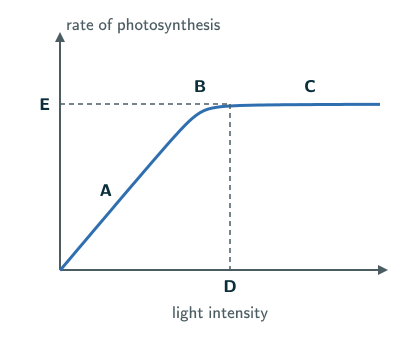
- At low light intensities, the rate of CO fixation rises linearly with incident light. At higher intensities the rate gradually stops rising, because other factors become limiting (page 149).
- NCERT notes that light saturation occurs at 10 per cent of full sunlight, so, except for plants in shade or in dense forests, light is rarely a limiting factor in nature (page 149).
- Increasing the incident light beyond a point causes the breakdown of chlorophyll and a decrease in photosynthesis (NCERT page 150).
Beyond the NCERT text, the 10 per cent figure is low for most leaves. A single leaf usually saturates at 500–1000 µmol of photons per square metre per second, a quarter to a half of full sunlight (about 2000), and because leaves shade one another, a whole plant is only rarely light-saturated (Taiz and Zeiger, Plant Physiology, 5th edition, 2010). NCERT itself says C plants respond to high light intensities (page 145). Use 10 per cent when a question explicitly asks for NCERT’s stated figure; it is not a universal saturation threshold.
Carbon dioxide concentration
- CO is the major limiting factor for photosynthesis. Its concentration in the atmosphere is very low, between 0.03 and 0.04 per cent. Raising it to about 0.05 per cent can increase the rate of CO fixation; beyond that, the levels can become damaging over longer periods (NCERT page 150).
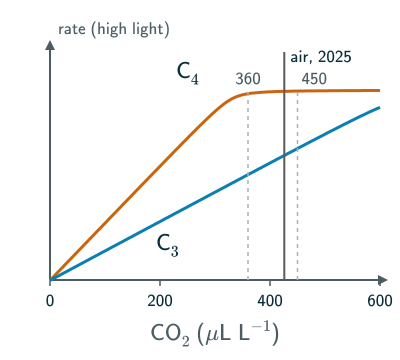
- C and C plants respond differently. At low light, neither responds to high CO. At high light, both photosynthesise faster. But C plants saturate at about 360 µL L, while C plants keep responding and saturate only beyond 450 µL L. So the current CO level is limiting to C plants (page 150).
- Growers use this: greenhouse crops such as tomatoes and bell pepper, both C plants, are grown in a CO-enriched atmosphere for higher yields (page 150).
Beyond the NCERT text: 0.05 per cent is not a universal toxicity threshold. Ontario’s agricultural guidance describes greenhouse enrichment calculations at 1300 ppm (0.13 per cent), well above that figure. Suitable enrichment depends on crop, light, temperature and ventilation (Ontario Ministry of Agriculture, Food and Agribusiness, Supplemental carbon dioxide in greenhouses). Separate NCERT’s stated values from practical crop recommendations; neither every C crop nor every growth condition has the same response.
Beyond the NCERT text: CO has risen past NCERT’s range. Its global average was about 426 µL L, or 0.043 per cent, in 2025 (NOAA Global Monitoring Laboratory). NOAA’s 2025 value is 425.62 ppm, rounded here to 426. Many C plants remain responsive to extra CO under suitable conditions, but comparing one atmospheric value with 450 µL L does not establish a universal saturation threshold; the response depends on the plant and environment.
Temperature
- The dark reactions are enzymatic, so they are controlled by temperature. The light reactions are also temperature-sensitive, but affected much less (NCERT page 150; see how temperature affects enzymes).
- C plants respond to higher temperatures with higher rates of photosynthesis, while C plants have a much lower temperature optimum (page 150).
- The temperature optimum also depends on habitat: tropical plants have a higher optimum than plants adapted to temperate climates (page 150).
Water
- Water is a reactant in the light reaction, but its effect as a factor works mostly through the plant, not directly on photosynthesis (NCERT page 150).
- Water stress closes the stomata, cutting the supply of CO. It also makes leaves wilt, which reduces their surface area and their metabolic activity (page 150).
Solved examples
Example 1: Reading NCERT Figure 11.10 (NCERT Exercise 8)
In NCERT Figure 11.10: (a) At which point or points (A, B or C) is light a limiting factor? (b) What could be the limiting factor in region A? (c) What do C and D represent?
Answer: (a) at A, where the rate rises in step with light intensity; light still partly limits at B, where the rate is still rising, but more slowly, as other factors begin to limit. (b) Light intensity: in region A, more light gives a proportionally higher rate. (c) C is the plateau, where more light no longer raises the rate because other factors, such as CO or temperature, have become limiting; D is the light intensity at which the rate reaches its maximum, E, the light saturation point (NCERT page 149).
Example 2: Which factor limits? (Blackman’s law)
A leaf in bright light at 30°C photosynthesises at a steady rate. Raising the light further changes nothing, but enriching the air with CO raises the rate. What was the limiting factor, and why?
Answer: CO. By Blackman’s law, the rate is set by the factor nearest its minimal value, the one that changes the rate when its quantity is changed. Extra light had no effect, so light was not limiting; extra CO raised the rate, so CO was (NCERT page 149). NCERT also calls CO the major limiting factor (page 150).
Example 3: Units of CO
Convert NCERT’s atmospheric range of 0.03 to 0.04 per cent into µL L, and compare it with the C saturation point.
Answer: 1 per cent = 10 000 µL L, so 0.03 per cent = 300 µL L and 0.04 per cent = 400 µL L. The C saturation point of about 360 µL L lies inside that range, while the C point, beyond 450 µL L, lies above it: so CO in air limits C plants (NCERT page 150).
Example 4: Only chlorophyll b? (NCERT Exercise 5)
Suppose a plant had plenty of chlorophyll b but no chlorophyll a. Would it carry out photosynthesis? Then why do plants have chlorophyll b and other accessory pigments?
Answer: no. The reaction centres of both photosystems, P680 and P700, are chlorophyll a (NCERT page 138); accessory pigments can only absorb light and pass the energy on to chlorophyll a (page 138). Without chlorophyll a there is nothing to use that energy. Plants have chlorophyll b and other accessory pigments so that a wider range of wavelengths can be used, and to protect chlorophyll a from photo-oxidation (page 138).
Example 5: Leaves in the dark (NCERT Exercise 6)
Why does a leaf kept in the dark often turn yellow or pale green? Which pigment do you think is more stable?
Answer: beyond the NCERT text: in the dark the leaf’s chlorophyll breaks down and is not replaced, since flowering plants need light to make chlorophyll, so the yellow pigments that the green had masked, the xanthophylls (yellow) and carotenoids (yellow to yellow-orange) of NCERT page 137, now show. They are therefore the more stable pigments.
Example 6: Sun and shade leaves (NCERT Exercise 7)
Compare leaves on the shady side of a plant with those on the sunny side, or potted plants in shade with those in sunlight. Which have darker green leaves, and why?
Answer: shade leaves often look darker green, an adaptation that helps capture scarce light. This does not mean ordinary sun leaves are damaged: sun and shade leaves differ in thickness and pigment organisation. Beyond NCERT, measurements commonly find more chlorophyll per dry mass in shade leaves but more per leaf area in sun leaves, so “more chlorophyll” needs a stated basis (Lichtenthaler and others, Photosynthesis Research, 1981). Excess light can damage pigments, but that is distinct from normal acclimation (NCERT page 150).
Common mistakes to avoid
Common mistake
Adding more of everything
Increasing a factor that is not limiting does not raise the rate; only the limiting factor does (NCERT page 149).
Common mistake
Expecting C plants to gain much from CO enrichment
C plants saturate at about 360 µL L, so CO beyond that does little for them; it is C plants that keep responding (NCERT page 150).
Common mistake
Mixing up Blackman and Liebig
The law of limiting factors for photosynthesis is Blackman’s (1905; NCERT page 149). Beyond the NCERT text, Liebig’s law of the minimum (1840) is an older rule about the scarcest plant nutrient (A Dictionary of Plant Sciences, Oxford University Press), a common wrong option.
Common mistake
Treating water as a direct limit
Water acts mostly through the plant, by closing stomata and wilting leaves, rather than as a reactant running short (NCERT page 150).
Quick revision summary
- Internal factors: number, size, age and orientation of leaves, mesophyll cells and chloroplasts, internal CO and chlorophyll; external factors: light, temperature, CO and water.
- Blackman’s law (1905): the rate is set by the factor nearest its minimal value.
- Light: linear rise at low intensity, saturation at 10 per cent of full sunlight (NCERT’s figure); too much light breaks down chlorophyll.
- CO: the major limiting factor; C plants saturate at about 360 µL L, C plants beyond 450 µL L, so CO limits C plants; greenhouse tomatoes and bell pepper gain from extra CO.
- Temperature: the enzymatic dark reactions are temperature-controlled; C plants have higher optima than C plants, tropical plants than temperate ones.
- Water: water stress closes stomata and wilts leaves.
Formula sheet
- rate set by the factor nearest its minimum (Blackman, 1905)
- light saturation: 10 per cent of full sunlight (NCERT’s figure)
- NCERT CO figures: C about 360 µL L, C beyond 450 µL L
- 1 per cent = 10 000 µL L
Questions students ask
Can you give a real-life example of the law of limiting factors?
A C leaf at dawn shows the law of limiting factors at work: light is then the factor nearest its minimal value, so enriching the air with CO does not raise the rate, and NCERT notes that at low light neither C nor C plants respond to high CO (NCERT pages 149–150). As the sun climbs, the rate rises with the light until another factor becomes limiting, and for C plants that may be CO, since current CO levels limit them (NCERT page 150). So the same extra CO that did nothing at dawn raises the rate in bright light: what limits the rate is whichever factor is in shortest supply at that moment.
What is the difference between the light compensation point and the light saturation point?
The light saturation point is the light intensity beyond which the rate of photosynthesis stops rising, because other factors have become limiting (NCERT page 149), while the light compensation point is a much lower intensity at which photosynthesis just balances respiration, so the leaf’s net CO uptake is zero (beyond the NCERT text; Taiz and Zeiger, Plant Physiology, 5th edition, 2010). Below the compensation point a leaf gives out more CO in respiration than it fixes; between the two points the rate rises with light; above saturation, more light adds nothing, and beyond a point it breaks down chlorophyll (NCERT page 150).
Why is CO the major limiting factor for photosynthesis?
CO is the major limiting factor for photosynthesis because there is so little of it in the air, between 0.03 and 0.04 per cent by NCERT’s figure, while C plants keep responding to more CO until beyond 450 µL L, so the current CO level limits them (NCERT page 150). Beyond the NCERT text, CO was about 0.043 per cent (about 426 µL L) in 2025 (NOAA). This dated atmospheric measurement should not be confused with a universal biological saturation point. The shortage hurts in a second way: in C plants, O, which is far more plentiful in air (NCERT Chapter 14, Table 14.1), competes with CO for RuBisCO’s active site and starts photorespiration (NCERT page 147).
Why does photosynthesis slow down at very high temperatures?
Photosynthesis slows down at very high temperatures mainly because its dark reactions are enzymatic and so temperature-controlled, while the light reactions are affected much less (NCERT page 150); sufficiently severe heat can destroy enzyme activity by denaturing proteins (NCERT Chapter 9, page 116; see how temperature affects enzymes). Beyond the NCERT text, heat also raises photorespiration in C plants, one reason C plants keep higher rates in hot weather (Taiz and Zeiger, Plant Physiology, 5th edition, 2010). A fall above the photosynthetic optimum does not prove that all enzymes have irreversibly denatured; several metabolic and stomatal responses can reduce the rate. Hot, dry spells also cause water stress, which closes the stomata and cuts the CO supply (NCERT page 150).
Practice questions
Try each question first, then open the answer to check your working.
-
Q1. Name the four external factors that affect photosynthesis.
Show answerHide answer
Sunlight, temperature, CO concentration and water (NCERT page 149).
-
Q2. In which year did Blackman state his Law of Limiting Factors?
Show answerHide answer
1905 (NCERT page 149).
-
Q3. Which reactions of photosynthesis are more strongly controlled by temperature, and why?
Show answerHide answer
The dark reactions, because they are enzymatic (NCERT page 150).