Calvin cycle
NCERT Class 11 Biology Chapter 11 Section 11.7
Quick answer
The Calvin cycle uses ATP and NADPH to fix CO in the chloroplast stroma. RuBisCO carboxylates RuBP to two 3-PGA; reduction forms triose phosphate, and regeneration restores RuBP. Each CO needs 3 ATP and 2 NADPH, so six turns provide a six-carbon sugar equivalent at a cost of 18 ATP and 12 NADPH.
With your textbook
NCERT Biology (Class 11), Chapter 11 “Photosynthesis in Higher Plants”, Section 11.7 “Where are the ATP and NADPH Used?”, pages 142–145.
Open the official NCERT chapter (PDF, 2.7 MB, ncert.nic.in) (opens in a new tab)
Checked against the 2026-27 reprint on .
Where ATP and NADPH are used
The Calvin cycle
The ATP and NADPH made in the light reaction drive the synthesis of sugars from CO and water in the stroma. This is the biosynthetic phase of photosynthesis, and its pathway is the Calvin cycle (NCERT pages 142–143).
Calvin and his co-workers then worked out the whole pathway and showed that the pathway operated in a cyclic manner; the RuBP was regenerated.
NCERT Biology (Class 11), Section 11.7.2, page 143
In plain words: the Calvin cycle is a carousel that picks up one CO at a time. The CO is clipped onto a five-carbon sugar, RuBP, and the six-carbon product at once splits into two three-carbon pieces, PGA. ATP and NADPH turn PGA into sugar. Most of that sugar is used to rebuild RuBP, so the carousel can keep turning; six turns fix six carbons, enough for one glucose.
The biosynthetic phase
- The products of the light reaction are ATP, NADPH and O. The O diffuses out of the chloroplast, while ATP and NADPH drive the synthesis of food, more accurately sugars: this is the biosynthetic phase of photosynthesis (NCERT page 142).
- It does not directly depend on light, but on the products of the light reaction, ATP and NADPH, besides CO and HO (page 142).
- How this is known: immediately after light becomes unavailable, the biosynthetic process continues for some time and then stops; when light is made available again, the synthesis starts again (page 142).
C and C pathways: PGA and OAA
- Just after the Second World War, Melvin Calvin used radioactive C in studies of algal photosynthesis and found that the first product of CO fixation is a 3-carbon organic acid, 3-phosphoglyceric acid (PGA) (NCERT page 142). Unlike the heavy oxygen, O, a stable isotope used to show that the O comes from water (beyond the NCERT text), C really is a radioactive isotope. NCERT’s profile of Calvin at the start of the chapter notes that mapping this pathway earned him the Nobel Prize in 1961 (page 132); beyond the NCERT text, it was the Nobel Prize in Chemistry.
- In another group of plants, the first stable product of CO fixation is a 4-carbon organic acid, oxaloacetic acid (OAA) (page 143).
- So CO assimilation is of two main types: the C pathway, with PGA as the first product, and the C pathway, with OAA as the first product (page 143).
The primary acceptor of CO
If fixing one CO gives a 3-carbon product, the scientists reasoned, the acceptor must have 2 carbons. They spent many years searching for a 2-carbon compound. Very unexpectedly, the acceptor turned out to be a 5-carbon ketose sugar, ribulose bisphosphate (RuBP) (NCERT page 143).
The arithmetic works because the 6-carbon result of 5 + 1 at once gives two molecules of the 3-carbon PGA (page 143).
The Calvin cycle
Calvin’s pathway runs in a cycle that regenerates RuBP, and it occurs in all photosynthetic plants, whether they have C or C (or any other) pathways (NCERT page 143). It has three stages (NCERT pages 143–144):
- Carboxylation: the fixation of CO into a stable organic intermediate, the most crucial step of the cycle. CO is used to carboxylate RuBP, catalysed by the enzyme RuBP carboxylase, giving two molecules of 3-PGA. Because the enzyme also has an oxygenation activity, it is more correctly called RuBP carboxylase-oxygenase, or RuBisCO.
- Reduction: a series of reactions that lead to the formation of glucose, using 2 ATP for phosphorylation and 2 NADPH for reduction per CO fixed. Six CO must be fixed, in 6 turns of the cycle, to make one molecule of glucose.
- Regeneration: the CO acceptor, RuBP, is re-formed so that the cycle can continue; this needs 1 ATP per CO.
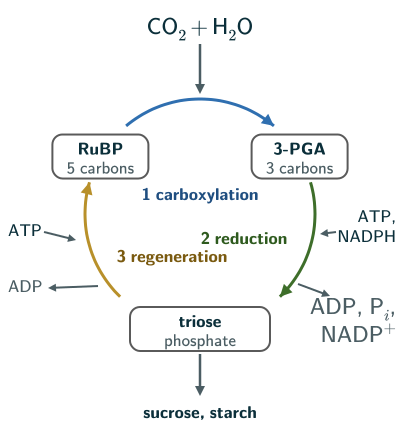
NCERT Figure 11.8 shows the reduction stage making triose phosphate, a 3-carbon sugar phosphate. The cycle exports a net triose-phosphate product; “one glucose” is a six-carbon accounting equivalent, not a direct reaction product of the cycle. From triose phosphates, sucrose and starch are made (page 144).
ATP and NADPH for one glucose
- For every CO that enters the cycle, 3 ATP and 2 NADPH are needed (NCERT page 145): 2 ATP and 2 NADPH in reduction, and 1 ATP in regeneration.
- The cycle uses more ATP than NADPH. NCERT suggests that cyclic photophosphorylation, which makes ATP but no NADPH, probably takes place to meet this difference (page 145).
- One glucose needs 6 turns of the cycle (page 145). What goes in and what comes out (page 145):
| In | Out |
|---|---|
| 6 CO | 1 glucose |
| 18 ATP | 18 ADP |
| 12 NADPH | 12 NADP |
Solved examples
Example 1: ATP and NADPH for one glucose (NCERT page 145)
Work out how many ATP and NADPH molecules are needed to make one molecule of glucose through the Calvin pathway.
Answer: per CO: 3 ATP and 2 NADPH. One glucose (6 carbons) needs 6 CO, so 6 turns: ATP = 6 × 3 = 18; NADPH = 6 × 2 = 12 (NCERT page 145).
Example 2: Counting the carbons for one glucose
Show that the carbon atoms balance when six CO make one glucose and RuBP is regenerated.
Answer: in: 6 RuBP × 5 carbons = 30, plus 6 CO × 1 = 6, so 36 carbons. Carboxylation gives 2 PGA per CO, so 12 PGA × 3 = 36 carbons. Out: 1 glucose × 6 = 6 carbons, and 6 RuBP regenerated × 5 = 30 carbons; 6 + 30 = 36. Of the 36 carbons in the 12 PGA, only 6 (one-sixth) leave as glucose; the other 30 rebuild the 6 RuBP. This establishes a net gain of six carbons, not that each carbon in an immediately released sugar must be one of the six atoms just supplied. Carbon atoms mix through the intermediate pool as the cycle turns (carbon balance from NCERT pages 143–145).
Example 3: The 2-carbon guess (NCERT page 143)
How many carbon atoms would a molecule have which, after accepting CO, gave 3 carbons (of PGA)? Why did the guess go wrong?
Answer: the natural guess is 2 carbons (2 + 1 = 3), and scientists spent many years looking for such a compound. But the acceptor is RuBP, with 5 carbons: 5 + 1 = 6 carbons, which give two molecules of 3-carbon PGA (NCERT page 143).
Example 4: Is “dark reaction” a misnomer? (NCERT page 142)
NCERT asks whether calling the biosynthetic phase the “dark reaction” is a misnomer. What do you think?
Answer: yes, in a sense. The biosynthetic phase does not need darkness and does not run on in the dark for long: without light, it continues only for some time, until the ATP and NADPH run out, and then stops (NCERT page 142). It is not directly driven by light, but it depends on the light reaction, so “carbon reactions” or “biosynthetic phase” describe it better (NCERT pages 136 and 142).
Example 5: Why the extra ATP?
The Calvin cycle needs ATP and NADPH in the ratio 3 : 2. What does NCERT suggest supplies the extra ATP?
Answer: cyclic photophosphorylation, which makes ATP but no NADPH; NCERT says it probably takes place to meet this difference (NCERT page 145).
Common mistakes to avoid
Common mistake
Calling RuBP the first product
RuBP is the acceptor; the first stable product of CO fixation in the Calvin cycle is 3-PGA (NCERT pages 142–143).
Common mistake
Thinking C plants skip the Calvin cycle
The Calvin pathway occurs in all photosynthetic plants, C and C alike (NCERT page 143).
Common mistake
Making six glucose from six turns
Six turns of the cycle, fixing six CO, make one glucose (NCERT page 145).
Quick revision summary
- ATP and NADPH from the light reaction drive the biosynthetic phase; it continues for a while after the light goes off, then stops.
- Calvin, using C, found the first product of CO fixation to be 3-PGA (C pathway); in C plants it is OAA.
- The CO acceptor is RuBP, a 5-carbon ketose sugar; RuBisCO carboxylates it to two molecules of 3-PGA.
- Three stages: carboxylation, reduction (2 ATP + 2 NADPH per CO) and regeneration (1 ATP per CO).
- Per CO: 3 ATP and 2 NADPH; per glucose: 6 turns, 18 ATP and 12 NADPH.
Formula sheet
- RuBP (5C) + CO → 2 × 3-PGA (3C)
- per CO: 3 ATP + 2 NADPH
- per glucose: 6 CO, 6 turns, 18 ATP, 12 NADPH
- stages: carboxylation, reduction, regeneration
Questions students ask
Why is the Calvin cycle called the C cycle?
The Calvin cycle is called the C cycle because the first product of CO fixation in it is a 3-carbon acid, 3-phosphoglyceric acid (PGA); the C pathway is named the same way, after its 4-carbon first product, OAA (NCERT pages 142–143). So the C cycle, the C pathway and the Calvin cycle are one and the same: NCERT says that C plants use “the C pathway or the Calvin cycle” as their main biosynthetic pathway (NCERT page 145). Plants whose first product of CO fixation is PGA are, by the same rule, C plants (NCERT page 143).
What is the difference between RuBP and RuBisCO?
RuBP and RuBisCO are a substrate and its enzyme: RuBP, ribulose bisphosphate, is the 5-carbon ketose sugar that accepts CO in the Calvin cycle, while RuBisCO, RuBP carboxylase-oxygenase, is the enzyme that joins CO to RuBP, giving two molecules of 3-PGA (NCERT pages 143 and 147). RuBP is used up in every turn and has to be regenerated from the products of the cycle, whereas RuBisCO, like any enzyme, is not used up. The “oxygenase” in RuBisCO’s name is its second activity: its active site can also bind O, which starts photorespiration (NCERT page 147).
How is the Calvin cycle different from the Krebs’ cycle?
The Calvin cycle builds sugar and the Krebs’ cycle breaks food down: the Calvin cycle runs in the stroma of chloroplasts, fixes CO and uses ATP and NADPH from the light reaction to make sugar, while the Krebs’ cycle, or TCA cycle, runs in the mitochondrial matrix, oxidises acetyl CoA, releases CO and makes NADH, FADH and a little ATP (NCERT pages 142–145; Chapter 12, pages 158–159). In the higher plants considered here, the Calvin cycle runs in photosynthetic chloroplasts, while the TCA cycle supplies energy and metabolic intermediates in many green and non-green cells. These are not universal organism-wide rules: some chemosynthetic bacteria also use the Calvin cycle (beyond NCERT; Krueger and others, The Biological Bulletin, 1996). Both regenerate their starting molecule: RuBP in the Calvin cycle, oxaloacetic acid in the Krebs’ cycle.
What is the end product of the Calvin cycle: glucose or triose phosphate?
The sugar that the Calvin cycle itself makes is triose phosphate, a 3-carbon sugar: NCERT Figure 11.8 shows the reduction stage turning 3-phosphoglycerate into triose phosphate, from which sucrose and starch are made (NCERT page 144). Beyond the NCERT text, the cycle has one spare triose phosphate to give out for every three CO it fixes, the rest rebuilding RuBP (Taiz and Zeiger, Plant Physiology, 5th edition, 2010). Two spare triose phosphates, from six turns, hold the 6 carbons of one glucose, which is why NCERT counts what goes in and comes out of 6 turns for one glucose (NCERT page 145).
How many turns of the Calvin cycle are needed to make 3 glucose molecules?
Three glucose molecules need 18 turns of the Calvin cycle, because each turn fixes one CO and each glucose holds six carbons from CO: 3 × 6 = 18 (NCERT page 145). At NCERT’s 3 ATP and 2 NADPH per CO, that is 18 × 3 = 54 ATP and 18 × 2 = 36 NADPH. In those 18 turns, 18 RuBP are carboxylated to 36 molecules of 3-PGA and 18 RuBP are regenerated, so the stock of RuBP is unchanged.
Practice questions
Try each question first, then open the answer to check your working.
-
Q1. What is the primary acceptor of CO in the Calvin cycle?
Show answerHide answer
Ribulose bisphosphate (RuBP), a 5-carbon ketose sugar (NCERT page 143).
-
Q2. Name the enzyme that catalyses carboxylation in the Calvin cycle.
Show answerHide answer
RuBP carboxylase-oxygenase, RuBisCO (NCERT page 143).
-
Q3. How many molecules of ATP are used in the regeneration of RuBP per CO fixed?
Show answerHide answer
One (NCERT page 144).