C₄ pathway (Hatch and Slack pathway)
NCERT Class 11 Biology Chapter 11 Section 11.8
Quick answer
In C plants such as maize and sorghum, PEP carboxylase in the mesophyll cells fixes CO onto the 3-carbon PEP to form the 4-carbon OAA. C acids carry the carbon to the bundle sheath cells, where CO is released into the Calvin cycle and a 3-carbon molecule returns to regenerate PEP. This raises the CO concentration at RuBisCO, so, as NCERT says, photorespiration does not occur in C plants.
With your textbook
NCERT Biology (Class 11), Chapter 11 “Photosynthesis in Higher Plants”, Section 11.8 “The C4 Pathway”, pages 145–147.
Open the official NCERT chapter (PDF, 2.7 MB, ncert.nic.in) (opens in a new tab)
Checked against the 2026-27 reprint on .
The C pathway
C pathway
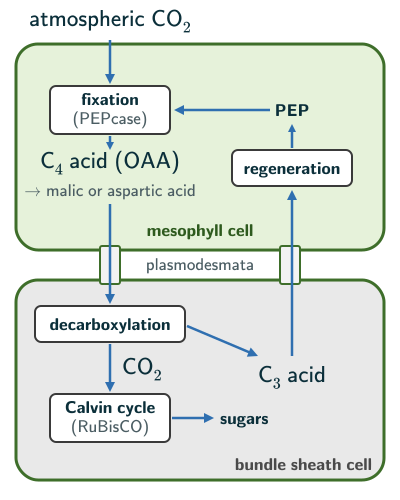
Many plants adapted to hot, bright conditions first fix CO into the 4-carbon acid OAA. They do this in their mesophyll cells, then release the CO again in the bundle sheath cells, where the Calvin cycle makes sugars (NCERT pages 145–147). The shuttle between the two cells is the Hatch and Slack pathway:
This pathway that has been named the Hatch and Slack Pathway, is again a cyclic process.
NCERT Biology (Class 11), Section 11.8, page 146
In plain words: a C plant runs a two-stage pump. The mesophyll cells grab CO with an enzyme that never mistakes it for oxygen, and pack it into a 4-carbon acid. The acid is carried inward to the bundle sheath cells, which form a ring around the vein that restricts CO leakage. There the CO is released, so it piles up around RuBisCO, and RuBisCO fixes more CO relative to O under suitable conditions.
This lesson follows NCERT’s typical two-cell, Kranz-type C model, illustrated by maize and sorghum. Anatomical and enzyme-localisation statements below refer to that model.
What makes C plants special
C plants have the C acid OAA as the first product of CO fixation, yet they use the C pathway, the Calvin cycle, as their main biosynthetic pathway (NCERT page 145). They are special in five ways (page 145):
- a special type of leaf anatomy;
- they tolerate higher temperatures;
- they respond to high light intensities;
- they lack photorespiration;
- they have greater productivity of biomass.
On the fourth point, beyond the NCERT text: gas-exchange measurements on maize, a C plant, show that photorespiration does occur, but at a low rate unless stress severely limits the CO inside the leaf (Dai, Ku and Edwards, Plant Physiology, 1993). NCERT’s own Table 11.1 (page 148) offers “negligible” as an answer for photorespiration. In an NCERT-based answer, write what NCERT page 147 says: “In C plants photorespiration does not occur”. Beyond the NCERT text: calling photorespiration in C plants strongly suppressed, or negligible under favourable conditions, states the mechanism more precisely (our reading of Dai, Ku and Edwards, 1993).
Kranz anatomy
- In C leaves, the particularly large cells around the vascular bundles are the bundle sheath cells, and leaves with this anatomy are said to have Kranz anatomy: “Kranz” means wreath, after the arrangement of the cells (NCERT page 145).
- The bundle sheath cells may form several layers around the vascular bundles. They have a large number of chloroplasts, thick walls described by NCERT as impervious to gaseous exchange and no intercellular spaces (page 145).
- Maize and sorghum are C plants whose leaf sections show Kranz anatomy; the presence of this bundle sheath helps identify C plants (page 145).
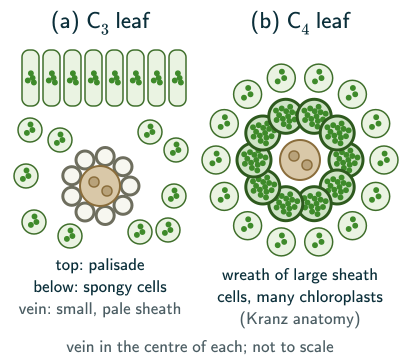
A C dicot leaf also has a bundle sheath, a layer of thick-walled cells around each vascular bundle (NCERT Chapter 6, page 77; see the dorsiventral leaf), but these are not the large, chloroplast-rich cells of Kranz anatomy, and the Calvin cycle runs in the mesophyll (NCERT page 147). Its palisade and spongy layers are a dicot feature, not a C one.
PEP carboxylase in mesophyll cells
- The primary CO acceptor in the C pathway is the 3-carbon molecule phosphoenol pyruvate (PEP), present in the mesophyll cells (NCERT page 146).
- The enzyme responsible for this fixation is PEP carboxylase, or PEPcase. The mesophyll cells lack RuBisCO (page 146).
- The C acid OAA is formed in the mesophyll cells (page 146).
The Hatch and Slack pathway
The pathway is a cycle that runs across two cells (NCERT page 146):
- In the mesophyll, PEPcase fixes inorganic carbon as bicarbonate (HCO) onto PEP, giving OAA, which then forms other 4-carbon compounds such as malic acid or aspartic acid.
- These C acids are transported to the bundle sheath cells.
- In the bundle sheath cells, the C acids are broken down to release CO and a 3-carbon molecule.
- The 3-carbon molecule is transported back to the mesophyll, where it is converted to PEP again, completing the cycle.
Calvin cycle in bundle sheath cells
- The CO released in the bundle sheath cells enters the C pathway, the Calvin cycle, which is common to all plants (NCERT page 146).
- The bundle sheath cells are rich in RuBisCO but lack PEPcase (NCERT page 147).
- So the Calvin cycle is common to C and C plants, but it runs in different cells: in all the mesophyll cells of C plants, and only in the bundle sheath cells of C plants (page 147).
Releasing CO inside the diffusion-resistant bundle sheath raises its concentration around RuBisCO, so RuBisCO works as a carboxylase and its oxygenase activity is kept to a minimum (NCERT Section 11.9, page 147). This is the C plant’s defence against photorespiration. The barrier is not perfectly airtight: some CO leaks back to the mesophyll, so the concentrating mechanism must continually maintain the gradient (beyond NCERT; Kromdijk and others, Journal of Experimental Botany, 2014).
Beyond the NCERT text: the pump is not free. In the standard pyruvate-to-PEP route, regeneration costs two ATP equivalents per CO. Pyruvate phosphate dikinase converts ATP to AMP and diphosphate, so this is two high-energy phosphate equivalents, not two ATP molecules each converted to ADP (IUBMB EC 2.7.9.1; Leegood, Journal of Experimental Botany, 2002). Adding the Calvin-cycle requirement gives the usual idealised accounting of about 5 ATP equivalents and 2 NADPH per CO, or 30 ATP equivalents and 12 NADPH per six-carbon sugar equivalent. Actual costs vary with subtype and CO leakage.
Solved examples
Example 1: Telling C from C from outside (NCERT Exercise 1)
By looking at a plant externally, can you tell whether it is a C or a C plant? Why and how?
Answer: not reliably. The difference lies inside the leaf, in its anatomy and enzymes: a C leaf has Kranz anatomy and PEPcase in its mesophyll. NCERT’s way to identify C plants is to cut vertical sections of leaves and look for the bundle sheath (NCERT page 145). Habitat is only a hint: C plants are adapted to dry tropical regions (page 145), and maize and sorghum are examples.
Example 2: Telling C from C from inside (NCERT Exercise 2)
By looking at which internal structure of a plant can you tell whether it is C or C? Explain.
Answer: the leaf’s bundle sheath, seen in a vertical section. In a C leaf, large bundle sheath cells, in one or more layers, form a wreath around each vascular bundle (Kranz anatomy); they have a large number of chloroplasts, thick walls impervious to gaseous exchange and no intercellular spaces (NCERT page 145).
Example 3: Few Calvin cells, high productivity (NCERT Exercise 3)
Even though very few cells in a C plant carry out the Calvin pathway, these plants are highly productive. Why?
Answer: all the many mesophyll cells work as CO pumps for the few bundle sheath cells: the C acids from the mesophyll release CO in the bundle sheath, raising its concentration around RuBisCO. RuBisCO then works as a carboxylase, with its oxygenase activity at a minimum, so, as NCERT says, photorespiration does not occur in C plants (page 147). They also tolerate higher temperatures and respond to high light, so in suitable conditions productivity and yields are better (NCERT pages 145 and 147).
Example 4: C and C pathways compared (NCERT Exercise 9a)
Compare the C and C pathways.
Answer:
| Feature | C | C |
|---|---|---|
| CO acceptor | RuBP (5C) | PEP (3C) |
| First product | PGA (3C) | OAA (4C) |
| First enzyme | RuBisCO | PEPcase |
| CO fixed | once (RuBisCO) | twice (PEPcase, then RuBisCO) |
| Cells fixing CO | mesophyll | mesophyll and bundle sheath |
| Calvin cycle in | all mesophyll cells | bundle sheath only |
| Kranz anatomy | absent | present |
Photorespiration occurs in C plants; C plants lack it (NCERT page 147). (NCERT pages 142–147. NCERT’s Table 11.1 asks for a fuller comparison; see the photorespiration topic of this chapter.)
Example 5: Leaf anatomy of C and C plants (NCERT Exercise 9c)
Compare the anatomy of the leaf in C and C plants.
Answer: the difference is the bundle sheath. In a C leaf, the bundle sheath is a layer of cells around each vascular bundle (thick-walled in the dicot leaf, NCERT Chapter 6, page 77), not the particularly large, chloroplast-rich wreath of a C leaf, and the Calvin cycle runs in all the mesophyll cells (NCERT page 147). In a C leaf, large bundle sheath cells, in one or more layers, with many chloroplasts, thick walls impervious to gaseous exchange and no intercellular spaces, form a wreath around each vascular bundle (Kranz anatomy). Only they run the Calvin cycle; the mesophyll cells around them lack RuBisCO and fix CO with PEPcase (NCERT pages 145–147). Palisade and spongy layers mark a dicot leaf, not a C leaf: an isobilateral (monocot) leaf has undifferentiated mesophyll (NCERT Chapter 6, page 77), and maize and sorghum are monocots.
Common mistakes to avoid
Common mistake
Saying C plants have no Calvin cycle
They use the Calvin cycle as their main biosynthetic pathway, but only in the bundle sheath cells (NCERT pages 145 and 147).
Common mistake
Putting RuBisCO in the C mesophyll
C mesophyll cells lack RuBisCO and fix CO with PEPcase; the bundle sheath cells have RuBisCO and lack PEPcase (NCERT pages 146–147).
Common mistake
Calling PEP a 4-carbon acceptor
PEP has 3 carbons; adding CO gives the 4-carbon OAA (NCERT page 146).
Quick revision summary
- C plants, adapted to dry tropical regions, first fix CO into the 4-carbon OAA, but use the Calvin cycle as their main biosynthetic pathway.
- C plants have Kranz anatomy and lack photorespiration (NCERT page 147); beyond the NCERT text, it is strongly suppressed rather than absent (Dai, Ku and Edwards, 1993). Their productivity advantage is greatest in hot, bright conditions.
- Kranz anatomy: large bundle sheath cells around the vascular bundles, with many chloroplasts, walls that restrict CO leakage and no intercellular spaces between sheath cells.
- Hatch and Slack pathway: PEP (3C) + CO → OAA (4C) by PEPcase in the mesophyll; C acids (malic or aspartic acid) go to the bundle sheath, release CO for the Calvin cycle, and the 3-carbon molecule returns to make PEP.
Formula sheet
- PEP (3C) + HCO → OAA (4C) + Pi, by PEPcase, in mesophyll
- C acid → CO + 3C molecule, in bundle sheath
- mesophyll: PEPcase, no RuBisCO
- bundle sheath: RuBisCO, Calvin cycle, no PEPcase
Questions students ask
Which plants are C plants, and are they monocots or dicots?
C plants are plants whose first product of CO fixation is the 4-carbon acid OAA; NCERT describes them as adapted to dry tropical regions and names maize and sorghum (NCERT pages 143 and 145). Beyond the NCERT text, sugarcane is another C crop, and only about 3 per cent of land plant species are C, most of them grasses and sedges, which are monocots; there are C dicots too, such as the amaranths, Amaranthus (Sage, New Phytologist, 2004; Sage and others, American Journal of Botany, 2007). Wheat and rice, though grasses, are C plants (beyond the NCERT text), as are the greenhouse tomatoes and bell pepper of NCERT page 150.
Why are C plants more efficient than C plants, and are they always?
C plants are more efficient than C plants mainly in hot, bright conditions, where their CO pump keeps RuBisCO working as a carboxylase, so that they lack photorespiration (NCERT page 147; beyond the NCERT text, it runs at a low rate), and NCERT adds that they tolerate higher temperatures and respond to high light intensities (NCERT page 145). The pump is not free: beyond the NCERT text, it costs about 2 extra ATP equivalents per CO (Leegood, Journal of Experimental Botany, 2002). So in cool, shaded conditions, where C plants lose little to photorespiration, C plants use light as efficiently as C plants or better (Ehleringer and Björkman, Plant Physiology, 1977).
What is the function of Kranz anatomy in C plants?
Kranz anatomy lets a C leaf concentrate CO where RuBisCO works: the C acids made in the mesophyll are broken down in the large bundle sheath cells around each vascular bundle, and their diffusion-resistant walls and close packing slow the loss of released CO (NCERT pages 145–147). The CO concentration around RuBisCO rises, so it works as a carboxylase with its oxygenase activity at a minimum (NCERT page 147). Beyond the NCERT text, measurements put the inorganic carbon in the bundle sheath at about 10–20 times the CO concentration of the mesophyll (Leegood, Journal of Experimental Botany, 2002).
What is the difference between C plants and CAM plants?
C and CAM plants both fix CO first with PEPcase into a 4-carbon acid and later release it to RuBisCO for the Calvin cycle, but C plants separate the two steps in space and CAM plants in time (beyond the NCERT text, which does not cover CAM, crassulacean acid metabolism). In a C leaf the mesophyll cells fix CO and the bundle sheath cells run the Calvin cycle (NCERT pages 146–147). CAM plants, such as pineapple and many cacti, open their stomata at night, store the CO as malic acid in their vacuoles, and release it inside the same cells by day with the stomata closed, which saves water in very dry habitats (Taiz and Zeiger, Plant Physiology, 5th edition, 2010).
Who discovered the C pathway, and why is it named after Hatch and Slack?
The C pathway was worked out by Marshall Hatch and Roger Slack, who from 1966 extended earlier sugarcane results of Kortschak, Hartt and Burr (1965), and others later named it after them (beyond the NCERT text; Hatch and Slack, Biochemical Journal, 1966; Hatch, Photosynthesis Research, 2002). NCERT uses the name Hatch and Slack pathway for the cyclic shuttle between the mesophyll and bundle sheath cells (NCERT page 146). Hatch and Slack never used their own names for it: they called it the C dicarboxylic acid pathway, later shortened to the C pathway (beyond the NCERT text; Hatch, 2002).
Practice questions
Try each question first, then open the answer to check your working.
-
Q1. What is the primary CO acceptor in the C pathway, and how many carbons does it have?
Show answerHide answer
Phosphoenol pyruvate (PEP), a 3-carbon molecule (NCERT page 146).
-
Q2. What does the word “Kranz” mean?
Show answerHide answer
Wreath (NCERT page 145).
-
Q3. Name two 4-carbon compounds that carry CO from the mesophyll to the bundle sheath.
Show answerHide answer
Malic acid and aspartic acid (NCERT page 146).