Productivity
NCERT Class 12 Biology Chapter 12 Section 12.2
Quick answer
Primary productivity is the rate of biomass production by autotrophs. Net primary productivity is gross primary productivity minus producer respiration; secondary productivity is the rate of formation of new organic matter by consumers. Rates must specify area, time and mass or energy units.
With your textbook
NCERT Biology (Class 12), Chapter 12 “Ecosystem”, Section 12.2 “Productivity”, pages 206–207.
Open the official NCERT chapter (PDF, 2.4 MB, ncert.nic.in) (opens in a new tab)
Checked against the 2026-27 reprint on .
What is productivity?
Productivity
Primary production is the amount of biomass or organic matter produced per unit area over a time period by plants during photosynthesis (NCERT pages 206–207). Its rate has its own name:
The rate of biomass production is called productivity.
NCERT Biology (Class 12), Section 12.2, page 207
In plain words: production is how much the plants of a place have made; productivity is how fast they make it. If a field produces 2 kg of new dry plant matter per square metre in one year, its average net productivity is 2 kg m yr. This is not simply the change in standing biomass: produced matter may be eaten or shed during the year.
- A constant input of solar energy is the basic requirement for any ecosystem to function and sustain (page 206). NCERT names the deep-sea hydrothermal ecosystem as the one exception (page 209). Beyond the NCERT text: communities at cold seeps also often rely on bacteria that turn chemicals such as methane and sulphides into food by chemosynthesis (NOAA Ocean Exploration, An Update on Cold Seeps in the Northwestern Atlantic Ocean, 2019; public domain).
- Units (page 207):
- primary production, an amount, is expressed as weight (g m) or energy (kcal m);
- productivity, a rate, is expressed as g m yr or (kcal m) yr, so that the productivity of different ecosystems can be compared.
Gross and net primary productivity
- Gross primary productivity (GPP) of an ecosystem is the rate of production of organic matter during photosynthesis (page 207). NCERT’s Summary puts it as the rate of capture of solar energy, or the total production of organic matter (page 214).
- A considerable amount of GPP is used by the plants themselves in respiration. GPP minus the respiration losses (R) is the net primary productivity (NPP) (page 207):
Net primary productivity (NCERT page 207)
- NPP is the biomass available for consumption by heterotrophs: herbivores and decomposers (page 207). It is what is left after the producers’ own use (NCERT Summary, page 214).
- Secondary productivity is the rate of formation of new organic matter by consumers (page 207).
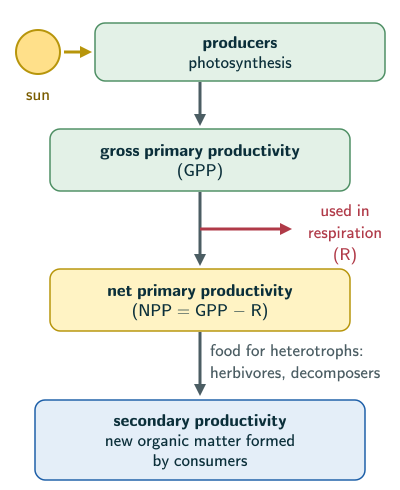
Reading notes (pages 207 and 214): NCERT prints “herbiviores” on page 207, a misprint for herbivores. Its Summary words secondary productivity a little differently, as “the rate of assimilation of food energy by the consumers” (page 214). Strictly, the two differ: a consumer uses part of the food energy it assimilates in its own respiration, as plants use part of their GPP, so the new organic matter is what remains (reasoned from NCERT page 207). For a definition, write the text’s version: the rate of formation of new organic matter by consumers (page 207).
What primary productivity depends on
Primary productivity varies from one type of ecosystem to another, because it depends on (page 207):
- the plant species inhabiting a particular area;
- a variety of environmental factors;
- the availability of nutrients;
- the photosynthetic capacity of the plants.
The rate of photosynthesis itself is determined by the factor nearest to its minimal value (Blackman’s law of limiting factors), as you saw with the factors affecting photosynthesis in Class 11 (NCERT Class 11 Biology, Chapter 11).
Productivity of land and oceans
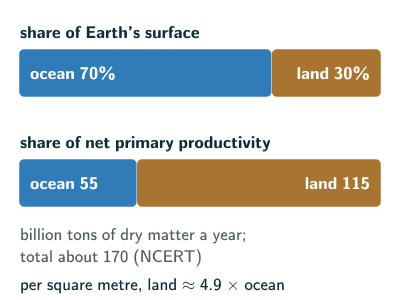
- The annual net primary productivity of the whole biosphere is approximately 170 billion tons (dry weight) of organic matter (page 207).
- Of this, despite occupying about 70 per cent of the surface, the oceans produce only 55 billion tons; the rest is on land (page 207): 170 − 55 = 115 billion tons (our arithmetic).
- So land, with about 30 per cent of the surface, makes about two-thirds of the biosphere’s NPP (115 ÷ 170 ≈ 68 per cent); square metre for square metre, land is about 4.9 times as productive as the ocean (Example 2).
NCERT asks you to discuss the main reason for the low productivity of the ocean (page 207). Beyond the NCERT text, NASA Earth Observatory (public domain) explains that phytoplankton, the producers at the base of the ocean’s food web, need carbon dioxide, sunlight and nutrients. Sunlight is used in the sunlit layers at the surface, while nutrients are richer in deeper water; they reach the sunlit layers mainly where storms mix the water or winds and currents bring deep water up, and those upwelling zones are among the most productive parts of the ocean. Over much of the open ocean, nutrients are scarce: in the remote ocean gyres phytoplankton are few for lack of nutrients, and very low iron limits their growth over large areas. In short, much of the open ocean has light without nutrients at the surface and nutrients without light below (our summing-up).
Secondary productivity
- Primary productivity belongs to the producers: the rate at which they make organic matter by photosynthesis (pages 206–207).
- Secondary productivity belongs to the consumers: the rate at which they form new organic matter from the food they eat (page 207). A goat grazing in a field builds its body from the grass; the rate of that building is secondary productivity.
- In a self-contained ecosystem, secondary productivity cannot exceed the NPP it feeds on: consumers can build only from the biomass the producers leave available (reasoned from NCERT page 207).
Solved examples
Example 1: Net primary productivity
In a grassland, the plants fix organic matter at 1800 g m yr by photosynthesis and use 750 g m yr in respiration. Find the NPP, and the fraction of GPP lost in respiration.
Answer: NPP = GPP − R = 1800 − 750 = 1050 g m yr. Fraction lost = 750 ÷ 1800 ≈ 0.42, about 42 per cent (NCERT’s equation, page 207).
Example 2: Land against ocean, per unit area
Using NCERT’s figures (biosphere NPP 170 billion tons a year, oceans 55 billion tons from about 70 per cent of the surface), how many times as productive as the ocean is land, per unit area?
Answer: land makes 170 − 55 = 115 billion tons from 30 per cent of the surface. Per unit of surface, land: 115 ÷ 30 ≈ 3.83; ocean: 55 ÷ 70 ≈ 0.786. Ratio = 3.83 ÷ 0.786 ≈ 4.9: land is about 4.9 times as productive per square metre (our arithmetic from NCERT page 207).
Example 3: Production or productivity?
A paddy field produces 1.2 kg of new dry organic matter on each square metre during a 120-day season. State its production and its productivity over the season.
Answer: production (an amount) = 1.2 kg m = 1200 g m. Productivity (a rate) = 1200 ÷ 120 = 10 g m per day over the season (NCERT’s definitions, page 207).
Common mistakes to avoid
Common mistake
Using production and productivity as the same word
Production is an amount per unit area (g m); productivity is a rate (g m yr) (NCERT page 207).
Common mistake
Adding respiration to get NPP
Respiration is a loss: NPP = GPP − R, so NPP is always less than GPP (NCERT page 207).
Common mistake
Expecting the ocean to be the most productive because it is the largest
The oceans cover about 70 per cent of the surface but make only 55 of the 170 billion tons of yearly NPP (NCERT page 207).
Common mistake
Calling consumers’ production primary
The rate at which consumers form new organic matter is secondary productivity; primary productivity belongs to the producers (NCERT page 207).
Quick revision summary
- Primary production: biomass made per unit area over a time period by plants in photosynthesis (g m or kcal m). Productivity: its rate (g m yr or kcal m yr).
- GPP: rate of production of organic matter in photosynthesis. NPP = GPP − R: the biomass available to herbivores and decomposers.
- Secondary productivity: rate of formation of new organic matter by consumers.
- Primary productivity depends on the plant species, environmental factors, nutrients and photosynthetic capacity, so it differs between ecosystems.
- Biosphere NPP ≈ 170 billion tons (dry weight) a year: oceans 55 (about 70 per cent of the surface), land 115.
Formula sheet
- NPP = GPP − R
- productivity: g m yr or kcal m yr
- biosphere NPP ≈ 170 billion tons a year
- oceans 55, land 115 billion tons
- secondary productivity: by consumers
Questions students ask
What is the difference between net primary productivity and standing crop?
Net primary productivity is a rate, while standing crop is an amount: NPP is the rate of biomass production left after the producers’ own respiration, GPP − R (NCERT page 207), whereas the standing crop is the mass of living material, or the number of organisms, at a trophic level at a particular time (page 211). So NPP carries a time unit, as in g m yr, and a standing crop does not, as in g m (our comparison of NCERT’s units for productivity and production, page 207). By our example, a pasture grazed steadily all year can keep a small standing crop of grass and still a high NPP, because the cattle keep eating what the grass makes.
How is primary productivity measured?
Primary productivity is measured as the organic matter that producers make on a unit area in a unit time, either as its weight or as its energy content (NCERT page 207), and NCERT adds that dry weight is the more accurate measure of biomass (page 211). Beyond the NCERT text, NASA maps net primary production by combining MODIS satellite data with other satellite and ground measurements, as “how much carbon dioxide is taken in by vegetation during photosynthesis minus how much is given off during respiration” (NASA Earth Observatory, 2003, public domain). By our reasoning, a field study can estimate it for a small plot by harvesting, drying and weighing its new plant growth.
Which ecosystems have the highest net primary productivity?
Beyond the NCERT text, tropical rainforests generally have the highest net primary productivity: from its satellite maps, NASA notes that “in any given year, tropical rainforests are generally the most productive places on Earth” (NASA Earth Observatory, 2003, public domain). NCERT names no most productive ecosystem, but its Chapter 13 points to one reason: there is “more solar energy available in the tropics, which contributes to higher productivity” (NCERT page 220). By our reasoning, warmth and rain through the year let a rainforest’s layered vegetation photosynthesise in every season, while a desert lacks water and a tundra lacks warmth.
Practice questions
Try each question first, then open the answer to check your working.
-
Q1. What is primary productivity? Give a brief description of the factors that affect primary productivity. (NCERT Exercise 9, page 215.)
Show answerHide answer
Primary productivity is the rate of biomass production by plants during photosynthesis, expressed in g m yr or (kcal m) yr; it is divided into gross primary productivity and net primary productivity (NPP = GPP − R). It depends on the plant species inhabiting the area, on environmental factors, on the availability of nutrients and on the photosynthetic capacity of the plants, so it varies from one type of ecosystem to another (NCERT page 207).
-
Q2. Distinguish between primary and secondary productivity. (NCERT Exercise 6(f), page 215.)
Show answerHide answer
Primary productivity is the rate of production of biomass by the producers, the plants, during photosynthesis (GPP, and NPP after respiration). Secondary productivity is the rate of formation of new organic matter by the consumers, built from the food they eat (NCERT page 207).
-
Q3. The GPP of a pond is 8000 kcal m yr and its producers use 4500 kcal m yr in respiration. What is its NPP, and what percentage of the GPP is it?
Show answerHide answer
NPP = 8000 − 4500 = 3500 kcal m yr, which is 3500 ÷ 8000 = 43.75 per cent of the GPP (NCERT’s equation, page 207).