Decomposition
NCERT Class 12 Biology Chapter 12 Section 12.3
Quick answer
Decomposition breaks down dead organic matter and wastes through overlapping physical and biological processes. Fragmentation reduces particle size, leaching transports solutes, catabolism breaks organic molecules down, humification contributes persistent organic matter, and mineralisation releases inorganic nutrients. Temperature, moisture, oxygen and detritus chemistry influence the rate.
With your textbook
NCERT Biology (Class 12), Chapter 12 “Ecosystem”, Section 12.3 “Decomposition”, pages 207–208.
Open the official NCERT chapter (PDF, 2.4 MB, ncert.nic.in) (opens in a new tab)
Checked against the 2026-27 reprint on .
What is decomposition?
Decomposition
The earthworm is called the farmer’s ‘friend’ because it helps break down complex organic matter and loosens the soil. Decomposers do the same kind of work (NCERT page 207):
decomposers break down complex organic matter into inorganic substances like carbon dioxide, water and nutrients and the process is called decomposition.
NCERT Biology (Class 12), Section 12.3, page 207
In plain words: decomposition is nature’s recycling. A dead leaf or a dead animal is taken apart, step by step, by small animals and microbes, releasing carbon dioxide, water and inorganic nutrients. Some of it becomes humus, which breaks down only very slowly (NCERT page 208).
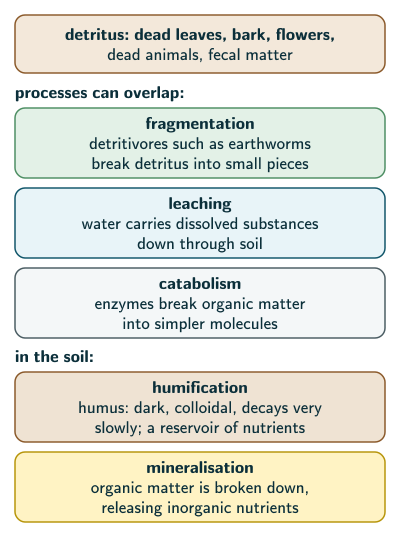
- Detritus is the raw material for decomposition: dead plant remains such as leaves, bark and flowers, and dead remains of animals, including fecal matter (page 207).
- The important steps are fragmentation, leaching, catabolism, humification and mineralisation (page 207).
- The products are carbon dioxide, water and inorganic nutrients (NCERT Summary, page 214).
The steps of decomposition
- Fragmentation: detritivores (for example, the earthworm) break down detritus into smaller particles (page 207).
- Leaching: water-soluble inorganic nutrients go down into the soil horizon and get precipitated as unavailable salts (page 207). Beyond the NCERT text: not every leached nutrient ends as an unavailable salt; nitrate, for example, can be carried in the water below the crop root zone and into groundwater (USDA Agricultural Research Service, Nitrate Leaching; public domain). For an NCERT-based answer, give NCERT’s definition.
- Catabolism: bacterial and fungal enzymes degrade detritus into simpler inorganic substances (page 207). The fungi that do this are saprophytes, absorbing soluble organic matter from dead substrates (NCERT Class 11 Biology, Chapter 2).
- All these steps operate simultaneously on the detritus (NCERT Figure 12.1, page 208, cited on page 207).
- Humification and mineralisation occur during decomposition in the soil (page 207):
- humification leads to the accumulation of humus, a dark coloured amorphous substance that is highly resistant to microbial action and decomposes at an extremely slow rate; being colloidal, it serves as a reservoir of nutrients (page 208);
- mineralisation: the humus is further degraded by some microbes, and inorganic nutrients are released (page 208). NCERT also uses the word for the pond, whose dead matter is decomposed and mineralised for reuse by the autotrophs (page 206). In an NCERT-based answer, say that humification and mineralisation occur in the soil (page 207).
NCERT slip (page 214): the chapter Summary says that decomposition “involves three processes, namely fragmentation of detritus, leaching and catabolism”, but the text names five important steps, adding humification and mineralisation (page 207). The Summary keeps the three that operate together on the detritus and leaves out the two that occur in the soil. In an exam that asks for the steps of decomposition, give all five, as the text does; if a question quotes the Summary’s three processes, they are fragmentation, leaching and catabolism.
The decomposition cycle
NCERT Figure 12.1 (page 208) follows a leaf through a terrestrial ecosystem:
- A tree grows in the soil, and a green leaf falls to the ground.
- Some leaves are eaten by insects and other animals: their nutrients and energy enter the food web.
- Others are partially consumed by decomposers such as fungi and bacteria; they begin to lose form and become litter.
- Earthworms, bacteria, soil mites, fungi and others decompose them further.
- Meanwhile, straight from the fallen leaves, some nutrients leach into the soil by chemical action (a separate arrow in the figure).
- The result is organic-rich soil, in which the tree grows.
NCERT slip (page 208): the label in NCERT Figure 12.1 puts a comma between soil and mites in its list of decomposers (earthworms, bacteria, soil, mites, fungi), so it reads as if soil were a decomposer (render of page 208). It means soil mites, small animals of the soil; soil itself is not a decomposer. In an answer, write soil mites.
Factors affecting decomposition
- Decomposition is largely an oxygen-requiring process (page 208). That is why bacteria working on organic matter use up oxygen, as the biochemical oxygen demand of sewage measures (NCERT Chapter 8, page 154).
- Its rate is controlled by the chemical composition of the detritus and by climatic factors (page 208).
- Chemical composition, in a given climate (page 208):
- slower if the detritus is rich in lignin and chitin;
- quicker if it is rich in nitrogen and water-soluble substances like sugars.
- Climate: temperature and soil moisture are the most important climatic factors; they act through their effects on the activities of soil microbes (page 208).
- Warm and moist environments favour decomposition; low temperature and anaerobiosis (lack of oxygen) inhibit it, so organic material builds up (page 208).
Solved examples
Example 1: Which goes first?
On the same forest floor, which will decompose faster: a nitrogen-rich fresh leaf full of sugars, or a twig rich in lignin? And which of a crab’s cast shell (rich in chitin) and a dead earthworm?
Answer: the nitrogen- and sugar-rich leaf, and the dead earthworm, whose soft, protein-rich body is rich in nitrogen. Detritus rich in nitrogen and water-soluble substances like sugars decomposes quicker; detritus rich in lignin or chitin decomposes slower (reasoned from NCERT page 208).
Example 2: Where does organic matter pile up?
Compare dead leaves in a warm, moist tropical forest, in a cold mountain forest, and at the waterlogged bottom of a marsh, where oxygen is scarce. Where will undecomposed organic matter build up most?
Answer: in the cold forest and the waterlogged marsh. Warm and moist conditions favour decomposition; low temperature and anaerobiosis inhibit it, so organic material builds up (NCERT page 208).
Example 3: Naming the step
Name the step: (a) an earthworm swallows leaf bits and leaves them smaller; (b) rain carries dissolved nutrients down into the soil, where they form unavailable salts; (c) fungal enzymes break detritus down into simple inorganic substances; (d) a dark, colloidal substance builds up that decays very slowly; (e) microbes break down humus and release inorganic nutrients.
Answer: (a) fragmentation; (b) leaching; (c) catabolism; (d) humification (humus); (e) mineralisation (NCERT pages 207–208).
Common mistakes to avoid
Common mistake
Thinking leaching makes nutrients available
In leaching, water-soluble inorganic nutrients go down into the soil horizon and get precipitated as unavailable salts (NCERT page 207).
Common mistake
Thinking humus breaks down quickly
Humus is highly resistant to microbial action and decomposes at an extremely slow rate; it is a reservoir of nutrients (NCERT page 208).
Common mistake
Giving the earthworm’s work to microbes, or the reverse
Detritivores such as the earthworm fragment detritus; catabolism is done by bacterial and fungal enzymes (NCERT page 207).
Common mistake
Calling decomposition an anaerobic process
Decomposition is largely oxygen-requiring; anaerobiosis inhibits it (NCERT page 208). Keep the word “largely”: some decomposition does go on without oxygen, as in the anaerobic sludge digesters of sewage treatment, where bacteria that grow anaerobically digest the bacteria and fungi of the sludge (NCERT Chapter 8, page 154).
Quick revision summary
- Decomposition: decomposers break complex organic matter into carbon dioxide, water and nutrients. Raw material: detritus (dead plant parts, dead animals, fecal matter).
- Steps: fragmentation (detritivores such as the earthworm), leaching (soluble nutrients go down, precipitate as unavailable salts), catabolism (bacterial and fungal enzymes), all at once on the detritus; humification (humus: dark, amorphous, colloidal, very slow to decay, a nutrient reservoir) and mineralisation (nutrients released) in the soil.
- Rate: set by the detritus’s chemistry (slow with lignin, chitin; fast with nitrogen, sugars) and climate (temperature, soil moisture). Warm and moist favour; cold and anaerobiosis inhibit.
Formula sheet
- detritus → CO + water + nutrients
- steps: fragmentation, leaching, catabolism
- in soil: humification, mineralisation
- slow: lignin, chitin; fast: nitrogen, sugars
- favoured: warm, moist; inhibited: cold, anaerobic
Questions students ask
What is the difference between detritus and humus?
Detritus is the raw material of decomposition, while humus forms partway through it: detritus is dead plant matter, such as fallen leaves, bark and flowers, and the dead remains of animals, fecal matter included (NCERT page 207), whereas humus is the dark coloured amorphous substance that accumulates through humification during decomposition in the soil (pages 207–208). Detritus is what decomposers start from, whereas humus is what builds up later, and only some microbes degrade it further, at an extremely slow rate (page 208). By our example, a fallen leaf is detritus, and the dark, shapeless organic matter that remains of it in the soil long afterwards is humus.
Does decomposition release heat?
Yes, decomposition releases heat: decomposers meet their energy needs by degrading dead organic matter (NCERT page 210), and NCERT Figure 12.3 marks heat escaping as energy passes from each trophic level to the decomposers (page 211). By our reasoning, the decomposers’ respiration therefore warms the material they work on. Beyond the NCERT text, the US Environmental Protection Agency says that a backyard compost pile, “if well maintained, can reach temperatures of 130° to 160° F”, about 54 to 71 °C, warming first and most at its centre as its materials begin to decompose (EPA, Composting at Home, public domain).
What would happen if there were no decomposers?
Without decomposers, dead organic matter would pile up and its nutrients would stay locked in it: decomposers break down complex organic matter into inorganic substances like carbon dioxide, water and nutrients (NCERT page 207), which are released back for reuse by the autotrophs, over and over again (page 206). NCERT’s Chapter 11 makes the same point for any plant species, which cannot survive alone because it “needs soil microbes to break down the organic matter in soil and return the inorganic nutrients for absorption” (page 196). By our reasoning, producers would then run short of nutrients, and every food chain that starts with them would shrink.
Practice questions
Try each question first, then open the answer to check your working.
-
Q1. Define decomposition and describe the processes and products of decomposition. (NCERT Exercise 10, page 215.)
Show answerHide answer
Decomposition is the breakdown of complex organic matter by decomposers into inorganic substances such as carbon dioxide, water and nutrients. Its raw material is detritus: dead plant remains such as leaves, bark and flowers, and dead remains of animals, including fecal matter. The processes are fragmentation (detritivores such as earthworms break detritus into smaller particles), leaching (water-soluble inorganic nutrients go down into the soil horizon and are precipitated as unavailable salts) and catabolism (bacterial and fungal enzymes degrade detritus into simpler inorganic substances), which act together on the detritus; then, in the soil, humification (accumulation of humus, dark, amorphous, colloidal and very slow to decompose, a reservoir of nutrients) and mineralisation (microbes degrade humus and release inorganic nutrients). The products are carbon dioxide, water and inorganic nutrients, with humus formed along the way (NCERT pages 207–208 and 214).
-
Q2. Fill in the blank: common detritivores in our ecosystem are ______. (NCERT Exercise 1(d), page 215.)
Show answerHide answer
Earthworms: they break down detritus into smaller particles (fragmentation) (NCERT page 207). NCERT Figure 12.1 also shows soil mites among the soil animals that decompose leaf litter (page 208).
-
Q3. Why does organic matter accumulate in very cold or waterlogged soils?
Show answerHide answer
Decomposition is largely an oxygen-requiring process, and it is regulated by temperature and soil moisture through their effect on soil microbes. Low temperature and anaerobiosis inhibit decomposition, so organic material builds up (NCERT page 208).