Ecosystem: structure and function
NCERT Class 12 Biology Chapter 12 Section 12.1
Quick answer
An ecosystem consists of organisms interacting with one another and with their physical environment. Species composition and stratification describe its structure; productivity, decomposition, energy flow and nutrient cycling describe its functioning. Nutrients are recycled while energy is dissipated as heat.
With your textbook
NCERT Biology (Class 12), Chapter 12 “Ecosystem”, Section 12.1 “Ecosystem – Structure and Function”, page 206.
Open the official NCERT chapter (PDF, 2.4 MB, ncert.nic.in) (opens in a new tab)
Checked against the 2026-27 reprint on .
What is an ecosystem?
Ecosystem
An ecosystem can be visualised as a functional unit of nature, where living organisms interact among themselves and also with the surrounding physical environment.
NCERT Biology (Class 12), Chapter 12, Introduction, page 205
In plain words: an ecosystem is a place taken together with everything in it, the plants, animals and microbes and also the water, soil, air, light and temperature, all working as one unit. The living members feed on one another and draw light, water, gases and minerals from the non-living surroundings, and the surroundings shape how fast they live and grow.
- An ecosystem can be any size, from a small pond to a large forest or a sea. Many ecologists regard the entire biosphere as a global ecosystem, a composite of all local ecosystems on Earth (page 205).
- The biosphere is too big and complex to study at one time, so it is divided into two basic categories (page 205):
- terrestrial ecosystems: forest, grassland and desert;
- aquatic ecosystems: pond, lake, wetland, river and estuary.
- Crop fields and an aquarium may also be considered man-made ecosystems (page 205).
- The chapter studies the structure of the ecosystem first, then its input (productivity), the transfer of energy (food chain or web, nutrient cycling) and the output (degradation and energy loss), and the cycles, chains and webs that these energy flows create (page 205).
Components: abiotic and biotic
- Every ecosystem has two kinds of component, abiotic (non-living) and biotic (living), and NCERT asks us to look at them in an integrated manner, following how energy flows among them (page 206).
- NCERT’s chapter Summary lists them: abiotic components are inorganic materials: air, water and soil; biotic components are the producers, consumers and decomposers (page 214).
- The interaction of biotic and abiotic components results in a physical structure that is characteristic of each type of ecosystem (page 206). The living members also interact with one another, as the interactions between populations show.
Structure: species composition and stratification
- Species composition: the identification and enumeration of the plant and animal species of an ecosystem (page 206).
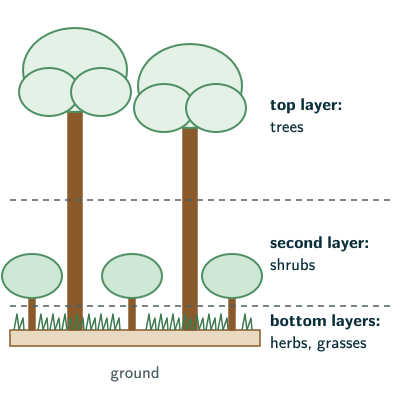
- Stratification: the vertical distribution of different species occupying different levels. In a forest, trees occupy the top vertical stratum or layer, shrubs the second, and herbs and grasses the bottom layers (page 206).
- Species composition and stratification are the two main structural features of an ecosystem (NCERT Summary, page 214).
Function: the four aspects
The components of an ecosystem are seen to function as a unit when you consider four aspects (page 206):
- Productivity: the rate at which the producers make biomass, the ecosystem’s input (pages 205–207).
- Decomposition: the breakdown of dead organic matter into inorganic substances by decomposers (page 207).
- Energy flow: the one-way movement of energy from the sun to producers and then to consumers (page 209).
- Nutrient cycling: the storage and movement of nutrient elements through the various components of the ecosystem, so that nutrients are used again and again (NCERT Summary, page 214).
- Nutrient cycling is of two types (NCERT Summary, page 214):
- gaseous, with the atmosphere or hydrosphere as the reservoir, as for carbon;
- sedimentary, with the Earth’s crust as the reservoir, as for phosphorus.
- The products of ecosystem processes are called ecosystem services, for example the purification of air and water by forests (NCERT Summary, page 214).
Reading note (page 214): the 2026–27 reprint has no section of its own on nutrient cycling; the chapter defines it only in its Summary. Learn the Summary’s lines above: the gaseous and sedimentary types and their reservoirs.
Reading note (pages 206 and 214): NCERT uses “components” in two senses. The abiotic and biotic components are the parts of an ecosystem, but the pond paragraph also calls productivity, decomposition, energy flow and nutrient cycling the “four basic components” (page 206), and the Summary calls them “the four important components of an ecosystem” (page 214). In a question, the parts are abiotic and biotic; the four processes are its functional components.
The pond as an ecosystem
NCERT takes a small pond to show how an aquatic ecosystem works. It is a shallow water body, fairly self-sustainable and rather simple, in which all four basic components of an ecosystem, as NCERT calls productivity, decomposition, energy flow and nutrient cycling here, are well exhibited (page 206).
- Abiotic component: the water with all its dissolved inorganic and organic substances, and the rich soil deposit at the bottom of the pond. The solar input, the cycle of temperature, day-length and other climatic conditions regulate the rate of function of the entire pond (page 206).
- Autotrophic components (producers): the phytoplankton, some algae, and the floating, submerged and marginal plants found at the edges (page 206).
- Consumers: the zooplankton, and the free-swimming and bottom-dwelling forms (page 206).
- Decomposers: the fungi, bacteria and flagellates, especially abundant at the bottom of the pond (page 206).
The pond performs all the functions of any ecosystem, and of the biosphere as a whole (page 206):
- the autotrophs convert inorganic into organic material with the help of the radiant energy of the sun;
- heterotrophs consume the autotrophs;
- the dead matter is decomposed and mineralised, releasing nutrients back for reuse by the autotrophs; these events are repeated over and over again;
- energy moves in one direction, towards the higher trophic levels, and is dissipated and lost as heat to the environment.
Solved examples
Example 1: Which kind of ecosystem?
Classify each as a terrestrial, aquatic or man-made ecosystem: a grassland, an estuary, a wheat field, a lake, a home aquarium, a desert.
Answer: terrestrial: grassland, desert; aquatic: estuary, lake; man-made: wheat field (a crop field) and home aquarium (NCERT page 205).
Example 2: Sorting the members of a pond
Sort these parts of a pond into abiotic components, producers, consumers and decomposers: dissolved phosphate, phytoplankton, a submerged water plant, zooplankton, a fish feeding at the bottom, bacteria in the bottom mud, the soil deposit at the bottom.
Answer: abiotic: dissolved phosphate, the soil deposit; producers: phytoplankton, the submerged plant; consumers: zooplankton, the bottom-feeding fish (a bottom-dwelling form); decomposers: the bacteria in the bottom mud (NCERT page 206).
Example 3: Why energy must keep coming but nutrients need not
A sealed jar holds pond water, plants, small animals and microbes, and stands on a sunny windowsill. Why does it need the sunlight every day, although no food or nutrient is ever added?
Answer: nutrients cycle: decomposers mineralise dead matter and release the nutrients back for reuse by the producers. Energy does not cycle: it moves in one direction, from the sun to producers and on to consumers, and at each step some is lost as heat. So the jar must keep receiving solar energy, while its nutrients are used again and again (NCERT pages 206 and 214).
Common mistakes to avoid
Common mistake
Thinking energy cycles like nutrients
Nutrients are released by decomposition and reused; energy flows one way, from the sun through the trophic levels, and is lost as heat (NCERT page 206).
Common mistake
Calling stratification a horizontal pattern
Stratification is the vertical distribution of species: trees on top, shrubs second, herbs and grasses at the bottom (NCERT page 206).
Common mistake
Mixing up structure and function
Species composition and stratification describe structure; productivity, decomposition, energy flow and nutrient cycling are how the ecosystem functions (NCERT pages 206 and 214).
Common mistake
Thinking an ecosystem must be large
An ecosystem can be as small as a pond or as large as a forest or a sea; the whole biosphere is the global ecosystem (NCERT page 205).
Quick revision summary
- Ecosystem: a structural and functional unit of nature (NCERT Summary, page 214) in which organisms interact among themselves and with the physical environment; from a pond to the whole biosphere.
- Types: terrestrial (forest, grassland, desert), aquatic (pond, lake, wetland, river, estuary), man-made (crop fields, aquarium).
- Components: abiotic (air, water, soil) and biotic (producers, consumers, decomposers).
- Structure: species composition and stratification (trees, then shrubs, then herbs and grasses).
- Function: productivity, decomposition, energy flow, nutrient cycling (gaseous: carbon; sedimentary: phosphorus).
- Pond: water, dissolved substances and bottom soil; phytoplankton and plants; zooplankton and swimming and bottom-dwelling animals; fungi, bacteria and flagellates at the bottom. Energy flows one way; nutrients cycle.
Formula sheet
- components: abiotic and biotic
- biotic: producers, consumers, decomposers
- structure: species composition, stratification
- function: productivity, decomposition, energy flow, nutrient cycling
- gaseous cycle: carbon; sedimentary: phosphorus
- energy: one way; nutrients: cycled
Questions students ask
What is the difference between an ecosystem and a community?
An ecosystem is a community together with its physical surroundings: NCERT says animals, plants and microbes “do not and cannot live in isolation but interact in various ways to form a biological community” (NCERT’s Chapter 11, page 196), while an ecosystem is a functional unit of nature where organisms interact among themselves and with the physical environment (Chapter 12, page 205). By our reading, a community has only living members, and an ecosystem adds the abiotic components and the flow of energy and nutrients between them (page 206). In a pond, by our example, the plankton, plants, fishes and mud microbes are the community; add water, bottom soil and sunlight for the ecosystem.
What is the difference between an ecosystem and a biome?
An ecosystem is a functional unit of nature of any size, from a small pond to a large forest or a sea (NCERT page 205), whereas a biome, beyond the NCERT text, is in NASA’s words “a community of plants and animals living together in a particular climate”; NASA’s Mission: Biomes describes seven, among them rainforest, grassland, desert and tundra (NASA Earth Observatory, public domain). NCERT does not define the biome, only listing biomes after ecosystems among the levels of biological organisation (NCERT’s Chapter 11, page 190). By our reading, one biome spans many local ecosystems of similar climate, and the biosphere is the global ecosystem of them all (page 205).
What is the difference between ecology and an ecosystem?
Ecology is a subject and an ecosystem is one of the things it studies: NCERT describes ecology as the subject “which studies the interactions among organisms and between the organism and its physical (abiotic) environment” (NCERT’s Chapter 11, page 191), and the ecosystem as the functional unit of nature in which those interactions take place, from a small pond to the whole biosphere (page 205). NCERT’s Chapter 11 explores ecology at the level of populations, and Chapter 12 at the level of the ecosystem, through its productivity, decomposition, energy flow and nutrient cycling (Chapter 11, page 191; Chapter 12, page 206).
Is the Ecosystem chapter in the NEET (UG) 2026 syllabus?
Yes, the Ecosystem chapter is in the NEET (UG) 2026 syllabus: Unit 10, Ecology and Environment, lists “Ecosystem: Patterns, components; productivity and decomposition; Energy flow; Pyramids of number, biomass, energy” (National Medical Commission, Syllabus for NEET (UG) 2026). That line covers NCERT Class 12 Biology Chapter 12 of the 2026–27 reprint (pages 205–215), whose five sections, 12.1 to 12.5, are this chapter’s five pages, from this one to ecological pyramids. By our reading, the line does not name nutrient cycling, which the reprint defines only in its Summary (page 214), and the reprint has no section on ecological succession.
Practice questions
Try each question first, then open the answer to check your working.
-
Q1. Describe the components of an ecosystem. (NCERT Exercise 7, page 215.)
Show answerHide answer
An ecosystem has abiotic and biotic components. The abiotic components are inorganic materials: air, water and soil, together with climatic factors such as solar input, temperature and day-length that regulate how fast the ecosystem functions. The biotic components are the producers (green plants, phytoplankton and algae), the consumers (herbivores and carnivores) and the decomposers (fungi and bacteria). Their interaction gives each ecosystem its characteristic physical structure, described by its species composition and stratification; in a pond, for example, the water, dissolved substances and bottom soil are abiotic, phytoplankton and plants are producers, zooplankton and swimming and bottom-dwelling forms are consumers, and fungi, bacteria and flagellates are decomposers. NCERT also calls productivity, decomposition, energy flow and nutrient cycling the four important components of an ecosystem: these are its functional components, through which the parts work as one unit (NCERT pages 206 and 214).
-
Q2. Fill in the blank: plants are called as ______ because they fix carbon dioxide. (NCERT Exercise 1(a), page 214.)
Show answerHide answer
Producers (autotrophs): they convert inorganic materials into organic material using the radiant energy of the sun (NCERT pages 206 and 209).
-
Q3. Which two features describe the structure of an ecosystem, and what is stratification in a forest?
Show answerHide answer
Species composition and stratification. Stratification is the vertical distribution of species at different levels: trees in the top layer, shrubs in the second, and herbs and grasses in the bottom layers (NCERT pages 206 and 214).