Biodiversity conservation
NCERT Class 12 Biology Chapter 13 Section 13.2
Quick answer
Biodiversity conservation protects genetic, species and ecosystem diversity for direct benefits, ecosystem services and ethical reasons. In situ conservation protects natural habitats; ex situ programmes, the desirable approach for endangered or threatened species, maintain organisms, seeds or tissues outside them. Hotspots combine high endemism with severe habitat loss; NCERT counts 34 in the world, three of them covering India’s exceptionally rich biodiversity regions.
With your textbook
NCERT Biology (Class 12), Chapter 13 “Biodiversity and Conservation”, Section 13.2 “Biodiversity Conservation”, pages 223–225.
Open the official NCERT chapter (PDF, 2.3 MB, ncert.nic.in) (opens in a new tab)
Checked against the 2026-27 reprint on .
What is biodiversity conservation?
Biodiversity conservation
Biodiversity conservation is the protection of the variety of life, at the genetic, species and ecosystem levels, either in its natural home (in situ) or outside it (ex situ) (NCERT pages 224–225). NCERT ends the chapter with why the task is shared:
Biodiversity knows no political boundaries and its conservation is therefore a collective responsibility of all nations.
NCERT Biology (Class 12), Section 13.2, page 225
In plain words: we conserve biodiversity because it feeds, heals and shelters us, because whole ecosystems quietly work for us, and because other species have a right to exist. The surest way is to protect their homes; for species on the brink, we also keep them, or their seeds and cells, safe in zoos, gardens and banks.
Why should we conserve biodiversity?
NCERT groups the reasons, obvious and less obvious but all equally important, into three categories (page 223):
- Narrowly utilitarian arguments: humans derive countless direct economic benefits from nature (page 223):
- food (cereals, pulses, fruits), firewood, fibre and construction material;
- industrial products: tannins, lubricants, dyes, resins and perfumes;
- medicines: more than 25 per cent of the drugs sold worldwide are derived from plants, and 25 000 species of plants contribute to the traditional medicines of native peoples;
- bioprospecting, exploring molecular, genetic and species-level diversity for products of economic importance, can bring great benefits to nations rich in biodiversity.
- Broadly utilitarian arguments: biodiversity plays a major role in the ecosystem services that nature provides (pages 223–224):
- the Amazon forest is estimated to produce, through photosynthesis, 20 per cent of the total oxygen in the earth’s atmosphere; NCERT invites you to price this service by asking what a hospital pays for a cylinder of oxygen;
- pollination, without which plants cannot give us fruits or seeds, is done by pollinators such as bees, bumblebees, birds and bats;
- intangible benefits: the aesthetic pleasure of walking through thick woods, watching spring flowers or waking to a bulbul’s song.
- The ethical argument: we owe something to the millions of plant, animal and microbe species with whom we share this planet. Every species has an intrinsic value, even with no current economic value to us; we have a moral duty to care for their well-being and to pass on our biological legacy in good order to future generations (page 224).
NCERT’s Summary adds pest control, climate moderation and flood control to the indirect benefits of ecosystem services (page 226).
NCERT slip (page 224): NCERT says the Amazon forest produces, through photosynthesis, 20 per cent of the total oxygen in the earth’s atmosphere. Beyond the NCERT text, ecologists at the University of Oxford’s ecosystems lab explain that the figure is roughly the Amazon’s share of the oxygen land plants release each year, not a share of the oxygen already in the air, whose level is set by slow geological and biological processes. The forest as a whole also uses about as much oxygen as it makes: its plants respire much of it away and the microbes that decay its litter take nearly all the rest (Oxford Ecosystems Lab blog, “Does the amazon provide 20% of our oxygen?”, facts in our words). This fits NCERT’s own Chapter 12: plants spend part of their gross production in respiration, and decomposition is largely an oxygen-requiring process. In an exam, quote NCERT’s 20 per cent where it is asked for.
How do we conserve biodiversity?
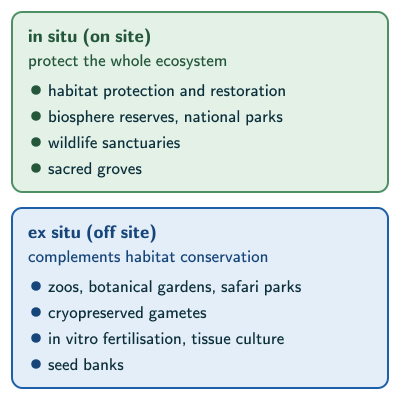
- In situ (on site) conservation protects the whole ecosystem, so its biodiversity at all levels is protected: we save the entire forest to save the tiger (page 224).
- Ex situ (off site) conservation is the desirable approach when an animal or plant is endangered or threatened, that is, facing a very high risk of extinction in the wild in the near future, and needs urgent measures to save it (page 224).
In situ conservation and biodiversity hotspots
- Faced with the conflict between development and conservation, many nations cannot afford to conserve all their biological wealth; the species waiting to be saved far exceed the resources available (page 224).
- Eminent conservationists therefore identified, for maximum protection, biodiversity hotspots: regions with very high levels of species richness and a high degree of endemism (species confined to that region and not found anywhere else) (page 224).
- Initially 25 hotspots were identified; nine more were added, bringing the total to 34. These hotspots are also regions of accelerated habitat loss (page 224).
- Three of them cover India’s exceptionally rich biodiversity regions: the Western Ghats and Sri Lanka, Indo-Burma and the Himalaya (page 224).
- All the hotspots together cover less than 2 per cent of the earth’s land area, yet they harbour an extremely high number of species, and their strict protection could reduce the ongoing mass extinctions by almost 30 per cent (pages 224–225).
Biosphere reserves, national parks and sanctuaries
- In India, ecologically unique and biodiversity-rich regions are legally protected as biosphere reserves, national parks and sanctuaries (page 225).
- NCERT’s count: 14 biosphere reserves, 90 national parks and 448 wildlife sanctuaries (page 225).
Reading note (pages 225 and 226): the text gives 448 wildlife sanctuaries, the Summary “> 450” (page 226). Both are NCERT’s; for a question on the count, give the text’s 448. Official counts change as new areas are notified, so learn NCERT’s figures for the exam.
Sacred groves
- India has a history of religious and cultural traditions that emphasised protection of nature. In many cultures, tracts of forest were set aside, and all the trees and wildlife within were venerated and given total protection: these are sacred groves (page 225).
- NCERT lists them in the Khasi and Jaintia Hills in Meghalaya, the Aravalli Hills of Rajasthan, the Western Ghat regions of Karnataka and Maharashtra, and the Sarguja, Chanda and Bastar areas (page 225).
- In Meghalaya, the sacred groves are the last refuges for a large number of rare and threatened plants (page 225).
Reading note (page 225): NCERT places Sarguja, Chanda and Bastar in Madhya Pradesh. Beyond the NCERT text, Surguja and Bastar districts are today in Chhattisgarh, and Chandrapur district, earlier called Chanda, is in Maharashtra (Wikipedia, facts in our words). In an exam, NCERT’s list of places is what is asked; give the present state if a question asks for it.
Ex situ conservation
- Threatened animals and plants are taken out of their natural habitat and placed in special settings where they can be protected and given special care: zoological parks, botanical gardens and wildlife safari parks (page 225).
- Many animals that have become extinct in the wild are still maintained in zoological parks (page 225).
- Ex situ conservation now goes beyond enclosures (page 225):
- gametes of threatened species can be preserved, viable and fertile, for long periods by cryopreservation;
- eggs can be fertilised in vitro, as in IVF;
- plants can be propagated by tissue culture methods;
- seeds of different genetic strains of commercially important plants can be kept for long periods in seed banks.
International efforts
- The historic Convention on Biological Diversity (‘The Earth Summit’), held in Rio de Janeiro in 1992, called upon all nations to take appropriate measures to conserve biodiversity and to use its benefits sustainably (page 225).
- In a follow-up, the World Summit on Sustainable Development, held in 2002 in Johannesburg, South Africa, saw 190 countries pledge to achieve by 2010 a significant reduction in the current rate of biodiversity loss at global, regional and local levels (page 225).
Reading note (page 225): NCERT calls the Convention on Biological Diversity ‘The Earth Summit’. Strictly, the Earth Summit was the United Nations Conference on Environment and Development at Rio de Janeiro in 1992, and the Convention is the treaty opened for signature there (beyond the NCERT text: Convention on Biological Diversity Secretariat, history of the Convention, facts in our words). In an exam, NCERT’s pairing is the answer: Earth Summit, Rio de Janeiro, 1992.
Solved examples
Example 1: Which argument?
Classify each reason for conserving biodiversity as narrowly utilitarian, broadly utilitarian or ethical: (a) a rain forest plant yields a new anticancer drug; (b) bees pollinate an orchard; (c) a rare frog has a right to exist though it is of no use to us; (d) forests reduce floods downstream.
Answer: (a) narrowly utilitarian (a direct product: medicine); (b) broadly utilitarian (an ecosystem service: pollination); (c) ethical (intrinsic value); (d) broadly utilitarian (an ecosystem service: flood control) (NCERT pages 223–224 and 226).
Example 2: In situ or ex situ?
Classify: (a) a national park; (b) a seed bank; (c) a sacred grove; (d) frozen sperm of a threatened deer; (e) a biosphere reserve; (f) a botanical garden.
Answer: in situ: (a), (c), (e), which protect species in their natural habitat; ex situ: (b), (d), (f), which keep them, or their seeds and gametes, outside it (NCERT pages 224–225).
Example 3: Hotspot arithmetic
NCERT says 25 hotspots were identified first and nine added later, and that the hotspots cover less than 2 per cent of the land. How many hotspots are there, and what share of them covers India’s richest regions?
Answer: 25 + 9 = 34 hotspots; India’s are 3 of them, 3 ÷ 34 ≈ 9 per cent of the hotspots (our arithmetic from NCERT page 224).
Common mistakes to avoid
Common mistake
Calling a sacred grove ex situ
Sacred groves protect whole tracts of forest where they stand, so they are in situ conservation (NCERT pages 224–226).
Common mistake
Calling a zoo in situ
Zoological parks, botanical gardens and safari parks take organisms out of their natural habitat: that is ex situ (NCERT page 225).
Common mistake
Defining hotspots by species richness alone
A biodiversity hotspot has very high species richness and a high degree of endemism, and it is also a region of accelerated habitat loss (NCERT page 224).
Common mistake
Mixing up the two summits
The Earth Summit, where the Convention on Biological Diversity was opened for signature (beyond the NCERT text, CBD Secretariat), was held in Rio de Janeiro in 1992, and the World Summit on Sustainable Development in Johannesburg in 2002 (NCERT page 225).
Quick revision summary
- Reasons to conserve: narrowly utilitarian (food, fibre, firewood, industrial products, drugs: over 25 per cent from plants; bioprospecting), broadly utilitarian (ecosystem services: oxygen, pollination, pest and flood control, aesthetic value), ethical (intrinsic value of every species).
- In situ: protect the whole ecosystem (save the forest to save the tiger): 34 hotspots (3 in India: Western Ghats and Sri Lanka, Indo-Burma, Himalaya); 14 biosphere reserves, 90 national parks, 448 sanctuaries; sacred groves.
- Ex situ: for endangered or threatened species: zoos, botanical gardens, wildlife safari parks; cryopreservation of gametes, in vitro fertilisation, tissue culture, seed banks.
- International: Earth Summit, Rio de Janeiro, 1992; World Summit on Sustainable Development, Johannesburg, 2002 (190 countries, target 2010).
Formula sheet
- arguments: narrowly, broadly utilitarian; ethical
- in situ: on site; ex situ: off site
- hotspots: 25 + 9 = 34; 3 in India
- India: 14 BR, 90 NP, 448 sanctuaries
- Earth Summit: Rio, 1992
- WSSD: Johannesburg, 2002
Questions students ask
What is the difference between a biodiversity hotspot and a biosphere reserve?
A biodiversity hotspot is a priority region that eminent conservationists picked out, on a global basis, for maximum protection, while a biosphere reserve is an area that a country protects: NCERT lists biosphere reserves with national parks and sanctuaries as India’s protected regions (page 225), and, by our reading, its Western Ghats and Sri Lanka hotspot spans two countries (page 224). Beyond the NCERT text, the biosphere reserve grew out of UNESCO’s Man and the Biosphere Programme (launched 1971; first reserves 1976), whose world network “integrates conservation and development, setting it apart from traditional protected areas” (Wu and others 2025, National Science Review, CC BY).
What is the difference between a national park and a wildlife sanctuary?
Beyond the NCERT text, the Wild Life (Protection) Act, 1972 protects a national park more strictly than a sanctuary: no livestock may graze in a national park (section 35(7)), and before its final declaration all rights over its land must be settled and vested in the state government, none continuing (section 35(3) and (4)). In a sanctuary, the Chief Wild Life Warden decides how far livestock may graze (section 33(d)), and the Collector may let some rights continue (section 24(2)(c)). The Wild Life (Protection) Amendment Act, 2022 keeps this but applies the sanctuary rules (sections 27 to 33A) to a proposed national park until its final declaration (section 35(3A); facts in our words).
Who coined the term biodiversity hotspot?
Beyond the NCERT text, the term biodiversity hotspot goes back to the British environmentalist Norman Myers, who coined ‘hotspot’ in 1988 (Pironon and others 2020, Plants, CC BY). His first list named 10 tropical forest areas, chosen for a combination of many endemic plants and rapid forest loss, and later revisions added more regions (same source). NCERT names no one: it says “eminent conservationists” identified the hotspots for maximum protection (page 224).
What is the difference between cryopreservation and a seed bank?
Cryopreservation and seed banks differ in what NCERT says they keep: cryopreservation preserves gametes of threatened species in viable and fertile condition for long periods, while seed banks keep seeds of different genetic strains of commercially important plants (NCERT page 225). NCERT’s Chapter 1 adds that pollen grains of a large number of species can be stored for years in liquid nitrogen at −196 °C, and that such stored pollen can be used as pollen banks, similar to seed banks (page 8). By our reading, that is cryopreservation applied to pollen, and it shows the cold involved.
Practice questions
Try each question first, then open the answer to check your working.
-
Q1. What are sacred groves? What is their role in conservation? (NCERT Exercise 7, page 227.)
Show answerHide answer
Sacred groves are tracts of forest set aside under religious and cultural traditions, in which all the trees and wildlife are venerated and given total protection. They are found, for example, in the Khasi and Jaintia Hills of Meghalaya, the Aravalli Hills of Rajasthan, the Western Ghat regions of Karnataka and Maharashtra, and the Sarguja, Chanda and Bastar areas. They are a form of in situ conservation: in Meghalaya, the sacred groves are the last refuges for a large number of rare and threatened plants (NCERT pages 225–226).
-
Q2. Among the ecosystem services are control of floods and soil erosion. How is this achieved by the biotic components of the ecosystem? (NCERT Exercise 8, page 227.)
Show answerHide answer
NCERT names flood control among the ecosystem services (page 226) without explaining how; the explanation is our reasoning. Plant cover breaks the force of rain before it hits the ground; roots bind the soil particles so that running water cannot carry them away; and the litter and humus of the forest floor, built up by decomposers and soil animals (NCERT Chapter 12, pages 207–208), soak up water like a sponge and let it seep into the soil slowly, so less water rushes downstream at once.
-
Q3. Distinguish between in situ and ex situ conservation, with two examples of each.
Show answerHide answer
In situ (on site) conservation protects the whole ecosystem, and so the species in their natural habitat, as in biodiversity hotspots, biosphere reserves, national parks, wildlife sanctuaries and sacred groves. Ex situ (off site) conservation takes threatened animals and plants out of their habitat into special settings, such as zoological parks, botanical gardens and safari parks, or keeps their gametes viable by cryopreservation, fertilises eggs in vitro, propagates plants by tissue culture and stores seeds in seed banks (NCERT pages 224–225).