Red Data Book and the IUCN Red List
Beyond NCERT In the NEET syllabus; the Class 12 book has no section for it.
Quick answer
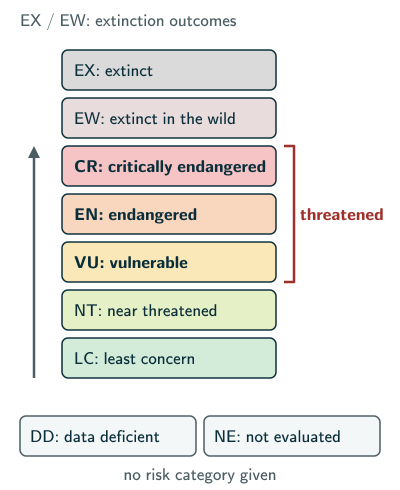
Red Data Books document species of conservation concern; the IUCN Red List assesses extinction risk and also includes non-threatened and extinct taxa. Critically Endangered, Endangered and Vulnerable are the three threatened categories. Data Deficient and Not Evaluated do not establish a risk level, and a Red List assessment is not itself a legal-protection designation.
What is a Red Data Book?
Red Data Book
A Red Data Book documents species of conservation concern and their status. The IUCN Red List of Threatened Species is a global extinction-risk assessment system that includes threatened, non-threatened and extinct taxa; national Red Data Books have their own scope and dates (beyond the NCERT text: IUCN Red List Categories and Criteria, facts in our words). NCERT cites the IUCN’s list when it counts recent extinctions:
The IUCN Red List (2004) documents the extinction of 784 species (including 338 vertebrates, 359 invertebrates and 87 plants) in the last 500 years.
NCERT Biology (Class 12), Section 13.1, page 221
In plain words: Red Data Books help identify conservation concerns, while the modern Red List assesses a wider range of taxa. Categories indicate extinction risk, not a countdown to extinction or an automatic priority ranking; feasibility, ecological role and other considerations also matter.
The 2026–27 NCERT book has no section on the Red Data Book; it only cites the IUCN Red List and its figures in Section 13.1. The NEET (UG) 2026 syllabus lists the Red Data Book in Unit 10. Everything below except NCERT’s own statements and figures is beyond the NCERT text: from the IUCN’s Red List Categories and Criteria (Version 3.1, second edition; facts in our words, no figures), a Journal of Threatened Taxa paper (CC BY 4.0), an Internet Archive catalogue record and Wikipedia (facts only).
The IUCN and its Red List
- The IUCN is the International Union for Conservation of Nature and Natural Resources, as NCERT names it (NCERT page 217).
- Its Red List of Threatened Species ranks species by how likely they are to die out. The IUCN cautions that a species’ rank is one input to conservation planning, not the whole of it (IUCN Red List Categories and Criteria, facts in our words).
- The IUCN’s older Red Data Books and Red Lists used categories that were more a matter of judgement; today’s categories are assigned by quantitative criteria, so that different assessors place species consistently (IUCN, facts in our words).
Historical NCERT figures, not current totals (NCERT names IUCN 2004 for the first two only):
- slightly more than 1.5 million plant and animal species described so far (IUCN, 2004) (NCERT page 217);
- 784 extinctions in the last 500 years: 338 vertebrates, 359 invertebrates and 87 plants (IUCN Red List, 2004) (NCERT page 221);
- more than 15 500 species worldwide facing the threat of extinction; 12 per cent of all bird species, 23 per cent of mammal species, 32 per cent of amphibian species and 31 per cent of gymnosperm species (NCERT page 222);
- of the threatened species, more than 650 are from India (NCERT Summary, page 226).
NCERT’s chapter on organisms and populations records that the Abingdon tortoise of the Galapagos Islands became extinct within a decade after goats were introduced, apparently due to the greater browsing efficiency of the goats, NCERT’s example of competition (NCERT Chapter 11, page 199); give this in an NCERT-based answer. Beyond the NCERT text: goats were brought to Pinta (Abingdon) Island in the late 1950s and ate much of its vegetation; hunting by buccaneers and whalers had already wiped out most of its tortoises by the end of the 19th century; a single male, Lonesome George, was found on the island in 1971 and died in captivity in 2012, the last known individual (Wikipedia, “Pinta Island tortoise”, facts in our words).
Threat categories
An assessment assigns a taxon one category for a stated geographic scope and date; global and regional assessments can differ (IUCN Red List Categories and Criteria, facts in our words):
- Extinct (EX): there is no reasonable doubt that the last individual has died, supported by appropriate exhaustive surveys when relevant. NCERT’s historical examples include species and subspecies: the dodo (Mauritius), quagga (Africa), thylacine (Australia), Steller’s sea cow (Russia) and three subspecies of tiger (Bali, Javan, Caspian) (NCERT page 221).
- Extinct in the Wild (EW): known to survive only in cultivation, captivity or naturalised populations well outside its past range, after appropriate surveys fail to find wild populations in its historic range. NCERT notes that many animals that are extinct in the wild are still kept in zoological parks (NCERT page 225).
- Critically Endangered (CR): the highest of the three threat levels: an extremely high risk of dying out in the wild.
- Endangered (EN): the middle threat level: a very high risk.
- Vulnerable (VU): the lowest threat level: a high risk.
- Near Threatened (NT): checked against the criteria and not yet threatened, but near a threat threshold or expected to cross one soon.
- Least Concern (LC): evaluated and not qualifying for CR, EN, VU or NT. Many widespread, abundant taxa are LC, but commonness alone is insufficient: rapid decline can qualify a widespread species as threatened.
- Data Deficient (DD): available information is inadequate for a direct or indirect risk assessment. The label records missing data, not a level of risk; once studied, the species could prove to be threatened.
- Not Evaluated (NE): not yet evaluated against the criteria.
- Threatened is the IUCN’s collective name for Critically Endangered, Endangered and Vulnerable. Assign the highest category for which the applicable criteria are met; the category is not inferred from a single feature such as rarity (IUCN, facts in our words).
- A species is placed in a threatened category if it meets any one of five criteria: (A) a reduction in population size; (B) a small geographic range; (C) a small population that is declining; (D) a very small or very restricted population; (E) a quantitative analysis of its probability of extinction. Each criterion has specified thresholds, time windows and, where relevant, additional conditions; small range or some decline alone is not enough (IUCN, facts in our words).
Reading note (page 224): NCERT uses “endangered or threatened” together, for “organisms facing a very high risk of extinction in the wild in the near future” (page 224). In the IUCN’s scheme the two words differ: a very high risk of dying out in the wild is what marks a species as Endangered, while threatened is the group of three categories, Critically Endangered, Endangered and Vulnerable. In an exam on NCERT’s text, NCERT’s wording is the answer; for a question on the IUCN categories, keep the IUCN’s meanings. A listing is an assessment, not by itself a legal-protection designation.
Indian Red Data Books
- India keeps its own Red Data Books, prepared by its two national surveys (beyond the NCERT text):
- the Botanical Survey of India published the Red Data Book of Indian Plants, edited by M. P. Nayar and A. R. K. Sastry, in three volumes: Volume 1 (1987), Volume 2 (1988) and Volume 3 (1990) (Journal of Threatened Taxa, CC BY 4.0, facts in our words);
- the Zoological Survey of India published The Red Data Book on Indian Animals, whose first part (1994) covers mammals, birds, reptiles and amphibians (Internet Archive catalogue, facts only).
- These books matter for conservation at home: NCERT notes that in Meghalaya the sacred groves are the last refuges for a large number of rare and threatened plants (NCERT page 225), and India’s threatened species number more than 650 by NCERT’s count (page 226).
Solved examples
Example 1: Reading NCERT’s IUCN figures
NCERT gives the IUCN Red List (2004) count of extinctions as 338 vertebrates, 359 invertebrates and 87 plants. Check the total and find the fraction that are plants.
Answer: 338 + 359 + 87 = 784, as NCERT states; plants are 87 ÷ 784 ≈ 0.11, about 11 per cent (our arithmetic from NCERT page 221).
Example 2: Which category?
Place each in an IUCN category: (a) a deer that now survives only in zoos; (b) a species whose last individual has certainly died; (c) an assessed beetle for which available information is insufficient for a direct or indirect risk assessment; (d) a sparrow assessed against the criteria and found not to qualify for CR, EN, VU or NT.
Answer: (a) Extinct in the Wild (EW); (b) Extinct (EX); (c) Data Deficient (DD), not a threat category; (d) Least Concern (LC) (IUCN Red List Categories, facts in our words).
Example 3: Threatened or not?
Which of these are threatened species in the IUCN’s sense: critically endangered, near threatened, vulnerable, data deficient, endangered?
Answer: critically endangered, endangered and vulnerable: these three make up the threatened group. Near threatened and data deficient are not threatened categories (IUCN, facts in our words).
Common mistakes to avoid
Common mistake
Counting data deficient species as threatened
Data Deficient records a gap in knowledge, not a level of risk (IUCN, facts in our words).
Common mistake
Ranking vulnerable above endangered
The order of risk is critically endangered (extremely high), endangered (very high), vulnerable (high) (IUCN).
Common mistake
Treating extinct in the wild as extinct
An Extinct in the Wild species still survives in captivity or cultivation, as in zoological parks (NCERT page 225; IUCN).
Common mistake
Quoting other years’ IUCN figures as NCERT’s
NCERT’s IUCN figures are from 2004: over 1.5 million species described and 784 extinctions in 500 years. Its count of more than 15 500 threatened species names no source (NCERT pages 217, 221–222).
Quick revision summary
- Red Data Book: a record of species of conservation concern and their status; the modern IUCN Red List also includes non-threatened and extinct taxa. India: Red Data Books of the Botanical Survey of India (plants, 3 volumes, 1987–1990) and the Zoological Survey of India (animals).
- IUCN categories: extinct, extinct in the wild, critically endangered, endangered, vulnerable, near threatened, least concern; data deficient and not evaluated outside the scale of risk. Threatened = critically endangered + endangered + vulnerable.
- Criteria A–E: population reduction, small range, small declining population, very small/restricted population, quantitative analysis.
- NCERT’s figures: over 1.5 million species described (IUCN, 2004); 784 extinctions in 500 years (IUCN Red List, 2004: 338 vertebrates, 359 invertebrates, 87 plants); over 15 500 species threatened (no source named).
Formula sheet
- threatened: CR, EN and VU
- risk: CR > EN > VU > NT > LC
- also EX, EW; DD, NE
- IUCN 2004: 784 extinctions in 500 years
- 338 + 359 + 87 = 784
Questions students ask
Why is the Red Data Book important?
Beyond the NCERT text, a Red Data Book, and today the IUCN Red List, is important because it grades how likely each species is to die out, which tells conservationists which species are closest to being lost (IUCN Red List Categories and Criteria, Version 3.1, second edition, 2012; facts in our words). Because the IUCN keeps its criteria unchanged on purpose, a species assessed again years later can be seen to have truly recovered or declined further (same source). NCERT itself relies on the IUCN Red List (2004) for its count of extinctions in the last 500 years (page 221).
What is the difference between endangered and vulnerable species?
Beyond the NCERT text, endangered species meet stricter thresholds than vulnerable ones on the IUCN’s criteria (IUCN Red List Categories and Criteria, Version 3.1, second edition, 2012; facts in our words). On population size alone, a species reaches the Endangered threshold below 250 mature individuals (criterion D) but the Vulnerable one below 1000 (criterion D1). On a quantitative analysis, Endangered needs a probability of extinction in the wild of 20 per cent or more over the longer of 20 years or five generations, capped at 100 years, and Vulnerable 10 per cent or more over 100 years (criterion E).
Which version of the IUCN Red List Categories and Criteria is in use?
Beyond the NCERT text, the IUCN Red List Categories and Criteria in use are Version 3.1: the IUCN Council adopted it in February 2000, it was first published in 2001, and its second edition (2012) directs new assessments to the latest adopted version (IUCN Red List Categories and Criteria, Version 3.1, second edition, 2012; facts in our words). It replaced the system the IUCN Council had adopted in 1994, and many countries apply it to their own national Red Lists (same source).
Practice questions
Try each question first, then open the answer to check your working.
-
Q1. What is a Red Data Book? Who keeps it globally and in India?
Show answerHide answer
A record of species of conservation concern and their status. The global IUCN Red List assesses a wider range, including threatened, non-threatened and extinct taxa; in India, the Botanical Survey of India has published the Red Data Book of Indian Plants (three volumes, 1987–1990) and the Zoological Survey of India the Red Data Book on Indian Animals (beyond the NCERT text).
-
Q2. Name the three IUCN categories that are together called threatened, from the highest risk.
Show answerHide answer
Critically Endangered (extremely high risk of dying out in the wild), Endangered (very high risk) and Vulnerable (high risk) (IUCN, facts in our words).
-
Q3. According to NCERT, what percentage of the world’s amphibian, mammal and bird species face the threat of extinction?
Show answerHide answer
Amphibians 32 per cent, mammals 23 per cent and birds 12 per cent; gymnosperms 31 per cent (NCERT page 222).