Biotechnological applications in agriculture
NCERT Class 12 Biology Chapter 10 Section 10.1
Quick answer
Plant biotechnology includes tissue culture, somatic hybridisation and genetic modification. Meristem culture can recover virus-free plants, while engineered traits can improve nutrition or resistance to selected pests. Bt proteins act on susceptible insects, and RNA interference reduces expression of a specific target gene.
With your textbook
NCERT Biology (Class 12), Chapter 10 “Biotechnology and Its Applications”, Section 10.1 “Biotechnological Applications in Agriculture”, pages 177–181.
Open the official NCERT chapter (PDF, 1.5 MB, ncert.nic.in) (opens in a new tab)
Checked against the 2026-27 reprint on .
What are biotechnological applications in agriculture?
Biotechnology in agriculture
- NCERT gives three options for increasing food production: (i) agro-chemical based agriculture, (ii) organic agriculture and (iii) genetically engineered crop-based agriculture (pages 177–178). Biotechnology contributes through tissue culture and through genetically modified (GM) crops.
- A GM crop is one kind of genetically modified organism:
Plants, bacteria, fungi and animals whose genes have been altered by manipulation are called Genetically Modified Organisms (GMO).
NCERT Biology (Class 12), Section 10.1, page 179
In plain words: farmers can grow more food with chemicals, with organic methods, or with crops whose genes have been changed. Biotechnology adds two tools: growing whole plants from tiny pieces in a test tube, and putting useful genes into crops, for example a gene that lets cotton kill the bollworms that eat it.
- The chapter opens by noting that biotechnology deals with industrial scale production of biopharmaceuticals and biologicals using genetically modified microbes, fungi, plants and animals. Its applications include therapeutics, diagnostics, GM crops, processed food, bioremediation, waste treatment and energy production (NCERT Chapter 10, Introduction, page 177).
- The three critical research areas of biotechnology are (page 177): (i) providing the best catalyst, an improved organism, usually a microbe, or a pure enzyme; (ii) creating optimal conditions through engineering for the catalyst to act; and (iii) downstream processing technologies to purify the protein or organic compound.
Three options for increasing food production
- The Green Revolution succeeded in tripling the food supply, but it was not enough to feed the growing human population (page 178).
- The increased yields came partly from improved crop varieties, but mainly from better management practices and the use of agrochemicals (fertilisers and pesticides) (page 178).
- NCERT: for farmers in the developing world, agrochemicals are often too expensive, and further increases in yield with existing varieties are not possible using conventional breeding (page 178).
- Organic agriculture, the second option, relies on natural predation rather than introduced chemicals (NCERT Section 8.5, page 156): natural predation and biocontrol agents against pests (NCERT Section 8.5), and biofertilisers for soil fertility (NCERT Section 8.6).
Tissue culture and micropropagation
- Traditional breeding failed to keep pace with demand, so tissue culture was developed. During the 1950s scientists learnt that whole plants could be regenerated from explants (page 178).
- An explant is any part of a plant taken out and grown in a test tube, under sterile conditions in special nutrient media (page 178).
- Totipotency is the capacity to generate a whole plant from any cell or explant (page 178).
- The nutrient medium must provide a carbon source such as sucrose, and also inorganic salts, vitamins, amino acids and growth regulators such as auxins and cytokinins (page 178).
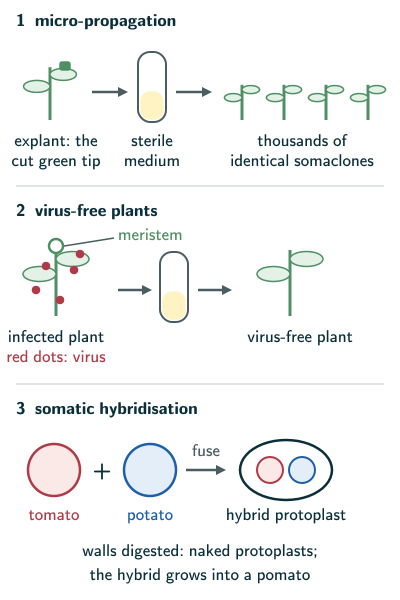
- Micro-propagation is the method of producing thousands of plants through tissue culture, in very short durations. Each of these plants will be genetically identical to the original plant from which it was grown: they are somaclones. Tomato, banana and apple have been produced on a commercial scale this way (page 178). Beyond the NCERT text: tissue culture can introduce somaclonal variation, variation among the plants it produces (Wikipedia, “Somaclonal variation”, facts in our words).
Virus-free plants from meristems
- Tissue culture also recovers healthy plants from diseased plants. Even if a plant is infected with a virus, its meristem (apical and axillary) is free of virus, so it can be removed and grown in vitro to obtain virus-free plants (page 178).
- Scientists have succeeded in culturing meristems of banana, sugarcane and potato (page 178).
Somatic hybridisation
- Single cells isolated from plants have their cell walls digested, leaving naked protoplasts surrounded by plasma membranes (page 178).
- Protoplasts from two different varieties, each with a desirable character, can be fused to give hybrid protoplasts, which can be further grown to form a new plant (pages 178–179). These are somatic hybrids, and the process is somatic hybridisation (pages 178–179).
- A protoplast of tomato fused with one of potato gave the pomato, but this plant did not have all the desired combination of characteristics for commercial use (page 179).
Genetically modified plants
NCERT asks whether there is a way to minimise the use of fertilisers and chemicals, to reduce their harmful effects on the environment; GM crops are a possible solution (page 179). Genetic modification has (page 179):
- made crops more tolerant to abiotic stresses (cold, drought, salt, heat);
- reduced reliance on chemical pesticides (pest-resistant crops);
- helped to reduce post-harvest losses;
- increased the efficiency of mineral usage by plants (this prevents early exhaustion of fertility of soil);
- enhanced the nutritional value of food, for example golden rice, a Vitamin A enriched rice (page 179). Beyond the NCERT text: golden rice makes beta-carotene (provitamin A), which the body converts to vitamin A (Wikipedia, “Golden rice”, facts in our words).
GM has also been used to create tailor-made plants that supply alternative resources to industries: starches, fuels and pharmaceuticals (page 179).
Bt cotton and cry genes
-
Bt toxin is produced by the bacterium Bacillus thuringiensis (Bt for short). NCERT: the Bt toxin gene has been cloned from the bacteria and expressed in plants to provide resistance to insects without the need for insecticides, in effect a bio-pesticide; examples are Bt cotton, Bt corn, rice, tomato, potato and soyabean (page 179). Chapter 8 met Bt as a biocontrol agent sprayed on plants against caterpillars (NCERT Chapter 8, page 157). A Bt crop resists only the insect groups its toxin targets (reasoned from NCERT page 180: most Bt toxins are insect-group specific), and which Bt crops may be grown differs between countries (our reading).
-
Some strains of B. thuringiensis produce proteins that kill certain insects: lepidopterans (tobacco budworm, armyworm), coleopterans (beetles) and dipterans (flies, mosquitoes) (page 179).
-
B. thuringiensis forms protein crystals during a particular phase of its growth; the crystals contain a toxic insecticidal protein (page 179).
-
NCERT asks why the toxin does not kill the Bacillus. NCERT’s answer: the Bt toxin protein exists as inactive protoxins, and once an insect ingests them, they are converted into an active form due to the alkaline pH of the gut, which solubilises the crystals (page 179); give this in an NCERT-based answer. Beyond the NCERT text: the alkaline gut dissolves the crystals so that gut proteases can cut out the active toxin, and only insects with matching gut receptors are affected (Wikipedia, “Bacillus thuringiensis”, facts in our words).
-
The activated toxin binds to the surface of midgut epithelial cells and creates pores, which cause cell swelling and lysis and eventually the death of the insect (page 179).
-
Specific Bt toxin genes were isolated from Bacillus thuringiensis and put into several crop plants such as cotton. The choice of genes depends on the crop and the targeted pest, as most Bt toxins are insect-group specific (page 180).
-
The toxin is coded by genes named cry. The proteins encoded by cryIAc and cryIIAb control the cotton bollworms; that of cryIAb controls the corn borer (page 180).
Reading note (page 180): NCERT’s sentence reads “The toxin is coded by a gene cryIAc named cry”; the render of the page prints it so. The name cryIAc there looks stray, since the next sentence lists cryIAc as one of several cry genes. In an exam: the toxin genes are called cry genes, and cryIAc and cryIIAb act against cotton bollworms.
Pest-resistant plants by RNA interference
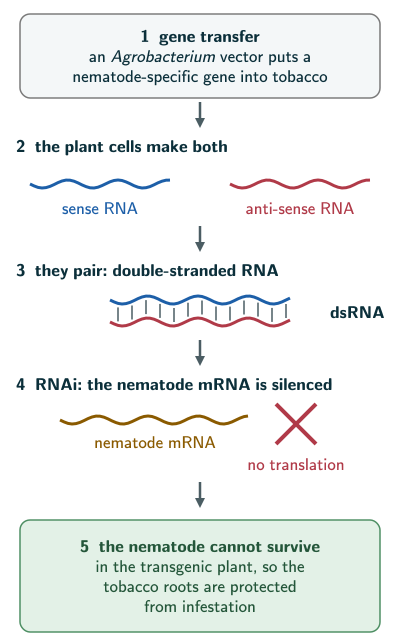
- Several nematodes (the roundworms of NCERT Class 11 Biology, Chapter 4) parasitise a wide variety of plants and animals, including human beings. A nematode, Meloidogyne incognita, infects the roots of tobacco plants and causes a great reduction in yield (page 180).
- The strategy adopted to prevent this infestation is based on RNA interference (RNAi). NCERT: “RNAi takes place in all eukaryotic organisms as a method of cellular defense” (page 180); give this in an NCERT-based answer. Beyond the NCERT text: RNAi is a sequence-specific silencing mechanism found in many eukaryotes, with roles in defence and gene regulation, but some lack it, such as baker’s yeast, Saccharomyces cerevisiae (Wikipedia, “RNA interference”, facts in our words).
- RNAi silences a specific mRNA: a complementary dsRNA molecule binds to it and prevents its translation (page 180); give this in an NCERT-based answer. Beyond the NCERT text: the dsRNA is first cut into small interfering RNAs, and a guide strand leads a silencing complex to the matching mRNA, which is usually degraded (Wikipedia, “RNA interference”, facts in our words).
- The complementary RNA may come from an infection by viruses with RNA genomes, or from mobile genetic elements (transposons) that replicate via an RNA intermediate (page 180).
- Using Agrobacterium vectors, nematode-specific genes were introduced into the host plant, so that the host cells produced both sense and anti-sense RNA. Being complementary, the two formed double-stranded RNA (dsRNA) that initiated RNAi and thus silenced the specific mRNA of the nematode (page 180).
- The parasite could not survive in the transgenic host expressing the specific interfering RNA, so the transgenic plant was protected (page 180). NCERT Figure 10.2 (page 181) photographs the roots of a control plant and of a protected transgenic plant five days after deliberate infection.
NCERT slip (page 180): NCERT prints the nematode as “Meloidegyne incognitia”. The species is Meloidogyne incognita: the NCBI Taxonomy database (US National Library of Medicine, public domain) lists Meloidogyne incognita and finds neither ‘Meloidegyne’ nor ‘incognitia’. In an exam, write Meloidogyne incognita; an option spelt as NCERT prints it means the same nematode.
Solved examples
Example 1: Virus-free plants
Which part of the plant is best suited for making virus-free plants and why? (NCERT Exercise 1, page 186.)
Answer: the meristem, apical or axillary. Even if the plant is infected with a virus, the meristem is free of virus, so it can be removed and grown in vitro to obtain virus-free plants, as has been done for banana, sugarcane and potato (NCERT page 178).
Example 2: Why Bt does not kill itself
Crystals of Bt toxin produced by some bacteria do not kill the bacteria themselves because (a) bacteria are resistant to the toxin; (b) toxin is immature; (c) toxin is inactive; (d) bacteria encloses toxin in a special sac. (NCERT Exercise 4, pages 186–187.)
Answer: (c). The Bt toxin exists as an inactive protoxin; once an insect ingests it, the alkaline pH of the gut solubilises the crystals and converts it into the active toxin (NCERT page 179). Beyond the NCERT text: gut proteases release the active toxin, and only insects with matching gut receptors are affected (Wikipedia, “Bacillus thuringiensis”, facts in our words).
Example 3: Cry proteins
What are Cry proteins? Name an organism that produces them. How has man exploited them to his benefit? (NCERT Exercise 7, page 187.)
Answer: Cry proteins are the insecticidal Bt toxin proteins coded by the cry genes. They are produced by the bacterium Bacillus thuringiensis. The genes have been put into crop plants, so that the plants make the toxin themselves and resist insects without insecticides: the proteins of cryIAc and cryIIAb protect Bt cotton against bollworms, and that of cryIAb protects corn against the corn borer (NCERT pages 179–180).
Common mistakes to avoid
Common mistake
Saying the Bt toxin is active inside the bacterium
The Bt toxin exists as an inactive protoxin; once an insect ingests it, the alkaline pH of the gut solubilises the crystals and converts it into the active toxin (NCERT page 179). Beyond the NCERT text: gut proteases release the active toxin, and only insects with matching gut receptors are affected (Wikipedia, “Bacillus thuringiensis”, facts in our words).
Common mistake
Confusing somaclones with somatic hybrids
NCERT: plants from micropropagation are genetically identical to the original plant, i.e., somaclones; somatic hybrids come from fusing protoplasts of two different varieties (NCERT page 178). Beyond the NCERT text: culture can introduce somaclonal variation (Wikipedia, “Somaclonal variation”, facts in our words).
Common mistake
Thinking RNAi poisons the nematode
The plant’s dsRNA silences a specific mRNA of the nematode; this is not Bt toxin action (NCERT page 180).
Quick revision summary
- Three options for more food: agro-chemical based, organic, and genetically engineered crop-based agriculture. The Green Revolution tripled the food supply, mainly through management and agrochemicals.
- Tissue culture: explants grown in sterile nutrient media (sucrose, salts, vitamins, amino acids, auxins, cytokinins); totipotency; micropropagation gives thousands of genetically identical plants (somaclones) in a short time (NCERT); beyond the NCERT text, culture can introduce somaclonal variation.
- Meristem culture gives virus-free plants. Fusing protoplasts gives somatic hybrids (pomato).
- GM crops: stress tolerance, fewer pesticides, fewer post-harvest losses, better mineral use, better nutrition (golden rice).
- Bt toxin: inactive protoxin in crystals, activated by the alkaline pH of the insect gut (NCERT); pores in midgut cells kill the insect. cryIAc and cryIIAb against cotton bollworms; cryIAb against the corn borer.
- RNAi: sense and anti-sense RNA form dsRNA that silences the nematode’s mRNA; the transgenic tobacco is protected.
Formula sheet
- totipotency: a whole plant from any cell
- micropropagation: identical somaclones
- virus-free plants: meristem culture
- fused protoplasts: somatic hybrid
- Bt protoxin: activated by alkaline insect gut
- cryIAc, cryIIAb: cotton bollworms
- RNAi: dsRNA silences a specific mRNA
Questions students ask
Are tissue culture and micropropagation the same?
No, tissue culture and micropropagation are not the same: tissue culture regenerates whole plants from explants, “any part of a plant taken out and grown in a test tube, under sterile conditions in special nutrient media”, and micro-propagation is one use of it, the propagation of a large number of plants (NCERT page 178). The same technique also recovers virus-free plants from meristems and, after protoplast fusion, gives somatic hybrids (pages 178–179). Totipotency, often confused with both, is not a technique at all but the capacity to generate a whole plant from any cell or explant, which tissue culture relies on (page 178).
Is Bt cotton banned in India?
No, Bt cotton is not banned in India: NCERT itself says that Bt-cotton “is being cultivated in some states of our country” (NCERT Chapter 8, page 157). Beyond the NCERT text, a 2026 country report of the Indian Council of Agricultural Research (ICAR) names Bt cotton as the one GM crop that India has cleared for commercial growing, since 2002. One GM crop that India has held back is Bt brinjal, which the same report places under a moratorium since 2010.
Does Bt cotton protect against all cotton pests?
No, Bt cotton does not protect against all cotton pests: its Bt toxins are aimed at the cotton bollworms, and most Bt toxins are insect-group specific (NCERT page 180). Beyond the NCERT text, the Indian Council of Agricultural Research’s cotton institute counts jassids, whitefly, aphids and thrips, sap-sucking insects outside the bollworm group, among the main threats to the crop, and it reports that the pink bollworm now resists the Cry toxins and is once more a serious pest (ICAR-CICR guide to integrated management of cotton pests, 2026). So, by our reading, Bt cotton still needs other pest management.
Is tissue culture in the NEET (UG) 2026 syllabus?
Tissue culture is not named in the NEET (UG) 2026 syllabus: Unit 9, Biotechnology and Its Applications, has an entry that begins “Application of Biotechnology in health and agriculture”, and the items it then lists, from “Human insulin and vaccine production” to “Biopiracy and patents”, name Bt crops but not tissue culture (National Medical Commission, Syllabus for NEET (UG) 2026). The entry’s opening words still cover it, by our reading, since NCERT teaches tissue culture as an application of biotechnology in agriculture in Section 10.1 of Class 12 Biology (pages 178–179), with micro-propagation, virus-free plants and somatic hybridisation.
Practice questions
Try each question first, then open the answer to check your working.
-
Q1. What is the major advantage of producing plants by micropropagation? (NCERT Exercise 2, page 186.)
Show answerHide answer
Thousands of plants can be produced in very short durations, each genetically identical to the original plant (somaclones); tomato, banana and apple are produced commercially this way (NCERT page 178). Beyond the NCERT text: culture can introduce somaclonal variation (Wikipedia, “Somaclonal variation”, facts in our words).
-
Q2. Name three groups of insects that Bt proteins kill, with an example of each.
Show answerHide answer
Lepidopterans (tobacco budworm, armyworm), coleopterans (beetles) and dipterans (flies, mosquitoes) (NCERT page 179).
-
Q3. In the RNAi strategy against the nematode, what two kinds of RNA did the transgenic plant make, and what did they form?
Show answerHide answer
Sense and anti-sense RNA of the nematode-specific gene; being complementary, they formed double-stranded RNA (dsRNA), which started RNA interference (NCERT page 180).