Processes of recombinant DNA technology
NCERT Class 12 Biology Chapter 9 Section 9.3
Quick answer
Recombinant DNA work can involve DNA isolation, cutting, amplification, joining to a vector, host introduction and product recovery. PCR uses primers and a thermostable polymerase to amplify DNA through repeated denaturation, annealing and extension. Bioreactors support controlled production, followed by purification and appropriate quality checks.
With your textbook
NCERT Biology (Class 12), Chapter 9 “Biotechnology: Principles and Processes”, Section 9.3 “Processes of Recombinant DNA Technology”, pages 171–175.
Open the official NCERT chapter (PDF, 3.1 MB, ncert.nic.in) (opens in a new tab)
Checked against the 2026-27 reprint on .
What are the processes of recombinant DNA technology?
Processes of recombinant DNA technology
Recombinant DNA technology involves several steps in specific sequence such as isolation of DNA, fragmentation of DNA by restriction endonucleases, isolation of a desired DNA fragment, ligation of the DNA fragment into a vector, transferring the recombinant DNA into the host, culturing the host cells in a medium at large scale and extraction of the desired product.
NCERT Biology (Class 12), Section 9.3, page 171
In plain words: get pure DNA out of the cell, cut out the gene you want, copy it, put it into a vector and a host, let the host make the protein, grow the host in huge tanks, and finally purify and package the product.
Isolation of the genetic material (DNA)
- Nucleic acid is the genetic material of all organisms; in most it is DNA. To be cut with restriction enzymes, DNA must be pure, free from other macromolecules (page 171).
- DNA is enclosed within membranes, so the cell is broken open, releasing DNA along with RNA, proteins, polysaccharides and lipids. This is done by treating the cells or tissue with enzymes such as lysozyme (bacteria), cellulase (plant cells) and chitinase (fungus) (page 171).
- Genes lie on long DNA molecules intertwined with proteins such as histones. RNA is removed with ribonuclease and proteins with protease; other molecules are removed by suitable treatments (page 171).
- Purified DNA finally precipitates on adding chilled ethanol, seen as a collection of fine threads in the suspension, which can be removed by spooling, as NCERT Figure 9.5 (page 171) shows. Beyond the NCERT text: in practice a salt is added along with the ethanol (Wikipedia, “Ethanol precipitation”, facts in our words).
Cutting of DNA at specific locations
- Restriction enzyme digestion: purified DNA is incubated with the restriction enzyme at the optimal conditions for that enzyme (page 172).
- Agarose gel electrophoresis checks the progress of the digestion: DNA, being negatively charged, moves towards the positive electrode, the anode (page 172). The process is repeated with the vector DNA (page 172).
- After the source DNA and the vector DNA are cut with a specific restriction enzyme, the cut-out ‘gene of interest’ and the cut vector with space are mixed and ligase is added, giving recombinant DNA (page 172).
Amplification of the gene of interest using PCR
- PCR stands for polymerase chain reaction. Multiple copies of the gene (or DNA) of interest are synthesised in vitro using two sets of primers, small chemically synthesised oligonucleotides complementary to regions of the DNA, and the enzyme DNA polymerase (pages 172–173). Beyond the NCERT text: the two primers pair with opposite strands, one at each end of the target (Wikipedia, “Polymerase chain reaction”, facts in our words).
- The enzyme extends the primers using the nucleotides provided in the reaction, with the genomic DNA as template. Repeated many times, the segment of DNA is amplified approximately a billion times (page 173).
- Repeated amplification is possible because the DNA polymerase used is thermostable, isolated from the bacterium Thermus aquaticus (NCERT Figure 9.6 labels it Taq polymerase): it stays active during the high temperature that denatures the double-stranded DNA (page 173). The amplified fragment can then be ligated with a vector for further cloning (page 173). Beyond the NCERT text: other heat-stable polymerases are also used; some proofread their copies; these are more accurate but run slower (Wikipedia, “Polymerase chain reaction”, facts in our words).
- Each cycle has three steps: (i) denaturation, (ii) primer annealing and (iii) extension of primers (NCERT Figure 9.6, page 172).
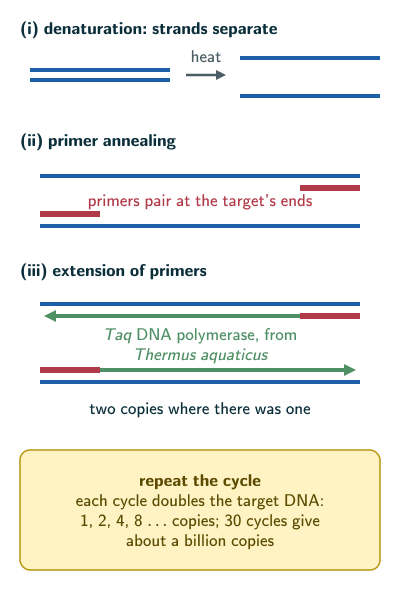
In the ideal model, the target DNA doubles each cycle: after n cycles, one molecule becomes 2n (our arithmetic). NCERT Figure 9.6 (page 172) runs 30 cycles and shows the product amplified about a billion times; 230 = 1 073 741 824 bears this out (our arithmetic). Beyond the NCERT text: in a real reaction the doubling slows and then stops, at a plateau, as the polymerase loses activity and the primers and nucleotides run out (Wikipedia, “Polymerase chain reaction”, facts in our words).
Insertion of recombinant DNA into the host
- Recipient cells, after being made competent, take up DNA present in their surroundings (page 173).
- If a recombinant DNA carrying a gene for resistance to an antibiotic such as ampicillin is transferred into E. coli, the host cells become ampicillin-resistant. Spread on agar plates containing ampicillin, only the transformants grow; untransformed cells die. The ampicillin resistance gene is here a selectable marker (page 173). A plasmid without an insert also gives ampicillin resistance, so a second marker is needed to tell the recombinants apart, as with pBR322 (reasoned from NCERT pages 169–170).
Obtaining the foreign gene product
- The alien DNA inserted into a cloning vector multiplies in the bacterial, plant or animal cell. In almost all recombinant technologies the ultimate aim is a desirable protein, so the recombinant DNA must be expressed; the foreign gene is expressed under appropriate conditions (page 173). Beyond the NCERT text: for that, the vector supplies signals the host can read, such as a suitable promoter; a vector built for this is an expression vector (Wikipedia, “Expression vector”, facts in our words).
- A protein encoded by a gene expressed in a heterologous host is a recombinant protein (page 173).
- Cells may be grown on a small scale, and the protein extracted and purified by separation techniques. They can also be multiplied in a continuous culture system, where used medium is drained out from one side and fresh medium added from the other, keeping the cells in their most active log (exponential) phase; this gives a larger biomass and higher yields (pages 173–174). Beyond the NCERT text: run at a steady state, such a culture (a chemostat) keeps the cells growing at a constant rate while the cell concentration stays constant (Wikipedia, “Chemostat”, facts in our words).
- NCERT asks why large-scale production is needed (page 173): small volume cultures cannot yield appreciable quantities of products (page 174).
Bioreactors
- To produce in large quantities, bioreactors were developed, in which large volumes (100–1000 litres) of culture can be processed. They are vessels in which raw materials are biologically converted into specific products, individual enzymes and so on, using microbial, plant, animal or human cells (page 174).
- A bioreactor provides the optimal conditions for the desired product: optimum growth conditions of temperature, pH, substrate, salts, vitamins and oxygen (page 174).
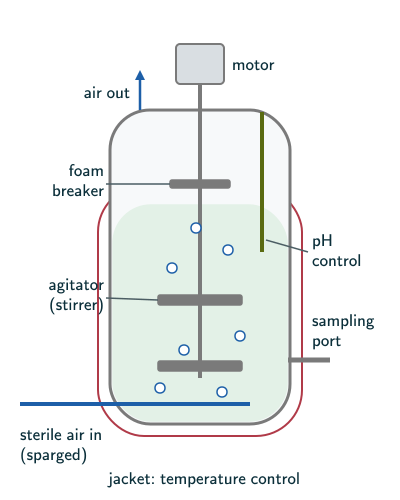
- The most commonly used bioreactors are of the stirring type. A stirred-tank reactor is usually cylindrical or has a curved base to help mix its contents. The stirrer gives even mixing and oxygen availability throughout; alternatively, air can be bubbled through the reactor (a sparged stirred-tank bioreactor) (page 174).
- NCERT Figure 9.7 (page 174) shows (a) a simple stirred-tank bioreactor and (b) a sparged one, “through which sterile air bubbles are sparged”; the bubbles greatly increase the area for oxygen transfer, as the figure’s labels note. Figure 9.7 (a) also draws a foam breaker on the stirrer shaft, part of the foam control system (NCERT’s label spells it ‘braker’).
- A bioreactor has an agitator system, an oxygen delivery system, a foam control system, a temperature control system, a pH control system and sampling ports, so that small volumes of the culture can be withdrawn from time to time (page 174).
Downstream processing
- After the biosynthetic stage, the product passes through a series of processes before it is ready for marketing as a finished product: separation and purification, together called downstream processing (pages 174–175).
- The product is formulated with suitable preservatives. A formulation must undergo thorough clinical trials, as for drugs, and every product needs strict quality control testing. Downstream processing and quality control vary from product to product (page 175).
Solved examples
Example 1: Copies after PCR
A PCR starts with 5 copies of a target DNA. Assuming every cycle doubles it, how many copies are there after 20 cycles?
Answer: each cycle doubles the DNA (reasoned from NCERT pages 172–173), so copies = 5 × 220 = 5 × 1 048 576 = 5 242 880.
Example 2: Stirred tanks and shake flasks
Besides better aeration and mixing, what other advantages do stirred-tank bioreactors have over shake flasks? (NCERT Exercise 6, page 175.)
Answer: they process large volumes (100–1000 litres), so appreciable quantities of product can be made, which small cultures cannot yield; and they have systems that keep conditions optimal throughout: temperature control, pH control, foam control, oxygen delivery, and sampling ports to withdraw small volumes for checking (NCERT page 174).
Example 3: Isolating DNA
Which enzymes break open bacterial, plant and fungal cells, and how are RNA and proteins removed from the DNA? (Chitinase is NCERT Exercise 11 (c), page 176.)
Answer: lysozyme for bacteria, cellulase for plant cells and chitinase for fungi; RNA is removed with ribonuclease and proteins with protease, and the purified DNA is precipitated with chilled ethanol (NCERT page 171). Chitinase digests chitin, which with polysaccharides makes up fungal cell walls (NCERT Class 11 Biology, Section 2.3, page 16), so it helps break fungal cells open to release their DNA.
Common mistakes to avoid
Common mistake
Using an ordinary DNA polymerase in PCR
PCR repeatedly heats the DNA to denature it, so it needs a thermostable DNA polymerase, such as the one from Thermus aquaticus, which stays active at that high temperature (NCERT page 173).
Common mistake
Calling purification ‘upstream’
Separation and purification after the biosynthetic stage are downstream processing; formulation, clinical trials and quality control follow (NCERT pages 174–175).
Common mistake
Thinking a closed culture gives the bigger yield
A continuous culture, with fresh medium added and used medium drained, keeps the cells in their most active log phase, giving more biomass and higher yields (NCERT pages 173–174).
Quick revision summary
- Steps: isolate DNA; cut with restriction endonucleases; isolate the desired fragment; ligate into a vector; transfer into the host; culture at large scale; extract the product.
- Isolation: lysozyme (bacteria), cellulase (plants), chitinase (fungi); ribonuclease removes RNA, protease proteins; chilled ethanol precipitates DNA, removed by spooling.
- Cutting: digestion checked by agarose gel electrophoresis (DNA to the anode); same enzyme for source and vector; ligase makes recombinant DNA.
- PCR: two primers, DNA polymerase, template; cycles of denaturation, annealing, extension; thermostable Taq polymerase from Thermus aquaticus; 30 cycles give about a billion copies.
- Host: competent cells; ampicillin resistance as selectable marker. Product: recombinant protein from a heterologous host; continuous culture keeps cells in log phase.
- Bioreactors (100–1000 litres): optimal temperature, pH, substrate, salts, vitamins, oxygen; stirred-tank, curved base; agitator, oxygen delivery, foam, temperature and pH control, sampling ports. Downstream processing: separation and purification, formulation, clinical trials, quality control.
Formula sheet
- PCR: denaturation, annealing, extension
- ideal PCR copies = 2n × start
- lysozyme, cellulase, chitinase open cells
- chilled ethanol precipitates DNA
- bioreactor: 100–1000 litres
- downstream: separation and purification
Questions students ask
What is the difference between PCR and DNA replication?
PCR copies in vitro only the chosen region between two primers, while DNA replication in a cell, once set in, duplicates the organism’s total DNA, starting at an origin of replication (NCERT pages 172–173; Chapter 5, pages 90–91). PCR uses one enzyme, a DNA polymerase, with chemically synthesised primers (page 173), whereas replication in a cell such as E. coli uses DNA-dependent DNA polymerase and many additional enzymes (page 90). In PCR, heat fully separates the template strands in every cycle (NCERT Figure 9.6, page 172), but in a cell replication occurs within a small opening of the helix, the replication fork (page 90).
What is the polymerase chain reaction (PCR) used for?
The polymerase chain reaction (PCR) is used to make many copies of a chosen stretch of DNA in vitro: in recombinant DNA technology NCERT uses it to amplify the gene of interest, whose copies can then be joined to a vector and cloned (page 173). NCERT Chapter 10 also names PCR among the techniques of early diagnosis, because amplifying the nucleic acid of bacteria or viruses detects them at a very low concentration, while symptoms are not yet visible (page 183). There NCERT adds that PCR is now routinely used to detect HIV in suspected AIDS patients, and that it is being used to detect mutations in genes in suspected cancer patients too (page 183).
Are a bioreactor and a fermentor the same?
A fermentor is, by our reading of NCERT, one kind of bioreactor: NCERT Chapter 8 calls the very large vessels in which microbes are grown for industrial production “fermentors” (page 151), while Chapter 9 defines bioreactors more broadly, as vessels in which raw materials are biologically converted into specific products using microbial, plant, animal or human cells (page 174). So a fermentor growing microbes for products such as beverages and antibiotics (page 151) is a bioreactor, but a bioreactor need not hold microbes at all (our reading).
What is the difference between upstream and downstream processing?
Upstream processing makes the product and downstream processing recovers it: NCERT names only the second, the separation and purification that a product goes through after the biosynthetic stage (pages 174–175). Beyond the NCERT text, upstream processing covers every stage before that point, from choosing the production cells and optimising their medium to scaling the culture up, one vessel size at a time, until it runs in the production bioreactor (Tripathi and Shrivastava, Frontiers in Bioengineering and Biotechnology, 2019, CC BY). By our reading, the bioreactor stage that NCERT describes (page 174) belongs to the upstream side.
What is the difference between a batch culture and a continuous culture?
Batch and continuous cultures differ in how the medium is supplied: beyond the NCERT text, a batch culture is one in which “all essential nutrients are provided in the initial base medium” (Tripathi and Shrivastava, 2019, CC BY), whereas NCERT’s continuous culture system keeps replacing used medium with fresh medium as the cells grow (page 173). The same review describes a middle course, fed-batch culture, in which nutrients are added during growth, and finds batch, fed-batch and continuous modes all in use for producing recombinant proteins. NCERT itself describes neither batch nor fed-batch culture (our reading of pages 173–174).
Practice questions
Try each question first, then open the answer to check your working.
-
Q1. Explain briefly the polymerase chain reaction. (NCERT Exercise 11 (a), page 176.)
Show answerHide answer
PCR makes multiple copies of a gene or DNA of interest in vitro, using two sets of primers and a thermostable DNA polymerase from Thermus aquaticus; each cycle of denaturation, primer annealing and extension doubles the target, and repeated cycles amplify it about a billion times (NCERT pages 172–173). Beyond the NCERT text: a real reaction finally levels off at a plateau (Wikipedia, “Polymerase chain reaction”, facts in our words).
-
Q2. What is a recombinant protein?
Show answerHide answer
A protein encoded by a gene that is expressed in a heterologous host (NCERT page 173).
-
Q3. How many copies of a single DNA molecule does PCR give after 10 cycles, assuming perfect doubling?
Show answerHide answer
210 = 1024 copies (doubling each cycle, reasoned from NCERT pages 172–173).