Principles of biotechnology
NCERT Class 12 Biology Chapter 9 Section 9.1
Quick answer
Biotechnology uses organisms, cells or biological components to make useful products and processes. Genetic engineering changes selected DNA sequences, while bioprocess engineering controls production. An alien piece of DNA multiplies in a host only when linked to an origin of replication; making multiple identical copies of it is cloning.
With your textbook
NCERT Biology (Class 12), Chapter 9 “Biotechnology: Principles and Processes”, Section 9.1 “Principles of Biotechnology”, pages 163–165.
Open the official NCERT chapter (PDF, 3.1 MB, ncert.nic.in) (opens in a new tab)
Checked against the 2026-27 reprint on .
What is biotechnology?
Biotechnology
- Biotechnology deals with techniques of using live organisms or enzymes from organisms to produce products and processes useful to humans (NCERT Chapter 9, Introduction, page 163).
- The European Federation of Biotechnology (EFB) gives a definition that covers both the traditional view and modern molecular biotechnology:
The integration of natural science and organisms, cells, parts thereof, and molecular analogues for products and services
NCERT Biology (Class 12), Chapter 9, Introduction, page 163
In plain words: people have used living things to make useful products for thousands of years. What is new is that we can now read, cut and move genes, so a microbe can be made to produce a selected product under suitable expression and culture conditions.
- In the broad sense, making curd, bread or wine, all microbe-mediated processes, could be thought of as biotechnology. Today the word is used in a restricted sense, for processes that use genetically modified organisms to achieve the same on a larger scale (page 163).
- Many other techniques also count as biotechnology: in vitro fertilisation leading to a ‘test-tube’ baby, synthesising a gene and using it, developing a DNA vaccine, or correcting a defective gene (page 163).
The two core techniques
Among many, the two core techniques that enabled the birth of modern biotechnology are (pages 163–164):
- Genetic engineering: techniques to alter the chemistry of genetic material (DNA and RNA), to introduce it into host organisms and so change the phenotype of the host organism.
- Bioprocess engineering: maintenance of a sterile (microbial contamination-free) ambience in chemical engineering processes, so that only the desired microbe or eukaryotic cell grows, in large quantities, for the manufacture of biotechnological products such as antibiotics, vaccines and enzymes.
Why genetic engineering?
- Sexual reproduction provides opportunities for variation and unique combinations of genes, some of which may benefit the organism and the population; asexual reproduction preserves the genetic information, while sexual reproduction permits variation (page 164). Beyond the NCERT text: mutations can still introduce variation in asexual lines (our reading).
- Traditional hybridisation in plant and animal breeding very often leads to the inclusion and multiplication of undesirable genes along with the desired ones (page 164).
- NCERT: genetic engineering, which includes the creation of recombinant DNA, the use of gene cloning and gene transfer, overcomes this limitation and lets us isolate and introduce only one or a set of desirable genes without introducing undesirable genes (page 164). Beyond the NCERT text: unintended effects still have to be assessed (our reading).
Cloning and the origin of replication
- NCERT asks what happens to a piece of DNA transferred into an alien organism. Most likely it would not be able to multiply in the progeny cells. But if it is integrated into the genome of the recipient, it may multiply and be inherited along with the host DNA, because it has become part of a chromosome, which can replicate (page 164).
- A chromosome has a specific DNA sequence, the origin of replication, which is responsible for initiating replication (page 164); it is the same origin met in DNA replication in NCERT Chapter 5. Beyond the NCERT text: most bacterial chromosomes have a single origin, while the much larger eukaryotic chromosomes start copying at many origins (Wikipedia, “Origin of replication”, facts in our words).
- So an alien piece of DNA is linked with an origin of replication, so that it can replicate and multiply in the host organism. This is cloning: making multiple identical copies of any template DNA (page 164).
The first recombinant DNA
NCERT account: pages 164–165 attribute recombinant plasmid construction to Stanley Cohen and Herbert Boyer in 1972, describing an antibiotic-resistance gene, a Salmonella typhimurium plasmid and cloning in E. coli. In an NCERT-based answer, give NCERT’s Cohen and Boyer, 1972.
Beyond the NCERT text, a historical distinction: Paul Berg and colleagues constructed recombinant DNA in vitro in 1972 (Jackson, Symons and Berg, PNAS, 1972). Cohen, Chang, Boyer and Helling reported biologically functional recombinant bacterial plasmids in 1973 (PNAS, 1973; Cohen, PNAS, 2013). These are different milestones; NCERT’s Cohen and Boyer, 1972, is the answer for an NCERT-based question, not the published chronology.
The mechanism to learn is: a restriction enzyme cuts DNA, a vector carries the selected fragment, DNA ligase joins the ends of cut DNA molecules, and the recombinant plasmid is copied in a suitable host using host replication machinery (pages 164–165). “Autonomously replicating” does not mean the plasmid copies itself without the host: in NCERT’s account the host’s DNA polymerase copies it (reasoned from NCERT page 165).
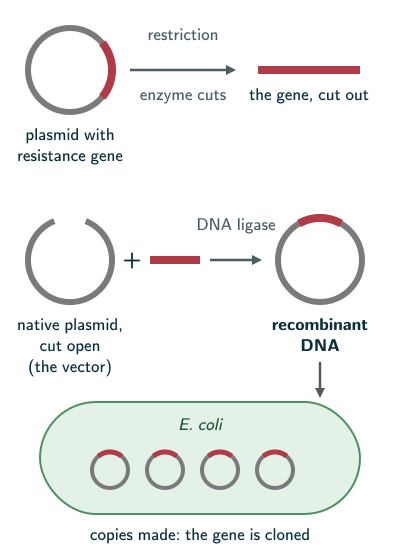
Three basic steps in genetic modification
There are three basic steps in genetically modifying an organism (page 165):
- identification of DNA with desirable genes;
- introduction of the identified DNA into the host;
- maintenance of the introduced DNA in the host and transfer of the DNA to its progeny.
Solved examples
Example 1: Origin of replication
Describe briefly the origin of replication. (NCERT Exercise 10 (a), page 176.)
Answer: a specific DNA sequence in a chromosome that is responsible for initiating replication. An alien piece of DNA can multiply in a host only if it is linked to an origin of replication, as part of a chromosome or a vector; it then makes multiple identical copies, which is cloning (NCERT pages 164–165).
Example 2: Plasmid and chromosomal DNA
How can plasmid DNA be told apart from chromosomal DNA? (NCERT Exercise 12 (a), page 176.)
Answer: in a bacterium the genomic DNA is a single chromosome, itself circular; plasmids are smaller circular DNA outside it, which give the bacterium unique phenotypic characters such as resistance to antibiotics (NCERT Class 11 Biology, Section 8.4, page 90). A plasmid is autonomously replicating extra-chromosomal DNA (NCERT page 164): it replicates independently of the control of chromosomal DNA, at anything from one or two to 15–100 or more copies per cell (NCERT page 168), which is why it can serve as a vector. So tell them apart by size, copy number and the genes they carry. Beyond the NCERT text: most plasmids are rings, yet some linear ones have been found, so shape alone is not a safe test (Wikipedia, “Plasmid”, facts in our words).
Example 3: Recombination in meiosis
Can you recall meiosis and indicate at what stage a recombinant DNA is made? (NCERT Exercise 8, page 175.)
Answer: during crossing over in prophase I of meiosis, at pachytene, when non-sister chromatids of homologous chromosomes exchange segments, the chromosomes carry new, recombinant combinations of genes (NCERT Class 11 Biology, Chapter 10). Genetic engineering makes recombinant DNA artificially, in vitro, with restriction enzymes and DNA ligase (NCERT page 165).
Common mistakes to avoid
Common mistake
Thinking any DNA put into a cell will multiply
An alien piece of DNA most likely cannot multiply in the progeny cells; it must be linked to an origin of replication, as part of a chromosome or a vector (NCERT pages 164–165).
Common mistake
Swapping the jobs of restriction enzymes and ligase
Restriction enzymes cut DNA at specific locations (‘molecular scissors’); DNA ligase joins the ends of cut DNA molecules (NCERT pages 164–165).
Common mistake
Calling bioprocess engineering a genetic technique
Bioprocess engineering is about keeping large-scale culture sterile so only the desired cells grow; altering genetic material is genetic engineering (NCERT pages 163–164).
Quick revision summary
- Biotechnology: using live organisms or their enzymes for useful products and processes; today, mainly processes using genetically modified organisms on a larger scale, though many other techniques are included too. EFB definition: the integration of natural science and organisms, cells, parts thereof and molecular analogues for products and services.
- Core techniques: genetic engineering (alter genetic material, introduce it into a host, change its phenotype) and bioprocess engineering (sterile large-scale growth of only the desired cells).
- Genetic engineering overcomes the limitation of hybridisation: only one or a set of desirable genes is introduced, without undesirable genes (NCERT).
- Alien DNA multiplies only when linked to an origin of replication; making identical copies is cloning.
- History: NCERT gives Cohen and Boyer, 1972. Beyond the NCERT text: Berg’s 1972 in-vitro recombinant DNA; the Cohen–Chang–Boyer–Helling 1973 functional plasmid paper.
- Three steps: identify the desirable DNA; introduce it into the host; maintain it in the host and pass it to the progeny.
Formula sheet
- biotechnology: organisms or enzymes for useful products
- core techniques: genetic and bioprocess engineering
- origin of replication: starts replication
- restriction enzyme cuts; DNA ligase joins
- plasmid: circular extra-chromosomal DNA
- steps: identify, introduce, maintain DNA
Questions students ask
Is genetic engineering the same as recombinant DNA technology?
Genetic engineering and recombinant DNA technology are, in NCERT, two names for the same key process: Section 9.2 opens with “genetic engineering or recombinant DNA technology” (page 165), and the chapter summary, after describing how humans learnt to alter the chemistry of DNA and construct recombinant DNA, calls this key process “recombinant DNA technology or genetic engineering” (page 175). Under either name, the same summary says, the process covers cutting DNA with restriction endonucleases, joining it with DNA ligase, ferrying it into a host on a plasmid or viral vector, and getting the foreign gene expressed and its protein purified (page 175).
What is the difference between an origin of replication and a promoter?
An origin of replication is the DNA sequence where replication starts, while a promoter is the DNA sequence where transcription of a gene starts: NCERT calls the origin the specific sequence in a chromosome “responsible for initiating replication” (page 164), and its Chapter 5 says RNA polymerase binds to the promoter and initiates transcription (page 93). So the origin lets DNA be copied and passed on to progeny cells, while the promoter lets a gene be copied into RNA on the way to its protein (our reading). A cloned gene that has to make a protein, which NCERT calls the ultimate aim of almost all recombinant technologies (page 173), therefore needs both (our reading).
Is gene editing the same as genetic engineering?
Gene editing (genome editing) is by our reading a newer kind of genetic engineering: beyond the NCERT text, the US National Human Genome Research Institute (public domain) says its tools “act like scissors, cutting the DNA at a specific spot”, after which scientists “can remove, add, or replace the DNA where it was cut”, and that many scientists now use CRISPR. It shares the aim NCERT gives genetic engineering, altering genetic material to change the phenotype of the host organism (pages 163–164; our reading), but where this chapter’s recombinant DNA method carries DNA into a host on a vector (pages 164–165), gene editing changes the cell’s own DNA at the cut (our reading).
Is biotechnology: principles and processes in the NEET (UG) 2026 syllabus?
Yes, biotechnology: principles and processes is in the NEET (UG) 2026 syllabus: Unit 9, Biotechnology and Its Applications, opens with “Principles and process of Biotechnology: Genetic engineering (Recombinant DNA technology).” (National Medical Commission, Syllabus for NEET (UG) 2026). That is NCERT Class 12 Biology Chapter 9 (pages 163–176), whose three sections are this chapter’s three pages. The unit’s second entry, on applications in health and agriculture such as human insulin, gene therapy, Bt crops and transgenic animals, is NCERT Chapter 10.
Practice questions
Try each question first, then open the answer to check your working.
-
Q1. Who made the first recombinant DNA, and in which year according to NCERT?
Show answerHide answer
NCERT page 164 attributes it to Stanley Cohen and Herbert Boyer, 1972. Beyond the NCERT text: Berg’s group made recombinant DNA in vitro in 1972, and Cohen, Chang, Boyer and Helling reported functional recombinant plasmids in 1973 (Cohen, PNAS, 2013).
-
Q2. What is meant by cloning?
Show answerHide answer
Making multiple identical copies of any template DNA (NCERT page 164).
-
Q3. List the three basic steps in genetically modifying an organism.
Show answerHide answer
Identification of DNA with desirable genes; introduction of the identified DNA into the host; maintenance of the introduced DNA in the host and transfer of the DNA to its progeny (NCERT page 165).