Energy flow
NCERT Class 12 Biology Chapter 12 Section 12.4
Quick answer
Energy flows through producers, consumers and decomposers, with respiration releasing heat at each level. Sunlight powers most ecosystems, while some use chemical energy. The textbook 10% transfer rule is an approximation for production energy over matching areas and intervals, not a universal efficiency.
With your textbook
NCERT Biology (Class 12), Chapter 12 “Ecosystem”, Section 12.4 “Energy Flow”, pages 209–211.
Open the official NCERT chapter (PDF, 2.4 MB, ncert.nic.in) (opens in a new tab)
Checked against the 2026-27 reprint on .
What is energy flow?
Energy flow
Energy flow is the movement of energy through an ecosystem: it enters as sunlight, is fixed by producers, and passes in one direction from them to the consumers, while some is lost as heat at every step (NCERT pages 206, 209–211 and 213). Its source:
Except for the deep sea hydro-thermal ecosystem, sun is the only source of energy for all ecosystems on Earth.
NCERT Biology (Class 12), Section 12.4, page 209
Beyond the NCERT text: the hydrothermal vents are not the only exception. At cold seeps, where fluids such as methane and sulphides escape from the sea floor, communities often rely on bacteria that turn these chemicals into food by chemosynthesis, not on sunlight (NOAA Ocean Exploration, An Update on Cold Seeps in the Northwestern Atlantic Ocean, 2019; public domain). In an NCERT-based answer, give NCERT’s sentence above.
In plain words: almost every meal on Earth is sunlight at second or third hand. Plants catch a little of the sun’s energy and store it in food; a goat eats the plant, a person eats the goat, and at each level respiration releases heat; uneaten material and wastes also divert energy into detrital pathways. Energy runs down the chain once and does not come back, so the sun has to keep supplying it.
Sunlight and photosynthetically active radiation
- Of the incident solar radiation, less than 50 per cent is photosynthetically active radiation (PAR) (page 209).
- Plants and photosynthetic bacteria (autotrophs) fix the Sun’s radiant energy to make food from simple inorganic materials. Plants capture only 2–10 per cent of the PAR, and this small amount of energy sustains the entire living world (page 209).
- All organisms depend for their food on producers, directly or indirectly, so there is a unidirectional flow of energy from the sun to producers and then to consumers (page 209).
NCERT asks whether this is in keeping with the first law of thermodynamics (page 209). It is. The first law is energy conservation: energy is not created or destroyed but changes form. Light energy becomes chemical energy in food, the food’s energy passes to consumers, and at each step part of it becomes heat; nothing is lost from the total, it only changes form (reasoned from NCERT page 209 and NCERT Class 11 Physics, Chapter 11).
- Ecosystems are not exempt from the Second Law of thermodynamics: they need a constant supply of energy to synthesise the molecules they require, to counteract the universal tendency toward increasing disorderliness (page 209).
Reading note (pages 209 and 213): NCERT says plants capture 2–10 per cent of the PAR (page 209), while its ideal pyramid of energy shows producers converting only 1 per cent of the sunlight into NPP (NCERT Figure 12.4 (d), page 213). The two fit: PAR is under half of the sunlight, so 2–10 per cent of PAR is less than 1–5 per cent of the sunlight, and NPP is smaller again, because plants use part of what they fix in respiration (our arithmetic from NCERT pages 207, 209 and 213). Learn each figure with its own base: 2–10 per cent of PAR; 1 per cent of sunlight, into NPP, in the ideal pyramid.
Producers and consumers
- The green plants in the ecosystem are called producers. In a terrestrial ecosystem the major producers are herbaceous and woody plants; in an aquatic ecosystem, species such as phytoplankton, algae and higher plants (page 209).
- Starting from the producers, food chains, or rather webs, form: an animal feeds on a plant or on another animal and is in turn food for another (page 209).
- No energy trapped in an organism remains in it for ever: the energy trapped by a producer is either passed on to a consumer or the organism dies. Death is the beginning of the detritus food chain or web (page 209). Part of what the producers fix is used by themselves: a considerable amount of GPP is utilised by plants in respiration (NCERT page 207).
- All animals depend on plants, directly or indirectly, for food, so they are consumers, or heterotrophs (page 209):
- primary consumers feed on the producers: they are herbivores, such as insects, birds and mammals on land and molluscs in water;
- secondary consumers eat animals that eat plants; they are carnivores, more correctly primary carnivores (though secondary consumers);
- animals that depend on the primary carnivores are secondary carnivores; there can be tertiary consumers too.
- A simple grazing food chain (GFC) (page 209): grass (producer) → goat (primary consumer) → man (secondary consumer).
Grazing and detritus food chains
- The detritus food chain (DFC) begins with dead organic matter. It is made up of decomposers, heterotrophs that are mainly fungi and bacteria, which meet their energy and nutrient needs by degrading dead organic matter or detritus (page 210).
- Decomposers are also called saprotrophs (sapro: to decompose). They secrete digestive enzymes that break down dead and waste materials into simple, inorganic materials, which they then absorb (page 210); keep these words in an NCERT-based answer. NCERT’s Class 11 book adds that most fungi absorb soluble organic matter from dead substrates, which is why they are called saprophytes (NCERT Class 11 Biology, Chapter 2).
- In an aquatic ecosystem, the GFC is the major conduit for energy flow. In a terrestrial ecosystem, a much larger fraction of energy flows through the DFC than through the GFC (page 210).
Food webs and trophic levels
- The DFC may be connected with the GFC at some levels: some organisms of the DFC are prey to GFC animals, and some animals, such as cockroaches and crows, are omnivores. These natural interconnections of food chains make a food web (page 210).
- NCERT asks how you would classify human beings (page 210). Humans eat both plants and animals, so, like crows and cockroaches, they are omnivores (reasoned from NCERT page 210).
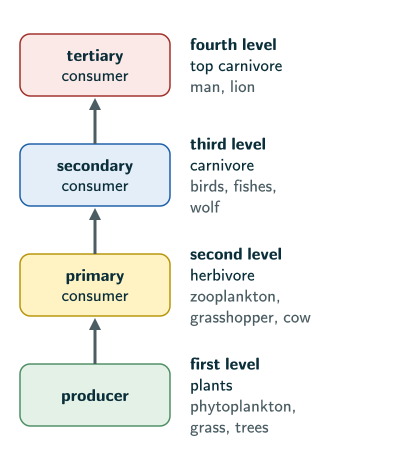
- Organisms occupy a place in the food chain according to their source of food: their trophic level. Producers belong to the first trophic level, herbivores (primary consumers) to the second, and carnivores (secondary consumers) to the third (page 210).
- NCERT Figure 12.2 (page 210) adds a fourth level, the top carnivores (tertiary consumers), with examples at each level:
- first: phytoplankton, grass, trees;
- second: zooplankton, grasshopper and cow;
- third: birds, fishes, wolf;
- fourth: man, lion.
- One animal can sit at two levels: man is the secondary consumer of grass → goat → man (page 209) but a top carnivore in NCERT Figure 12.2, and birds are herbivores on page 209 but carnivores in the figure. A trophic level is a functional level, not a species (NCERT page 213).
- The amount of energy decreases at successive trophic levels. When any organism dies, it becomes detritus, or dead biomass, an energy source for decomposers. Organisms at each trophic level depend on those at the lower level for their energy (page 211).
- The predators of the populations chapter are one link in this flow: predation is nature’s way of transferring the energy fixed by plants to higher trophic levels (NCERT Chapter 11, page 197).
Standing crop
- Each trophic level has a certain mass of living material at a particular time, called the standing crop. It is measured as the mass of living organisms (biomass) or as the number in a unit area (page 211).
- The biomass of a species is expressed as fresh or dry weight; measurement in dry weight is more accurate (page 211).
NCERT asks why dry weight is more accurate (page 211). The water in living tissue varies a great deal, with the time of day, the weather and how recently the organism drank or was watered, and water itself carries no food energy; drying removes this changing part and leaves dry matter, including organic matter and mineral ash, which can be compared fairly (reasoned from NCERT page 211).
The 10 per cent law
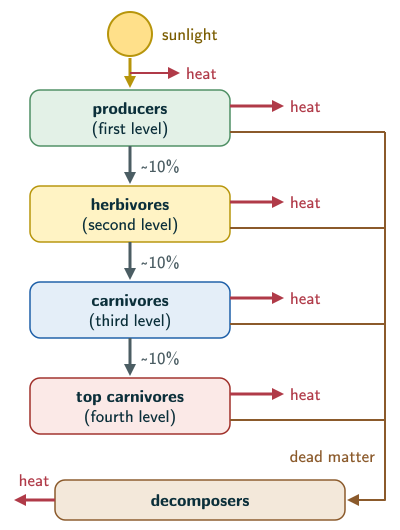
- The number of trophic levels in the grazing food chain is restricted, because the transfer of energy follows the 10 per cent law: only 10 per cent of the energy is transferred to each trophic level from the lower one (page 211).
- In nature, it is possible to have the levels producer, herbivore, primary carnivore and secondary carnivore in the grazing food chain (NCERT Figure 12.3, page 211).
- The 10 per cent figure is a rule of thumb: NCERT itself calls the pyramid built on it, from 10 000 J in producers to 10 J in top carnivores, “an ideal pyramid of energy” (NCERT Figure 12.4 (d), page 213), so a real ecosystem need not pass exactly a tenth at every step (reasoned from NCERT page 213). In an exam, use 10 per cent at every step unless the question gives another figure.
NCERT asks whether there is any such limitation in a detritus food chain (page 211). In principle, yes: every feeding step in a detritus chain also passes on only part of the energy and diverts the rest to respiration, wastes or uneaten material, so it cannot have unlimited steps either. But a detritus chain is fed by dead matter from every trophic level, not only from the one below it, and on land a much larger fraction of the energy flows through it than through the grazing chain (page 210); so its supply is not a single stream that narrows by ten at each step (reasoned from NCERT pages 210–211).
Solved examples
Example 1: The 10 per cent law
The producers of a grassland supply 20 000 J as NPP over a specified area and interval. Following the 10 per cent law, how much reaches the herbivores, the primary carnivores and the secondary carnivores?
Answer: herbivores 20 000 × 0.1 = 2000 J; primary carnivores 200 J; secondary carnivores 20 J (NCERT’s 10 per cent law, page 211).
Example 2: Working backwards
The hawks at the fourth trophic level receive 6 J over a specified area and interval. Under the 10 per cent law, what NPP is required at the producers at the base?
Answer: each step down multiplies by 10: 6 × 10 × 10 × 10 = 6000 J (three transfers: producers to herbivores to primary carnivores to the hawk) (NCERT page 211).
Example 3: From sunlight to plants
Of 1 000 000 J of sunlight falling on a field, at most what share is PAR, and at most how much energy can the plants capture, if they take 2–10 per cent of the PAR?
Answer: PAR is less than 50 per cent, so under 500 000 J. Plants capture at most 10 per cent of that: under 50 000 J, that is under 5 per cent of the sunlight. Even if PAR were the full 50 per cent, capturing 2 per cent of it would give only 10 000 J, 1 per cent of the sunlight (NCERT page 209; our arithmetic).
Common mistakes to avoid
Common mistake
Saying energy cycles in an ecosystem
Energy flows one way, from the sun to producers to consumers, and is lost as heat; only nutrients cycle (NCERT pages 206 and 209).
Common mistake
Taking 2–10 per cent of sunlight
Plants capture 2–10 per cent of the PAR, and PAR is less than half of the incident sunlight (NCERT page 209).
Common mistake
Calling a primary carnivore a primary consumer
A carnivore that eats herbivores is a primary carnivore but a secondary consumer; the primary consumers are the herbivores (NCERT page 209).
Common mistake
Thinking the grazing chain carries most energy everywhere
The grazing food chain is the major conduit in water; on land a much larger fraction of energy flows through the detritus food chain (NCERT page 210).
Quick revision summary
- The sun is the only source of energy for all ecosystems except deep-sea hydrothermal ones. PAR is less than 50 per cent of incident sunlight; plants capture only 2–10 per cent of the PAR.
- Energy flows one way: sun → producers → consumers, with heat lost at each step (first and second laws of thermodynamics).
- Producers: herbaceous and woody plants on land; phytoplankton, algae and higher plants in water. Consumers: herbivores (primary), then primary and secondary carnivores.
- GFC: grass → goat → man; the major conduit in water. DFC: starts with dead organic matter; decomposers (saprotrophs: fungi, bacteria); carries more energy on land.
- Food web: interconnected food chains (omnivores, DFC organisms eaten by GFC animals). Trophic levels: producers first, herbivores second, secondary consumers third and tertiary consumers fourth; the diet determines the level.
- Standing crop: mass (biomass) or number of living organisms at a level at a time; dry weight is more accurate. 10 per cent law: about 10 per cent of energy passes to the next level.
Formula sheet
- PAR < 50% of sunlight
- plants capture 2–10% of PAR
- energy: sun → producers, then consumers
- next level gets about 10%
- GFC: grass → goat → man
- DFC: starts with dead organic matter
Questions students ask
Who gave the 10 per cent law of energy flow?
Beyond the NCERT text, the 10 per cent law goes back to the ecologist Raymond L. Lindeman: a 2026 global synthesis in Science Advances traces the figure to his 1942 paper in the journal Ecology, which worked out how energy moved between the feeding levels of a lake (Wu and colleagues, 2026). NCERT states the law without naming its author (page 211). The same synthesis, pooling 2052 estimates from 122 studies, found that its 1563 estimates for energy average only about 6 per cent from one level to the next, and about 1.5 per cent on land; by our reading, 10 per cent is a convenient round figure, and for NEET you use NCERT’s 10 per cent.
What is the difference between a food chain and a trophic level?
A food chain is the whole sequence of feeding, while a trophic level is one step in it: in a food chain an animal feeds on a plant or on another animal and is in turn food for another, as in grass → goat → man (NCERT page 209), and a trophic level is the specific place an organism occupies in the chain according to its source of food, producers first, herbivores second and carnivores third (page 210). One chain passes through several levels, and one level holds many species: NCERT’s common herbivores, all at the second level, include insects, birds and mammals on land and molluscs in water (page 209). By our reading, a chain names organisms, while a level names a feeding position.
What trophic level are decomposers at?
Decomposers have no single trophic level in NCERT’s scheme: its numbered levels follow the grazing food chain, producers first, herbivores second and carnivores third (NCERT page 210), while decomposers live on detritus, and any organism that dies, at any level, is converted to detritus that serves as an energy source for decomposers (page 211). NCERT Figure 12.3 accordingly draws dead matter flowing to the decomposers from all four trophic levels (page 211). By our reading, a fungus on a fallen leaf feeds on first-level matter and one on a dead top carnivore on fourth-level matter, which is why decomposers are shown as a group beside the levels, not as a fifth level.
Practice questions
Try each question first, then open the answer to check your working.
-
Q1. Give an account of energy flow in an ecosystem. (NCERT Exercise 11, page 215.)
Show answerHide answer
Except for the deep-sea hydrothermal ecosystem, the sun is the only source of energy for all ecosystems. Less than 50 per cent of the incident sunlight is PAR, and plants capture only 2–10 per cent of it, fixing it in food made from simple inorganic materials. This energy flows in one direction: from the producers (green plants; phytoplankton in water) to the herbivores (primary consumers), then to the primary and secondary carnivores, along grazing food chains such as grass → goat → man. When organisms die, their energy passes into the detritus food chain of decomposers, which carries most of the energy on land, while the grazing chain is the main conduit in water. Chains interconnect into food webs. At each trophic level energy decreases: only about 10 per cent passes to the next level (10 per cent law); the rest is lost as heat or passes to the decomposers in dead matter, and this limits the number of trophic levels. Ecosystems obey the laws of thermodynamics and need a constant supply of energy (NCERT pages 206, 209–211 and 213).
-
Q2. Distinguish between the grazing food chain and the detritus food chain. (NCERT Exercise 6(a), page 215.)
Show answerHide answer
The grazing food chain begins with living producers (green plants), which are eaten by herbivores and then carnivores, as in grass → goat → man; it is the major conduit for energy flow in aquatic ecosystems. The detritus food chain begins with dead organic matter and is made up of decomposers (saprotrophs, mainly fungi and bacteria) that secrete enzymes and absorb the simple products; in terrestrial ecosystems a much larger fraction of energy flows through it (NCERT pages 209–210).
-
Q3. The second trophic level in a lake is: (a) phytoplankton; (b) zooplankton; (c) benthos; (d) fishes. (NCERT Exercise 3, page 215.)
Show answerHide answer
(b) Zooplankton: they eat the phytoplankton, the producers of the first trophic level; NCERT Figure 12.2 lists zooplankton at the second trophic level (page 210).