Microbes in sewage treatment
NCERT Class 12 Biology Chapter 8 Section 8.3
Quick answer
Primary treatment removes solids physically, while secondary treatment uses microbes to reduce biodegradable pollution. BOD measures oxygen demand under specified conditions, not all pollutants or drinking-water safety. Some activated sludge returns to aeration, and excess sludge may undergo anaerobic digestion to produce biogas.
With your textbook
NCERT Biology (Class 12), Chapter 8 “Microbes in Human Welfare”, Section 8.3 “Microbes in Sewage Treatment”, pages 153–155.
Open the official NCERT chapter (PDF, 12.9 MB, ncert.nic.in) (opens in a new tab)
Checked against the 2026-27 reprint on .
What is sewage, and why treat it?
Sewage
- Large quantities of waste water are generated every day in cities and towns (page 153).
A major component of this waste water is human excreta. This municipal waste-water is also called sewage.
NCERT Biology (Class 12), Section 8.3, page 153
- Sewage contains large amounts of organic matter and microbes, many of them pathogenic. It cannot be discharged directly into rivers and streams, so it is treated in sewage treatment plants (STPs) to make it less polluting (page 153).
In plain words: the waste water from our homes is full of food for microbes and full of germs. A treatment plant first strains out the solids and then lets useful microbes consume most of the organic matter left in it before the water goes back to a river.
NCERT asks why sewage cannot go straight into rivers (page 153). Its organic matter would pollute the water, and its pathogens would spread disease (our reasoning from NCERT pages 153 and 155: untreated sewage pollutes rivers and increases water-borne diseases). Treatment is done by the heterotrophic microbes naturally present in the sewage, in two stages (pages 153–154); the first stage, primary treatment, is physical, and the microbes do their work in the second (reasoned from NCERT page 154). Such microbes feed on organic matter, like the heterotrophic bacteria of Class 11.
Primary treatment
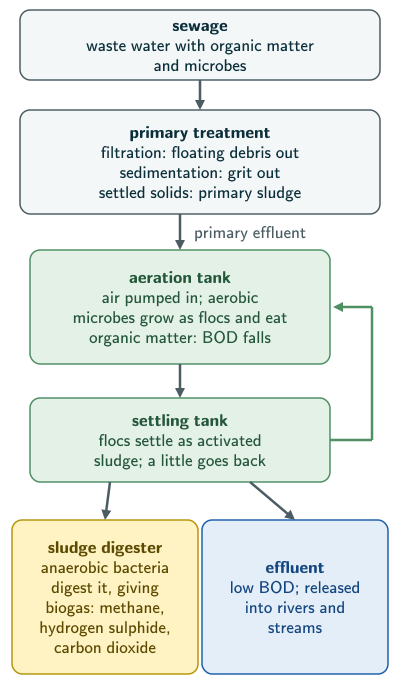
- Primary treatment is the physical removal of particles, large and small, from the sewage through filtration and sedimentation (page 154).
- First, floating debris is removed by sequential filtration. Then the grit (soil and small pebbles) is removed by sedimentation (page 154).
- All the solids that settle form the primary sludge, and the supernatant forms the effluent. The effluent from the primary settling tank goes on to secondary treatment (page 154).
Secondary (biological) treatment
- The primary effluent is passed into large aeration tanks, where it is constantly agitated mechanically and air is pumped into it (page 154).
- This allows vigorous growth of useful aerobic microbes into flocs: masses of bacteria associated with fungal filaments to form mesh-like structures (page 154). They need oxygen for aerobic respiration, which is why air is pumped in (our reasoning).
- While growing, these microbes consume the major part of the organic matter in the effluent, which significantly reduces the BOD of the effluent. The sewage is treated until the BOD is reduced (page 154).
Biochemical oxygen demand (BOD)
BOD refers to the amount of the oxygen that would be consumed if all the organic matter in one liter of water were oxidised by bacteria.
NCERT Biology (Class 12), Section 8.3, page 154
- The BOD test measures the rate of uptake of oxygen by micro-organisms in a sample of water. So, indirectly, BOD is a measure of the organic matter present in the water (page 154).
- The greater the BOD of waste water, the more is its polluting potential (page 154).
- Beyond the NCERT text: in the standard laboratory test, a sample is kept in the dark at 20 °C for five days, and the dissolved oxygen used up in that time, in mg per litre, is its BOD (US EPA Method 405.1, Biochemical Oxygen Demand, five days at 20 °C, in the National Environmental Methods Index; public domain). So the test reports the oxygen used up in a fixed five days, and the method’s stated use is to determine the relative oxygen requirements of waste waters; NCERT’s “rate of uptake” and “all the organic matter” are the idea behind the test, simplified (our reasoning from the method). BOD tracks the oxygen-demanding organic load only: a low BOD does not show that water is free of pathogens or toxic chemicals (our reasoning). In an NCERT-based answer, keep NCERT’s sentences above.
Activated sludge and anaerobic sludge digesters
- Once the BOD has been reduced significantly, the effluent is passed into a settling tank, where the bacterial flocs are allowed to sediment. This sediment is called activated sludge (page 154).
- A small part of the activated sludge is pumped back into the aeration tank to serve as the inoculum (page 154).
- The remaining major part is pumped into large tanks called anaerobic sludge digesters. There, other kinds of bacteria, which grow anaerobically, digest the bacteria and the fungi in the sludge (page 154).
- During this digestion, the bacteria produce a mixture of gases such as methane, hydrogen sulphide and carbon dioxide. These gases form biogas, which can be used as a source of energy because it is inflammable (page 154); biogas is predominantly methane (NCERT Section 8.4, page 155).
- The methanogens such as Methanobacterium, which produce methane, are commonly found in the anaerobic sludge during sewage treatment (NCERT Section 8.4, page 155); NCERT’s Class 11 book places them among the archaebacteria (NCERT Class 11 Biology, Section 2.1.1, page 13).
- The effluent from the secondary treatment plant is generally released into natural water bodies such as rivers and streams (page 154). NCERT Figure 8.7 (page 155) is an aerial view of such a plant.
Microbes, rivers and the action plans
- Microbes treat millions of gallons of waste water every day across the globe. The method has been practised for more than a century, in almost all parts of the world; NCERT adds that, till date, no man-made technology has been able to rival the microbial treatment of sewage (page 155).
- With increasing urbanisation, much more sewage is produced, but the number of treatment plants has not increased enough. Untreated sewage is often discharged directly into rivers, polluting them and increasing water-borne diseases (page 155).
- The Ministry of Environment and Forests has initiated the Ganga Action Plan and the Yamuna Action Plan to save these major rivers from pollution. Under them, a large number of sewage treatment plants are to be built, so that only treated sewage is discharged into the rivers (page 155). This is NCERT’s account as printed; in an exam, give the ministry and the plans as NCERT names them.
Solved examples
Example 1: Labelling three water samples
River water, untreated sewage and the secondary effluent of a sewage treatment plant were labelled A, B and C without noting which was which. Their BOD values were A = 20 mg/L, B = 8 mg/L and C = 400 mg/L. Which sample is most polluted? Label each, assuming the river water is relatively clean. (NCERT Exercise 11, page 159.)
Answer: the greater the BOD, the more organic matter and the more polluting the water (NCERT page 154). Order of BOD: C (400) > A (20) > B (8).
- C, 400 mg/L: untreated sewage, the most polluted.
- A, 20 mg/L: the secondary effluent, whose BOD has already been lowered by treatment.
- B, 8 mg/L: the river water, the cleanest.
Example 2: How much BOD a plant removes
Raw sewage entering a plant has a BOD of 300 mg/L, and the secondary effluent leaving it has 15 mg/L. By what percentage has treatment lowered the BOD?
Answer: fall = 300 − 15 = 285 mg/L; percentage = 285 ÷ 300 × 100 = 95 per cent. The aerobic microbes in the aeration tanks have consumed most of the organic matter (NCERT page 154; the numbers are our own example).
Example 3: Primary and secondary treatment
What is the key difference between primary and secondary sewage treatment? (NCERT Exercise 8, page 159.)
Answer: primary treatment is physical: floating debris and grit are removed by filtration and sedimentation. Secondary treatment is biological: aerobic microbes, growing as flocs in aeration tanks, consume most of the organic matter and so reduce the BOD (NCERT page 154).
Common mistakes to avoid
Common mistake
Thinking a high BOD means clean water
BOD measures the oxygen that bacteria would use to oxidise the organic matter. The higher the BOD, the more organic matter and the more polluting the water (NCERT page 154).
Common mistake
Sending all the activated sludge to the digester
A small part of the activated sludge goes back to the aeration tank as inoculum; only the major remaining part goes to the anaerobic sludge digesters (NCERT page 154).
Common mistake
Calling the aeration tank anaerobic
Air is pumped into the aeration tanks for aerobic microbes; the anaerobic step is the sludge digester, where biogas forms (NCERT page 154).
Quick revision summary
- Sewage: municipal waste water, with human excreta as a major component; rich in organic matter and microbes, many pathogenic; treated in STPs before disposal.
- Primary treatment (physical): filtration removes floating debris, sedimentation removes grit; settled solids form primary sludge; the supernatant is the effluent.
- Secondary treatment (biological): aeration tanks; aerobic microbes grow as flocs and consume organic matter; BOD falls.
- BOD: the oxygen bacteria would use to oxidise all the organic matter in one litre of water; higher BOD, more pollution.
- Activated sludge settles; a small part returns as inoculum; the rest goes to anaerobic sludge digesters, where bacteria make biogas (methane, hydrogen sulphide, carbon dioxide). Effluent goes to rivers.
- Ganga and Yamuna Action Plans: more sewage treatment plants, so that only treated sewage reaches the rivers.
Formula sheet
- primary treatment: filtration, sedimentation
- secondary treatment: aerobic microbes in flocs
- higher BOD → more organic matter
- activated sludge: part back as inoculum
- digester: anaerobic bacteria → biogas
- biogas: methane, HS, CO
Questions students ask
What is the difference between BOD and COD?
BOD lets microbes do the oxidising and COD, beyond the NCERT text, uses a chemical, though both express how much oxygen the matter in a water sample would use up: NCERT defines BOD as the oxygen that would be consumed if all the organic matter in one litre of water were oxidised by bacteria (page 154), while COD (chemical oxygen demand) is measured by heating the sample with dichromate at 150 °C for two hours in the US EPA’s Method 410.4 (public domain), against five days at 20 °C for the standard BOD test (US Geological Survey). By our reading, the chemical also oxidises matter that microbes break down slowly or not at all in that time, which is why COD is normally the higher figure.
Why is BOD measured over five days?
Beyond the NCERT text, BOD is measured over five days by custom rather than for a scientific reason: a US Geological Survey manual (public domain) states that “a 5-day duration for BOD determination has no theoretical grounding but is based on historical convention”. Quoting a 1985 textbook, it traces this to Britain’s Royal Commission on Sewage Disposal early in the twentieth century: no British river takes more than five days to reach the open sea, and 18.3 °C was the top of the country’s long-term average summer temperatures, later rounded up to 20 °C. It adds that five days catch only part of the total demand; by convention, twenty days is taken as enough for complete oxidation.
What is the difference between primary sludge and activated sludge?
Primary sludge is sewage solids removed by settling, while activated sludge is a mass of microbes grown during treatment: NCERT says that all solids that settle in primary treatment form the primary sludge (page 154), a physical step, whereas activated sludge is the sediment of bacterial flocs that forms in a settling tank only after the effluent has been aerated and its BOD reduced (page 154). So primary sludge is collected before the microbes have done their work and activated sludge after it; primary sludge still carries the microbes that come with sewage (page 153), but activated sludge is itself the grown mass of aerobic microbes that did the biological treatment (our reading).
What is the difference between BOD and dissolved oxygen (DO)?
Beyond the NCERT text, dissolved oxygen (DO) is the oxygen actually present in the water, while BOD, as NCERT defines it, is the oxygen that bacteria would use up in oxidising its organic matter (page 154). The US EPA (public domain) defines DO as “the amount of oxygen that is present in water” and explains that microbes decomposing excess organic material consume it, so, by our reading, water with a high BOD tends to lose DO. By the EPA’s general guide, DO below 5 mg/L is considered stressful for fish and below 3 mg/L too low to support them, which is how untreated sewage reaching a river can starve its fish of oxygen (our reading).
Practice questions
Try each question first, then open the answer to check your working.
-
Q1. What are flocs?
Show answerHide answer
Masses of bacteria associated with fungal filaments to form mesh-like structures, which grow in the aeration tanks (NCERT page 154).
-
Q2. Name the gases produced in anaerobic sludge digesters.
Show answerHide answer
A mixture such as methane, hydrogen sulphide and carbon dioxide, which together form biogas (NCERT page 154).
-
Q3. One water sample has a BOD of 60 mg/L and another 6 mg/L. Which is more polluted, and why?
Show answerHide answer
The sample with 60 mg/L: a greater BOD means more organic matter and more polluting potential (NCERT page 154).