Algae
NCERT Class 11 Biology Chapter 3 Section 3.1
Quick answer
NCERT describes algae as chlorophyll-bearing, thalloid, mostly aquatic organisms and compares green, brown and red classes by pigments, stored food, walls and reproduction. They reproduce by fragmentation, spores and gamete fusion; oogamy involves a large non-motile egg, but the smaller male gamete need not be motile, as red algae show. Algae support many aquatic food webs and provide food, algin, carrageen and agar.
With your textbook
NCERT Biology (Class 11), Chapter 3 “Plant Kingdom”, Section 3.1 “Algae”, pages 24–28.
Open the official NCERT chapter (PDF, 5.2 MB, ncert.nic.in) (opens in a new tab)
Checked against the 2026-27 reprint on .
What are algae?
Algae
Algae are chlorophyll-bearing, simple, thalloid, autotrophic and largely aquatic (both fresh water and marine) organisms.
NCERT Biology (Class 11), Section 3.1, page 24
- Habitats: fresh water and the sea; also moist stones, soils and wood; some live with fungi (in lichens) or on animals.
- Form and size: colonial (Volvox), filamentous (Ulothrix, Spirogyra), and massive marine kelps.
- Three classes: Chlorophyceae (green algae), Phaeophyceae (brown algae) and Rhodophyceae (red algae).
In plain words: algae are the simplest members of the plant kingdom. Their body is a thallus, not divided into true roots, stems and leaves; they carry chlorophyll and make their own food; and most of them live in water. NCERT’s summary (page 34) says they are sorted into the three classes by the type of pigment they have and the type of food they store.
NCERT’s example of algae living on an animal is printed as “on sloth bear” (page 24). Beyond the NCERT text: this is an error. The animal well known for green algae in its fur is the sloth, a slow, tree-dwelling mammal of the forests of Central and South America; the sloth bear is a bear of the Indian subcontinent, not closely related to it. If a question quotes NCERT’s wording, recognise “sloth bear” as NCERT’s example.
How the plant kingdom is classified
Chapter 3 opens with how Whittaker’s five-kingdom system (1969) narrowed the plant kingdom. Fungi, and the members of Monera and Protista that have cell walls, are no longer placed in Plantae, although earlier classifications put them there (page 23).
So, the cyanobacteria that are also referred to as blue green algae are not ‘algae’ any more.
NCERT Biology (Class 11), Chapter 3, Introduction, page 23
NCERT then traces how systems of classification for flowering plants developed (pages 23–24):
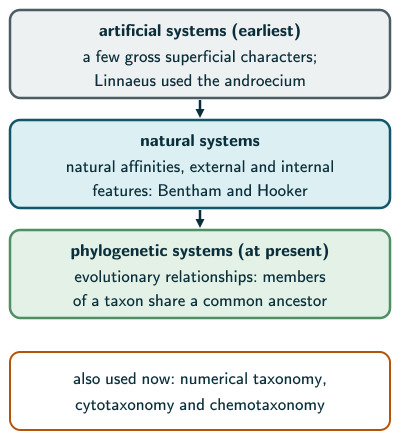
- Artificial systems came first. They used only gross superficial morphological characters, such as habit, colour, and the number and shape of leaves, based mainly on vegetative characters or on the structure of the androecium (the system of Linnaeus). Based on a few characters, they separated closely related species, and they gave equal weight to vegetative and sexual characters, although vegetative characters are more easily affected by the environment.
- Natural systems followed. They are based on natural affinities among organisms and use internal features as well as external ones: ultrastructure, anatomy, embryology and phytochemistry. George Bentham and Joseph Dalton Hooker gave such a classification for flowering plants.
- Phylogenetic systems are used today. They assume that organisms belonging to the same taxon have a common ancestor.
At present phylogenetic classification systems based on evolutionary relationships between the various organisms are acceptable.
NCERT Biology (Class 11), Chapter 3, Introduction, page 24
Other sources of information help, especially where there is no supporting fossil evidence (page 24). Numerical taxonomy, now easily carried out with computers, assigns numbers and codes to all observable characters, so that each character gets equal importance and hundreds of characters can be considered at once. Cytotaxonomy uses cytological information such as chromosome number, structure and behaviour, and chemotaxonomy uses the chemical constituents of the plant.
Reproduction in algae
Algae reproduce by vegetative, asexual and sexual methods (page 24).
- Vegetative: by fragmentation; each fragment develops into a thallus.
- Asexual: by different types of spores, the most common being zoospores. These are flagellated (motile), and on germination each gives rise to a new plant.
- Sexual: by the fusion of two gametes.
Sexual reproduction takes place through fusion of two gametes.
NCERT Biology (Class 11), Section 3.1, page 24
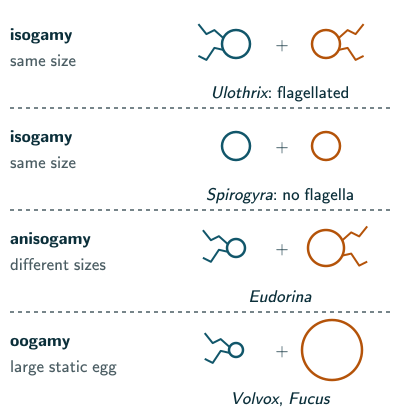
NCERT names three kinds of sexual reproduction by how the two gametes compare (page 24):
- Isogamous: the gametes are similar in size. They may be flagellated, as in Ulothrix, or non-flagellated (non-motile), as in Spirogyra.
- Anisogamous: the gametes are dissimilar in size, as in species of Eudorina.
- Oogamous: a large, non-motile egg fuses with a much smaller male gamete. In NCERT’s examples Volvox and Fucus, the male gamete is motile; red algae are also oogamous but have non-motile male gametes (pages 27–28).
Why algae matter
At least a half of the total carbon dioxide fixation on earth is carried out by algae through photosynthesis.
NCERT Biology (Class 11), Section 3.1, page 26
Beyond the NCERT text: estimates of this share usually count all phytoplankton, including cyanobacteria, which NCERT no longer calls algae.
NCERT lists these uses (page 26):
- Being photosynthetic, algae raise the level of dissolved oxygen in the water around them.
- As primary producers of energy-rich compounds, they support many aquatic food webs. NCERT’s “all aquatic animals” is a broad summary; as NOAA’s vent studies show, some deep-sea food webs instead depend on chemosynthetic microbes.
- Many species of Porphyra, Laminaria and Sargassum are among the 70 species of marine algae used as food.
- Certain marine brown and red algae produce large amounts of hydrocolloids (water-holding substances): algin from brown algae and carrageen from red algae, both used commercially.
- Agar, obtained from Gelidium and Gracilaria, is used to grow microbes and in preparations of ice-creams and jellies.
- Chlorella, a unicellular alga rich in proteins, is used as a food supplement, even by space travellers.
The three classes at a glance
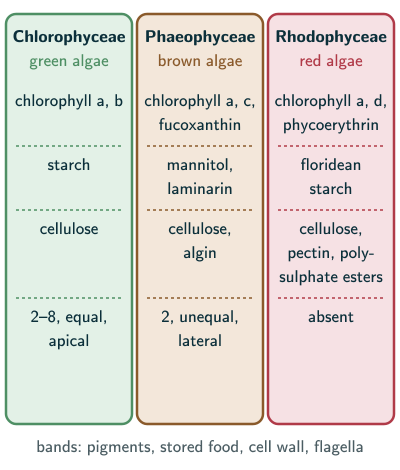
NCERT Table 3.1 (page 27) compares the three classes. Its habitat column reads:
- Chlorophyceae: fresh water, brackish water and salt water.
- Phaeophyceae: fresh water (rare), brackish water and salt water.
- Rhodophyceae: fresh water (some), brackish water and salt water (most).
Chlorophyceae: green algae
The plant body may be unicellular, colonial or filamentous. Green algae are usually grass green because the pigments chlorophyll a and b dominate (page 26).
The pigments are localised in definite chloroplasts.
NCERT Biology (Class 11), Section 3.1.1, page 26
- Chloroplasts: discoid, plate-like, reticulate, cup-shaped, spiral or ribbon-shaped in different species.
- Pyrenoids: most members have one or more of these storage bodies in the chloroplasts. Some algae may store food as oil droplets.
- Cell wall: usually rigid, with an inner layer of cellulose and an outer layer of pectose. NCERT Table 3.1 lists only cellulose.
- Stored food and flagella (NCERT Table 3.1): starch; the flagellated cells have 2–8 equal, apical flagella. This is not a claim that every green alga or every cell bears flagella; Spirogyra has non-flagellated gametes.
- Reproduction: vegetative usually by fragmentation; asexual by flagellated zoospores produced in zoosporangia; sexual reproduction varies in the type and formation of sex cells and may be isogamous, anisogamous or oogamous.
- Examples: Chlamydomonas, Volvox, Ulothrix, Spirogyra and Chara.
Pyrenoids contain protein besides starch.
NCERT Biology (Class 11), Section 3.1.1, page 26
Phaeophyceae: brown algae
Brown algae are found primarily in marine habitats and vary greatly in size and form: from simple branched, filamentous forms such as Ectocarpus to profusely branched kelps, which NCERT says may reach a height of 100 metres (page 26). Beyond the NCERT text: the longest verified specimen of the largest alga, the giant kelp Macrocystis pyrifera, measured 60 metres (Guinness World Records, “Largest alga”); in NCERT-based exams, quote NCERT’s 100 metres.
- Pigments: chlorophyll a and c, carotenoids and xanthophylls. Their colour, from olive green to shades of brown, depends on how much of the xanthophyll fucoxanthin they contain (pages 26–27).
- Stored food: laminarin and mannitol. Beyond NCERT’s broad “complex carbohydrates” wording, laminarin is a polysaccharide, whereas PubChem identifies mannitol as a sugar alcohol; they are not both polysaccharides.
- Cell wall: cellulose, usually covered on the outside by a gelatinous coating of algin.
- Protoplast: besides plastids, a centrally located vacuole and nucleus.
- Reproduction: vegetative by fragmentation; asexual in most brown algae by biflagellate zoospores, which are pear-shaped and have two unequal, laterally attached flagella; sexual reproduction may be isogamous, anisogamous or oogamous. The motile gametes are pyriform (pear-shaped), with two laterally attached flagella; in oogamous species the egg is non-motile and retained in the oogonium.
- Examples: Ectocarpus, Dictyota, Laminaria, Sargassum and Fucus.
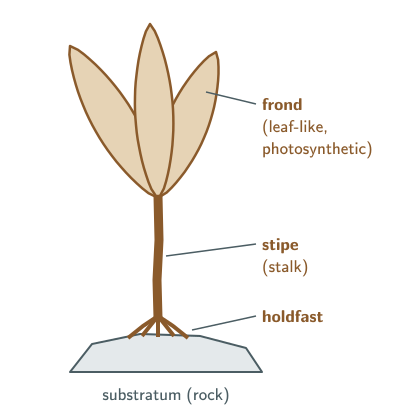
The plant body is usually attached to the substratum by a holdfast, and has a stalk, the stipe and leaf like photosynthetic organ – the frond.
NCERT Biology (Class 11), Section 3.1.2, page 27
Rhodophyceae: red algae
Red algae owe their name to the predominance of the red pigment r-phycoerythrin (page 27). Most are marine, with greater concentrations in warmer areas. They grow both in well-lighted regions close to the surface and at great depths in the oceans, where relatively little light penetrates.
- Pigments (NCERT Table 3.1): chlorophyll a, d and phycoerythrin.
- Body: the red thalli of most red algae are multicellular; some have a complex body organisation.
- Stored food: floridean starch.
- Cell wall (NCERT Table 3.1): cellulose, pectin and polysulphate esters.
- Reproduction: vegetative usually by fragmentation; asexual by non-motile spores; sexual by non-motile gametes. Red algae have no flagella (NCERT Table 3.1).
- Examples: Polysiphonia, Porphyra, Gracilaria and Gelidium.
The food is stored as floridean starch which is very similar to amylopectin and glycogen in structure.
NCERT Biology (Class 11), Section 3.1.3, page 27
Sexual reproduction is oogamous and accompanied by complex post fertilisation developments.
NCERT Biology (Class 11), Section 3.1.3, page 28
Solved examples
Example 1: The basis of classifying algae (NCERT Exercise Q1)
What is the basis of classification of algae?
Answer: the type of pigment present and the type of food stored (NCERT Summary, page 34). NCERT Table 3.1 also compares their cell wall, the number and position of flagella, and habitat.
Example 2: Isogamy (NCERT Exercise Q8(vi))
Explain isogamy with suitable examples.
Answer: isogamy is the fusion of two gametes similar in size. The gametes may be flagellated, as in Ulothrix, or non-flagellated, as in Spirogyra (NCERT page 24).
Example 3: Red algae and brown algae (NCERT Exercise Q9(i))
Differentiate between red algae and brown algae.
Answer: from NCERT pages 26–28 and Table 3.1:
- Pigments: red algae have chlorophyll a, d and phycoerythrin; brown algae have chlorophyll a, c and fucoxanthin.
- Stored food: floridean starch in red algae; mannitol and laminarin in brown algae.
- Cell wall: cellulose, pectin and polysulphate esters in red algae; cellulose and algin in brown algae.
- Flagella: absent in red algae; brown algae have 2 unequal, lateral flagella.
- Sexual reproduction: oogamous, with complex post-fertilisation developments, in red algae; isogamous, anisogamous or oogamous in brown algae.
- Asexual reproduction: non-motile spores in red algae; biflagellate, pear-shaped zoospores in most brown algae.
- Habitat: both mainly marine; red algae are commoner in warmer areas and reach great depths, and some live in fresh water; freshwater brown algae are rare.
- Examples: Polysiphonia, Porphyra, Gracilaria, Gelidium (red); Ectocarpus, Dictyota, Laminaria, Sargassum, Fucus (brown).
Example 4: Economic importance of algae (NCERT Exercise Q5, algae part)
Write a note on the economic importance of algae.
Answer: NCERT attributes at least half of global carbon dioxide fixation to algae (with the scope qualification above); algae also raise dissolved oxygen; as primary producers they support aquatic food cycles. Many species of Porphyra, Laminaria and Sargassum are among the 70 species of marine algae used as food. Brown algae give algin and red algae give carrageen, both commercial hydrocolloids. Agar from Gelidium and Gracilaria is used to grow microbes and in ice-creams and jellies, and protein-rich Chlorella is a food supplement, even for space travellers (NCERT page 26).
Example 5: Name the class
Name the class of algae from each clue: (a) the food is floridean starch; (b) the food is mannitol or laminarin; (c) pyrenoids in the chloroplasts contain protein and starch.
Answer: (a) Rhodophyceae; (b) Phaeophyceae; (c) Chlorophyceae (NCERT pages 26–27).
Example 6: Where does *Chlamydomonas* go? (NCERT Exercise Q10(a))
NCERT asks you to match Chlamydomonas with moss, pteridophyte, algae or gymnosperm. What is the answer, and why can it puzzle you?
Answer: algae, because NCERT Chapter 3 lists it among the common green algae (page 26). It can puzzle you because NCERT Chapter 2 says Kingdom Protista has brought together Chlamydomonas and Chlorella, both earlier placed in algae within plants (page 12). Chapter 3’s own introduction also says that members of Protista having cell walls are now excluded from Plantae (page 23). The two chapters are not consistent. Answer by the question’s frame: in a plant-group match like this one, algae (green algae); for Whittaker’s kingdom, Protista.
Common mistakes to avoid
Common mistake
Calling cyanobacteria algae
Blue-green algae (cyanobacteria) are prokaryotes in Monera (NCERT Chapter 2, page 13), and Chapter 3 says they are not algae any more (page 23). Chapter 2 still describes them as freshwater, marine or terrestrial “algae” (page 13); follow Chapter 3.
Common mistake
Mixing up anisogamy and oogamy
Anisogamy involves gametes of unequal size. Oogamy is a specialised form with a large, non-motile egg and a much smaller male gamete; male motility is not universal, since red algae have non-motile gametes.
Common mistake
Giving red algae flagella
Red algae have no flagella: their spores and gametes are non-motile (NCERT page 27 and Table 3.1).
Common mistake
Swapping the stored foods
Green algae store starch, brown algae laminarin or mannitol, and red algae floridean starch.
Common mistake
Putting an example in the wrong class
Porphyra is a red alga, though NCERT lists it with the brown Laminaria and Sargassum as food. Volvox and Chara are green; Ectocarpus and Dictyota are brown; Polysiphonia is red.
Common mistake
Getting the source of agar wrong
Agar comes from the red algae Gelidium and Gracilaria. Algin is from brown algae and carrageen from red algae.
Quick revision summary
- Algae: chlorophyll-bearing, simple, thalloid, autotrophic and largely aquatic; colonial, filamentous or massive (kelps).
- Cyanobacteria are no longer algae. Classification moved from artificial (Linnaeus) to natural (Bentham and Hooker) to phylogenetic systems, aided by numerical taxonomy, cytotaxonomy and chemotaxonomy.
- Reproduction: vegetative by fragmentation; asexual by spores, mostly zoospores; sexual by isogamy, anisogamy or oogamy.
- Uses: major carbon dioxide fixation (NCERT gives at least half globally); food (Porphyra, Laminaria, Sargassum); algin, carrageen and agar; Chlorella.
- Green algae: chlorophyll a, b; starch in pyrenoids; cellulose and pectose wall; Chlamydomonas, Volvox, Ulothrix, Spirogyra, Chara.
- Brown algae: chlorophyll a, c and fucoxanthin; laminarin or mannitol; algin coat; holdfast, stipe and frond; Ectocarpus, Dictyota, Laminaria, Sargassum, Fucus.
- Red algae: r-phycoerythrin; floridean starch; no flagella; oogamous; Polysiphonia, Porphyra, Gracilaria, Gelidium.
Formula sheet
- algae: chlorophyll-bearing, simple, thalloid, autotrophic, largely aquatic
- isogamy: gametes of the same size, flagellated or not
- anisogamy: gametes of different sizes
- oogamy: large non-motile egg + small male gamete (not always motile)
- green: chlorophyll a, b; starch; cellulose; motile cells have 2–8 equal apical flagella
- brown: chlorophyll a, c, fucoxanthin; mannitol, laminarin; cellulose, algin; 2 unequal, lateral
- red: chlorophyll a, d, phycoerythrin; floridean starch; no flagella
- algin: brown algae; carrageen and agar: red algae
Questions students ask
Are algae plants?
Algae are plants in NCERT Class 11: Chapter 3 places the green, brown and red algae in Kingdom Plantae as its simplest members, with a thalloid body that is not divided into true roots, stems and leaves. But ‘algae’ is a loose term rather than one natural group: NCERT places the diatoms and golden algae, the chrysophytes, in Kingdom Protista, not in Plantae. Beyond the NCERT text, many modern classifications also keep the brown algae out of the plant kingdom, because they are not closely related to green plants, which is why some sources say that algae are not plants.
What is the difference between algae and fungi?
Algae differ from fungi mainly in nutrition: algae are chlorophyll-bearing autotrophs that photosynthesise, while fungi are heterotrophs, most absorbing soluble organic matter from dead substrates and others parasitic on living plants and animals. Their walls and bodies differ too: algal cell walls contain cellulose and fungal walls chitin and polysaccharides, and most fungi have a thallus made of hyphae. “Thallus” means a body not differentiated into true roots, stems and leaves; it is not exclusive to algae. The two can also live together as a lichen, in which the alga prepares food and the fungus gives shelter and absorbs water and minerals.
What is the difference between green algae and red algae?
Green algae (Chlorophyceae) are grass green because chlorophyll a and b dominate, while red algae (Rhodophyceae) have chlorophyll a and d, with the red pigment r-phycoerythrin predominating. Green algae store starch, often in pyrenoids, and red algae floridean starch; the motile cells of green algae bear 2–8 equal, apical flagella, while red algae have no flagella. Green algae live in fresh, brackish and salt water and may be isogamous, anisogamous or oogamous, whereas most red algae are marine and their sexual reproduction is oogamous. Examples are Chlamydomonas, Spirogyra and Chara (green) and Polysiphonia, Porphyra and Gelidium (red).
What is the difference between algae and seaweed?
Seaweeds are algae: ‘seaweed’ is a common name, not a scientific group, for the large, multicellular algae of the sea, such as the kelps and Sargassum among the brown algae and Porphyra and Gelidium among the red algae. ‘Algae’ is the wider word, since it also covers microscopic and freshwater forms such as the unicellular Chlorella and the filamentous Spirogyra, which are not seaweeds. NCERT does not use the word seaweed, but it notes that a few marine forms such as kelps form massive plant bodies.
What does the NEET 2026 syllabus ask about algae?
The NEET (UG) 2026 Biology syllabus lists algae in Unit 1, Diversity in Living World, as the first of the major plant groups, algae, bryophytes, pteridophytes and gymnosperms, and asks for ‘three to five salient and distinguishing features and at least two examples of each category’. For algae, those features and examples are the ones in NCERT Section 3.1 and its Table 3.1, which describe the group and its three classes, Chlorophyceae, Phaeophyceae and Rhodophyceae.
Practice questions
Try each question first, then open the answer to check your working.
-
Q1. Name the three parts of the body of a typical brown alga.
Show answerHide answer
The holdfast, which attaches it to the substratum; the stalk, called the stipe; and the leaf-like photosynthetic frond (NCERT page 27).
-
Q2. What are zoospores?
Show answerHide answer
The most common asexual spores of algae: they are flagellated (motile), and on germination each gives rise to a new plant (NCERT page 24).
-
Q3. Why do red algae look red, and how deep can they grow?
Show answerHide answer
Because of the predominance of the red pigment r-phycoerythrin. They grow both near the well-lighted surface and at great depths where relatively little light penetrates (NCERT page 27).
-
Q4. Which pigment decides the colour of a brown alga?
Show answerHide answer
The amount of the xanthophyll fucoxanthin; brown algae range from olive green to shades of brown (NCERT pages 26–27).