Pteridophytes
NCERT Class 11 Biology Chapter 3 Section 3.3
Quick answer
Pteridophytes are seedless vascular plants with a dominant diploid sporophyte; most have true roots, stems and leaves, with exceptions such as rootless whisk ferns. Sporangia produce haploid spores by meiosis, and fertilisation needs water. Most are homosporous with free-living gametophytes, while heterosporous forms produce separate microspores and megaspores and illustrate steps towards the seed habit.
With your textbook
NCERT Biology (Class 11), Chapter 3 “Plant Kingdom”, Section 3.3 “Pteridophytes”, pages 30–32.
Open the official NCERT chapter (PDF, 5.2 MB, ncert.nic.in) (opens in a new tab)
Checked against the 2026-27 reprint on .
What are pteridophytes?
Pteridophytes
Evolutionarily, they are the first terrestrial plants to possess vascular tissues – xylem and phloem.
NCERT Biology (Class 11), Section 3.3, page 30
- Pteridophytes include the horsetails and ferns.
- The main plant body is the sporophyte, usually differentiated into true roots, stems and leaves; exceptions are noted below.
- They are used for medicinal purposes and as soil-binders, and are often grown as ornamentals.
In plain words: pteridophytes are the first land plants with proper plumbing. Xylem carries water and phloem carries food, so the plant can have true roots, stems and leaves. Like bryophytes, they still need water for fertilisation, but the large plant you see is now the diploid sporophyte, not the haploid gametophyte.
Pteridophytes are found in cool, damp, shady places, though some may flourish in sandy-soil conditions (page 30).
Beyond the NCERT Biology text: xylem conducts water through very fine tubes. Water rises a little way in such tubes on its own, by capillary rise, but this alone cannot lift water to the top of a tall plant; most of the lift comes from the pull of water evaporating from the leaves (transpiration).
The sporophyte plant body
In bryophytes the dominant phase of the life cycle is the gametophyte. In pteridophytes the main plant body is a sporophyte, differentiated into true root, stem and leaves (page 30).
These organs possess well-differentiated vascular tissues.
NCERT Biology (Class 11), Section 3.3, page 30
Beyond NCERT’s general description: Psilotum lacks true roots, as documented in the Flora of New Zealand. Therefore true roots, stems and leaves should not be treated as a checklist that every member must possess.
The leaves of pteridophytes may be small, called microphylls, as in Selaginella, or large, called macrophylls, as in ferns (page 30).
Sporophylls and strobili
The sporophytes bear sporangia that are subtended by leaf-like appendages called sporophylls.
NCERT Biology (Class 11), Section 3.3, page 30
- In some pteridophytes the sporophylls form distinct compact structures called strobili or cones, as in Selaginella and Equisetum.
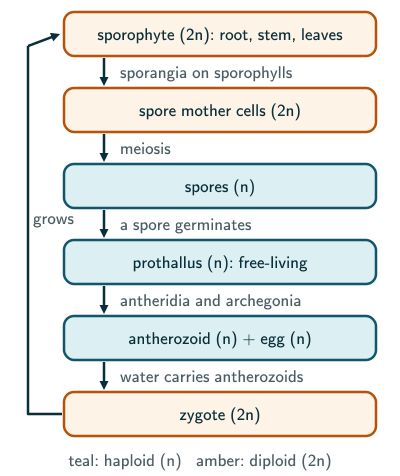
- The sporangia produce spores by meiosis in spore mother cells.
The prothallus and fertilisation
In NCERT’s usual homosporous-fern account, spores germinate into inconspicuous, small but multicellular, free-living, mostly photosynthetic thalloid gametophytes called the prothallus (pages 30 and 32). Heterosporous forms require the separate account below.
These gametophytes require cool, damp, shady places to grow.
NCERT Biology (Class 11), Section 3.3, page 32
NCERT uses these requirements to explain habitat restrictions (page 32). Read “narrow geographical regions” as a broad ecological summary rather than a claim that the entire group has a small world distribution; the chapter itself also mentions sandy-soil habitats.
- The gametophytes bear the male and female sex organs, antheridia and archegonia.
- Water is needed to carry the antherozoids, the male gametes released from the antheridia, to the mouth of the archegonium.
- A male gamete fuses with the egg in the archegonium to form the zygote.
Zygote thereafter produces a multicellular well-differentiated sporophyte which is the dominant phase of the pteridophytes.
NCERT Biology (Class 11), Section 3.3, page 32
Homosporous and heterosporous pteridophytes
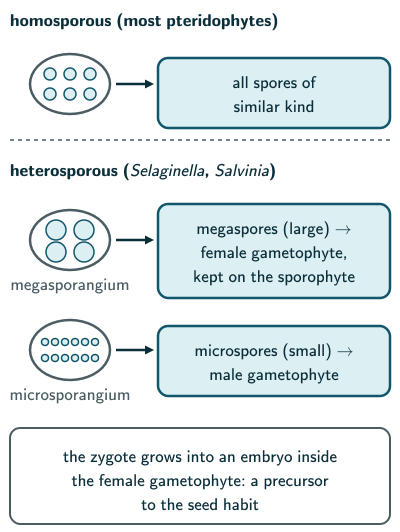
In majority of the pteridophytes all the spores are of similar kinds; such plants are called homosporous.
NCERT Biology (Class 11), Section 3.3, page 32
Genera such as Selaginella and Salvinia produce two kinds of spores, large and small, and are called heterosporous (page 32). The large spores give rise to female gametophytes and the small spores to male gametophytes. The female gametophytes are retained on the parent sporophytes for variable periods, and the zygotes develop into young embryos within them.
NCERT calls pteridophyte gametophytes free-living (pages 30 and 32) and says gymnosperms differ in this (page 33). That holds for the prothallus of homosporous pteridophytes, but the female gametophyte of Selaginella and Salvinia is an exception: it is retained on the parent sporophyte for variable periods. In gymnosperms neither gametophyte is ever free-living (page 33). Beyond the NCERT Biology text: Salvinia is a small water fern, so not every fern is homosporous.
This event is a precursor to the seed habit considered an important step in evolution.
NCERT Biology (Class 11), Section 3.3, page 32
NCERT calls the large spores macrospores in one sentence and megaspores in the next (page 32). The two words mean the same thing; megaspore is the usual term, and the one NCERT uses for the spores of gymnosperms and in the Summary (pages 33 and 35), although page 33 also calls female cones macrosporangiate.
The four classes
NCERT classifies pteridophytes into four classes (page 32):
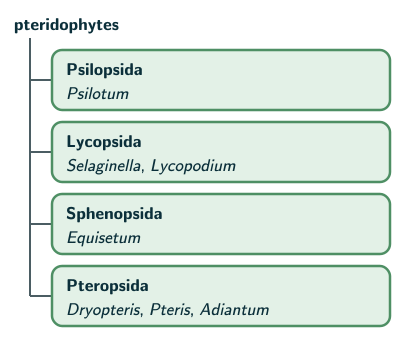
- Psilopsida: Psilotum.
- Lycopsida: Selaginella, Lycopodium.
- Sphenopsida: Equisetum.
- Pteropsida: Dryopteris, Pteris, Adiantum.
Solved examples
Example 1: Why pteridophytes stay local
How does NCERT explain habitat restrictions in many pteridophytes?
Answer: their gametophytes (prothalli) need cool, damp, shady places to grow, and fertilisation needs water to carry the antherozoids to the archegonium (NCERT page 32).
Example 2: Where meiosis happens in a fern (NCERT Exercise Q2, fern part)
When and where does reduction division take place in the life cycle of a fern?
Answer: in the sporophyte, when it forms spores: the sporangia, borne on sporophylls, produce spores by meiosis in their spore mother cells (NCERT page 30).
Example 3: Ploidy in a fern (NCERT Exercise Q4, fern items)
Give the ploidy of a prothallus cell of a fern and of the zygote of a fern.
Answer: a prothallus cell is haploid (n), since the prothallus is the gametophyte grown from a spore; the zygote is diploid (2n), formed by the fusion of two gametes, and it grows into the sporophyte (NCERT pages 30–32).
Example 4: Heterospory (NCERT Exercise Q7)
What is heterospory? Briefly comment on its significance and give two examples.
Answer: heterospory is the production of two kinds of spores: large (mega) spores, which give female gametophytes, and small (micro) spores, which give male gametophytes. Its significance: in heterosporous pteridophytes the female gametophyte is retained on the parent sporophyte, and the zygote develops into a young embryo within the female gametophyte, a precursor to the seed habit, which NCERT calls an important step in evolution. Examples: Selaginella and Salvinia (NCERT page 32).
Example 5: Homosporous and heterosporous (NCERT Exercise Q9(iii))
Differentiate between homosporous and heterosporous pteridophytes.
Answer: point by point, homosporous first, then heterosporous (NCERT page 32):
- Spores: one kind; or large megaspores and small microspores.
- Gametophytes: free-living prothalli; or female and male gametophytes, the female retained on the parent sporophyte for variable periods.
- Seed habit: only heterospory is its precursor.
- Examples: the majority, such as Dryopteris, Pteris and Lycopodium (beyond the NCERT text); or Selaginella and Salvinia.
Example 6: Sporophyll (NCERT Exercise Q8(v))
Explain the term sporophyll with an example.
Answer: a sporophyll is a leaf-like appendage that subtends (bears) sporangia. In Selaginella and Equisetum the sporophylls form compact strobili or cones (NCERT page 30).
Common mistakes to avoid
Common mistake
Calling the fern plant a gametophyte
The fern plant you see is the diploid sporophyte; the gametophyte is the small, free-living prothallus.
Common mistake
Thinking pteridophytes are free of water for fertilisation
Like bryophytes, they need water to carry the antherozoids to the archegonium (NCERT page 32).
Common mistake
Calling all pteridophytes heterosporous
Most are homosporous; NCERT names Selaginella and Salvinia as heterosporous (page 32).
Common mistake
Mixing up the classes and their examples
Equisetum (beyond the NCERT text: a horsetail) is in Sphenopsida, Selaginella and Lycopodium in Lycopsida, and the ferns Dryopteris, Pteris and Adiantum in Pteropsida.
Quick revision summary
- Pteridophytes (horsetails and ferns) are the first terrestrial plants with vascular tissues, xylem and phloem; they are used in medicine, as soil-binders and as ornamentals.
- The main plant body is the sporophyte, usually with true roots, stems and leaves (exceptions occur); leaves are microphylls (Selaginella) or macrophylls (ferns).
- Sporangia are subtended by sporophylls, which may form strobili or cones (Selaginella, Equisetum); spores form by meiosis in spore mother cells.
- In the usual homosporous-fern account, spores grow into the prothallus, a small, free-living, mostly photosynthetic gametophyte that needs cool, damp, shady places; fertilisation needs water.
- Most pteridophytes are homosporous; Selaginella and Salvinia are heterosporous, and the retained female gametophyte is a precursor to the seed habit.
- Four classes: Psilopsida, Lycopsida, Sphenopsida and Pteropsida.
Formula sheet
- pteridophytes: first land plants with xylem and phloem
- main plant body: vascular sporophyte (2n), usually with roots, stems and leaves
- sporangia on sporophylls; compact sporophylls form strobili (cones)
- spore mother cells → meiosis → spores (n) → prothallus (n)
- fertilisation needs water; zygote (2n) → dominant sporophyte
- heterosporous: megaspores → female, microspores → male gametophyte
- classes: Psilopsida, Lycopsida, Sphenopsida, Pteropsida
Questions students ask
What is the difference between bryophytes and pteridophytes?
The main difference is that pteridophytes have vascular tissues, xylem and phloem, while bryophytes have none: NCERT calls the pteridophytes the first terrestrial plants to possess them. In bryophytes the main plant body is the haploid gametophyte, with rhizoids but no true roots, stems or leaves, and the sporophyte stays attached to it and depends on it; in pteridophytes the main plant body is the diploid sporophyte, with true root, stem and leaves, and the gametophyte is usually a small, free-living prothallus. For example, the moss Funaria is a bryophyte and the fern Dryopteris a pteridophyte.
Why are pteridophytes called vascular cryptogams?
Pteridophytes are called vascular cryptogams because they have vascular tissues, xylem and phloem, yet reproduce by spores, with no flowers or seeds; cryptogam, from Greek words meaning ‘hidden marriage’, is an old name for plants whose sexual reproduction is not easily seen. Algae and bryophytes are cryptogams without vascular tissue, while the seed plants, gymnosperms and angiosperms, were called phanerogams, ‘visible marriage’. Both terms come from older systems of classification and are beyond the NCERT text, which calls pteridophytes the first terrestrial plants to possess vascular tissues.
What is the difference between a prothallus and a protonema?
A prothallus is the gametophyte of a pteridophyte, as in a fern: a small, free-living, mostly photosynthetic thalloid body that grows from a spore and bears the antheridia and archegonia. A protonema is the first stage of a moss gametophyte: a creeping, green, branched and frequently filamentous stage that develops directly from a spore, while the sex organs are borne later by the leafy stage, which develops from the secondary protonema as a lateral bud. Both are haploid, but the prothallus is the whole gametophyte of a plant whose main body is the sporophyte, while the protonema is only the first stage of the main plant body of a moss.
Are all pteridophytes ferns?
Not all pteridophytes are ferns: NCERT says that the pteridophytes include horsetails and ferns, and of their four classes the ferns make up only Pteropsida. The others were traditionally called fern allies: the horsetails, such as Equisetum, the club mosses, such as Lycopodium, and Selaginella and Psilotum. Beyond the NCERT text, modern classifications count the horsetails and Psilotum as ferns too, so only the lycophytes, such as Lycopodium and Selaginella, are pteridophytes that are not ferns. All share a dominant vascular sporophyte and spores formed in sporangia, but structures vary: Psilotum, for example, lacks true roots.
Practice questions
Try each question first, then open the answer to check your working.
-
Q1. What is the prothallus?
Show answerHide answer
The gametophyte of a pteridophyte: an inconspicuous, small but multicellular, free-living, mostly photosynthetic thalloid structure that grows from a spore (NCERT pages 30 and 32).
-
Q2. Give an example of a pteridophyte with microphylls, and name the group with macrophylls.
Show answerHide answer
Selaginella has microphylls; ferns have macrophylls (NCERT page 30).
-
Q3. Name the four classes of pteridophytes with one example each.
Show answerHide answer
Psilopsida (Psilotum), Lycopsida (Selaginella or Lycopodium), Sphenopsida (Equisetum) and Pteropsida (Dryopteris, Pteris or Adiantum) (NCERT page 32).
-
Q4. Which event in heterosporous pteridophytes does NCERT call a precursor to the seed habit?
Show answerHide answer
The development of the zygotes into young embryos within the female gametophytes, which are retained on the parent sporophytes (NCERT page 32).