Gymnosperms
NCERT Class 11 Biology Chapter 3 Section 3.4
Quick answer
Gymnosperms have ovules outside an ovary and seeds unenclosed by fruits; naked seeds still have a protective seed coat. They are heterosporous, producing microspores that develop into pollen and megaspores that develop into female gametophytes within ovules. NCERT describes wind pollination and pollen-tube growth towards the egg; fertilisation produces a zygote, then an embryo, while the ovule becomes a seed.
With your textbook
NCERT Biology (Class 11), Chapter 3 “Plant Kingdom”, Section 3.4 “Gymnosperms”, pages 32–33.
Open the official NCERT chapter (PDF, 5.2 MB, ncert.nic.in) (opens in a new tab)
Checked against the 2026-27 reprint on .
What are gymnosperms?
Gymnosperms
The gymnosperms (gymnos : naked, sperma : seeds) are plants in which the ovules are not enclosed by any ovary wall and remain exposed, both before and after fertilisation.
NCERT Biology (Class 11), Section 3.4, page 32
- Their seeds are “naked” because they are not enclosed in an ovary-derived fruit, not because they lack a protective seed coat.
- Gymnosperms include medium-sized trees, tall trees and shrubs; the giant redwood Sequoia is one of the tallest tree species.
- They are heterosporous, and their male and female gametophytes are not free-living.
In plain words: gymnosperms are seed plants without fruits. Their ovules sit openly on megasporophylls (grouped into female cones in Pinus), so the seeds are exposed. The plant you see is the diploid sporophyte; the pollen grain has only a few cells, and the multicellular female gametophyte stays inside the ovule.
Roots, stems and leaves
The roots are generally tap roots.
NCERT Biology (Class 11), Section 3.4, page 32
- Roots: in some genera the roots have a fungal association called mycorrhiza (Pinus); in others (Cycas) small specialised coralloid roots are associated with N2-fixing cyanobacteria.
- Stems: unbranched (Cycas) or branched (Pinus, Cedrus).
- Leaves: simple or compound; in Cycas the pinnate leaves persist for a few years.
Beyond the NCERT Biology text: plants cannot use the nitrogen gas of the air directly, because the two atoms of N2 are held by a triple bond, the strongest bond among the homonuclear diatomic molecules of the second period. Only certain prokaryotes, such as some bacteria and cyanobacteria, can fix it, which is why the cyanobacteria in coralloid roots matter to Cycas.
The leaves in gymnosperms are well-adapted to withstand extremes of temperature, humidity and wind.
NCERT Biology (Class 11), Section 3.4, page 32
In conifers, the needle-like leaves reduce the surface area, and their thick cuticle and sunken stomata also help to reduce water loss (page 32).
Cones and spores
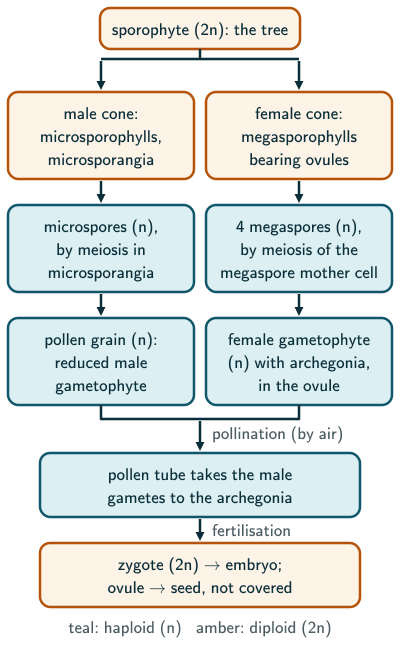
The gymnosperms are heterosporous; they produce haploid microspores and megaspores.
NCERT Biology (Class 11), Section 3.4, page 33
The two kinds of spores are produced within sporangia borne on sporophylls, which are arranged spirally along an axis to form lax or compact strobili or cones (page 33).
- Male strobili (microsporangiate): bear microsporophylls and microsporangia. The microspores develop into a male gametophyte that is highly reduced, confined to only a limited number of cells, and develops within the microsporangia.
- Female strobili: cones bearing megasporophylls with ovules or megasporangia. NCERT calls them macrosporangiate (page 33), the same idea usually written megasporangiate.
- The male and female cones may be borne on the same tree (Pinus). In Cycas, male cones and megasporophylls are borne on different trees.
This reduced gametophyte is called a pollen grain.
NCERT Biology (Class 11), Section 3.4, page 33
The ovule and the female gametophyte
The megaspore mother cell is differentiated from one of the cells of the nucellus.
NCERT Biology (Class 11), Section 3.4, page 33
The nucellus is protected by envelopes, and the whole structure is called an ovule. Ovules are borne on megasporophylls, which may be clustered to form the female cones (page 33).
- The megaspore mother cell divides by meiosis to form four megaspores.
- One of the megaspores, enclosed within the megasporangium, develops into a multicellular female gametophyte that bears two or more archegonia.
- The female gametophyte is retained within the megasporangium.
Pollination and fertilisation
Unlike bryophytes and pteridophytes, in gymnosperms, the male and the female gametophytes do not have an independent free-living existence.
NCERT Biology (Class 11), Section 3.4, page 33
The female gametophyte remains inside the ovule, while the male gametophyte develops in a microsporangium and is dispersed as pollen. In NCERT’s wind-pollination account, the pollen grains, released from the microsporangium, are carried in air currents and come in contact with the opening of the ovules borne on megasporophylls. The pollen tube carrying the male gametes grows towards the archegonia in the ovules and discharges its contents near the mouth of the archegonia (page 33).
Following fertilisation, zygote develops into an embryo and the ovules into seeds.
NCERT Biology (Class 11), Section 3.4, page 33
These seeds are not enclosed in fruits (page 33); the ovule’s integument contributes a protective seed coat.
Beyond the NCERT text: unlike bryophytes and pteridophytes, gymnosperms need no external water for fertilisation, because the pollen tube carries the male gametes to the archegonia. In Cycas the male gametes are still motile, but they swim only in fluid inside the ovule. Those of Pinus are non-motile.
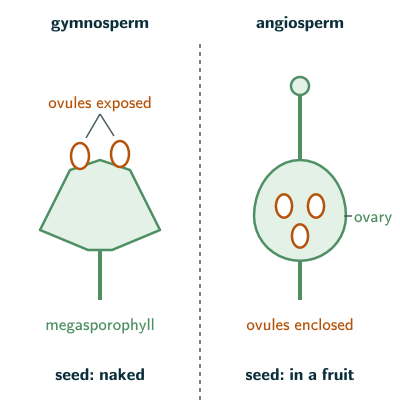
Gymnosperms and angiosperms
Both groups bear seeds. In gymnosperms the ovules are not enclosed by an ovary wall, so the seeds are naked (page 32). In angiosperms the pollen grains and ovules develop in flowers, and the seeds are enclosed in fruits (page 34).
Solved examples
Example 1: Characteristics of gymnosperms (NCERT Exercise Q11)
Describe the important characteristics of gymnosperms.
Answer: from NCERT pages 32–33:
- Ovules not enclosed by an ovary wall, exposed before and after fertilisation; seeds naked.
- Medium-sized or tall trees and shrubs (Sequoia is one of the tallest), with generally tap roots; mycorrhiza in Pinus, coralloid roots with N2-fixing cyanobacteria in Cycas; stems unbranched (Cycas) or branched (Pinus, Cedrus).
- Leaves simple or compound, adapted to extremes of temperature, humidity and wind; needle-like leaves, thick cuticle and sunken stomata in conifers.
- Heterosporous: microspores and megaspores form in sporangia; Pinus bears male and female cones on the same tree, whereas Cycas bears male cones and loose female megasporophylls on separate plants.
- The pollen grain is the reduced male gametophyte; the multicellular female gametophyte, with two or more archegonia, stays within the megasporangium; neither gametophyte is free-living.
- Pollen is carried by air to the ovule; the pollen tube takes the male gametes to the archegonia; the zygote forms an embryo and the ovule a seed.
Example 2: Two kinds of seed plants (NCERT Exercise Q6)
Both gymnosperms and angiosperms bear seeds. Why are they classified separately?
Answer: in gymnosperms the ovules are not enclosed by any ovary wall and the seeds are naked. In angiosperms the pollen grains and ovules develop in flowers and the seeds are enclosed in fruits (NCERT pages 32–33; for angiosperms, Section 3.5, page 34).
Example 3: Where meiosis happens (NCERT Exercise Q2)
When and where does reduction division take place in the life cycle of a gymnosperm?
Answer: in the sporophyte, when it makes spores. In the ovule, the megaspore mother cell, differentiated from a cell of the nucellus, divides meiotically to form four megaspores; in the microsporangia of the male cones, haploid microspores are formed (NCERT page 33); beyond the NCERT text, they too come by meiosis, from microspore mother cells.
Example 4: Two root partnerships
Compare the roots of Pinus and Cycas.
Answer: Pinus roots have a fungal association, mycorrhiza; Cycas has small specialised coralloid roots associated with N2-fixing cyanobacteria (NCERT page 32).
Example 5: One tree or two? (based on NCERT Exercise Q10(b))
To which group does Cycas belong, and how are its cones borne compared with Pinus?
Answer: Cycas is a gymnosperm, so (b) matches (iv). In Pinus the male and female cones may be borne on the same tree, while in Cycas the male cones and megasporophylls are borne on different trees (NCERT page 33). Beyond the NCERT text: plants with both sexes on one plant are called monoecious, and those with separate male and female plants dioecious. So Pinus is monoecious and Cycas dioecious. Cycas forms no female cone: its megasporophylls are loosely clustered at the stem tip.
Example 6: Economic importance of gymnosperms (NCERT Exercise Q5)
Write a note on the economic importance of gymnosperms.
Answer: the 2026–27 NCERT chapter does not describe any uses of gymnosperms, so this answer is beyond the NCERT text. Conifers such as pines and deodar (Cedrus deodara) give timber; pines also give resin, from which turpentine is obtained; the seeds of the chilgoza pine (Pinus gerardiana) are eaten; and Cycas is grown as an ornamental plant.
Common mistakes to avoid
Common mistake
Giving gymnosperms fruits
Gymnosperms have no ovary wall around their ovules, so they form no fruits; their seeds are naked.
Common mistake
Calling the pollen grain a male gamete
The pollen grain is the highly reduced male gametophyte; the male gametes are carried by its pollen tube.
Common mistake
Calling gymnosperm gametophytes free-living
Neither gametophyte is free-living. The pollen grain develops in a microsporangium and, once carried by air to an ovule, grows only as a pollen tube inside it; the female gametophyte stays within the megasporangium (NCERT page 33).
Common mistake
Calling the gymnosperm endosperm triploid
Beyond the NCERT text: the food store of a gymnosperm seed is female gametophyte tissue, so it is haploid (n) and forms before fertilisation. Triploid endosperm, as in the dicot of NCERT Exercise Q4, occurs only in angiosperms.
Common mistake
Calling some gymnosperms homosporous
All gymnosperms are heterosporous, producing microspores and megaspores (NCERT page 33).
Quick revision summary
- Gymnosperms have ovules not enclosed by any ovary wall, so their seeds are naked; they include trees and shrubs, such as the giant redwood Sequoia.
- Tap roots; mycorrhiza in Pinus; coralloid roots with N2-fixing cyanobacteria in Cycas; leaves adapted to extremes, with needles, thick cuticle and sunken stomata in conifers.
- Heterosporous: sporophylls often form strobili; Cycas has loose female megasporophylls rather than a female cone. The pollen grain is the reduced male gametophyte.
- In the ovule, the megaspore mother cell (from the nucellus) gives four megaspores; one forms the female gametophyte with two or more archegonia, retained in the megasporangium.
- Pollen reaches the ovule by air; the pollen tube carries the male gametes to the archegonia; the zygote forms the embryo and the ovule the seed.
Formula sheet
- gymnosperms: ovules and seeds naked (no ovary wall)
- heterosporous: microspores (n) and megaspores (n)
- male strobilus → microsporangia → pollen grain (reduced male gametophyte)
- megaspore mother cell (2n) → meiosis → 4 megaspores; 1 → female gametophyte
- female gametophyte: multicellular, two or more archegonia, inside the ovule
- pollen by air → pollen tube → male gametes → zygote → embryo; ovule → seed
Questions students ask
What is the difference between pteridophytes and gymnosperms?
Gymnosperms bear seeds and pteridophytes do not: gymnosperm ovules are exposed and become naked seeds, while pteridophytes reproduce by spores, and even heterosporous Selaginella shows only a precursor to the seed habit. Pteridophyte prothalli are mostly free-living, but no gymnosperm gametophyte is: the female one stays within the megasporangium, and the pollen grain, once carried to an ovule, grows there only as a pollen tube. Pteridophytes need water to carry their antherozoids to the archegonium, whereas gymnosperm pollen travels by air and a pollen tube takes the male gametes to the archegonia.
Is a cycad a palm tree?
No, a cycad is not a palm: cycads such as Cycas are gymnosperms, with naked seeds borne on megasporophylls and no flowers or fruits, while palms such as the coconut are angiosperms, monocotyledons that flower and enclose their seeds in fruits. The two only look alike, since Cycas has an unbranched stem topped by large pinnate leaves that persist for a few years, which is why one species, Cycas revoluta, is commonly called the sago palm. Their roots differ too: Cycas has coralloid roots associated with N2-fixing cyanobacteria.
Why are cycads and ginkgo called living fossils?
Cycads, such as Cycas, and the ginkgo are called living fossils because they belong to very ancient lineages of seed plants, with fossil relatives far older than the flowering plants, and they still look much like those fossils. Ginkgo biloba, the maidenhair tree, is the only living species of its group. The label is loose, though: Nagalingum and colleagues’ 2011 Science study of cycad DNA and fossils found that today’s cycad species arose fairly recently, even though the lineage is ancient. NCERT does not use the term, but it shows Cycas and Ginkgo among its gymnosperms in Figure 3.4.
What are the four groups of gymnosperms?
Living gymnosperms are usually placed in four groups: the cycads (Cycas), the ginkgo (Ginkgo biloba), the conifers (Pinus, Cedrus, Sequoia) and the gnetophytes (Gnetum, Ephedra, Welwitschia). NCERT Class 11 does not divide gymnosperms into groups, but its examples come from the first three: Cycas, Ginkgo, and the conifers Pinus, Cedrus and Sequoia. Some recent classifications place the gnetophytes within the conifers, so the number of groups depends on the system used.
Practice questions
Try each question first, then open the answer to check your working.
-
Q1. What do the Greek words in “gymnosperm” mean?
Show answerHide answer
Gymnos means naked and sperma means seeds (NCERT page 32).
-
Q2. How do the needle-like leaves of conifers help them?
Show answerHide answer
They reduce the surface area; with a thick cuticle and sunken stomata, they help to reduce water loss (NCERT page 32).
-
Q3. What is an ovule, in NCERT’s description of gymnosperms?
Show answerHide answer
The nucellus together with the envelopes that protect it; it contains the megaspore mother cell (NCERT page 33). Beyond the NCERT text, the envelopes are called integuments, and the ovule’s opening is the micropyle.
-
Q4. How do the pollen grains of gymnosperms reach the ovules?
Show answerHide answer
They are carried in air currents and come in contact with the opening of the ovules borne on megasporophylls (NCERT page 33).