Kingdom Plantae
NCERT Class 11 Biology Chapter 2 Section 2.4
Quick answer
NCERT’s Plantae includes algae, bryophytes, pteridophytes, gymnosperms and angiosperms: eukaryotes with cellulose-rich walls, most of which photosynthesise. Insectivorous plants supplement photosynthesis with prey nutrients, while some parasites depend on a host and lack chlorophyll. Land-plant life cycles alternate diploid sporophytes and haploid gametophytes; algal life cycles include variations on this pattern.
With your textbook
NCERT Biology (Class 11), Chapter 2 “Biological Classification”, Section 2.4 “Kingdom Plantae”, page 19.
Open the official NCERT chapter (PDF, 3.3 MB, ncert.nic.in) (opens in a new tab)
Checked against the 2026-27 reprint on .
What is Kingdom Plantae?
Kingdom Plantae
Kingdom Plantae includes all eukaryotic chlorophyll-containing organisms commonly called plants.
NCERT Biology (Class 11), Section 2.4, page 19
- Plant cells are eukaryotic and typically have a cellulose-rich wall; photosynthetic cells contain chloroplasts, but many cells such as root cells do not.
- Plantae includes algae, bryophytes, pteridophytes, gymnosperms and angiosperms.
In plain words: plants are walled eukaryotes with chlorophyll; almost all make their own food by photosynthesis. In NCERT Table 2.1 (page 11) they are the kingdom with a cellulose cell wall, a body organised into tissues and organs, and autotrophic (photosynthetic) nutrition. Each of its five groups is a subset of the kingdom (every bryophyte is a plant, but not every plant is a bryophyte), and each is studied in detail in NCERT Chapter 3.
Not every plant makes all its food
A few members are partially heterotrophic such as the insectivorous plants or parasites.
NCERT Biology (Class 11), Section 2.4, page 19
Bladderwort and Venus fly trap are examples of insectivorous plants and Cuscuta is a parasite.
NCERT Biology (Class 11), Section 2.4, page 19
Beyond the NCERT text: insectivorous plants photosynthesise and obtain additional nutrients, especially nitrogen, by trapping and digesting small animals, with leaves modified as traps. Cuscuta draws its food from its host plant, and NCERT Class 12 Biology (Organisms and Populations, page 200) says it “has lost its chlorophyll and leaves in the course of evolution”. Both are still placed in Plantae. The phrase “partially heterotrophic” is NCERT Chapter 2’s broad wording; Class 12’s account of a chlorophyll-lacking parasite describes dependence on the host, not a plant making most of its own food.
Alternation of generations
Life cycle of plants has two distinct phases – the diploid sporophytic and the haploid gametophytic – that alternate with each other.
NCERT Biology (Class 11), Section 2.4, page 19
The sporophyte (diploid, 2n, two sets of chromosomes) produces haploid spores by meiosis; a spore grows into the gametophyte (haploid, n), which produces gametes by mitosis; two gametes fuse into a diploid zygote, which grows into the next sporophyte. NCERT’s Chapter 3 describes exactly these steps for bryophytes (page 29). Beyond the NCERT text: this is the general pattern; in many algae, such as Volvox and Spirogyra, the zygote itself undergoes meiosis, so it is the only diploid stage.
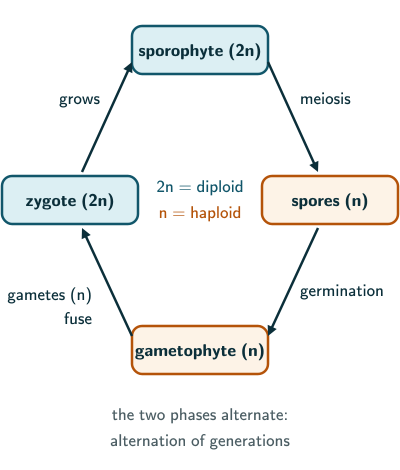
This phenomenon is called alternation of generations.
NCERT Biology (Class 11), Section 2.4, page 19
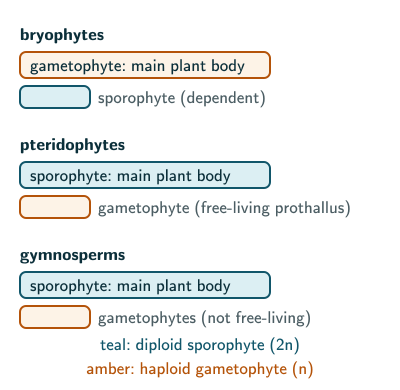
How long each phase lasts, and whether it is free-living or depends on the other, varies among the groups of plants (page 19). NCERT Chapter 3 gives three cases:
- Bryophytes: the main plant body is the haploid gametophyte; the sporophyte is not free-living but attached to the gametophyte and fed by it (page 29).
- Pteridophytes: the main plant body is the sporophyte; the gametophyte is a small, free-living, mostly photosynthetic prothallus (pages 30 and 32).
- Gymnosperms: the sporophyte is the plant. The male gametophyte is highly reduced, and the multicellular female gametophyte stays inside the megasporangium; neither is free-living (page 33).
Solved examples
Example 1: Partially heterotrophic plants (NCERT Chapter 2, Exercise 7, page 22)
Plants are autotrophic. Name some plants that are partially heterotrophic.
Answer: insectivorous plants such as bladderwort and Venus fly trap, and parasites such as Cuscuta (NCERT page 19).
Example 2: Which groups are plants?
List the groups NCERT includes in Kingdom Plantae.
Answer: algae, bryophytes, pteridophytes, gymnosperms and angiosperms.
Example 3: Diploid or haploid?
Which phase of a plant life cycle is diploid, and how is each phase formed?
Answer: the sporophyte is diploid and forms from the zygote; the gametophyte is haploid and forms from a spore produced by meiosis.
Example 4: The main plant body
Of bryophytes, pteridophytes and gymnosperms, in which group is the main plant body haploid?
Answer: in bryophytes, where the gametophyte is the main plant body and the sporophyte depends on it (NCERT page 29).
Example 5: A green, walled cell that is not a plant
Chlamydomonas has chlorophyll and a cell wall. In which kingdom does Whittaker’s system place it?
Answer: Protista: it is a single-celled eukaryote, earlier placed in algae within plants (NCERT page 12), although NCERT Chapter 3 still lists it among the green algae (page 26).
Example 6: Variation in the life cycle
What, according to NCERT, varies among plant groups in their life cycles?
Answer: the lengths of the haploid and diploid phases, and whether these phases are free-living or dependent on others (page 19).
Common mistakes to avoid
Common mistake
Thinking every plant is fully autotrophic
Insectivorous plants photosynthesise but gain nutrients from prey. Parasitic plants may depend partly or wholly on a host; NCERT’s Cuscuta account illustrates loss of chlorophyll. These are still plants.
Common mistake
Swapping the ploidy of the two phases
The sporophyte is diploid (2n) and the gametophyte haploid (n). Spores come from the sporophyte by meiosis.
Common mistake
Assuming the sporophyte always dominates
In bryophytes the gametophyte is the main plant body and the sporophyte depends on it.
Common mistake
Putting blue-green algae or fungi in Plantae
Blue-green algae are in Monera and fungi in Fungi; single-celled green eukaryotes such as Chlamydomonas are in Protista (NCERT page 12).
Quick revision summary
- Plantae: eukaryotes, mostly photosynthetic, with cellulose-rich walls; chloroplasts occur in photosynthetic cells, and some parasitic plants lack chlorophyll.
- Groups: algae, bryophytes, pteridophytes, gymnosperms and angiosperms.
- NCERT’s partial-heterotroph examples are insectivorous plants and parasites; distinguish photosynthesis supplemented by prey nutrients from dependence on a host.
- The life cycle alternates a diploid sporophytic phase and a haploid gametophytic phase: alternation of generations.
- The dominant phase differs: gametophyte in bryophytes; sporophyte in pteridophytes and gymnosperms.
Formula sheet
- Plantae: eukaryotic, mostly photosynthetic, cellulose-rich walls
- groups: algae, bryophytes, pteridophytes, gymnosperms, angiosperms
- nutritional exceptions: insectivorous plants and parasites
- sporophyte 2n → meiosis → spores n → gametophyte n
- gametes n + n → zygote 2n → sporophyte
Questions students ask
What is the difference between Kingdom Plantae and Kingdom Fungi?
Plants and fungi differ in nutrition and cell wall: Kingdom Plantae is mostly photosynthetic, with chloroplasts in its photosynthetic cells and walls mainly of cellulose, but some parasitic plants depend on a host, while Kingdom Fungi is heterotrophic, saprophytic or parasitic, with walls of chitin and polysaccharides. Their bodies differ too: plants are organised into tissues and organs, while most fungi are a mycelium of hyphae (multicellular or loose tissue in NCERT Table 2.1), and yeasts are unicellular. Earlier systems put fungi among plants only because both have a cell wall.
Is alternation of generations the same as metagenesis?
Alternation of generations in plants and metagenesis in cnidarians both alternate two forms in one life cycle, but they are not the same. In plants the two generations differ in chromosome number: the diploid sporophyte makes haploid spores by meiosis, and the haploid gametophyte makes the gametes. In cnidarians such as Obelia, NCERT calls metagenesis an alternation of generations in which polyps produce medusae asexually and medusae form the polyps sexually; beyond the NCERT text, both the polyp and the medusa are diploid, so the change is one of body form, not of ploidy (see Phylum Coelenterata).
Do angiosperms show alternation of generations?
Angiosperms do show alternation of generations, but the plant itself is the sporophyte and the gametophytes are much reduced: NCERT Class 12 Biology (Chapter 1, Sexual Reproduction in Flowering Plants) says that the pollen grains represent the male gametophytes, and that the embryo sac, inside the ovule, is the female gametophyte. Neither gametophyte is free-living, so the trend from bryophytes, where the gametophyte is the main plant body, through pteridophytes to gymnosperms continues: the sporophyte dominates more and more (see angiosperm life cycles).
Practice questions
Try each question first, then open the answer to check your working.
-
Q1. Define alternation of generations.
Show answerHide answer
The life cycle of plants has two distinct phases, the diploid sporophytic and the haploid gametophytic, which alternate with each other (NCERT page 19).
-
Q2. What is the plant cell wall mainly made of?
Show answerHide answer
Cellulose (NCERT page 19).
-
Q3. What is the prothallus, and in which group is it found?
Show answerHide answer
The small, free-living, mostly photosynthetic thalloid gametophyte of pteridophytes (NCERT page 32).
-
Q4. Is Cuscuta autotrophic? Explain.
Show answerHide answer
No. NCERT Class 11 names it as a partially heterotrophic parasite (page 19), and NCERT Class 12 Biology (page 200) adds that it has lost its chlorophyll and derives its nutrition from its host.