The respiratory balance sheet: 38 ATP
NCERT Class 11 Biology Chapter 12 Section 12.5
Quick answer
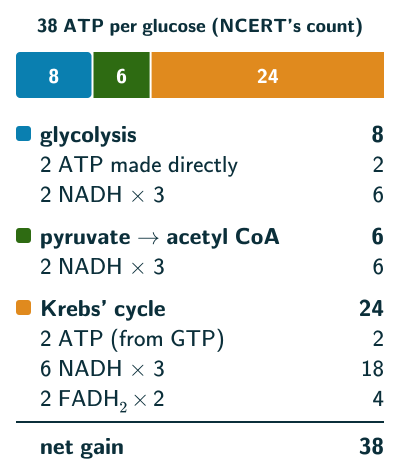
The respiratory balance sheet counts the net ATP from one glucose fully oxidised in aerobic respiration: with 3 ATP per NADH and 2 per FADH, glycolysis gives 8, pyruvate to acetyl CoA 6 and the Krebs’ cycle 24, a net 38 ATP. NCERT calls this a theoretical exercise, since it assumes an orderly sequential pathway, glycolytic NADH oxidised in the mitochondria, no intermediates drawn off and glucose as the only substrate. Fermentation nets only 2 ATP.
With your textbook
NCERT Biology (Class 11), Chapter 12 “Respiration in Plants”, Section 12.5 “The Respiratory Balance Sheet”, pages 161–162.
Open the official NCERT chapter (PDF, 1.7 MB, ncert.nic.in) (opens in a new tab)
Checked against the 2026-27 reprint on .
The respiratory balance sheet
Respiratory balance sheet
The respiratory balance sheet is the count of the net ATP gained when one molecule of glucose is fully oxidised in aerobic respiration. NCERT is careful about what such a count means:
It is possible to make calculations of the net gain of ATP for every glucose molecule oxidised; but in reality this can remain only a theoretical exercise.
NCERT Biology (Class 11), Section 12.5, page 161
In plain words: think of it as a household budget drawn up on paper. You list every rupee that comes in at each stage, add them up, and get a neat total. The real household never runs quite like the plan, but the plan shows where the money comes from. The balance sheet does the same for ATP: it adds up the ATP made at each stage of respiration and arrives at 38 ATP per glucose, a figure that holds only under a few tidy assumptions.
Assumptions in counting ATP
NCERT says the calculation can be made only on four assumptions (page 161):
- There is a sequential, orderly pathway, with one substrate forming the next, and with glycolysis, the TCA cycle and the ETS following one after another.
- The NADH made in glycolysis is transferred into the mitochondria and undergoes oxidative phosphorylation.
- None of the intermediates in the pathway is used to make any other compound.
- Only glucose is respired: no alternative substrates enter the pathway at any intermediate stage.
NCERT then adds that “this kind of assumptions are not really valid in a living system” (page 161):
- all pathways work simultaneously, not one after another;
- substrates enter and leave the pathways as and when necessary;
- ATP is used as and when needed;
- enzymatic rates are controlled by multiple means.
Transport clarification: NCERT’s second assumption is an accounting shorthand. Cytosolic NADH does not freely cross the inner mitochondrial membrane; its reducing equivalents reach the respiratory chain through transfer routes whose entry points affect ATP yield (Alberts and others, Molecular Biology of the Cell, “The Mitochondrion”).
Yet the exercise is still worth doing, NCERT says, “to appreciate the beauty and efficiency of the living system in extraction and storing energy” (page 161).
Net gain of 38 ATP
NCERT concludes: “Hence, there can be a net gain of 38 ATP molecules during aerobic respiration of one molecule of glucose” (page 161). The 38 comes from adding up the earlier sections, using NCERT’s values of 3 ATP per NADH and 2 ATP per FADH oxidised in the ETS (page 160):
| Stage | Products | ATP |
|---|---|---|
| Glycolysis | 2 ATP, 2 NADH | 2 + 6 = 8 |
| Pyruvate → acetyl CoA | 2 NADH | 6 |
| Krebs’ cycle | 2 ATP, 6 NADH, 2 FADH | 2 + 18 + 4 = 24 |
| Total | 38 |
- Glycolysis: a net 2 ATP made directly, and 2 NADH + H (NCERT page 156); by assumption 2 these NADH are oxidised in the mitochondria, giving 2 × 3 = 6 ATP.
- Pyruvate to acetyl CoA: two NADH from the two pyruvic acid of one glucose (page 158), giving 2 × 3 = 6 ATP.
- Krebs’ cycle: per pyruvate, three NADH + H, one FADH and one GTP, which gives one ATP (page 159). For two pyruvate: 2 ATP + 6 × 3 + 2 × 2 = 24 ATP.
Beyond the NCERT text, the real yield is lower than 38. Measured values are about 2.5 ATP per NADH and 1.5 per FADH (Hinkle, Biochimica et Biophysica Acta, 2005), which turn the same count into 4 + 10 × 2.5 + 2 × 1.5 = 32 ATP. NCERT itself warns that its count rests on assumptions that are not really valid in a living system: all the pathways work at the same time, substrates enter and are withdrawn as needed, ATP is used as and when needed, and enzyme rates are controlled in many ways (page 161). This 32 is still an idealised calculation. If the two cytosolic reducing equivalents instead enter at the ubiquinone level and each yields 1.5 ATP, the total is 30 ATP. These common 30–32 estimates are not universal yields, especially across plants and microbes with different respiratory routes. Use 38 when a question explicitly requests NCERT’s model or specifies its 3/2 assumptions.
Fermentation and aerobic respiration compared
NCERT compares fermentation with aerobic respiration on page 162. Its slow/vigorous wording is a qualitative textbook description, not a universal comparison of reaction rates: fermentation can support rapid glycolytic flux.
| Feature | Fermentation | Aerobic |
|---|---|---|
| Glucose | partly broken down | fully, to CO + HO |
| Net ATP | 2 per glucose | many more (38) |
| NADH → NAD mechanism | reduction of organic intermediates | respiratory electron transport |
So aerobic respiration extracts far more ATP from each glucose: by NCERT’s count, 38 against 2 (Example 2).
Solved examples
Example 1: Building the 38 (NCERT page 161)
Using 3 ATP per NADH and 2 per FADH, show that one glucose gives a net 38 ATP in aerobic respiration.
Answer: ATP made directly: 2 (glycolysis, net) + 2 (Krebs’ cycle) = 4. NADH: 2 (glycolysis) + 2 (pyruvate → acetyl CoA) + 6 (Krebs’ cycle) = 10, giving 10 × 3 = 30 ATP. FADH: 2, giving 2 × 2 = 4 ATP. Total: 4 + 30 + 4 = 38 ATP (NCERT pages 156–161).
Example 2: How much better is aerobic respiration?
By NCERT’s count, how many times as much ATP does aerobic respiration give per glucose as fermentation?
Answer: 38 ÷ 2 = 19 times (NCERT pages 161–162).
Example 3: Why some books say 36
Some books give 36 ATP per glucose instead of 38. Using NCERT’s values, show how this happens if the electrons of the two glycolytic NADH are picked up by FAD inside the mitochondria.
Answer: each glycolytic NADH would then count as FADH, worth 2 ATP instead of 3, so the total falls by 2 × (3 − 2) = 2: 38 − 2 = 36 ATP. NCERT’s assumption 2, that the NADH made in glycolysis is transferred into the mitochondria and undergoes oxidative phosphorylation, avoids this by counting all 3 ATP (page 161).
Example 4: Assumptions in the ATP count (NCERT Exercise 8)
What are the assumptions made during the calculation of net gain of ATP?
Answer: (i) a sequential, orderly pathway, with glycolysis, the TCA cycle and the ETS following one after another; (ii) the NADH made in glycolysis is transferred into the mitochondria and undergoes oxidative phosphorylation; (iii) no intermediate is used to make another compound; (iv) only glucose is respired, with no other substrate entering midway (NCERT page 161).
Example 5: Aerobic respiration and fermentation (NCERT Exercise 1c)
Differentiate between aerobic respiration and fermentation.
Answer: fermentation takes place under anaerobic conditions; aerobic respiration needs O, and in eukaryotes its later steps take place within the mitochondria (NCERT pages 157–158). Fermentation breaks glucose down only partly, to ethanol and CO or lactic acid, releasing less than seven per cent of its energy, with a net gain of 2 ATP per glucose; aerobic respiration degrades glucose completely to CO and HO and yields many more ATP (38 by NCERT’s count). NADH is reoxidised by reducing organic intermediates in fermentation, versus respiratory electron transport in aerobic respiration (pages 157 and 161–162). ATP yield per glucose and ATP-production rate are different quantities.
Common mistakes to avoid
Common mistake
Treating 38 ATP as a measured value
NCERT calls the count “only a theoretical exercise”; its assumptions are not really valid in a living system (page 161).
Common mistake
Counting glycolysis as only 2 ATP in the balance sheet
Glycolysis also makes 2 NADH; by NCERT’s assumption they are oxidised in the mitochondria, adding 6 ATP, so glycolysis counts 8 (pages 156 and 161).
Common mistake
Counting the Krebs’ cycle once, not twice
One glucose gives two pyruvate, so the cycle turns twice: 2 ATP, 6 NADH and 2 FADH per glucose (page 159).
Quick revision summary
- The ATP count per glucose is only a theoretical exercise, made on four assumptions: an orderly sequential pathway, glycolytic NADH oxidised in the mitochondria, no intermediates drawn off, and glucose as the only substrate.
- In a living system, pathways run simultaneously, substrates enter and leave, ATP is used as needed, and enzyme rates are controlled in many ways.
- With 3 ATP per NADH and 2 per FADH: glycolysis 8, pyruvate → acetyl CoA 6, Krebs’ cycle 24, a net 38 ATP per glucose.
- Fermentation breaks glucose down partly and nets 2 ATP through glycolysis; aerobic respiration breaks it down fully to CO and HO and makes many more ATP.
Formula sheet
- NCERT model: NADH → 3 ATP; FADH → 2 ATP
- glycolysis: 2 ATP + 2 NADH = 8 ATP
- pyruvate → acetyl CoA: 2 NADH = 6 ATP
- Krebs’ cycle: 2 ATP + 6 NADH + 2 FADH = 24 ATP
- net gain: 8 + 6 + 24 = 38 ATP per glucose
- fermentation: net 2 ATP per glucose
Questions students ask
Why do newer textbooks give fewer than 38 ATP per glucose?
Newer textbooks give fewer ATP per glucose because they use measured values, which are lower than NCERT’s: NCERT’s 38 uses 3 ATP per NADH and 2 per FADH (page 160), while measurements, beyond the NCERT text, give about 2.5 and 1.5 (Hinkle, Biochimica et Biophysica Acta, 2005), so the same 10 NADH and 2 FADH give 4 + 10 × 2.5 + 2 × 1.5 = 32 ATP. NCERT itself warns that its count rests on assumptions that do not hold in a living cell, where substrates are withdrawn from the pathways as and when necessary (NCERT page 161). A different shuttle can lower this idealised count to 30; actual coupling and substrate use also matter. Use 38 when the question explicitly uses NCERT’s assumptions.
Why is NCERT’s 38 ATP called a net gain, and what is the gross yield?
NCERT’s 38 ATP per glucose is a net gain because the 2 ATP that glycolysis uses at its start, to phosphorylate glucose and then fructose-6-phosphate, have already been subtracted, the deduction NCERT asks for when it counts the ATP of glycolysis (NCERT pages 156–157 and 161). By the same count, which NCERT does not write out, the gross yield of one glucose in aerobic respiration is 38 + 2 = 40 ATP. The same subtraction is behind fermentation’s net gain of only two ATP per glucose (NCERT page 162).
Why does aerobic respiration make so much more ATP than fermentation?
Aerobic respiration gives more ATP per glucose than these fermentation pathways because, with O as the final hydrogen acceptor, the NADH + H and FADH formed as glucose is broken down are oxidised through the electron transport system, which drives the synthesis of most of the ATP (NCERT page 160). Without O, the cell reoxidises its NADH + H to NAD by turning pyruvic acid into ethanol and CO or into lactic acid, which makes no ATP (page 157), so only the net 2 ATP of glycolysis remain (page 162). Most of the energy of glucose stays locked in the ethanol or lactic acid: less than seven per cent of it is released (page 157).
Do prokaryotes get 38 ATP from one glucose and eukaryotes only 36?
NCERT gives one figure, a net gain of 38 ATP per glucose, and does not treat prokaryotes and eukaryotes separately; its count assumes that the NADH made in glycolysis is transferred into the mitochondria and gives 3 ATP each (NCERT pages 160–161). Beyond the NCERT text, some older textbooks give eukaryotes 36, counting the 2 glycolytic NADH at 2 ATP each, as if they were FADH, and prokaryotes 38, since they have no mitochondria for that NADH to enter (NCERT Chapter 8, page 90). Both figures are model-dependent; there is no universal prokaryote/eukaryote 38/36 rule. Common modern eukaryotic estimates are about 30–32 depending on transfer of cytosolic reducing equivalents, and actual yields vary further.
Practice questions
Try each question first, then open the answer to check your working.
-
Q1. What is the net gain of ATP from the aerobic respiration of one glucose molecule, according to NCERT?
Show answerHide answer
38 ATP (NCERT page 161).
-
Q2. How many NADH does one glucose yield in all, counting glycolysis, the conversion of pyruvate to acetyl CoA and the Krebs’ cycle?
Show answerHide answer
2 + 2 + 6 = 10 NADH (NCERT pages 156–159).
-
Q3. According to NCERT’s qualitative wording, in which process is NADH oxidised to NAD “rather slowly”?
Show answerHide answer
In fermentation; in aerobic respiration the reaction is very vigorous (NCERT page 162).