Glycolysis
NCERT Class 11 Biology Chapter 12 Section 12.2
Quick answer
Classical glycolysis converts one glucose to two pyruvate in the cytoplasm without directly using O. Two ATP are invested, four are made by substrate-level phosphorylation, and two NADH are formed, giving net 2 ATP per glucose. Continued glycolysis needs NAD regeneration; pyruvate’s later fate depends on the organism and conditions.
With your textbook
NCERT Biology (Class 11), Chapter 12 “Respiration in Plants”, Section 12.2 “Glycolysis”, pages 155–157.
Open the official NCERT chapter (PDF, 1.7 MB, ncert.nic.in) (opens in a new tab)
Checked against the 2026-27 reprint on .
Glycolysis
Glycolysis
Glycolysis is the partial oxidation of one glucose molecule to two molecules of pyruvic acid. The classical EMP pathway takes place in the cytoplasm and does not directly require oxygen (NCERT page 155). It yields a net two ATP and two NADH per glucose.
The term glycolysis has originated from the Greek words, glycos for sugar, and lysis for splitting.
NCERT Biology (Class 11), Section 12.2, page 155
In plain words: glycolysis is the first cut. The cell spends two ATP to prime a glucose molecule, splits it into two 3-carbon halves, and then pulls a little energy out of each half: some as ATP and some as NADH. What is left, pyruvic acid, still holds most of glucose’s energy; what happens to it next depends on the cell, its needs and oxygen availability.
The EMP pathway in the cytoplasm
- The scheme of glycolysis was given by Gustav Embden, Otto Meyerhof and J. Parnas, so it is often called the EMP pathway (NCERT page 155).
- NCERT describes glycolysis as universal and as the only respiratory process in anaerobes (page 155). These are simplifications: some microbes use alternative glucose pathways, and anaerobic respiration can include electron transport to non-O acceptors (Baron, Medical Microbiology, “Bacterial Metabolism”).
- Glucose undergoes partial oxidation to form two molecules of pyruvic acid (page 155).
- In plants, the glucose comes from sucrose, the end product of photosynthesis, or from storage carbohydrates such as starch. The enzyme invertase converts sucrose into glucose and fructose, and both enter glycolysis (NCERT pages 155–156).
- The enzyme hexokinase phosphorylates glucose to glucose-6-phosphate, which then isomerises to fructose-6-phosphate; from here on, glucose and fructose follow the same steps (page 156).
NCERT writes that “Glucose and fructose are phosphorylated to give rise to glucose-6-phosphate” (page 156). Strictly, fructose is phosphorylated straight to fructose-6-phosphate, so it joins the pathway one step after glucose without passing through glucose-6-phosphate. In plants the main enzyme for this is fructokinase; hexokinase can do it too, but binds fructose far less well (beyond the NCERT text; Stein and Granot, Frontiers in Plant Science, 2018). When a question explicitly asks for NCERT’s stated enzyme, identify hexokinase; for actual plant fructose phosphorylation, distinguish fructokinase from glucose-phosphorylating hexokinase.
Steps of glycolysis
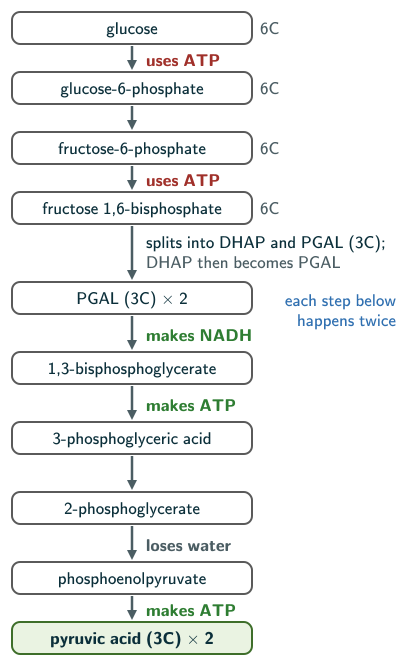
Glycolysis is a chain of ten reactions, each controlled by its own enzyme, that turns glucose into pyruvate (NCERT page 156):
- Glucose is phosphorylated to glucose-6-phosphate (G6P) by hexokinase, using one ATP.
- G6P isomerises to fructose-6-phosphate (F6P).
- F6P is phosphorylated to fructose 1,6-bisphosphate (F1,6BP), using a second ATP.
- F1,6BP splits into two 3-carbon triose phosphates: dihydroxyacetone phosphate (DHAP) and 3-phosphoglyceraldehyde (PGAL), also called glyceraldehyde-3-phosphate.
- DHAP and PGAL interconvert (the two-way arrow in NCERT Figure 12.1), so the DHAP also becomes PGAL: two PGAL per glucose.
- PGAL is oxidised, and combines with inorganic phosphate, to form 1,3-bisphosphoglycerate (BPGA); two redox equivalents (two hydrogen atoms) go to NAD, forming NADH + H.
- BPGA becomes 3-phosphoglyceric acid (PGA), and the energy released is trapped as ATP.
- PGA becomes 2-phosphoglycerate.
- 2-phosphoglycerate loses a molecule of water to form phosphoenolpyruvate (PEP).
- PEP becomes pyruvic acid, and another ATP is made.
Steps 6 to 10 happen twice for each glucose, once for each PGAL.
NCERT Figure 12.1 labels 1,3 bisphosphoglyceric acid “Triose bisphosphate” and 3-phosphoglyceric acid “Triose phosphate” (page 156). Strictly (beyond the NCERT text), a triose is a 3-carbon sugar, and these two are 3-carbon acids. Only PGAL and DHAP are true triose phosphates, which is why NCERT’s own Calvin cycle figure (Chapter 11, Figure 11.8, page 144) shows 3-phosphoglycerate being reduced to triose phosphate.
ATP and NADH in glycolysis
NCERT asks you to note where ATP and NADH + H are used or made (page 156):
| Step | ATP | NADH + H |
|---|---|---|
| glucose → G6P | −1 | 0 |
| F6P → F1,6BP | −1 | 0 |
| PGAL → BPGA (× 2) | 0 | +2 |
| BPGA → PGA (× 2) | +2 | 0 |
| PEP → pyruvate (× 2) | +2 | 0 |
So, per glucose: 4 ATP made directly, 2 ATP used, a net gain of 2 ATP, and 2 NADH + 2H (from NCERT page 156). These 2 NADH are reoxidised to NAD when pyruvic acid is fermented (NCERT page 157); in aerobic respiration, NCERT’s balance sheet assumes they enter the mitochondria for oxidative phosphorylation (page 161).
Fates of pyruvic acid
Pyruvic acid is the key product of glycolysis, and its fate depends on the cell’s needs. There are three major ways in which cells handle it (NCERT pages 156–157):
- lactic acid fermentation and alcoholic fermentation, which take place under anaerobic conditions in many prokaryotes and unicellular eukaryotes;
- aerobic respiration, the complete oxidation of glucose to CO and HO, which needs an O supply.
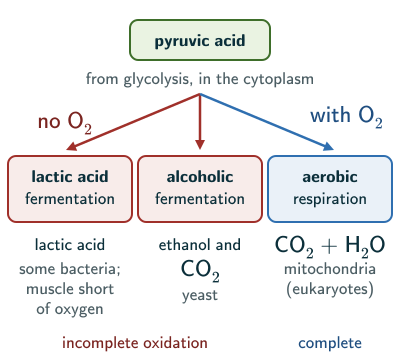
NCERT says that for complete oxidation “organisms adopt Krebs’ cycle which is also called as aerobic respiration” (page 157). Aerobic respiration is more than the Krebs’ cycle: NCERT’s own Section 12.4 adds the conversion of pyruvate to acetyl CoA before it and the electron transport system after it (pages 158–161).
Solved examples
Example 1: Net ATP from glycolysis (NCERT page 156)
How many ATP molecules are directly synthesised in glycolysis from one glucose molecule? What is the net gain?
Answer: ATP is made at two steps, BPGA → PGA and PEP → pyruvic acid, and each happens twice per glucose: 2 × 2 = 4 ATP made. ATP is used at two steps, glucose → glucose-6-phosphate and fructose-6-phosphate → fructose 1,6-bisphosphate: 2 used. Net: 4 − 2 = 2 ATP (NCERT page 156).
Example 2: Counting the carbons
Follow the carbons from glucose to pyruvic acid.
Answer: glucose has 6 carbons and stays 6-carbon until fructose 1,6-bisphosphate splits into two 3-carbon sugars (3 + 3 = 6). Each gives one 3-carbon pyruvic acid, so 2 × 3 = 6: no carbon is lost as CO in glycolysis (NCERT pages 155–156).
Example 3: Where is NADH made?
At which step of glycolysis is NADH + H formed, and how many per glucose?
Answer: when PGAL is converted to BPGA: two hydrogen atoms are removed from PGAL and transferred to NAD. This happens once for each 3-carbon half, so 2 NADH and 2H per glucose (NCERT page 156).
Example 4: Sucrose into glycolysis
How does sucrose, the end product of photosynthesis, enter glycolysis?
Answer: invertase splits sucrose into glucose and fructose, and both monosaccharides enter glycolysis after phosphorylation: glucose to G6P by hexokinase, fructose mainly to F6P by fructokinase in plants. NCERT names hexokinase for both (page 156); the distinction is explained above.
Example 5: Glycolysis against the Krebs’ cycle and fermentation (NCERT Exercises 1b, 7b and 7c)
Distinguish glycolysis from (i) the Krebs’ (citric acid) cycle and (ii) fermentation.
Answer:
| Feature | Glycolysis | Krebs’ cycle |
|---|---|---|
| Where | cytoplasm | mitochondrial matrix |
| Oxygen | not directly needed | indirectly dependent on O for sustained aerobic operation |
| Input, output | glucose → 2 pyruvic acid | acetyl CoA → 2 CO per turn |
| Per glucose | net 2 ATP, 2 NADH + 2H | 2 ATP, 6 NADH + 6H, 2 FADH |
(ii) Fermentation is glycolysis followed by the conversion of pyruvic acid to ethanol and CO or to lactic acid, which reoxidises the NADH; glycolysis is the shared first stage of both fermentation and aerobic respiration (NCERT pages 155–159).
Common mistakes to avoid
Common mistake
Counting 4 ATP as the gain
Glycolysis makes 4 ATP directly but uses 2, so the net gain is 2 ATP per glucose (NCERT page 156).
Common mistake
Calling the ATP of glycolysis oxidative phosphorylation
Both ATP-making steps (BPGA → PGA and PEP → pyruvic acid) pass a phosphate group from the substrate straight to ADP. This is substrate-level phosphorylation, the term NCERT uses for the GTP step of the Krebs’ cycle (page 159). No oxygen or electron transport system is involved: the ATP-producing reactions of classical glycolysis occur in the cytoplasm (page 155).
Common mistake
Putting glycolysis in the mitochondria
The standard pathway discussed here occurs in the cytoplasm; microbial pathway variants do not make “every organism has identical EMP glycolysis” a valid universal rule.
Common mistake
Thinking glycolysis needs oxygen
Glycolysis needs no oxygen directly, but it needs NAD regeneration. Some anaerobes also have other pathways, including anaerobic electron transport.
Quick revision summary
- Glycolysis (EMP pathway: Embden, Meyerhof, Parnas) breaks one glucose into two pyruvic acid molecules in the cytoplasm in the standard pathway; it needs no oxygen directly.
- In plants, sucrose is split by invertase into glucose and fructose; glucose is phosphorylated by hexokinase and fructose mainly by fructokinase in plants.
- Ten enzyme-controlled reactions: ATP is used at two steps (glucose → G6P, F6P → F1,6BP); NADH + H is made when PGAL → BPGA; ATP is made when BPGA → PGA and PEP → pyruvic acid.
- Per glucose: 4 ATP made, 2 used, net 2 ATP, and 2 NADH + 2H.
- Pyruvic acid goes to lactic acid fermentation, alcoholic fermentation or aerobic respiration.
Formula sheet
- glucose (6C) → 2 pyruvic acid (3C)
- ATP: 4 made − 2 used = net 2 per glucose
- per glucose: 2 NADH + 2H
Questions students ask
Why does glycolysis use up 2 ATP before it makes any?
Glycolysis spends 2 ATP at the start to phosphorylate the sugar twice, turning glucose into fructose 1,6-bisphosphate, a 6-carbon sugar carrying two phosphates that then splits into two 3-carbon sugar phosphates (NCERT page 156). The investment is repaid later, when each 3-carbon half makes ATP twice, so glycolysis still ends with a net gain.
Why is glycolysis called the partial oxidation of glucose?
Glycolysis is called the partial oxidation of glucose because it takes glucose only as far as two molecules of pyruvic acid, not to CO and water (NCERT page 155). Its one oxidation step removes just two hydrogen atoms from each PGAL and hands them to NAD (NCERT page 156), so pyruvic acid still holds most of the energy of glucose: even with fermentation added, less than seven per cent of that energy is released (page 157). The complete oxidation of pyruvic acid to CO and HO needs O and, in eukaryotes, takes place in the mitochondria by aerobic respiration (NCERT pages 157–158).
Is glycolysis aerobic or anaerobic?
Glycolysis is anaerobic in the sense that it needs no oxygen, yet it runs in aerobic and anaerobic organisms alike: it is the first stage of both aerobic respiration and fermentation (NCERT pages 155–157). It hands the hydrogen it removes to NAD, not to O, so glycolysis can go on as long as NAD is regenerated from NADH + H, by fermentation when oxygen is lacking or, in aerobic respiration, by oxidation in the mitochondria (NCERT pages 157 and 161).
How many ATP does glycolysis give in aerobic respiration: 2 or 8?
Glycolysis itself makes a net gain of 2 ATP in all conditions (NCERT page 156), and 2 is the answer when a question asks for the net ATP of glycolysis. In aerobic respiration, the balance sheet also credits glycolysis with 2 NADH + 2H, which NCERT assumes are oxidised in the mitochondria at 3 ATP each (pages 160–161), so glycolysis counts 2 + 6 = 8 of the 38 ATP, a share NCERT does not state itself. In fermentation that NADH + H is reoxidised to NAD without making ATP, so the gain stays at 2 (page 157). Beyond NCERT, glycolysis itself still gives net 2 ATP. Its two cytosolic NADH carry reducing equivalents that reach mitochondrial electron transport through shuttles or other routes; they do not simply cross the inner membrane. With common modern accounting, this contribution is 7 ATP if each equivalent yields 2.5, or 5 if it yields 1.5. These are model-dependent totals, not a change to glycolysis’s direct yield (Alberts and others, Molecular Biology of the Cell, “The Mitochondrion”; Hinkle, 2005).
Practice questions
Try each question first, then open the answer to check your working.
-
Q1. Why is glycolysis also called the EMP pathway?
Show answerHide answer
After Gustav Embden, Otto Meyerhof and J. Parnas, who gave its scheme (NCERT page 155).
-
Q2. Which enzyme converts sucrose into glucose and fructose?
Show answerHide answer
Invertase (NCERT page 156).
-
Q3. Into which two 3-carbon compounds does fructose 1,6-bisphosphate split?
Show answerHide answer
Dihydroxyacetone phosphate and 3-phosphoglyceraldehyde (PGAL) (NCERT page 156).