Post-fertilisation: structures and events
NCERT Class 12 Biology Chapter 1 Section 1.4
Quick answer
After double fertilisation, endosperm and embryo develop, ovules mature into seeds, and the ovary develops into fruit. In the typical pattern, endosperm growth begins before substantial embryo development; accessory fruits also include tissues beyond the ovary.
With your textbook
NCERT Biology (Class 12), Chapter 1 “Sexual Reproduction in Flowering Plants”, Section 1.4 “Post-fertilisation: Structures and Events”, pages 18–22.
Open the official NCERT chapter (PDF, 36.8 MB, ncert.nic.in) (opens in a new tab)
Checked against the 2026-27 reprint on .
What are post-fertilisation events?
Post-fertilisation events
Following double fertilisation, events of endosperm and embryo development, maturation of ovule(s) into seed(s) and ovary into fruit, are collectively termed post-fertilisation events.
NCERT Biology (Class 12), Section 1.4, page 18
In plain words: after double fertilisation in the embryo sac, four sets of events follow. The primary endosperm cell first builds a food tissue, the endosperm; the zygote then grows into an embryo; meanwhile each fertilised ovule becomes a seed and the ovary becomes a fruit.
Endosperm
Endosperm development precedes embryo development.
NCERT Biology (Class 12), Section 1.4.1, page 18
- In the typical NCERT pathway, the primary endosperm cell divides repeatedly and forms triploid endosperm tissue. Its cells are filled with reserve food materials, used for the nutrition of the developing embryo (pages 18–19).
- NCERT asks why the endosperm comes first. Its own answer comes on the next page: most zygotes divide only after a certain amount of endosperm has formed, which is an adaptation to provide assured nutrition to the developing embryo (page 19).
- NCERT’s Summary says endosperm formation “always precedes” embryo development (page 24), while the main text says “most zygotes” wait (page 19). The lesson’s main developmental pattern is endosperm formation before substantial embryo growth; avoid turning it into a universal timing rule for every species.
- The endosperm may be completely consumed by the developing embryo before the seed matures, as in pea, groundnut and beans, or it may persist in the mature seed, as in castor and coconut, and be used up during germination (page 19).
Free-nuclear and cellular endosperm
In the most common type of endosperm development (page 19):
- the PEN undergoes successive nuclear divisions that give free nuclei; this stage is the free-nuclear endosperm;
- later, cell walls form and the endosperm becomes cellular.
The number of free nuclei formed before cellularisation varies greatly (page 19).
The coconut water from tender coconut that you are familiar with, is nothing but free-nuclear endosperm (made up of thousands of nuclei) and the surrounding white kernel is the cellular endosperm.
NCERT Biology (Class 12), Section 1.4.1, page 19
NCERT asks whether the endosperm persists in the cereals wheat, rice and maize (page 19). The same chapter lists wheat and maize among the seeds that keep part of their endosperm (page 20), so in wheat and maize it persists. Rice is not on that list, but NCERT Class 11 Biology, Chapter 5, page 66, notes that monocot seeds are generally endospermic, so it persists in rice too (our reasoning); that endosperm is the food you eat in all three grains.
Embryo
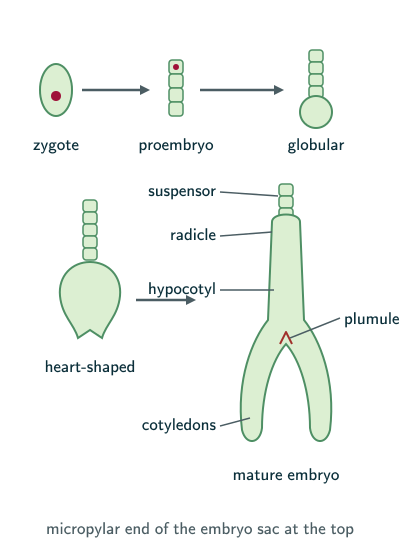
- The embryo develops at the micropylar end of the embryo sac, where the zygote is (page 19).
- Most zygotes divide only after a certain amount of endosperm is formed: an adaptation that assures nutrition to the developing embryo (page 19). This answers NCERT Exercise 12, on why the zygote stays dormant for some time.
- The seeds differ greatly, but the early stages of embryo development (embryogeny) are similar in monocotyledons and dicotyledons (page 19).
- In the illustrated dicot pattern, the zygote gives rise to the proembryo and then to the globular, heart-shaped and mature embryo (page 19).
Dicot and monocot embryos
A typical dicot embryo has an embryonal axis and two cotyledons (page 19):
- the part of the axis above the level of the cotyledons is the epicotyl, which ends in the plumule (stem tip);
- the cylindrical part below the cotyledons is the hypocotyl, which ends in the radicle (root tip); the root tip is covered by a root cap.
Monocot embryos have only one cotyledon (pages 19–20). In the grass family:
- the cotyledon is the scutellum, situated to one side (laterally) of the embryonal axis;
- at its lower end the axis has the radicle and root cap, enclosed in an undifferentiated sheath, the coleorrhiza;
- the part of the axis above the scutellum’s attachment is the epicotyl; it has a shoot apex and a few leaf primordia, enclosed in a hollow foliar structure, the coleoptile.
- NCERT Figure 1.14 (b) also labels the epiblast, a small outgrowth on the side of the axis opposite the scutellum; the text does not describe it. The figure spells the sheath coleorhiza, with one r, as NCERT Class 11 does (Chapter 5, page 67); both spellings name the same part.
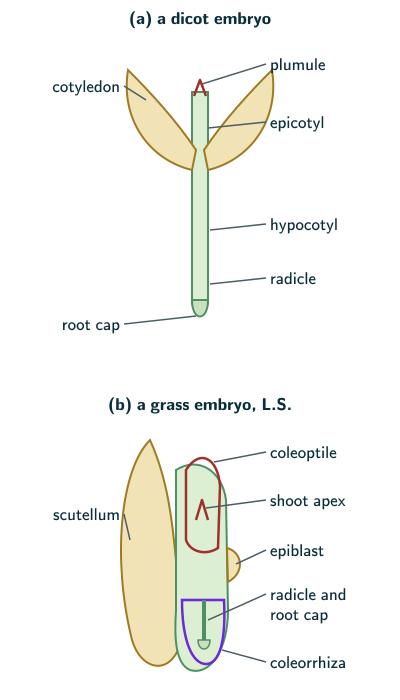
NCERT slip (page 20): the sentence on the grass embryo prints “radical and root cap”. It means the radicle, the embryonic root tip named on page 19 (“the radicle or root tip”); a radical is a different word altogether. Write radicle in an exam.
Seed
In angiosperms, the seed is the final product of sexual reproduction.
NCERT Biology (Class 12), Section 1.4.3, page 20
- A sexually produced seed is a mature ovule containing an embryo; seeds form inside fruits (page 20). “Fertilised ovule” is useful shorthand, but apomictic embryos can form without egg fertilisation.
- A seed typically consists of seed coat(s), cotyledon(s) and an embryo axis. The cotyledons are simple structures, generally thick and swollen with stored food, as in legumes (page 20).
- The integuments of the ovule harden into tough, protective seed coats. The micropyle remains as a small pore in the seed coat, which lets oxygen and water into the seed during germination (page 20). NCERT Class 11 Biology, Chapter 5, page 66, names the two layers of the seed coat: the outer testa and the inner tegmen; the Class 11 seed page labels these parts in a bean seed.
Albuminous and non-albuminous seeds
- Non-albuminous seeds have no residual endosperm, because the developing embryo uses it all: pea, groundnut (page 20).
- Albuminous seeds keep part of the endosperm, because the embryo does not use it all: wheat, maize, barley, castor (page 20).
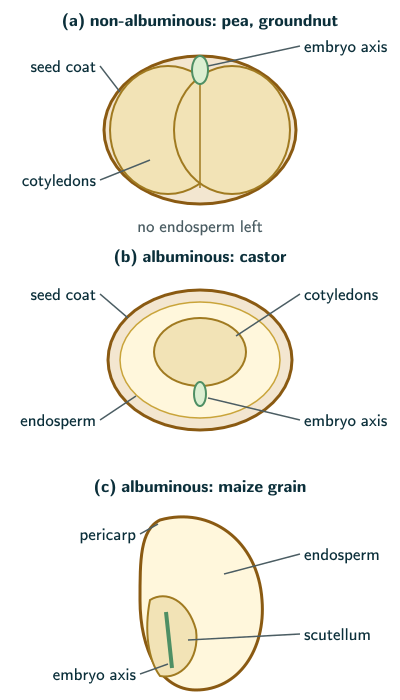
NCERT slip (page 20): the paragraph opens “Mature seeds may be non-albuminous or ex-albuminous”. Ex-albuminous is another name for non-albuminous, so the sentence names one type twice; the next two sentences show that the two types are albuminous and non-albuminous (ex-albuminous). Learn those two.
Perisperm and seed dormancy
- In some seeds, such as black pepper and beet, remnants of the nucellus also persist. This residual, persistent nucellus is the perisperm (page 20).
- NCERT describes maturation drying to about 10–15 per cent moisture by mass, with slowed embryo metabolism (page 20). This is a general account of desiccation-tolerant seeds, not all seeds: recalcitrant seeds are damaged by drying and need different storage methods (Royal Botanic Gardens, Kew, seed-conservation guidance).
- NCERT describes dormancy as inactivity (page 20). More precisely, a dormant viable seed does not germinate even under otherwise suitable conditions until its dormancy is relieved; a merely quiescent seed resumes germination when the missing external requirement, such as water, is supplied (FAO, A Guide to Forest Seed Handling, glossary). Germination itself is covered in seed germination.
Four terms to keep apart (NCERT pages 18–20; the ploidies are our reasoning from NCERT: the endosperm is triploid, pages 18–19, while the nucellus, the integuments and the ovary wall are tissues of the diploid parent plant):
- Endosperm: from the primary endosperm cell; 3n; kept in albuminous seeds.
- Perisperm: from the nucellus; 2n; black pepper, beet.
- Seed coat: derived from maternal integuments; 2n in the diploid plant considered here. Its persistence and structure vary among species.
- Pericarp: derived from the maternal ovary wall; 2n in the diploid plant considered here.
True and false fruits
- As ovules mature into seeds, the ovary develops into a fruit; the two proceed simultaneously (page 20).
- The wall of the ovary develops into the wall of the fruit, the pericarp. Fruits may be fleshy (guava, orange, mango) or dry (groundnut, mustard). Many fruits have evolved mechanisms for dispersing their seeds (page 20).
- In most plants, the other floral parts degenerate and fall off as the fruit develops. In accessory or false fruits, tissues beyond the ovary contribute to the mature structure. In a few species, such as apple, strawberry and cashew, the thalamus also contributes to fruit formation; such fruits are false fruits (page 20). In an NCERT-based answer, name the thalamus. Beyond the NCERT text: the fleshy cashew apple grows from the swollen flower stalk (pedicel) and the receptacle (the thalamus), while the kidney-shaped true fruit holds the seed (Wikipedia, “Cashew”, facts in our words). Most fruits develop only from the ovary and are true fruits (page 20).
- NCERT asks how the number of ovules in an ovary relates to the number of seeds in the fruit. Our reasoning: each seed comes from one ovule, so a fruit from one ovary normally cannot have more seeds than that ovary had ovules. Fewer seeds may result from failed fertilisation or later seed abortion; aggregate and multiple fruits involve more than one ovary.
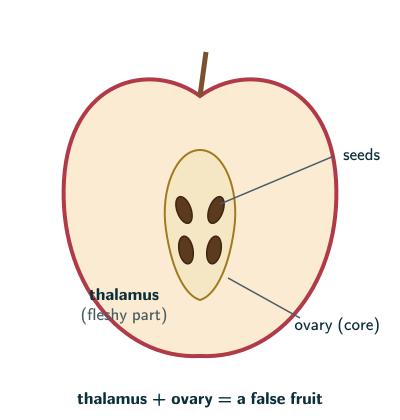
The Class 11 fruit page lists the edible parts of these fruits.
Parthenocarpy
Parthenocarpy can be induced through the application of growth hormones and such fruits are seedless.
NCERT Biology (Class 12), Section 1.4.3, page 21
- Although in most species fruits result from fertilisation, in a few species fruits develop without fertilisation; these are parthenocarpic fruits. Banana is one example (pages 20–21).
- Do not confuse it with apomixis, seed formation without fertilisation (NCERT Section 1.5, page 22): parthenocarpy makes a fruit without fertilisation, apomixis makes a seed without fertilisation.
Advantages of seeds
NCERT lists the advantages of seeds to angiosperms (pages 21–22):
- Fertilisation does not require an external water film for sperm to swim through: the pollen tube delivers the male gametes. Most angiosperms also use non-water pollination, but hydrophilous species do use water to transport pollen.
- Seeds have better adaptive strategies for dispersal to new habitats and help the species colonise other areas.
- In many species, food reserves support the young seedling until it can photosynthesise; very small seeds such as orchid seeds have different nutritional dependencies.
- The hard seed coat protects the young embryo.
- Being products of sexual reproduction, seeds generate new genetic combinations, leading to variations.
Seed is the basis of our agriculture (page 22): dehydration and dormancy of mature seeds let us store them, to eat through the year and to raise the next season’s crop.
How long do seeds stay alive? The period varies greatly: a few species lose viability within a few months, many live for several years, and some remain alive for hundreds of years (page 22). NCERT gives two records:
- the oldest, a lupine, Lupinus arcticus, excavated from Arctic Tundra, which germinated and flowered after an estimated 10 000 years of dormancy;
- a recent record, a 2000-year-old viable seed of the date palm, Phoenix dactylifera, found in an archaeological excavation at King Herod’s palace near the Dead Sea (page 22).
Beyond the NCERT text: Zazula and colleagues’ 2009 radiocarbon study found that the Lupinus arcticus plants had grown from modern, not Pleistocene, seeds (New Phytologist, 2009). A roughly 2000-year-old date seed’s germination was reported by Sallon and colleagues (Science, 2008). In an NCERT-based answer, give the lupine (about 10 000 years) as NCERT’s oldest record; outside one, do not present it as a valid longevity record.
Huge numbers of seeds (page 22): an orchid fruit contains thousands of tiny seeds, as do the fruits of some parasitic species such as Orobanche and Striga; a large Ficus tree grows from a tiny seed.
Solved examples
Example 1: Four pairs of terms (NCERT Exercise 13)
Differentiate between (a) hypocotyl and epicotyl; (b) coleoptile and coleorrhiza; (c) integument and testa; (d) perisperm and pericarp.
Answer: (a) the epicotyl is the part of the embryonal axis above the cotyledons, ending in the plumule; the hypocotyl is the part below them, ending in the radicle (NCERT page 19). (b) In a grass embryo, the coleoptile is the hollow foliar structure enclosing the shoot apex and leaf primordia; the coleorrhiza is the sheath enclosing the radicle and root cap (pages 19–20). (c) The integuments are the one or two protective envelopes of the ovule, round the nucellus (NCERT page 9); after fertilisation they harden into the seed coat (page 20). The testa is only the outer layer of that seed coat; the inner layer is the tegmen (NCERT Class 11 Biology, Chapter 5, page 66). The integument belongs to the ovule, the testa to the seed. (d) The perisperm is the residual, persistent nucellus inside some seeds, such as black pepper and beet; the pericarp is the wall of the fruit, formed from the ovary wall (page 20).
Example 2: The apple (NCERT Exercise 14)
Why is apple called a false fruit? Which part(s) of the flower form the fruit?
Answer: in apple, the thalamus also contributes to fruit formation, so it is a false fruit (NCERT page 20). The fruit forms from the thalamus and the ovary; the fleshy part is the thalamus (NCERT Figure 1.15 (b), page 21).
Example 3: Chromosome numbers in a seed
In a plant with 2n = 14, how many chromosomes are there in a cell of (a) the endosperm, (b) the embryo, (c) the perisperm, (d) the seed coat?
Answer: (a) 3 × 7 = 21, since the endosperm is triploid; (b) 14, since the embryo grows from the diploid zygote; (c) 14, since the perisperm is nucellus, diploid tissue of the parent; (d) 14, since the seed coat comes from the parent’s integuments (NCERT pages 18–20).
Example 4: Choosing fruits for parthenocarpy (NCERT Exercise 16)
If parthenocarpy can be induced with growth substances, which fruits would you choose, and why?
Answer: fruits that are eaten for their flesh and whose seeds are a nuisance to eat or to process, for example orange, lemon, watermelon and guava. Parthenocarpic fruits are seedless, and they form without fertilisation (NCERT pages 20–21). (Our reasoning: NCERT gives no list for this question.)
Common mistakes to avoid
Common mistake
Thinking the embryo develops before the endosperm
Endosperm development precedes embryo development; most zygotes divide only after some endosperm has formed (NCERT pages 18–19).
Common mistake
Mixing up perisperm and pericarp
Perisperm is leftover nucellus inside a seed (black pepper, beet); pericarp is the fruit wall, from the ovary wall (NCERT page 20).
Common mistake
Calling coconut water cellular endosperm
Coconut water is free-nuclear endosperm with thousands of nuclei; the white kernel is the cellular endosperm (NCERT page 19).
Common mistake
Swapping coleoptile and coleorrhiza
The coleoptile covers the shoot apex; the coleorrhiza covers the radicle and root cap (NCERT pages 19–20).
Common mistake
Calling the whole seed coat the testa
The integuments harden into the seed coat (NCERT page 20); the testa is only its outer layer, and the inner layer is the tegmen (NCERT Class 11 Biology, Chapter 5, page 66).
Quick revision summary
- Post-fertilisation events: endosperm and embryo development, ovules into seeds, ovary into fruit.
- Endosperm comes first: the PEC divides into triploid food tissue, usually free-nuclear first and cellular later (coconut water and kernel).
- Illustrated dicot embryogeny: zygote, proembryo, globular, heart-shaped, mature. Dicot embryo: two cotyledons, epicotyl to plumule, hypocotyl to radicle and root cap. Grass embryo: scutellum, coleoptile, coleorrhiza.
- Seeds: non-albuminous (pea, groundnut) or albuminous (wheat, maize, barley, castor); perisperm in black pepper and beet; integuments become seed coats; many seeds undergo maturation drying; NCERT gives 10–15 per cent moisture. Dormancy is distinct from simple lack of favourable conditions.
- Fruits: pericarp from the ovary wall; accessory fruits include tissues beyond the ovary (apple, strawberry, cashew); parthenocarpic fruits (banana) form without fertilisation and are seedless.
- Pollen-tube delivery removes the need for an external water film for fertilisation; seeds aid dispersal and embryo protection, and sexual seeds carry new genetic combinations.
Formula sheet
- typical pattern: endosperm develops before substantial embryo growth
- common nuclear type: PEC (3n) → free nuclei → cellular endosperm
- dicot embryo stages: zygote, proembryo, globular, heart-shaped, mature
- epicotyl → plumule; hypocotyl → radicle
- integuments → seed coats; ovary wall → pericarp
- ovules → seeds; ovary → fruit
- perisperm = persistent nucellus
- accessory fruit: tissues beyond ovary contribute; parthenocarpy: fruit without fertilisation
Questions students ask
What is the difference between pre-fertilisation and post-fertilisation events?
Pre-fertilisation events are all that happens before the gametes fuse, from forming pollen grains and embryo sacs to pollination and the pollen tube’s growth into an ovule (NCERT Section 1.2, pages 4–17), while post-fertilisation events follow double fertilisation (Section 1.3) and are, in NCERT’s words, “events of endosperm and embryo development, maturation of ovule(s) into seed(s) and ovary into fruit” (Section 1.4, page 18). The pre-fertilisation events involve both stamens and pistil; the post-fertilisation ones take place in the pistil, with the thalamus joining in only in false fruits (page 20).
What is the difference between endosperm and cotyledon?
The endosperm is a food-storing tissue of the seed that lies outside the embryo, formed after triple fusion and triploid in NCERT’s typical pathway, while a cotyledon is a seed leaf, part of the embryo itself, and so diploid like the zygote it came from (NCERT pages 18–19). Both can store food: in legumes the cotyledons swell with the reserves and the embryo uses up the endosperm before the seed matures, whereas in albuminous seeds part of the endosperm remains and is used during germination (pages 19–20).
Why is endosperm triploid in flowering plants but haploid in gymnosperms?
In NCERT’s typical pathway the endosperm of a flowering plant is triploid (3n) because it grows from the primary endosperm cell, whose nucleus forms by triple fusion of one haploid male gamete with the two haploid polar nuclei (NCERT pages 18–19). A gymnosperm has no triple fusion; beyond the NCERT text, a conifer seed’s food store is its female gametophyte, or megagametophyte (Kolotelo, Anatomy and Morphology of Conifer Tree Seed, BC Ministry of Forests, 1997). That tissue is haploid because it grows from a megaspore formed by meiosis, and it forms in the ovule before fertilisation (NCERT Class 11, Chapter 3, page 33; see the gymnosperm ovule).
What do the parts of an ovule become after fertilisation?
After fertilisation the ovule matures into a seed: its zygote develops into the embryo, its primary endosperm cell into the endosperm, and its integuments harden into the seed coats, in which the micropyle stays as a small pore that lets oxygen and water in at germination (NCERT pages 18–20). In a few seeds, such as those of black pepper and beet, leftover nucellus also survives, as the perisperm (page 20). Meanwhile the ovary develops into the fruit, the two changes going on side by side (page 20).
Practice questions
Try each question first, then open the answer to check your working.
-
Q1. Name two seeds in which the endosperm is completely consumed by the embryo, and two in which it persists.
Show answerHide answer
Consumed: any two of pea, groundnut, beans. Persists: castor and coconut (NCERT page 19); NCERT also lists wheat, maize and barley as albuminous (page 20).
-
Q2. In a grass embryo, what is the scutellum, and where is it placed?
Show answerHide answer
The single cotyledon, situated to one side (laterally) of the embryonal axis (NCERT page 19).
-
Q3. What moisture content does NCERT give for a drying mature seed, and is this a rule for every seed?
Show answerHide answer
About 10–15 per cent by mass in NCERT’s general account (pages 20 and 22). Drying slows metabolism and aids storage in tolerant seeds; recalcitrant seeds cannot safely be treated the same way.