Flower: a fascinating organ of angiosperms
NCERT Class 12 Biology Chapter 1 Section 1.1
Quick answer
A flower is the reproductive structure of an angiosperm. A typical bisexual flower has sepals, petals, stamens and a gynoecium; pollen develops in anthers and embryo sacs develop in ovules within the ovary.
With your textbook
NCERT Biology (Class 12), Chapter 1 “Sexual Reproduction in Flowering Plants”, Section 1.1 “Flower – A Fascinating Organ of Angiosperms”, pages 3–4.
Open the official NCERT chapter (PDF, 36.8 MB, ncert.nic.in) (opens in a new tab)
Checked against the 2026-27 reprint on .
What is a flower?
The flower
To a biologist, flowers are morphological and embryological marvels and the sites of sexual reproduction.
NCERT Biology (Class 12), Section 1.1, page 4
- Flowers are the seat of sexual reproduction in angiosperms (NCERT Summary, page 23).
- In the flower, the androecium, a whorl of stamens, represents the male reproductive organ, and the gynoecium represents the female reproductive organ (page 4).
In plain words: a flower is where a flowering plant makes its gametes and where fertilisation happens. Many floral colours, scents and shapes are adaptations that help reproduction, often by attracting pollinators; not all flowers are colourful or scented. The end products of all this are fruits and seeds.
Why flowers matter to the plant
All flowering plants show sexual reproduction.
NCERT Biology (Class 12), Chapter 1, Introduction, page 3
- The flowers we enjoy, their scents and their rich colours “are all there as an aid to sexual reproduction” (page 3).
- The diversity of inflorescences, flowers and floral parts shows an amazing range of adaptations that ensure the end products of sexual reproduction: the fruits and seeds (page 3).
- This introductory statement describes the characteristic reproductive system of angiosperms. Some plants also reproduce asexually, and some form seeds by apomixis, discussed later in the chapter.
- The chapter studies the morphology, structure and processes of sexual reproduction in flowering plants, the angiosperms (page 3).
Flowers in human culture
Flowers are objects of aesthetic, ornamental, social, religious and cultural value – they have always been used as symbols for conveying important human feelings such as love, affection, happiness, grief, mourning, etc.
NCERT Biology (Class 12), Section 1.1, page 3
NCERT asks you to do three things here (pages 3–4):
- list at least five flowers of ornamental value that are commonly grown at homes and in gardens;
- find five more flowers that your family uses in social and cultural celebrations;
- say what floriculture refers to.
The lists depend on where you live and on your family’s customs; rose, marigold, jasmine and hibiscus are familiar examples. The chapter does not define floriculture, but the word explains itself (our own reading): flori-, flower, and culture, cultivation, so floriculture includes cultivating flowers and other ornamental plants (ICAR, Floriculture and Landscaping syllabus).
Parts of a typical flower
NCERT Figure 1.1 (page 4) recalls the parts of a typical flower, which you studied in Class 11. Cut lengthwise, the flower shows its whorls on the thalamus at the tip of the stalk (pedicel):
- Sepals and petals, the outer whorls (calyx and corolla).
- Stamens, together the androecium: each stamen has a long, slender stalk, the filament, and a terminal, generally bilobed anther (page 5).
- The pistil (one or more), together the gynoecium: each pistil has a stigma, a style and an ovary (page 8). The ovary holds the ovules.
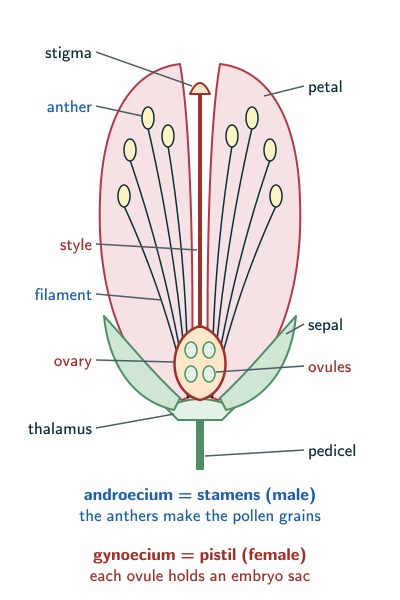
NCERT then asks: “Can you name the two parts in a flower in which the two most important units of sexual reproduction develop?” (page 4). The two units are the male and female gametophytes:
- the pollen grains, the male gametophytes, develop in the anther, inside its microsporangia (pages 5–6);
- the embryo sac, the female gametophyte, develops in the ovule, inside the ovary (pages 9–10).
The gametes form in these gametophytes: the generative cell produces two male gametes, either before pollen shedding or during pollen-tube growth (pages 7 and 17), and the egg cell is one of the cells of the embryo sac (page 11).
The chapter in one chart
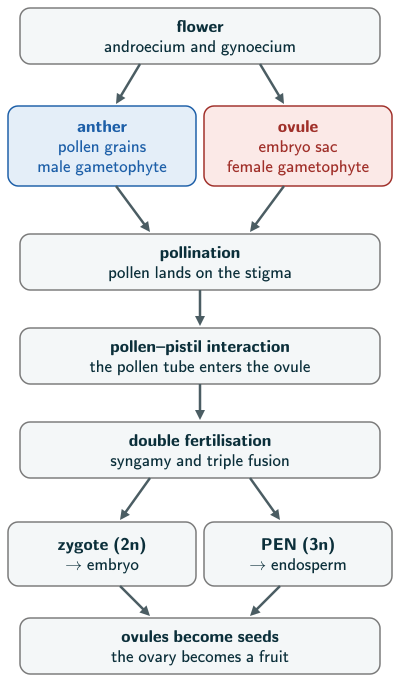
The rest of the chapter follows these structures through NCERT Sections 1.2 to 1.5: the gametophytes form and pollination happens before fertilisation; double fertilisation follows; then the embryo, endosperm, seed and fruit develop; a few plants make seeds without fertilisation (apomixis).
Solved examples
Example 1: Where the gametophytes develop (NCERT Exercise 1)
Name the parts of an angiosperm flower in which the male and female gametophytes develop.
Answer: the male gametophyte, the pollen grain, develops in the anther of the stamen, inside its microsporangia (pollen sacs). The female gametophyte, the embryo sac, develops in the ovule, in its nucellus, inside the ovary of the pistil (NCERT pages 5–10).
Example 2: Counting pollen sacs
A flower has 6 stamens, each with a typical angiosperm anther. How many microsporangia does the flower have?
Answer: a typical anther is bilobed and dithecous, with four microsporangia, two in each lobe (NCERT page 5). So the flower has 6 × 4 = 24 microsporangia.
Example 3: Which whorl does what
Which whorl would you remove from a flower bud so that the flower can make no pollen of its own? Which part must stay for the flower to give seeds?
Answer: remove the stamens (androecium): pollen grains form in their anthers. The pistil (gynoecium) must stay, because seeds develop from the ovules inside its ovary (NCERT pages 4 and 18). Plant breeders do exactly this before a cross; removing the anthers from a bud is called emasculation (NCERT page 17).
Common mistakes to avoid
Common mistake
Calling the pollen grain the male gamete
The pollen grain is the male gametophyte; the generative cell forms the two male gametes, sometimes after the pollen tube has begun growing (NCERT pages 7 and 17).
Common mistake
Calling the ovary the female gametophyte
The ovary holds the ovules; the female gametophyte is the embryo sac inside each ovule (NCERT pages 9–10).
Common mistake
Treating the stamen and the anther as the same thing
A stamen is the filament and the anther; only the anther makes pollen (NCERT page 5).
Quick revision summary
- Flowers are the sites of sexual reproduction in angiosperms; their fruits and seeds are its end products.
- Flowers also have aesthetic, ornamental, social, religious and cultural value for people.
- A typical flower: sepals, petals, stamens (androecium, male) and pistil (gynoecium, female).
- Stamen = filament + anther; pistil = stigma + style + ovary with ovules.
- Pollen grains (male gametophytes) develop in the anther; the embryo sac (female gametophyte) develops in the ovule.
Formula sheet
- flower: site of sexual reproduction in angiosperms
- androecium (stamens) = male; gynoecium (pistil) = female
- stamen: filament + anther; pistil: stigma + style + ovary
- anther → pollen grains (male gametophytes)
- ovule → embryo sac (female gametophyte)
- end products: fruits and seeds
Questions students ask
What is the process of sexual reproduction in flowering plants?
Sexual reproduction in flowering plants is a sequence of events: the male and female gametophytes, pollen grains and embryo sacs, develop in the flower, pollination brings pollen to a stigma, and a compatible pollen tube grows through the style into an ovule (NCERT pages 5–17). In the embryo sac one male gamete fuses with the egg and the other with the two polar nuclei, which is double fertilisation (page 18). The primary endosperm cell then forms the endosperm and the zygote the embryo, while the ovules mature into seeds and the ovary into a fruit (pages 18–20).
Why is sexual reproduction important in flowering plants?
Sexual reproduction is important in flowering plants because it creates variation: NCERT’s Unit VI opener says the sexual mode of reproduction “enables creation of new variants, so that survival advantage is enhanced” (page 1). NCERT also notes that continued self-pollination results in inbreeding depression, so many flowering plants have devices that discourage self-pollination and encourage cross-pollination (page 15).
Are all flowers bisexual?
No, not all flowers are bisexual, though most are: NCERT says the majority of flowering plants bear hermaphrodite (bisexual) flowers, with both androecium and gynoecium, while some species bear unisexual flowers (page 15). Castor and maize have separate male and female flowers on the same plant, the monoecious condition, whereas papaya bears its male and female flowers on different plants, which is dioecy (page 15). NCERT counts unisexual flowers among the outbreeding devices that discourage self-pollination.
Is sexual reproduction in flowering plants in the NEET (UG) 2026 syllabus?
Yes, sexual reproduction in flowering plants is in the NEET (UG) 2026 syllabus: Biology Unit 6, Reproduction, lists “Sexual reproduction in flowering plants: Flower structure; Development of male and female gametophytes; Pollination-types, agencies and examples; Outbreeding devices; Pollen-Pistil interaction; Double fertilization; Post fertilization events- Development of endosperm and embryo, Development of seed and formation of fruit; Special modes - apomixis, parthenocarpy, polyembryony; Significance of seed and fruit formation.” Each of these items is taught in NCERT Class 12 Biology Chapter 1, which this page and its four sibling pages cover section by section.
Practice questions
Try each question first, then open the answer to check your working.
-
Q1. Which part of the pistil serves as the landing platform for pollen grains?
Show answerHide answer
The stigma (NCERT page 8).
-
Q2. Name the female reproductive whorl and the three main parts of a typical pistil.
Show answerHide answer
The gynoecium consists of one or more pistils; a typical pistil has stigma, style and ovary (NCERT pages 4 and 8).
-
Q3. What are the end products of sexual reproduction in flowering plants?
Show answerHide answer
Fruits and seeds (NCERT page 3).