Apomixis and polyembryony
NCERT Class 12 Biology Chapter 1 Section 1.5
Quick answer
Apomixis produces an embryo without fertilisation, often preserving the maternal genotype; NCERT calls it seed formation without fertilisation. Some apomicts still require fertilisation for endosperm, while polyembryony simply means more than one embryo in a seed.
With your textbook
NCERT Biology (Class 12), Chapter 1 “Sexual Reproduction in Flowering Plants”, Section 1.5 “Apomixis and Polyembryony”, pages 22–23.
Open the official NCERT chapter (PDF, 36.8 MB, ncert.nic.in) (opens in a new tab)
Checked against the 2026-27 reprint on .
What is apomixis?
Apomixis
Although seeds, in general are the products of fertilisation, a few flowering plants such as some species of Asteraceae and grasses, have evolved a special mechanism, to produce seeds without fertilisation, called apomixis.
NCERT Biology (Class 12), Section 1.5, page 22
- Apomixis is a form of asexual reproduction that mimics sexual reproduction (page 22): the embryo forms without fertilisation of its egg or other embryo-forming cell.
- NCERT’s Summary adds that apomixis is found particularly in grasses and that apomicts have several advantages in horticulture and agriculture (page 24).
In plain words: an apomictic embryo develops without receiving a paternal genome. In the clonal routes described here, the maternal chromosome complement is retained. Beyond the NCERT text: most apomicts still need pollination and fertilisation of the central cell to form endosperm, called pseudogamy; a few form endosperm without it (Mahlandt, Singh and Mercier, Theoretical and Applied Genetics, 2023). So NCERT’s “seeds without fertilisation” (page 22) refers to the embryo (our reading).
Do not mix it up with parthenocarpy, which NCERT’s own question points to (“What is fruit production without fertilisation called?”, page 22): parthenocarpy is a fruit without fertilisation, and the fruit is seedless (page 21); apomixis is a seed without fertilisation.
How apomictic seeds develop
NCERT describes two of the several ways in which apomictic seeds develop (pages 22–23):
- In some species, the diploid egg cell is formed without reduction division and develops into the embryo without fertilisation.
- More often, as in many Citrus and mango varieties, some of the nucellar cells surrounding the embryo sac start dividing, protrude into the embryo sac and develop into embryos. In such species each ovule contains many embryos.
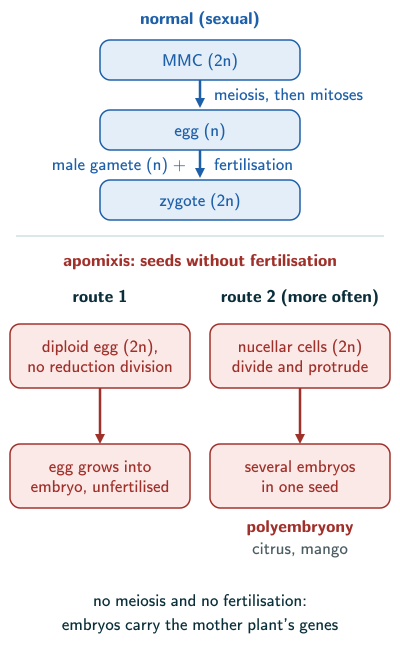
In the normal route, the megaspore mother cell divides by meiosis, so the egg is haploid and the zygote formed at fertilisation is diploid (NCERT pages 10 and 18). For the diploid examples shown, both apomictic routes give an embryo from a diploid maternal cell: an egg that skipped reduction division, or a cell of the nucellus.
Polyembryony
Occurrence of more than one embryo in a seed is referred to as polyembryony.
NCERT Biology (Class 12), Section 1.5, page 23
- Polyembryony follows from the second route: when several nucellar cells grow into embryos, one seed can hold several embryos (pages 22–23). Polyembryony describes the number of embryos, not necessarily their origin: a sexual embryo may coexist with nucellar embryos, so not every embryo in such a seed must be a maternal clone.
- Try it (page 23): take out some seeds of orange and squeeze them. In a polyembryonic variety, some seeds may contain several embryos of different sizes; count those you find rather than assuming every orange seed contains many.
Are apomictic embryos clones? NCERT asks about their genetic nature (page 23). For NCERT’s clonal routes, the embryo-forming lineage avoids meiotic segregation and fertilisation, so apomictic embryos are maternal clones, apart from possible mutations. This statement applies to the nucellar/apomictic embryos; a coexisting zygotic embryo is genetically different.
Apomixis and hybrid seeds
NCERT explains why plant breeders want apomixis (page 23):
- Hybrid varieties of several food and vegetable crops are extensively cultivated, and hybrids have tremendously increased productivity.
- But hybrid seeds have to be produced every year: if seeds collected from hybrids are sown, the progeny segregate and do not keep the hybrid characters.
- Producing hybrid seed is costly, so hybrid seed becomes too expensive for farmers.
- If the hybrids reliably produced clonal apomictic seed, there would be no segregation of characters in the hybrid progeny, and farmers could keep using their own seed year after year.
- Because of this, active research is going on in many laboratories around the world to understand the genetics of apomixis and to transfer apomictic genes into hybrid varieties.
Why a hybrid’s own seeds “segregate” is the subject of Mendel’s laws in NCERT Chapter 4. Example 3 below shows the numbers for one and two genes.
Solved examples
Example 1: Apomixis and its importance (NCERT Exercise 18)
What is apomixis, and what is its importance?
Answer: apomixis is the production of seeds without fertilisation, a form of asexual reproduction that mimics sexual reproduction, found in some species of Asteraceae and grasses (NCERT page 22). Its importance is in the hybrid seed industry: if hybrid varieties are made apomictic, their clonal apomictic progeny do not segregate, so farmers can sow seed from their own hybrid crop year after year instead of buying costly hybrid seed every year (NCERT page 23).
Example 2: Ploidy in the two routes
In a plant with 2n = 18, how many chromosomes are there in (a) a normal egg cell, (b) an egg cell formed without reduction division, (c) an embryo that grows from a nucellar cell, (d) a normal zygote?
Answer: (a) 9: meiosis halves the number. (b) 18: no reduction division. (c) 18: the nucellus is diploid tissue of the mother plant. (d) 9 + 9 = 18 (NCERT pages 10, 18 and 22–23).
Example 3: Why hybrid seed must be bought every year
A hybrid crop plant is heterozygous for one gene, Aa. Its flowers self-pollinate and set seed sexually. What fraction of the next generation is Aa, like the hybrid? What if the hybrid is AaBb for two independent genes? What would an apomictic hybrid give?
Answer: beyond this chapter, using Mendel’s rules from NCERT Chapter 4. Each gamete carries A or a with equal chance, so the offspring are AA, Aa, aA and aa in equal numbers: 1/2 are Aa. For two independent genes, 1/2 × 1/2 = 1/4 are AaBb; the other three quarters differ from the hybrid. Under ideal obligate clonal apomixis, all resulting embryos retain AaBb (ignoring mutation). Facultative apomicts may also form sexual seeds, so complete clonal seed production is an important breeding requirement (NCERT page 23: no segregation).
Common mistakes to avoid
Common mistake
Calling apomixis sexual reproduction because it makes seeds
Apomixis produces seeds without fertilisation; NCERT calls it a form of asexual reproduction that mimics sexual reproduction (NCERT page 22).
Common mistake
Confusing apomixis with parthenocarpy
Parthenocarpy gives a seedless fruit without fertilisation (banana); apomixis gives a seed without fertilisation (NCERT pages 21–22).
Common mistake
Thinking every extra embryo comes from the egg
In the nucellar-polyembryony examples of Citrus and mango, extra embryos arise from nucellar cells (NCERT pages 22–23). Polyembryony more broadly can have other developmental origins.
Quick revision summary
- Apomixis: seeds without fertilisation, a form of asexual reproduction that mimics sexual reproduction; some Asteraceae and grasses.
- Two routes: a diploid egg formed without reduction division grows into the embryo without fertilisation; or nucellar cells round the embryo sac grow into embryos (Citrus, mango).
- Polyembryony: more than one embryo in a seed, as in orange.
- In the diploid clonal routes shown, apomictic embryos retain the maternal genotype; some seeds may also contain a sexual embryo, and some apomicts require fertilisation for endosperm.
- Hybrids made apomictic would not segregate, so farmers could reuse hybrid seed every year.
Formula sheet
- apomixis: seed without fertilisation
- parthenocarpy: fruit without fertilisation
- polyembryony: more than one embryo in a seed
- clonal apomictic embryo: maternal genotype (apart from mutation)
- selfed hybrid: 1/2 Aa; independent loci: 1/4 AaBb
Questions students ask
What is the difference between apomixis and polyembryony?
Apomixis is the production of seeds without fertilisation, a form of asexual reproduction, while polyembryony is, in NCERT’s words, the “occurrence of more than one embryo in a seed” (NCERT pages 22–23). The two overlap in NCERT’s second apomictic route: when several nucellar cells round the embryo sac grow into embryos, the apomictic seed is also polyembryonic (pages 22–23). A seed whose embryo grew from a diploid egg formed without reduction division can hold a single embryo, so not every apomictic seed is polyembryonic (our reasoning from page 22).
What is the difference between apomixis and parthenogenesis?
Apomixis is seed formation without fertilisation in flowering plants (NCERT page 22), while parthenogenesis is the growth of an unfertilised egg into a new organism, as in the haploid drones of the honey bee (NCERT Chapter 4, page 71; honey bee). The two meet in the apomictic route in which a diploid egg, formed without reduction division, grows into the embryo (page 22): beyond the NCERT text, such an egg “develops parthenogenetically into a maternal embryo” (Springer and Musiał, Plant Reproduction, 2026; CC BY 4.0). The nucellar route involves no egg, so it is apomixis without parthenogenesis.
How can polyembryony be commercially exploited?
Polyembryony can be exploited to raise many uniform plants from seed, because in polyembryonic varieties the extra embryos grow from nucellar cells round the embryo sac rather than from a zygote (NCERT pages 22–23). Beyond the NCERT text, citrus growers use this for rootstocks: a rootstock can affect how the variety grafted onto it develops, so its seedlings must be uniform, and nucellar seedlings have to be told apart from zygotic ones, which differ genetically from the mother (Martínez-Ochoa and others, Scientia Agricola, 2022; CC BY). NCERT’s Summary adds that “Apomicts have several advantages in horticulture and agriculture” (page 24).
What is the difference between apomixis and amphimixis?
Amphimixis, a term beyond the NCERT text, is ordinary sexual reproduction, by meiosis and the fusion of gametes, and plants that reproduce this way are called amphimictic (Springer and Musiał, Plant Reproduction, 2026; CC BY 4.0), whereas apomixis is NCERT’s seed formation without fertilisation (page 22). In an amphimictic flowering plant the embryo grows from a zygote formed by syngamy, so seeds carry new genetic combinations (NCERT pages 18 and 22), while an apomictic embryo comes from a diploid egg formed without reduction division or from a nucellar cell and keeps the mother’s genotype (our reasoning from NCERT pages 22–23).
Practice questions
Try each question first, then open the answer to check your working.
-
Q1. Name two groups of flowering plants in which NCERT reports apomixis.
Show answerHide answer
Some species of Asteraceae and grasses (NCERT page 22).
-
Q2. In which fruits do nucellar cells develop into embryos, giving many embryos in one ovule?
Show answerHide answer
In many Citrus and mango varieties (NCERT pages 22–23).
-
Q3. Why do hybrid seeds have to be produced every year?
Show answerHide answer
If seeds collected from hybrids are sown, the plants of the progeny segregate and do not maintain the hybrid characters (NCERT page 23).