The male reproductive system
NCERT Class 12 Biology Chapter 2 Section 2.1
Quick answer
The male reproductive system includes testes in the scrotum, accessory ducts and glands, and the external genitalia, the penis. Seminiferous tubules produce sperm, Sertoli cells support germ cells, and Leydig cells secrete androgens. Sperm mature in the epididymis and travel through ducts to the urethra; accessory-gland secretions contribute seminal plasma.
With your textbook
NCERT Biology (Class 12), Chapter 2 “Human Reproduction”, Section 2.1 “The Male Reproductive System”, pages 26–28.
Open the official NCERT chapter (PDF, 64.5 MB, ncert.nic.in) (opens in a new tab)
Checked against the 2026-27 reprint on .
What is the male reproductive system?
The male reproductive system
It includes a pair of testes alongwith accessory ducts, glands and the external genitalia.
NCERT Biology (Class 12), Section 2.1, page 26
- It is located in the pelvis region (page 26).
- The testes produce the sperms and the male hormones; the accessory ducts store and carry the sperms; the accessory glands add the seminal plasma; the penis is the male external genitalia (page 28), and the testes lie outside the abdominal cavity in a pouch, the scrotum (page 27).
In plain words: the testes make the sperms, a chain of tubes carries them out of the body through the urethra, and three kinds of glands add the fluid in which the sperms travel.
Human reproduction in outline
As you are aware, humans are sexually reproducing and viviparous.
NCERT Biology (Class 12), Chapter 2, Introduction, page 26
The reproductive events in humans are (page 26):
- gametogenesis: formation of gametes, sperms in males and ova in females;
- insemination: transfer of sperms into the female genital tract;
- fertilisation: fusion of the male and female gametes, giving the zygote;
- formation of the blastocyst and its attachment to the uterine wall, implantation;
- embryonic development, gestation;
- delivery of the baby, parturition.
NCERT says these reproductive events occur after puberty (page 26), but not every step starts then: oogenesis begins before birth (NCERT page 32). NCERT contrasts the sexes: “sperm formation continues even in old men, but formation of ovum ceases in women around the age of fifty years” (page 26); the menstrual cycles cease at about 50 years of age, at menopause (NCERT Section 2.4, page 35).
Testes and scrotum
- The testes lie outside the abdominal cavity, in a pouch called the scrotum (page 27).
- The scrotum keeps the testes at a low temperature, 2–2.5 °C lower than the normal internal body temperature, which is necessary for spermatogenesis (page 27).
- In adults, each testis is oval, about 4 to 5 cm long and 2 to 3 cm wide, with a dense covering (page 27).
- Each testis has about 250 compartments, the testicular lobules (page 27).
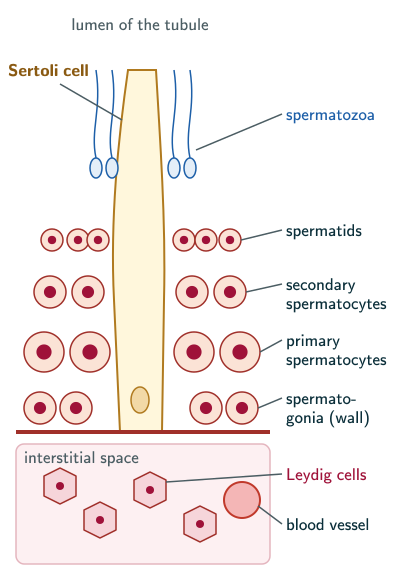
Seminiferous tubules, Sertoli cells and Leydig cells
- Each lobule contains one to three highly coiled seminiferous tubules, in which the sperms are produced (page 27).
- Each tubule contains germ cells at successive developmental stages, starting with spermatogonia, and supporting Sertoli cells (page 27).
The male germ cells undergo meiotic divisions finally leading to sperm formation, while Sertoli cells provide nutrition to the germ cells.
NCERT Biology (Class 12), Section 2.1, page 27
- The interstitial spaces outside the tubules contain small blood vessels and the interstitial cells or Leydig cells. Other immunologically competent cells are also present (page 27).
Leydig cells synthesise and secrete testicular hormones called androgens.
NCERT Biology (Class 12), Section 2.1, page 27
Spermatogonia multiply by mitosis; their descendant primary spermatocytes enter meiosis. The quotation summarises the whole germ-cell lineage, rather than saying spermatogonia themselves directly undergo meiosis (NCERT page 31).
The testis as an endocrine gland is covered in Class 11.
Male accessory ducts
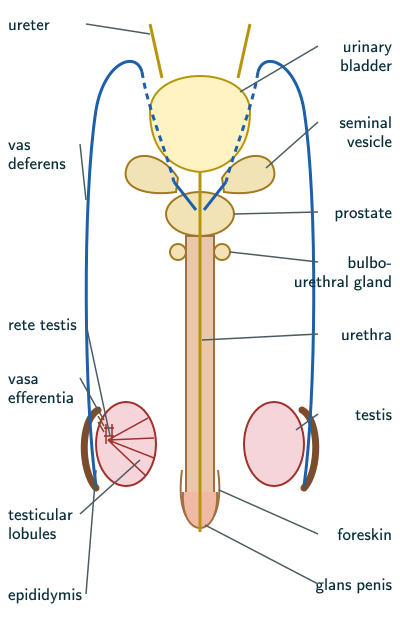
The male sex accessory ducts are the rete testis, vasa efferentia, epididymis and vas deferens (page 27). Their path (page 27):
- the seminiferous tubules open into the vasa efferentia through the rete testis;
- the vasa efferentia leave the testis and open into the epididymis, along the posterior surface of each testis;
- the epididymis leads to the vas deferens, which ascends to the abdomen and loops over the urinary bladder;
- the vas deferens receives a duct from the seminal vesicle and opens into the urethra as the ejaculatory duct;
- the urethra, which starts at the urinary bladder, runs through the penis to its external opening, the urethral meatus.
These ducts store and transport the sperms from the testis to the outside through the urethra (page 27). The secretions of the epididymis, vas deferens, seminal vesicle and prostate are essential for their maturation (see the glands below; NCERT Section 2.3, page 32). Beyond the NCERT text: the sperms undergo their final maturation in the epididymis (NCI SEER Training Modules, Testes).
Accessory glands and seminal plasma
The male accessory glands are the paired seminal vesicles, a prostate and the paired bulbourethral glands (page 28).
Secretions of these glands constitute the seminal plasma which is rich in fructose, calcium and certain enzymes.
NCERT Biology (Class 12), Section 2.1, page 28
- The secretions of the bulbourethral glands also help in the lubrication of the penis (page 28).
- The seminal plasma together with the sperms is the semen; the secretions of the epididymis, vas deferens, seminal vesicle and prostate are essential for the maturation and motility of sperms, and the androgens maintain the functions of the accessory ducts and glands (NCERT Section 2.3, page 32).
The penis
- The penis is the male external genitalia. It is made of special tissue that helps in its erection, to facilitate insemination (page 28).
- Beyond the NCERT text: anatomy texts count the scrotum among the external genitalia too (MedlinePlus Genetics, SRD5A2 gene: “the external genitalia, including the penis and scrotum”). In an NCERT-based answer, name the penis, as NCERT does.
- Its enlarged end, the glans penis, is covered by a loose fold of skin, the foreskin (page 28).
Solved examples
Example 1: The seminiferous tubule (NCERT Exercise 5)
Describe the structure of a seminiferous tubule.
Answer: each testis has about 250 testicular lobules, and each lobule holds one to three highly coiled seminiferous tubules. A tubule is lined on its inside by male germ cells (spermatogonia), which multiply by mitosis and give rise to the cells that undergo meiosis and form sperms (NCERT pages 27 and 31), and by Sertoli cells, which nourish the germ cells. Outside the tubules, the interstitial spaces hold small blood vessels and Leydig cells, which secrete androgens (NCERT page 27).
Example 2: Counting the tubules
Using NCERT’s numbers, what is the range of the number of seminiferous tubules in one testis, and in both?
Answer: about 250 lobules × 1 to 3 tubules = about 250 to 750 tubules in one testis, so about 500 to 1500 in both (NCERT page 27). This is arithmetic from the textbook’s approximate lobule/tubule figures, not an individual anatomical measurement.
Example 3: Ducts and glands (NCERT Exercises 10 and 11)
What are the major components of seminal plasma, and what are the major functions of the male accessory ducts and glands?
Answer: seminal plasma, the secretion of the seminal vesicles, prostate and bulbourethral glands, is rich in fructose, calcium and certain enzymes (NCERT page 28). The accessory ducts store the sperms and carry them from the testis to the outside (page 27). The glands make the seminal plasma; the bulbourethral secretion also lubricates the penis (page 28); and the secretions of the epididymis, vas deferens, seminal vesicle and prostate are essential for the maturation and motility of the sperms (page 32).
Common mistakes to avoid
Common mistake
Swapping Sertoli and Leydig cells
Sertoli cells line the seminiferous tubules and nourish the germ cells; Leydig (interstitial) cells lie outside the tubules and secrete androgens (NCERT page 27).
Common mistake
Mixing up vasa efferentia and vas deferens
The vasa efferentia run from the rete testis to the epididymis; the vas deferens runs from the epididymis over the bladder to the ejaculatory duct (NCERT page 27).
Common mistake
Thinking the testes are kept warm
The scrotum keeps the testes 2–2.5 °C below the internal body temperature, because spermatogenesis needs the lower temperature (NCERT page 27).
Common mistake
Calling seminal plasma semen
Seminal plasma is the secretion of the glands; semen is the seminal plasma together with the sperms (NCERT pages 28 and 32).
Quick revision summary
- Humans are sexually reproducing and viviparous; reproductive capacity develops at puberty, but oogenesis begins before birth.
- Testes lie in the scrotum, 2–2.5 °C below body temperature; each has about 250 lobules with one to three seminiferous tubules each.
- Spermatogonia in the tubules form sperms; Sertoli cells nourish them; Leydig cells outside secrete androgens.
- Duct path: seminiferous tubules, rete testis, vasa efferentia, epididymis, vas deferens, ejaculatory duct, urethra, urethral meatus.
- Glands: seminal vesicles (paired), prostate, bulbourethral glands (paired); seminal plasma is rich in fructose, calcium and enzymes.
Formula sheet
- testis: about 250 lobules, 1 to 3 seminiferous tubules each
- scrotum: 2–2.5 °C below body temperature
- Sertoli cells: nourish germ cells; Leydig cells: androgens
- tubules → rete testis → vasa efferentia → epididymis
- epididymis → vas deferens → ejaculatory duct → urethra
- seminal plasma: fructose, calcium, enzymes
- semen = seminal plasma + sperms
Questions students ask
What is the difference between the male and female reproductive systems?
The male and female reproductive systems both lie in the pelvis and have a pair of primary sex organs, accessory ducts and external genitalia, but they do different jobs (NCERT pages 26 and 28). The male system makes sperms in two testes held outside the abdominal cavity in the scrotum and sends them out through a chain of ducts ending in the urethra of the penis, with seminal vesicles, a prostate and bulbourethral glands adding the seminal plasma (pages 27–28). The female system keeps its two ovaries in the lower abdomen, and its oviducts, uterus and vagina, with a pair of mammary glands, support ovulation, fertilisation, pregnancy, birth and child care (page 28).
Is it testis or testes, and are they the same as testicles?
Testis is the singular and testes the plural: the male reproductive system has a pair of testes, which lie outside the abdominal cavity in a pouch called the scrotum (NCERT pages 26–27). Beyond the NCERT text, testicles is the everyday name for the same organs, and MeSH lists both testes and testicles as names for the testis (MeSH, Testis). NCERT uses the singular for one organ, as in “Each testis has about 250 compartments called testicular lobules” (page 27).
Does the male urethra carry both urine and semen?
Yes, in the human male the urethra carries both urine and semen: it starts at the urinary bladder and runs through the penis to its external opening, the urethral meatus, and the ducts that bring sperms from the testes open into it (NCERT page 27). Beyond the NCERT text, MeSH notes that the urethra “also has a reproductive function in the male” on top of its urinary role in both sexes (MeSH, Urethra), so in the human female it carries urine only. NCERT gives the name urinogenital duct to the male frog’s shared passage (frog, NCERT Class 11, pages 82 and 84).
What do Sertoli cells secrete?
Sertoli cells secrete factors that help spermiogenesis: NCERT says FSH from the anterior pituitary acts on the Sertoli cells and “stimulates secretion of some factors which help in the process of spermiogenesis” (NCERT pages 31–32; hormonal control). Beyond the NCERT text, MeSH credits Sertoli cells with androgen-binding protein and anti-Müllerian hormone (MeSH, Sertoli Cells) and with inhibin, which acts back on the pituitary to cut its FSH output (MeSH, Inhibins). NCERT names none of these, so in a NEET question built on the NCERT text the answer is the FSH-stimulated factors for spermiogenesis.
Practice questions
Try each question first, then open the answer to check your working.
-
Q1. Which cells of the testis secrete androgens, and where are they?
Show answerHide answer
The Leydig (interstitial) cells, in the interstitial spaces outside the seminiferous tubules (NCERT page 27).
-
Q2. Where does the vas deferens open into the urethra, and under what name?
Show answerHide answer
After receiving a duct from the seminal vesicle, it opens into the urethra as the ejaculatory duct (NCERT page 27).
-
Q3. True or false: androgens are produced by Sertoli cells. Correct the statement if it is false. (NCERT Exercise 16 a)
Show answerHide answer
False. Androgens are produced by the Leydig cells; Sertoli cells nourish the germ cells (NCERT page 27).