Menstrual cycle
NCERT Class 12 Biology Chapter 2 Section 2.4
Quick answer
The menstrual cycle coordinates ovarian activity with changes in the uterine lining. The ovarian follicular phase includes menstruation; a mid-cycle LH surge triggers ovulation in the typical 28-day model, followed by the progesterone-rich luteal phase. Without hCG support after implantation, the corpus luteum regresses, ovarian hormones fall and the functional endometrium sheds.
With your textbook
NCERT Biology (Class 12), Chapter 2 “Human Reproduction”, Section 2.4 “Menstrual Cycle”, pages 33–35.
Open the official NCERT chapter (PDF, 64.5 MB, ncert.nic.in) (opens in a new tab)
Checked against the 2026-27 reprint on .
What is the menstrual cycle?
The menstrual cycle
The reproductive cycle in the female primates (e.g. monkeys, apes and human beings) is called menstrual cycle.
NCERT Biology (Class 12), Section 2.4, page 33
- In human females, menstruation is repeated at an average interval of about 28/29 days; the cycle of events from one menstruation till the next is the menstrual cycle (page 33).
- Usually one secondary oocyte is released in an ovulatory cycle. NCERT uses a 28-day model with ovulation near day 14; real cycles vary and not every cycle is ovulatory.
In plain words: in a typical ovulatory cycle, the ovary matures a follicle and releases a secondary oocyte, and the lining of the uterus thickens to receive an embryo. If no pregnancy follows, the functional layer of the lining breaks down and is shed, and the cycle starts again. Hormones from the pituitary and the ovary keep the two in step.
Menarche and menopause
- The first menstruation begins at puberty and is called menarche (page 33).
- In human beings, menstrual cycles cease around 50 years of age; this is menopause (page 35).
- Cyclic menstruation is an indicator of the normal reproductive phase and extends between menarche and menopause (page 35).
Menstrual phase
- The cycle starts with the menstrual phase, when the menstrual flow occurs; it lasts for 3–5 days (page 34).
- The flow results from the breakdown of the functional endometrial layer of the uterus and its blood vessels, which forms a liquid that comes out through the vagina (page 34).
Menstruation only occurs if the released ovum is not fertilised.
NCERT Biology (Class 12), Section 2.4, page 34
This textbook sentence summarises the usual nonpregnant cycle. The direct trigger is withdrawal of ovarian hormones, not detection of an unfertilised egg. Fertilisation without successful implantation does not maintain the corpus luteum; bleeding can also occur in anovulatory cycles.
- Lack of menstruation may indicate pregnancy; however, it may also be caused by other underlying causes, such as stress or poor health (page 34).
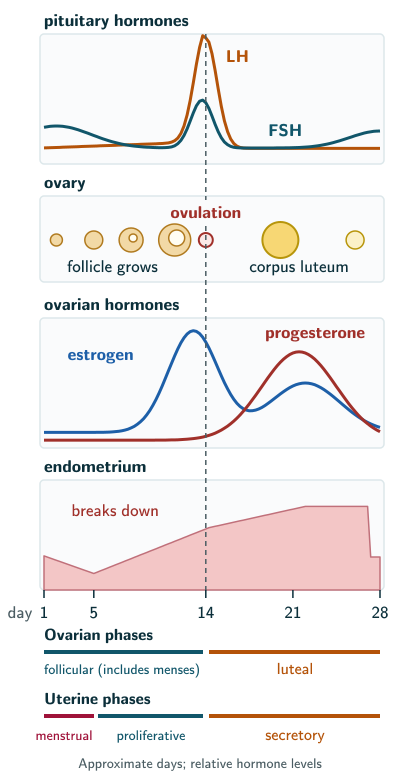
Follicular phase
Distinguish ovarian from uterine phases: the ovarian follicular phase begins on day 1 and includes menstruation. After menstrual flow, the uterine endometrium enters its proliferative phase. NCERT describes these events sequentially (page 34):
- In the ovary, the primary follicles grow into a fully mature Graafian follicle.
- At the same time, the endometrium regenerates through proliferation (hence also the proliferative phase, as NCERT Figure 2.9 labels it on page 34).
- These changes in the ovary and the uterus are induced by changes in the levels of pituitary and ovarian hormones (page 34); the pituitary gonadotropins and the ovarian hormones are introduced in Class 11.
- FSH rises around the transition from the preceding luteal phase to the early follicular phase, supporting follicle recruitment. As the growing follicles produce estradiol and inhibin B, negative feedback generally lowers FSH before its smaller mid-cycle surge.
- LH and FSH support follicular development and estrogen secretion. Sustained high estradiol switches to positive feedback, producing the large LH surge.
- Textbook qualification: NCERT page 35 says both gonadotropins increase gradually, but its Figure 2.9 shows the follicular FSH decline. The corrected schematic here follows the physiological pattern described in Endotext, The Normal Menstrual Cycle and the Control of Ovulation; neither hormone rises continuously through the entire phase.
LH surge and ovulation
Both LH and FSH attain a peak level in the middle of cycle (about 14th day).
NCERT Biology (Class 12), Section 2.4, page 35
- The rapid secretion of LH up to its maximum level at mid-cycle is the LH surge. It induces the rupture of the Graafian follicle and so the release of the ovum: ovulation (page 35).
- In the textbook 28-day model this is the ovulatory phase, around day 14 (page 35). This is an approximate teaching example, not a fixed prediction for an individual cycle.
Luteal phase and the corpus luteum
- Ovulation is followed by the luteal phase, during which the remaining parts of the Graafian follicle transform into the corpus luteum (page 35).
- The corpus luteum secretes large amounts of progesterone, which is essential for maintaining the endometrium. Such an endometrium is necessary for implantation of the fertilised ovum and the other events of pregnancy (page 35). Beyond the NCERT text: the corpus luteum secretes some estrogen as well (NCI SEER Training Modules, Ovaries).
- During pregnancy, all events of the menstrual cycle stop and there is no menstruation (page 35).
- In the absence of fertilisation, the corpus luteum degenerates. This causes disintegration of the endometrium, leading to menstruation and a new cycle (page 35). Beyond the NCERT text: in a pregnancy, hCG made by the embryo maintains the corpus luteum (Open RN, Nursing Health Promotion, 2025; CC BY 4.0), so its hormones maintain the endometrium; without that signal it regresses, and the fall in progesterone and estrogen lets the functional endometrium shed.
The phases of a typical 28-day cycle, with days read from NCERT Figure 2.9 (page 34):
- Uterine menstrual, approximately days 1–5: the functional endometrium sheds; the ovarian follicular phase is already underway.
- Uterine proliferative, approximately days 6–13 in this model: the endometrium rebuilds while the ovarian follicular phase continues.
- Ovulatory, about day 14: LH surge and ovulation.
- Luteal (secretory), days 15–28: the corpus luteum secretes progesterone; the endometrium is maintained.
Menstrual hygiene
NCERT’s note on menstrual hygiene (page 35) says that maintaining hygiene and sanitation during menstruation is very important:
- take a bath and clean yourself regularly;
- use sanitary napkins or clean homemade pads, and change them every 4–5 hours as per the requirement;
- dispose of used napkins properly, wrapped in used paper; do not throw them into the drainpipes of toilets or in the open;
- wash your hands with soap after handling a napkin.
Solved examples
Example 1: The cycle and its hormones (NCERT Exercise 17)
What is the menstrual cycle? Which hormones regulate it?
Answer: the menstrual cycle is the reproductive cycle of female primates: the cycle of events from one menstruation to the next, averaging about 28/29 days in NCERT’s account, with ovulation near the middle in its model (NCERT page 33). It is regulated by the pituitary hormones LH and FSH and the ovarian hormones, estrogens from the growing follicles and progesterone from the corpus luteum (NCERT pages 34–35).
Example 2: Corpus luteum (NCERT Exercise 15 a)
What is the function of the corpus luteum, and what happens to it if the ovum is not fertilised?
Answer: it secretes large amounts of progesterone, which maintains the endometrium for implantation and pregnancy. In the absence of fertilisation, the corpus luteum degenerates; this causes disintegration of the endometrium, leading to menstruation and a new cycle (NCERT page 35). Beyond the NCERT text: in a pregnancy, hCG from the embryo maintains it (Open RN, Nursing Health Promotion, 2025; CC BY 4.0).
Example 3: Counting cycles
Menarche comes at 13 and menopause at 50 for a woman whose cycles last 28 days. Assuming every cycle is ovulatory and ignoring pregnancies, lactation and other interruptions, about how many ovulations does this simplified model predict?
Answer: she has 50 − 13 = 37 years of cycles. 365 ÷ 28 ≈ 13 cycles a year, so about 37 × 13 ≈ 480 ovulations, one ovum each (NCERT pages 33 and 35). Compare the 60 000–80 000 primary follicles present in each ovary at puberty (NCERT page 32): most of them never ovulate.
Common mistakes to avoid
Common mistake
Crediting FSH alone with ovulation
Both LH and FSH peak at mid-cycle, but it is the LH surge that induces the rupture of the Graafian follicle (NCERT page 35).
Common mistake
Naming estrogen instead of progesterone as the corpus luteum’s main hormone
NCERT says the corpus luteum secretes large amounts of progesterone, which is essential for maintenance of the endometrium (page 35); give progesterone in an NCERT answer. NCERT’s estrogens come from the growing follicles (page 35). Beyond the NCERT text: the corpus luteum “secretes progesterone and some estrogen” (NCI SEER Training Modules, Ovaries, public domain).
Common mistake
Treating every missed period as pregnancy
Lack of menstruation may indicate pregnancy, but it may also be caused by stress, poor health and other causes (NCERT page 34).
Quick revision summary
- Menstrual cycle: the reproductive cycle of female primates, about 28/29 days in NCERT’s model, usually one oocyte in an ovulatory cycle; from menarche at puberty to menopause around 50.
- Menstrual phase (3–5 days): the functional endometrium and its blood vessels break down after ovarian hormone withdrawal.
- Follicular phase: a Graafian follicle forms and the endometrium proliferates; FSH supports recruitment, then usually declines before its mid-cycle surge; follicles secrete estrogens.
- LH and FSH peak about day 14; the LH surge causes ovulation.
- Luteal phase: the corpus luteum secretes progesterone to maintain the endometrium; without hCG rescue after implantation it regresses, hormones fall and menstruation follows.
- Hygiene: clean napkins or pads, changed every 4–5 hours, disposed of properly.
Formula sheet
- textbook model: 28/29-day cycle; ovulation near day 14, with real variation
- menstrual phase: functional endometrium sheds; ovarian follicular phase has begun
- follicular phase: Graafian follicle, estrogens, endometrium proliferates
- LH surge → rupture of Graafian follicle → ovulation
- luteal phase: corpus luteum → progesterone → endometrium maintained
- no hCG rescue: corpus luteum regresses → hormones fall → menstruation
Questions students ask
Is the menstrual cycle the same as a period?
No, the menstrual cycle is not the same as a period: a period is the menstrual flow, which lasts 3–5 days at the start of each cycle (NCERT page 34), while the menstrual cycle is the whole cycle of events from one menstruation till the next, about 28/29 days on average in human females (page 33). After the flow, the endometrium regenerates while a follicle matures, ovulation comes in the middle of the cycle and the luteal phase follows until the next period (pages 34–35).
What is the difference between the menstrual cycle and the oestrous cycle?
The menstrual cycle is the reproductive cycle of female primates such as monkeys, apes and human beings (NCERT page 33), while the oestrous (estrous) cycle, beyond the NCERT text, is that of non-primate female mammals, named after oestrus, the phase “associated with maximum sexual receptivity and fertility” (MeSH, Estrous Cycle; Estrus). They differ most when no embryo implants: in the menstrual cycle the endometrium breaks down and flows out through the vagina (page 34), while a 2012 study in mice, also beyond the NCERT text, marks the oestrous cycle by “complete reabsorption of the endometrial lining, which is not externally visible” (Rudolph and others, PLOS ONE, 2012, CC BY).
What is the difference between the corpus luteum and the corpus albicans?
The corpus luteum is the hormone-secreting body that the remaining parts of the Graafian follicle form after ovulation (NCERT page 35), while the corpus albicans, a term from beyond the NCERT text, is the inactive, fibrous body left in the ovary after it breaks down. NCERT follows the corpus luteum only as far as its degeneration (page 35); beyond the NCERT text, a 2023 review ends that breakdown, once hormone output has fallen, with “the corpus luteum dissipates into a fibrotic corpus albicans within the ovarian stroma” (Monaco and Davis, Frontiers in Physiology, 2023, CC BY). MeSH, also beyond the NCERT text, calls the corpus luteum the yellow body (MeSH, Corpus Luteum).
How much does the day of ovulation vary from cycle to cycle?
Beyond the NCERT text, the day of ovulation varies a good deal from cycle to cycle, though NCERT places it in the middle of the cycle, about the 14th day (NCERT pages 33 and 35), the figure to give for NEET: NICHD gives 28 days as the average cycle but says this “varies between women and from month to month”, with ovulation “anywhere between 10 and 21 days after the first day” of the cycle. A study of 612 613 cycles logged in a fertility app, funded by the app’s maker, found a mean cycle of 29.3 days and a mean estimated ovulation day of 16.9; only 13 per cent of cycles were 28 days long, and those averaged ovulation on day 15.4 (Bull and others, npj Digital Medicine, 2019, CC BY 4.0).
Practice questions
Try each question first, then open the answer to check your working.
-
Q1. What is the first menstruation called, and when does it begin?
Show answerHide answer
Menarche; it begins at puberty (NCERT page 33).
-
Q2. Ovulation is induced by a hormone called ______. (NCERT Exercise 1 g)
Show answerHide answer
Luteinising hormone (LH), through the LH surge at mid-cycle (NCERT page 35).
-
Q3. True or false: the menstrual cycle ceases during pregnancy. (NCERT Exercise 16 f)
Show answerHide answer
True: during pregnancy all events of the menstrual cycle stop and there is no menstruation (NCERT page 35).