Inheritance of one gene: the monohybrid cross
NCERT Class 12 Biology Chapter 4 Section 4.2
Quick answer
Mendel’s monohybrid model predicts a 3:1 F phenotype ratio and 1:2:1 genotype ratio under complete dominance. A test cross helps distinguish genotypes, but a small all-dominant sample does not prove homozygosity. Incomplete dominance, codominance and multiple alleles extend the model, as shown by snapdragons and ABO blood groups.
With your textbook
NCERT Biology (Class 12), Chapter 4 “Principles of Inheritance and Variation”, Section 4.2 “Inheritance of One Gene”, pages 55–62.
Open the official NCERT chapter (PDF, 19.2 MB, ncert.nic.in) (opens in a new tab)
Checked against the 2026-27 reprint on .
What is the inheritance of one gene?
Alleles and the monohybrid cross
Genes which code for a pair of contrasting traits are known as alleles, i.e., they are slightly different forms of the same gene.
NCERT Biology (Class 12), Section 4.2, page 56
- Genes are the units of inheritance; Mendel called them “factors” (page 56).
- A plant heterozygous for the genes of one character, such as Tt for height, is a monohybrid, and the cross between TT and tt is a monohybrid cross (pages 56–57).
In plain words: this model follows one locus with two alleles that explain the tall/dwarf contrast in Mendel’s lines; actual plant height can also depend on other genes and environment. Each parent passes on just one of its two alleles to each gamete, and when the two in an offspring differ, usually only one of them shows.
The monohybrid cross: F and F
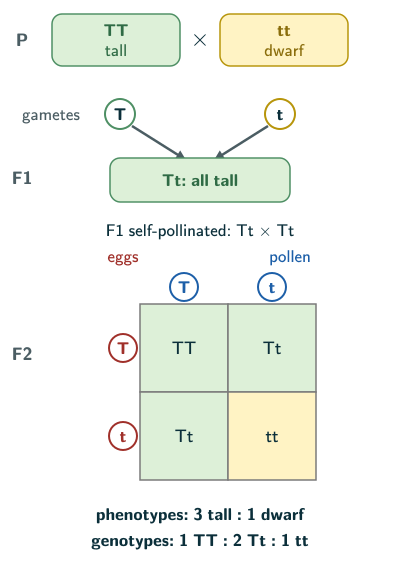
- Mendel crossed tall and dwarf pea plants, collected the seeds and grew them into the first hybrid generation, the filial progeny or F (page 55).
- All the F plants were tall, like one parent; none was dwarf. For the other pairs of traits too, the F always resembled one parent only (page 55).
- He then self-pollinated the tall F plants. In the F, ¼ of the plants were dwarf and ¾ tall: the trait not seen in the F was expressed again (page 55).
- The F plants were either tall or dwarf, identical to the parental types; none was of in-between height, so the traits did not blend (page 55).
- The other traits behaved the same way: one parental trait in the F, and both in the F in the proportion 3 : 1 (page 55).
Genes and alleles
- Mendel proposed that something was passed down stably, unchanged, from parent to offspring through the gametes, over successive generations. He called these things “factors”; now we call them genes, the units of inheritance, which carry the information to express a particular trait (page 56).
- Alleles are alternative versions of a gene at the same locus. They need not always produce visibly contrasting traits; NCERT illustrates them with T and t (page 56).
- Symbols: a capital letter for the trait expressed in the F and the small letter for the other, so T for tall and t for dwarf. T and t are alleles of each other, and the pair for height is TT, Tt or tt (page 56).
- NCERT’s advice: do not write T for tall and d for dwarf, or you may not remember whether T and d are alleles of the same gene (page 56).
Genotype and phenotype
- “TT and tt are called the genotype of the plant while the descriptive terms tall and dwarf are the phenotype” (page 56).
- In true-breeding tall and dwarf varieties the two alleles are identical: homozygous, TT or tt. A plant with dissimilar alleles, Tt, is heterozygous (pages 56–57).
- The F heterozygote Tt looked exactly like the TT parent. So in a pair of dissimilar factors one dominates the other: T (tallness) is dominant and t (dwarfness) is recessive. Mendel saw the same for every other pair of traits he studied (page 56).
The Punnett square
- The Punnett square, developed by the British geneticist Reginald C. Punnett, is a graphical way to calculate the probability of all possible genotypes of offspring in a cross. The possible gametes go along two sides, usually the top row and the left column, and every combination fills the boxes (page 57).
- When the parents form gametes by meiosis, the two alleles of the pair segregate and only one goes into each gamete. In a heterozygote under Mendelian segregation, a gamete has a 50 per cent chance of carrying either allele (page 57).
- So TT plants give only T gametes, tt plants give only t gametes, and the F is Tt. Selfed, the F makes T and t gametes in equal proportion, and fertilisation is random (page 57).
- The F is ¼ TT, ½ Tt and ¼ tt (page 58). TT and Tt both look tall, so:
- phenotypic ratio: ¾ tall : ¼ dwarf, that is 3 : 1;
- genotypic ratio: ¼ TT : ½ Tt : ¼ tt, that is 1 : 2 : 1 (page 58).
- The same result is the binomial expansion of the gamete frequencies, ½ each: (½ T + ½ t) = ¼ TT + ½ Tt + ¼ tt (page 58).
- Mendel self-pollinated the F plants: the dwarfs gave only dwarf plants in the F and F, so the dwarfs were homozygous, tt (page 58).
Expected ratios, not guaranteed counts: these predictions assume Mendelian segregation, random fertilisation, equal survival and the stated dominance pattern. Small offspring samples can depart from 3:1 by chance.
Test cross
- Looking at a dominant phenotype does not tell you the genotype: a tall plant of unknown parentage could be TT or Tt; the known F of TT×tt is Tt (page 58).
- So Mendel crossed a tall F plant with a dwarf plant. In this test cross, an organism showing the dominant phenotype, whose genotype is to be found, is crossed with a homozygous recessive tester (not necessarily its literal parent) instead of being selfed (page 58).
- A TT×tt cross predicts all dominant offspring, while Tt×tt predicts 1:1. A recessive offspring establishes Tt in this model, but a finite all-dominant sample only supports TT: a Tt parent has probability (½) of producing n dominant offspring by chance.
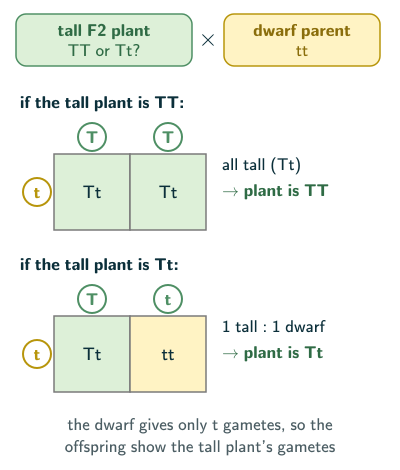
NCERT slip (pages 58–59): NCERT’s text names the flower-colour alleles V (violet) and v (white) (page 58), but its Figure 4.5 (page 59) labels them W and w. The cross is the same either way; in an answer, use the letters the question gives, or say which letter stands for which allele.
Mendel’s first two laws
From his monohybrid crosses Mendel proposed two general rules, today called the Principles or Laws of Inheritance: the First Law or Law of Dominance and the Second Law or Law of Segregation (page 59).
Law of dominance
- Characters are controlled by discrete units called factors.
- Factors occur in pairs.
- In a dissimilar pair of factors, one member of the pair dominates (dominant) the other (recessive) (page 59).
The law explains why only one parental character is expressed in the F of a monohybrid cross and both in the F, and it explains the 3 : 1 ratio of the F (page 59).
Law of segregation
Though the parents contain two alleles during gamete formation, the factors or alleles of a pair segregate from each other such that a gamete receives only one of the two factors.
NCERT Biology (Class 12), Section 4.2.2, page 59
- The law rests on two facts: the alleles do not blend, and both characters are recovered as such in the F, though one of them is not seen in the F (page 59).
- A homozygous parent produces gametes that are all alike; a heterozygous parent produces two kinds, each with one allele, in equal proportion (page 59).
Incomplete dominance
- When other traits in other plants were studied, the F sometimes resembled neither parent and was in between the two (page 60).
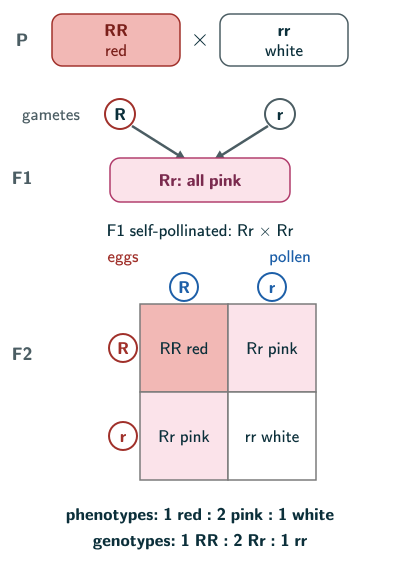
- Flower colour in the dog flower (snapdragon, Antirrhinum sp.) is the NCERT example: true-breeding red-flowered (RR) × true-breeding white-flowered (rr) plants give a pink F (Rr) (page 60).
- Selfing the F gives an F of 1 RR red : 2 Rr pink : 1 rr white (page 60).
- The genotypic ratio is the usual 1 : 2 : 1, but the phenotypic ratio has changed from 3 : 1 to 1 : 2 : 1: R is not completely dominant over r, so Rr can be told apart as pink (page 60).
Explaining dominance
- For a typical autosomal locus in a diploid cell there are two copies, a pair of alleles. Sex-linked, copy-number and other exceptions need separate treatment. They need not be identical: one may have undergone a change that modifies its information (page 60).
- Take a gene for an enzyme that transforms a substrate S. A modified allele could produce (i) the normal or a less efficient enzyme, (ii) a non-functional enzyme, or (iii) no enzyme at all (page 60).
- If enough functional enzyme remains, two alleles can give the same observed phenotype despite different enzyme activities. In the loss-of-function example, one functioning copy may supply enough enzyme to mask the effect of the other (NCERT page 61).
- This explains one common recessive mechanism; it is not a rule that every mutation is recessive or every functional allele dominant. Dominance depends on gene dosage, product function and the phenotype examined.
- Dominance also depends on the phenotype you look at. Starch synthesis in pea seeds is controlled by one gene with alleles B and b. BB seeds make large starch grains and are round; bb seeds make smaller grains and are wrinkled. Bb seeds are round, so for seed shape B looks dominant, but their starch grains are of intermediate size, so for grain size the alleles show incomplete dominance (page 62).
- NCERT’s conclusion: dominance is not an autonomous feature of a gene or of its product; it depends on the gene product and on the particular phenotype chosen for study (page 62).
Co-dominance: the ABO blood groups
- In co-dominance the F resembles both parents, where with dominance it resembles one parent and with incomplete dominance it is in between (page 61).
- The NCERT example is the ABO blood groups of humans, controlled by the gene I. The plasma membrane of red blood cells carries sugar polymers, and the kind of sugar is controlled by this gene (page 61).
- The gene I has three alleles, IA, IB and i (page 61). The alleles IA and IB produce a slightly different form of the sugar, while allele i does not produce any sugar (page 61). Beyond the NCERT text: the gene encodes an enzyme that adds a sugar to a precursor on the red cells, the H antigen: N-acetylgalactosamine for IA and galactose for IB, while the common i allele has a premature stop codon, so it makes no working enzyme (Wikipedia, “ABO blood group system” and “Hh antigen system”, facts in our words; the last step is our reasoning).
- IA and IB are completely dominant over i. When IA and IB are together, both express their own sugars and the red blood cells carry both A and B: this is co-dominance (page 61).
| Genotype | Sugars on red blood cells | Blood group |
|---|---|---|
| IAIA | A | A |
| IAi | A | A |
| IBIB | B | B |
| IBi | B | B |
| IAIB | A and B | AB |
| ii | no A or B antigen; H precursor remains | O |
- Three alleles make six possible genotypes, which show four phenotypes: blood groups A, B, AB and O (NCERT Table 4.2, page 61).
Reading note: NCERT Table 4.2 (page 61) has seven rows because it lists IAIB twice, once for each order of the parents’ alleles; the distinct genotypes are six, as the text says.
Multiple alleles
This is the simplified ABO model. Beyond the NCERT text: in the rare Bombay phenotype (hh) both copies of another gene, FUT1, are inactive, so no H antigen is made and A or B sugars cannot be added (Wikipedia, “Hh antigen system”, facts in our words).
The ABO gene is also an example of multiple alleles: more than two alleles, here three, govern the same character (page 62).
Since in an individual only two alleles can be present, multiple alleles can be found only when population studies are made.
NCERT Biology (Class 12), Section 4.2.2, page 62
Reading note: NCERT has three spelling slips in this section: “genopytic” (page 58) for genotypic, “preceeding” (page 58) for preceding, and “effected” (page 61) where “affected” is meant.
Solved examples
Example 1: The law of dominance in a monohybrid cross (NCERT Exercise 4)
Explain the law of dominance using a monohybrid cross.
Answer: cross true-breeding tall (TT) and dwarf (tt) pea plants. Factors occur in pairs, and each gamete carries one, so the F is Tt. Every F plant is tall: in the dissimilar pair, T dominates t. Selfing the F gives ¼ TT, ½ Tt and ¼ tt; the TT and Tt plants are both tall, so the F shows 3 tall : 1 dwarf. Dominance explains why one parental character shows in the F and both in the F, in the ratio 3 : 1 (NCERT pages 58–59).
Example 2: Define and design a test cross (NCERT Exercise 5)
Define a test cross and design one for a violet-flowered pea plant.
Answer: a test cross crosses an organism showing the dominant phenotype, whose genotype is unknown, with the recessive parent (NCERT page 58). Let W stand for violet and w for white (the letters of NCERT Figure 4.5, page 59). Cross the violet plant with a white (ww) plant:
- if it is WW, all its gametes are W, and all the offspring are Ww, violet;
- if it is Ww, half its gametes are W and half w, so the offspring are ½ Ww violet and ½ ww white, 1 : 1.
These are expected outcomes. A small all-violet sample can also arise from Ww by chance; the probabilities become more informative as sample size increases.
Example 3: Homozygous female × heterozygous male (NCERT Exercise 6)
Using a Punnett square, work out the phenotypes of the first filial generation from a cross between a homozygous female and a heterozygous male for a single locus.
Answer: the heterozygous male (Tt) gives T and t gametes, ½ each. “Homozygous” can mean either genotype, so work out both:
- female TT (eggs all T): offspring ½ TT + ½ Tt, all tall;
- female tt (eggs all t): offspring ½ Tt tall + ½ tt dwarf, 1 tall : 1 dwarf.
The second cross is a test cross of the male (NCERT page 58).
Example 4: Blood group O child (NCERT Exercise 12)
A child has blood group O. The father has blood group A and the mother blood group B. Work out the genotypes of the parents and the possible genotypes of their other children.
Answer: blood group O is ii, so the child got an i from each parent. The father (group A) is therefore IAi, and the mother (group B) is IBi. Each parent gives its two alleles ½ each, so the children can be, each with chance ¼:
- IAIB, group AB;
- IAi, group A;
- IBi, group B;
- ii, group O.
All four blood groups are possible (NCERT page 61).
Common mistakes to avoid
Common mistake
Swapping the 3 : 1 and 1 : 2 : 1 ratios
In the F of a monohybrid cross, 3 : 1 is the phenotypic ratio (tall : dwarf) and 1 : 2 : 1 the genotypic ratio (TT : Tt : tt) (NCERT page 58).
Common mistake
Calling incomplete dominance blending
The snapdragon F gets back pure red and pure white flowers (NCERT Figure 4.6, page 60), so the alleles themselves did not mix; only the Rr phenotype is in between.
Common mistake
Calling blood group AB incomplete dominance
AB red blood cells carry both the A and the B sugar, each fully expressed, so this is co-dominance, not an in-between form (NCERT page 61).
Common mistake
Test-crossing with the dominant parent
A classical test cross uses a homozygous recessive tester; a cross with a dominant TT plant gives all-dominant offspring whatever the unknown is (NCERT page 58).
Quick revision summary
- Alleles are slightly different forms of one gene; genes are the units of inheritance.
- Tall TT × dwarf tt gives an all-tall F (Tt); its F is 3 tall : 1 dwarf, with genotypes 1 TT : 2 Tt : 1 tt.
- The ratio follows from equal T and t gametes, the binomial (½ T + ½ t).
- A test cross predicts all dominant offspring for TT and 1:1 for Tt; finite samples require probability-based interpretation.
- Law of dominance: factors in pairs, one dominant; law of segregation: each gamete gets one factor of the pair.
- Incomplete dominance (snapdragon): F pink, F 1 red : 2 pink : 1 white.
- Co-dominance and multiple alleles (ABO): three alleles, six genotypes, four blood groups.
Formula sheet
- monohybrid cross: TT × tt → F Tt, all tall
- F: ¼ TT + ½ Tt + ¼ tt, genotypes 1 : 2 : 1
- F phenotypes: 3 tall : 1 dwarf
- (½ T + ½ t) gives ¼ TT + ½ Tt + ¼ tt
- test cross: TT × tt → all dominant; Tt × tt → 1 : 1
- snapdragon F: 1 RR red : 2 Rr pink : 1 rr white
- ABO: IAIA, IAi → A; IBIB, IBi → B; IAIB → AB; ii → O
Questions students ask
What is the difference between incomplete dominance and co-dominance?
Incomplete dominance and co-dominance differ in what the heterozygote expresses: in co-dominance each allele makes its own product and both show, as IA and IB each produce “a slightly different form of the sugar” and group AB red blood cells carry both (NCERT page 61), while in incomplete dominance the heterozygote has a single phenotype of in-between degree, as in pink snapdragons (page 60). Either way the heterozygote can be told apart from both homozygotes, so the phenotypic ratio equals the genotypic one, 1 : 2 : 1, not 3 : 1. Two group AB parents, for example, are expected to have children of groups A, AB and B in the ratio 1 : 2 : 1 (our working).
What is the difference between a test cross and a back cross?
A test cross and a back cross overlap but are not the same. NCERT’s test cross crosses an organism showing the dominant phenotype, whose genotype is to be found, “with the recessive parent instead of self-crossing” (page 58); beyond the NCERT text, a back cross is any cross of a hybrid back to one of its parental types (BioCyc genetics glossary), whatever trait that parent shows. So crossing a tall F pea (Tt) with its dwarf parent (tt) is both, crossing it with its tall parent (TT) is only a back cross, and crossing a tall plant with an unrelated dwarf tester is a test cross but not a back cross.
Is the ABO blood group an example of co-dominance or of multiple alleles?
The ABO blood group is an example of both, and of complete dominance too, because each term describes a different feature of the one gene I (NCERT pages 61–62). It shows multiple alleles because the gene has three, IA, IB and i, though any one person carries only two; it shows co-dominance because IA and IB together give group AB, with both sugars on the red blood cells; and each of them is completely dominant over i. Multiple alleles is a statement about the population, while dominance and co-dominance describe how two alleles act together in one person.
Can two parents with blood group A have a child with blood group O?
Yes, two parents with blood group A can have a group O child if both are IAi: each passes on i with a chance of ½, so each child has a ¼ chance of being ii, group O, and a ¾ chance of group A (our working from NCERT Table 4.2, page 61). If either parent is IAIA, no child can be group O. In NCERT’s model a parent of group AB, IAIB, has no i to pass on and so cannot have a group O child, whatever the other parent’s group.
Practice questions
Try each question first, then open the answer to check your working.
-
Q1. Differentiate between (a) dominant and recessive, and (b) homozygous and heterozygous. (NCERT Exercise 2 a, b)
Show answerHide answer
(a) In a dissimilar pair of factors, the dominant one is expressed and the recessive one is not: in Tt, T (tall) dominates t (dwarf) (NCERT page 56). In this diploid autosomal model a recessive trait shows in tt; hemizygous X-linked traits are an exception to that scope. NCERT’s Summary says “The recessive characters are only expressed in homozygous conditions” (page 77). (b) A homozygote has two identical alleles, TT or tt; a heterozygote has two dissimilar alleles, Tt (NCERT pages 56–57).
-
Q2. From Tt × Tt you raise 400 F plants. How many would you expect to be tall, and how many of them TT?
Show answerHide answer
Tall: ¾ × 400 = 300. TT: ¼ × 400 = 100, so 100 of the 300 tall plants are expected to be TT and 200 to be Tt.
-
Q3. In snapdragon, what flower colours appear in the F of red × white, and in what ratio?
Show answerHide answer
1 red (RR) : 2 pink (Rr) : 1 white (rr) (NCERT page 60).