Mutation
NCERT Class 12 Biology Chapter 4 Section 4.7
Quick answer
A mutation changes genetic material, with effects that may be harmful, beneficial, neutral or undetectable. Point substitutions include the sickle-cell variant; coding-region insertions or deletions shift the reading frame when their length is not divisible by three. Mutagens such as UV radiation can induce mutations.
With your textbook
NCERT Biology (Class 12), Chapter 4 “Principles of Inheritance and Variation”, Section 4.7 “Mutation”, page 72.
Open the official NCERT chapter (PDF, 19.2 MB, ncert.nic.in) (opens in a new tab)
Checked against the 2026-27 reprint on .
What is mutation?
Mutation
Mutation is a phenomenon which results in alteration of DNA sequences and consequently results in changes in the genotype and the phenotype of an organism.
NCERT Biology (Class 12), Section 4.7, page 72
- Besides recombination, mutation is another phenomenon that leads to variation in DNA (page 72).
- NCERT’s summary puts it briefly: mutation is a change in the genetic material (page 77).
In plain words: DNA is normally copied and passed on without change, but now and then a piece of it is lost, gained or rearranged, or a single base is changed. Such changes alter the genotype. Beyond the NCERT text: their effects on fitness may be harmful, beneficial or neutral, and some mutations make no detectable change in the phenotype at all (Wikipedia, “Mutation”, facts in our words), so do not read NCERT’s definition as saying that every mutation visibly changes a trait. In a definition question, still write NCERT’s sentence as printed (page 72). A germ-cell mutation can be passed on to offspring, while one confined to somatic cells ordinarily is not (reasoned from NCERT Chapter 5, page 105).
Chromosomal aberrations
- In a typical eukaryotic chromatid, one double-stranded DNA molecule runs continuously from one end to the other, in a highly supercoiled form (page 72).
- At chromosome scale, the loss (deletion) or gain (insertion or duplication) of a segment of DNA alters the chromosome (page 72).
- Genes are located on chromosomes, so these alterations result in abnormalities or aberrations. Chromosomal aberrations are commonly observed in cancer cells (page 72).
- Changes in the number of chromosomes, the gain or loss of a chromosome (aneuploidy) or an increase by a whole set (polyploidy), are explained with the chromosomal disorders (NCERT Section 4.8.3, page 75).
Point mutation: sickle-cell anaemia
- A mutation can also arise from a change in a single base pair of DNA: a point mutation. The classical example is sickle-cell anaemia (page 72).
- In the gene for the beta globin chain of haemoglobin, a single base substitution in the sixth codon replaces glutamic acid (Glu) with valine (Val) at the sixth position of the chain (NCERT Section 4.8.2, pages 74–75).
- Under low oxygen tension the mutant haemoglobin polymerises, and the red blood cell changes from a biconcave disc to an elongated sickle-like structure (page 75).
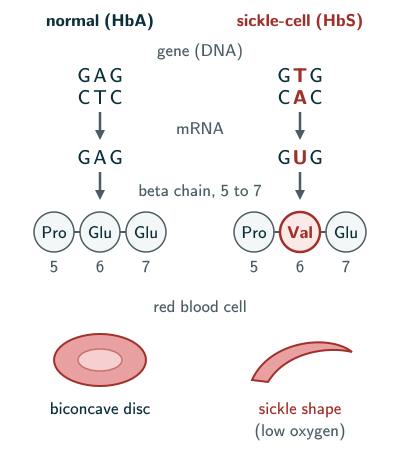
NCERT slip (page 75): NCERT’s text says the base substitution changes the sixth codon of the beta globin gene “from GAG to GUG”. GUG is the mRNA codon, since U occurs only in RNA. NCERT’s own Figure 4.15 (page 74) shows the gene changing from GAG to GTG (its other strand from CTC to CAC) and the mRNA from GAG to GUG. In a written answer, give both: gene GAG → GTG, mRNA codon GAG → GUG, glutamic acid → valine at position 6. Specify the molecule and strand: the 5′→3′ coding DNA strand changes GAG→GTG; the mRNA changes GAG→GUG. In a multiple-choice question that repeats NCERT’s “GAG to GUG”, treat it as correct.
Frame-shift mutations
- Deletions and insertions of base pairs of DNA cause frame-shift mutations (page 72). This holds inside a protein-coding sequence when the number of bases added or lost is not a multiple of three; an insertion or deletion in the untranslated regions shifts no reading frame (reasoned from NCERT Section 5.6.1, pages 97–98, and the untranslated regions on page 99). In a question that repeats page 72’s line, answer frame-shift mutations.
- Chapter 5 shows why with a sentence of three-letter words, read like the genetic code: “RAM HAS RED CAP”. Insert one letter, B, after HAS and the triplets read “RAM HAS BRE DCA P”; every word after the insertion changes (NCERT Section 5.6.1, page 97).
- Inserting or deleting one or two bases changes the reading frame from that point on. Inserting or deleting three bases, or a multiple of three, adds or removes one or more codons, and so one or more amino acids, and the reading frame stays unaltered after that point (NCERT Section 5.6.1, pages 97–98). If the bases added or lost do not fall exactly between two codons, the amino acid at the junction can also differ (our reasoning).
Mutagens
- The mechanism of mutation is beyond the scope of this chapter, but many chemical and physical factors induce mutations: these are mutagens (page 72).
- UV radiation can cause mutations in organisms: it is a mutagen (page 72).
Solved examples
Example 1: Point mutation (NCERT Exercise 14)
What is point mutation? Give one example.
Answer: a point mutation is a mutation that arises from a change in a single base pair of DNA (NCERT page 72). Example: sickle-cell anaemia, where a single base substitution in the sixth codon of the beta globin gene (GAG → GTG in the gene, GAG → GUG in the mRNA) replaces glutamic acid with valine at the sixth position of the beta chain (NCERT pages 74–75).
Example 2: Reading the frame
Using NCERT’s sentence RAM HAS RED CAP, show what deleting the R of RED does, and what inserting the three letters BIG after HAS does.
Answer: deleting R gives RAMHASEDCAP, read in threes: RAM HAS EDC AP. Every word after the deletion is changed: a frame shift. Inserting BIG gives RAM HAS BIG RED CAP: one whole word is added, and the words after it are read as before, so the frame is unaltered (NCERT pages 97–98).
Example 3: How many codons change?
A mutation deletes one base in the 2nd codon of a gene whose message is 10 codons long. From which codon on is the message misread? Would deleting three neighbouring bases inside the 2nd codon do the same?
Answer: deleting one base shifts the reading frame from the point of deletion, so the grouping changes from codon 2 onward (nine complete triplets remain in the shortened 29-base message), and the last two bases no longer make a codon. Deleting all three bases of codon 2 removes one whole codon, so one amino acid is lost and the codons after it are read as before (NCERT Section 5.6.1, pages 97–98).
Common mistakes to avoid
Common mistake
Writing GUG as the change in the gene
GUG is the mRNA codon; in the gene the change is GAG to GTG (NCERT Figure 4.15, page 74). The only exception is a multiple-choice question that repeats NCERT’s own “GAG to GUG” (see the NCERT slip above).
Common mistake
Calling every insertion a frame shift
Inserting or deleting three bases, or a multiple of three, leaves the reading frame unaltered after that point; inserting or deleting one or two bases shifts it (NCERT pages 97–98).
Common mistake
Forgetting recombination as a source of variation
NCERT lists mutation as a source of variation in DNA in addition to recombination, not instead of it (NCERT page 72).
Quick revision summary
- Mutation alters DNA sequences and so changes the genotype and the phenotype (NCERT’s definition); beyond NCERT, some mutations have no detectable effect; with recombination, it is a source of variation.
- Deletion, insertion or duplication of a DNA segment gives chromosomal aberrations, which are common in cancer cells.
- A point mutation is a change in a single base pair; in sickle-cell anaemia, glutamic acid becomes valine at position 6 of the beta chain.
- Deleting or inserting one or two bases shifts the reading frame (frame-shift mutation); a multiple of three adds or removes one or more codons, and so amino acids, and leaves the frame unaltered after that point (NCERT pages 97–98); the codon at the junction may still change (our reasoning).
- Mutagens, chemical and physical factors such as UV radiation, induce mutations.
Formula sheet
- point mutation: change in a single base pair
- sickle-cell: gene GAG → GTG; mRNA GAG → GUG; Glu → Val at position 6 of the beta chain
- coding-region insertion/deletion not divisible by 3 → frame shift
- coding-region insertion/deletion of 3n bases → downstream frame preserved
- mutagens: chemical and physical factors, e.g. UV radiation
Questions students ask
What is the difference between a point mutation and a frame-shift mutation?
A point mutation is a change in a single base pair of DNA, while a frame-shift mutation is an insertion or deletion of bases that changes the reading frame from that point onwards (NCERT pages 72 and 97). A one-base substitution alters only one codon, and in sickle-cell anaemia it replaces a single amino acid of the beta globin chain (page 75), whereas a frame shift regroups every codon after it. The two terms overlap: NCERT Chapter 5 also counts the insertion or deletion of a single base as a point mutation (page 97), and such a change shifts the frame.
What is the difference between a point mutation and a chromosomal mutation?
A point mutation changes one base pair of DNA, while a chromosomal mutation changes a chromosome: NCERT’s chromosomal aberrations come from the loss (deletion) or gain (insertion or duplication) of a segment of DNA (page 72). Such a segment can hold whole genes, and NCERT Chapter 5 notes that large deletions and rearrangements may cause the loss or gain of a gene and so of a function (page 97). NCERT’s summary also counts changes in chromosome number as mutations (pages 77–78), as in the chromosomal disorders.
What are the types of point mutation?
Point mutations change, add or delete one base pair: NCERT’s sickle-cell example is a base substitution (pages 72 and 75), and NCERT Chapter 5 also counts a one-base insertion or deletion as a point mutation (page 97). Beyond the NCERT text, substitutions are sorted by their effect on the protein (NHGRI): a missense mutation puts a different amino acid at one position, as sickle-cell anaemia does (our reading), and a nonsense mutation turns an amino acid’s codon into a stop codon, ending the protein early. A substitution can also leave the protein unchanged, since the code is degenerate (NCERT Chapter 5, page 96): mRNA GCU to GCC still gives alanine (our working, NCERT Table 5.1).
What is the difference between a mutagen and a carcinogen?
A mutagen is an agent that induces mutations, while a carcinogen causes cancer: NCERT calls the chemical and physical factors that induce mutations mutagens (Chapter 4, page 72), and the physical, chemical or biological agents that turn normal cells into cancerous cells carcinogens (Chapter 7, page 141). The two groups overlap, since Chapter 7 says that ionising radiations such as X-rays and gamma rays “cause DNA damage leading to neoplastic transformation” (page 141). Beyond the NCERT text, X-rays are also listed as mutagens, and “Most carcinogens work by interacting with a cell’s DNA to produce mutations” (NHGRI Talking Glossary).
How do mutations occur?
Beyond the NCERT text, mutations occur in three ways: through errors in copying DNA when a cell divides, through exposure to mutagens and through viral infection (NHGRI Talking Glossary). NCERT says only that DNA, normally transmitted from one generation to the other without change, is occasionally altered (page 73), and it leaves the mechanism beyond the scope of the chapter while naming mutagens, the chemical and physical factors that induce mutations (page 72). So a mutagen is a cause and a mutation the change left in the DNA, and a copying error can produce a mutation with no mutagen at all (our reading).
Practice questions
Try each question first, then open the answer to check your working.
-
Q1. Name a physical mutagen given by NCERT.
Show answerHide answer
UV radiation (NCERT page 72).
-
Q2. Where are chromosomal aberrations commonly observed?
Show answerHide answer
In cancer cells (NCERT page 72).
-
Q3. What change does the sickle-cell point mutation make in the beta chain of haemoglobin?
Show answerHide answer
Glutamic acid (Glu) is replaced by valine (Val) at the sixth position (NCERT page 75).