Polygenic inheritance
NCERT Class 12 Biology Chapter 4 Section 4.4
Quick answer
NCERT calls traits generally controlled by three or more genes polygenic traits, as in its additive skin-colour model (NHGRI’s general definition is two or more genes). Under equal additive effects and independent assortment, AaBbCc × AaBbCc predicts seven classes in the ratio 1:6:15:20:15:6:1. Real pigmentation involves many genes and environment, so these classes are a teaching model.
With your textbook
NCERT Biology (Class 12), Chapter 4 “Principles of Inheritance and Variation”, Section 4.4 “Polygenic Inheritance”, page 69.
Open the official NCERT chapter (PDF, 19.2 MB, ncert.nic.in) (opens in a new tab)
Checked against the 2026-27 reprint on .
What is polygenic inheritance?
Polygenic traits
Such traits are generally controlled by three or more genes and are thus called as polygenic traits.
NCERT Biology (Class 12), Section 4.4, page 69
- “Such traits” are traits that are not distinct alternatives but are spread across a gradient, such as human height (page 69).
- In NCERT’s additive model, allele contributions add to the phenotype (page 69). NCERT’s definition, quoted above, is that such traits are generally controlled by three or more genes; give this in an NCERT-based answer. Beyond the NCERT text: NHGRI defines a polygenic trait as one “influenced by two or more genes” (NHGRI Talking Glossary, “Polygenic Trait”).
In plain words: Mendel’s pea characters came in two clear forms, tall or dwarf. Many human traits do not. Height and skin colour vary smoothly from one end of a range to the other, because several genes each add a small share, and the environment adds its share too.
Traits on a gradient: human height
- Mendel’s studies mainly described traits with distinct alternate forms, such as flower colour that is either purple or white (page 69; NCERT Table 4.1 calls it violet).
- Many traits are not so distinct: they are spread across a gradient. Humans are not just tall or short, as two distinct alternatives; there is a whole range of possible heights (page 69).
- Such traits involve multiple genes: NCERT says they are generally controlled by three or more (page 69); beyond the NCERT text, NHGRI’s general definition is two or more.
- Besides the many genes, polygenic inheritance also takes into account the influence of the environment (page 69).
Skin colour and the additive effect of alleles
Human skin colour is another classic example of a polygenic trait (page 69). NCERT explains it with a model that assumes three genes, A, B and C (page 69):
- The dominant alleles A, B and C each make the skin darker; the recessive alleles a, b and c make it lighter.
- AABBCC, with all six alleles dominant, has the darkest skin colour; aabbcc, with all six recessive, the lightest.
- A genotype with three dominant and three recessive alleles has an intermediate colour.
- So the number of dominant alleles in the genotype, not which genes they belong to, sets how dark or light the skin is.
These are equal-effect additive assumptions, not a complete description of real human pigmentation. Uppercase “dominant” alleles here count pigment contributions; one copy contributes less than two, unlike complete dominance. Real skin colour involves many loci and environmental influences, not seven natural categories of people.
Following the model through a cross (our working): two parents of genotype AaBbCc each pass on one allele of every gene at meiosis, and each allele comes from a gene that assorts independently. Their children can carry anything from 0 to 6 dominant alleles, in seven classes, most of them in the middle:
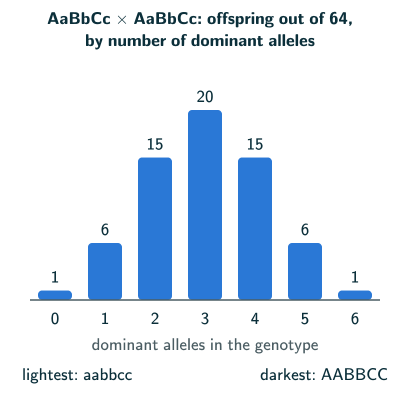
| Dominant alleles | Example genotype | Expected per 64 offspring |
|---|---|---|
| 0 | aabbcc | 1 |
| 1 | Aabbcc | 6 |
| 2 | AaBbcc | 15 |
| 3 | AaBbCc | 20 |
| 4 | AABbCc | 15 |
| 5 | AABBCc | 6 |
| 6 | AABBCC | 1 |
These are expected frequencies, not guaranteed family counts. The counts come from choosing which of the 6 allele places carry a dominant allele: with ½ chance at each place, a child has 0 dominant alleles with chance (½) = 1/64, and 3 with chance 20/64. Add the effect of the environment, which NCERT includes in polygenic inheritance (page 69), and the seven steps blur into a smooth range: this is why such traits look continuous.
Each gene gives three genotypes (AA, Aa, aa), so the cross gives 3 × 3 × 3 = 27 genotypes but only 7 phenotype classes: genotypes with the same number of dominant alleles look alike (our working).
Polygenic inheritance and the other patterns
- Multiple alleles are more than two alleles of one gene, such as the three alleles of the ABO gene (NCERT Section 4.2, page 62). Polygenic traits are generally controlled by three or more genes, each with its own alleles (NCERT page 69; beyond the NCERT text, NHGRI says two or more).
- Incomplete dominance gives one in-between phenotype from one gene, such as pink snapdragons (NCERT page 60). In a polygenic trait the in-between phenotypes come from adding up the alleles of several genes (page 69).
- A pleiotropic gene is the reverse case: one gene affecting several traits (NCERT Section 4.5, page 69).
Solved examples
Example 1: Ranking genotypes
In NCERT’s three-gene model of skin colour, arrange AaBbCc, AABbcc and aaBbCc from darkest to lightest.
Answer: count the dominant alleles: AaBbCc has 3, AABbcc has 3 and aaBbCc has 2. So AaBbCc and AABbcc have the same intermediate colour, and aaBbCc is lighter. Only the number of dominant alleles matters, because their effects add up (NCERT page 69).
Example 2: Two intermediate parents
Two people of genotype AaBbCc have children. What fraction would you expect to have (a) the lightest colour, aabbcc, and (b) the same number of dominant alleles as the parents?
Answer (our working with NCERT’s model, page 69):
- (a) aabbcc needs a recessive allele from each parent for all three genes: (¼) = 1/64.
- (b) 3 dominant alleles out of the 6 places: 20 of the 64 equally likely combinations, so 20/64 = 5/16.
Example 3: Why height is not like pea height
Pea plants are either tall or dwarf, but human height takes a whole range of values. Explain.
Answer: Mendel’s tall/dwarf contrast is explained by the T/t locus in his experimental lines; this does not mean all variation in pea height depends on one gene. Human height is influenced by many loci and environment, producing a broad range (NCERT pages 56 and 69, with scope clarified).
Common mistakes to avoid
Common mistake
Calling polygenic inheritance multiple alleles
Multiple alleles are three or more alleles of one gene (ABO, NCERT page 62); polygenic traits are generally controlled by three or more genes (NCERT page 69; beyond the NCERT text, NHGRI says two or more).
Common mistake
Calling every intermediate phenotype incomplete dominance
An intermediate result alone cannot identify the inheritance pattern. NCERT’s skin-colour model adds contributions across three loci. Incomplete dominance describes the heterozygote at a particular locus; it can coexist with a polygenic trait.
Common mistake
Forgetting the environment
NCERT says polygenic inheritance also takes into account the influence of the environment, not only the genes (page 69).
Quick revision summary
- Polygenic traits, such as human height and skin colour, are spread across a gradient and are generally controlled by three or more genes (NCERT; beyond the NCERT text, NHGRI says two or more).
- In the equal-effect additive model, the phenotype depends on the total number of contributing uppercase alleles.
- NCERT’s model of skin colour assumes three genes: AABBCC darkest, aabbcc lightest, three dominant alleles intermediate.
- Two AaBbCc parents give seven classes, 0–6 dominant alleles, in the ratio 1 : 6 : 15 : 20 : 15 : 6 : 1.
- The environment also influences polygenic traits, which smooths the classes into a continuous range.
Formula sheet
- polygenic trait: 3 or more genes (NCERT); 2 or more (NHGRI); additive effects
- 3 genes: 0–6 dominant alleles → 7 phenotype classes
- AABBCC darkest; aabbcc lightest; 3 dominant alleles intermediate
- AaBbCc × AaBbCc: 1 : 6 : 15 : 20 : 15 : 6 : 1 (of 64)
- AaBbCc parents: aabbcc child (1/4)3 = 1/64
Questions students ask
What is the difference between polygenic inheritance and pleiotropy?
Polygenic inheritance and pleiotropy are opposite cases: in polygenic inheritance several genes control one trait, while in pleiotropy a single gene shows multiple phenotypic expressions (NCERT page 69). NCERT’s examples are human skin colour, where the alleles of three assumed genes add up to a gradient of shades, and phenylketonuria, where one gene affects both brain development and hair and skin pigmentation. Pleiotropy usually works through “the effect of a gene on metabolic pathways which contribute towards different phenotypes” (page 69), while a polygenic trait reflects the additive effect of each allele.
Is a polygenic trait the same as a multifactorial trait?
A polygenic trait is not quite the same as a multifactorial one: ‘polygenic’ names the many genes behind a trait, while ‘multifactorial’, a term beyond the NCERT text, adds the environment, and NHGRI’s glossary notes that “Many polygenic traits are also influenced by the environment and are called multifactorial.” NCERT does not use the word, but its own account of polygenic inheritance already brings in the environment (page 69), so by that reading human height and skin colour, its two examples, are polygenic and multifactorial at once.
Is human height genetic or environmental?
Human height is both genetic and environmental: NCERT gives it as a polygenic trait, and polygenic inheritance “also takes into account the influence of environment” (page 69); beyond the NCERT text, MedlinePlus Genetics (US National Library of Medicine) reports the estimate that “about 80 percent of an individual’s height is determined by the DNA sequence variations they have inherited”, counts more than 700 variants of modest effect and names nutrition as an environmental factor. Its heritability page warns that such figures describe how much of the variation among people in a population is genetic, not what share of one person’s height the genes produce.
How is polygenic inheritance different from co-dominance?
Polygenic inheritance involves several genes adding their effects to one trait, while co-dominance is the full expression of both alleles of one gene in a heterozygote. In NCERT’s skin-colour model, genotypes with the same number of dominant alleles look alike, so the shades form a gradient (page 69); in co-dominance an IAIB person has both the A and the B sugar on the red blood cells, a separate group, AB, not a shade between A and B (page 61). So co-dominance gives a few distinct classes, while polygenic traits, blurred further by the environment, vary continuously.
Practice questions
Try each question first, then open the answer to check your working.
-
Q1. What is a polygenic trait? Give two human examples.
Show answerHide answer
A trait generally controlled by three or more genes, which also shows the influence of the environment; human height and skin colour are examples (NCERT page 69). Beyond the NCERT text: NHGRI’s general definition is two or more genes.
-
Q2. In NCERT’s three-gene model, which genotype has the darkest skin colour and which the lightest?
Show answerHide answer
AABBCC the darkest and aabbcc the lightest (NCERT page 69).
-
Q3. In a simplified model with two unlinked loci, A and B, equal additive contributions and no environmental variation, how many phenotype classes would two AaBb parents give, and in what ratio?
Show answerHide answer
0 to 4 dominant alleles: 5 classes, in the ratio 1 : 4 : 6 : 4 : 1 (out of 16).