Family Gramineae (Poaceae)
Beyond NCERT In the NEET syllabus; the Class 11 book has no section for it.
Quick answer
Gramineae (Poaceae) has typically jointed culms and sheathing leaves, often with a ligule. Florets form spikelets, usually with two glumes, lemma and palea, reduced lodicules and commonly three stamens; rice has six and bamboos vary. The ovary is superior with one ovule, and the usual fruit is a caryopsis; using a two-fused-carpel convention, a representative formula is Br % ⚥ P2 A3 G(2), with G underlined.
The family Gramineae
Gramineae (Poaceae)
Gramineae, also called Poaceae, is the grass family of monocotyledons. It includes the cereals (wheat, rice and maize), sugarcane and bamboo.
- The stem is a jointed culm, with solid nodes and usually hollow internodes.
- Each leaf has a sheath round the stem and, usually, a ligule where the sheath meets the blade.
- The small flowers (florets) are grouped in spikelets and protected by bracts: glumes, lemma and palea; the perianth is reduced to lodicules.
- The fruit is a caryopsis, its thin wall fused with the seed coat.
The 2026–27 NCERT book describes one family, Solanaceae (Section 5.9), and gives one other floral formula, for mustard (Figure 5.16, pages 67–68), while the NEET (UG) 2026 syllabus lists Gramineae in Unit 2. NCERT does describe monocot roots, leaves and the maize seed in Chapter 5, and those lines are cited below. Everything else is beyond the 2026–27 NCERT text.
Jointed culm, leaf sheath and ligule
- Habit: mostly herbs; bamboos are tall and woody.
- Root: fibrous and adventitious, growing from the base of the stem. NCERT gives the wheat plant as its example of a fibrous root system and names grass among its examples of adventitious roots (page 58). Beyond the NCERT text, maize and sugarcane also have stilt roots from their lower nodes.
- Stem: a culm, cylindrical and jointed: the nodes are solid and the internodes usually hollow, as in wheat and bamboo. In maize and sugarcane the internodes are solid.
- Leaves: alternate, in two rows, simple, with parallel venation; NCERT gives parallel venation as the characteristic of most monocotyledons (page 60).
- Leaf sheath: NCERT notes that in monocotyledons the leaf base expands into a sheath covering the stem partially or wholly (page 60).
- Ligule: a small, thin outgrowth on the inner side, at the junction of the sheath and the blade (absent in a few grasses).
- NCERT’s Chapter 6 adds two grass features: dumb-bell shaped guard cells (page 72) and bulliform cells that roll the leaf when water is short (page 77).
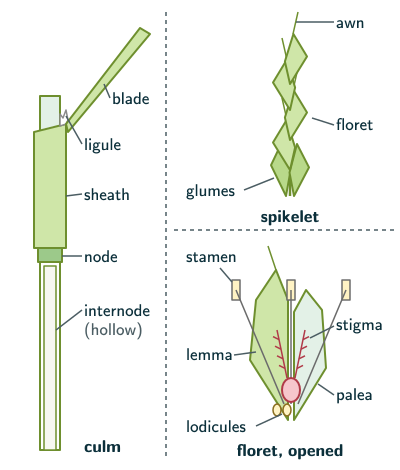
Spikelets: glumes, lemma, palea and lodicules
- Inflorescence: made of spikelets, which are grouped into spikes (wheat) or panicles (rice, oats).
- Typical spikelet: two sterile bracts at its base, the glumes, and above them one or more florets on a short axis, the rachilla.
- Floret: enclosed by the outer lemma, its bract (often ending in a bristle, the awn), and the inner palea, its bracteole.
- Perianth: usually reduced to two small scales, the lodicules, which swell to push the lemma and palea apart when the floret opens.
- Androecium: usually three stamens (six in rice), with long filaments and anthers attached at the middle (versatile), so that they swing in the wind.
- Gynoecium: a superior, one-chambered ovary with a single ovule. It is a compound gynoecium, described as two or three fused carpels in botanical treatments; one locule or one ovule does not imply one carpel. The Australian National Botanic Gardens family key uses two fused carpels, the convention represented in the formula below. Stigma number varies, commonly two. The feathery stigmas catch wind-borne pollen.
- Most florets are bisexual, but maize has separate male (tassel) and female (cob) inflorescences. The silks of the cob are the long styles of the female florets, one to each grain.
- Bamboos vary: many have three lodicules, but their stamen number is not universally six. A 2025 study of 23 species found six in the sampled Bambusa and Dendrocalamus, and three in Phyllostachys and Fargesia.
The caryopsis
The fruit of grasses is a caryopsis: a one-seeded dry fruit whose thin wall is fused with the seed coat. This is the cereal grain.
NCERT notes that in cereals such as maize the seed coat is membranous and generally fused with the fruit wall (pages 66–67). The seed is endospermic (page 66): the endosperm is bulky and stores food (page 67), and the embryo has one cotyledon, the scutellum (page 67).
Floral formula
Beyond the NCERT text, for a typical grass floret: Br % ⚥ P2 A3 G(2), with the G underlined.
- Br: bracteate; each floret sits in the axil of its lemma (NCERT defines bracteate on page 62 and lists the symbol on page 67).
- % ⚥: zygomorphic and bisexual.
- P2: the perianth reduced to two lodicules.
- A3: three free stamens (six in rice).
- G(2), underlined: two fused carpels in a superior, one-chambered ovary under the convention used here.
Some Indian university course notes write the formula as Br % ⚥ P2 A3 G1, describing the gynoecium as monocarpellary: a superior, one-chambered ovary with a single ovule (for example, Mahatma Gandhi Central University, M.Sc. Botany, Systematics and Evolution, Unit II: Poaceae). The 2026–27 NCERT book gives no formula for this family. G1 and G(2) describe the same one-chambered, one-ovuled ovary; if a question writes G1, read it as that convention (our reading).
Economic importance
| Use | Plants |
|---|---|
| Cereals | wheat (Triticum aestivum), rice (Oryza sativa), maize (Zea mays), barley (Hordeum vulgare), oats (Avena sativa) |
| Millets | bajra (Pennisetum glaucum), jowar (Sorghum bicolor), ragi (Eleusine coracana) |
| Sugar | sugarcane (Saccharum officinarum) |
| Building, paper | bamboo (Bambusa, Dendrocalamus) |
| Fodder, lawns | doob grass (Cynodon dactylon) |
Solved examples
Example 1: Spot the family
A plant has a jointed stem with hollow internodes, leaves with a sheath and a ligule, and tiny flowers in spikelets. Name the family.
Answer: Gramineae (Poaceae), the grass family.
Example 2: What are lodicules?
What are lodicules, and what do they do?
Answer: usually two small scales representing the perianth of a typical grass floret; they swell to push the lemma and palea apart when the floret opens.
Example 3: Glume, lemma or palea?
Which bracts are at the base of a spikelet, and which enclose each floret?
Answer: the two glumes are at the base of the spikelet; each floret is enclosed by its own lemma (outer) and palea (inner).
Example 4: Why is a grain a fruit?
Why is a wheat or maize grain called a fruit and not a seed?
Answer: because it develops from the whole ovary, so it includes the fruit wall. That wall is thin and fused with the seed coat (NCERT pages 66–67 note this for maize), which is why this one-seeded fruit, a caryopsis, looks like a seed.
Example 5: Reading the formula
What do P2 and A3 stand for in Br % ⚥ P2 A3 G(2)?
Answer: P2: the perianth reduced to two lodicules; A3: three free stamens (symbols as on NCERT pages 67–68).
Common mistakes to avoid
Common mistake
Calling every culm hollow
The internodes are hollow in wheat and many bamboos but solid in maize and sugarcane; solid nodes are a typical grass feature.
Common mistake
Giving every grass three stamens
Most grasses have three, but rice has six.
Common mistake
Calling the lemma and palea petals
The lemma is a bract and the palea a bracteole; the perianth is reduced to the lodicules.
Quick revision summary
- Gramineae (Poaceae), the grass family: monocots; fibrous roots (NCERT: wheat); jointed culm with solid nodes and usually hollow internodes.
- Leaves alternate, two-ranked, parallel-veined, with a sheath round the stem and a ligule at the sheath–blade junction.
- Spikelets: two glumes at the base; each floret in a lemma (often awned) and a palea; perianth of two lodicules.
- Stamens usually 3 (rice 6), versatile; ovary superior, one ovule, two feathery stigmas; fruit a caryopsis, wall fused with the seed coat.
- Formula: Br % ⚥ P2 A3 G(2), G underlined.
- Uses: cereals (wheat, rice, maize), sugarcane (sugar), bamboo (building, paper), fodder.
Formula sheet
- Gramineae: grass family (Poaceae); culm with solid nodes
- leaf: sheath round the stem, ligule at the junction
- spikelet: 2 glumes; floret in a lemma and a palea
- perianth usually 2 lodicules; stamens commonly 3 (rice 6; bamboos variable)
- fruit caryopsis: wall fused with the seed coat
- formula: Br % ⚥ P2 A3 G(2), G underlined
Questions students ask
Are Gramineae and Poaceae the same family?
Yes, Gramineae and Poaceae are two names for the same family, the grass family. Gramineae, from the Latin gramen, ‘grass’, is the old descriptive name that the botanical code still allows because of its long use, and Poaceae is the regular name, formed from the genus Poa, the meadow grasses. The NEET (UG) 2026 syllabus lists the family as ‘graminae’.
Is grass a flowering plant?
Yes, grass is a flowering plant: the grasses are monocotyledonous angiosperms, and their small flowers, the florets, have stamens and an ovary that ripens into a one-seeded fruit, the grain. Grass flowers are easy to miss because they are small, green and hidden between bracts, with no showy petals, and they are grouped into spikelets.
What is the difference between Poaceae and Fabaceae?
Poaceae and Fabaceae differ from root to seed: grasses are monocots with fibrous roots, a jointed culm and simple, parallel-veined leaves with a sheath and a ligule, while legumes are dicots with tap roots, often bearing nitrogen-fixing nodules, and usually pinnately compound, stipulate leaves. A grass floret has no showy corolla and usually three stamens and forms a caryopsis, while a pea flower has a papilionaceous corolla and ten diadelphous stamens and forms a legume. The grass seed is endospermic, while NCERT gives bean, gram and pea as seeds with no endosperm when mature.
What is the difference between Poaceae and Malvaceae?
Poaceae and Malvaceae differ as a monocot and a dicot family: grasses have fibrous roots and parallel-veined leaves with a sheath and a ligule, while Malvaceae has stipulate, often palmately lobed leaves with reticulate venation. A grass floret sits in a spikelet, between a lemma and a palea, and usually has three free stamens and a one-ovuled ovary that forms a caryopsis. A china rose flower has an epicalyx, five twisted petals, many monadelphous stamens and a five-carpelled ovary with axile placentation that forms a capsule.
What is the difference between Poaceae and Cyperaceae?
Poaceae, the grasses, and Cyperaceae, the sedges, look alike but differ in stem, leaves and fruit: a grass culm is usually round, with solid nodes and usually hollow internodes, while a sedge stem is usually triangular and solid, without swollen joints. Grass leaves are in two rows, with a sheath that is usually open on one side, while sedge leaves are usually in three rows, with a closed, tubular sheath. Each grass floret lies between a lemma and a palea and forms a caryopsis, while a sedge flower sits in the axil of a single scale and forms a small, nut-like achene.
Practice questions
Try each question first, then open the answer to check your working.
-
Q1. What is a ligule?
Show answerHide answer
A small, thin outgrowth where the leaf sheath meets the blade.
-
Q2. In a grass floret, which part represents (a) the bract, (b) the bracteole, (c) the perianth?
Show answerHide answer
(a) the lemma; (b) the palea; (c) the lodicules.
-
Q3. Name two grasses with six stamens.
Show answerHide answer
Rice and bamboos such as Bambusa. Bamboo is a broad group: Phyllostachys species have three stamens.
-
Q4. Name the fruit of wheat and maize.
Show answerHide answer
A caryopsis (grain).