Exchange of gases and partial pressures
NCERT Class 11 Biology Chapter 14 Section 14.3
Quick answer
Gas exchange occurs by diffusion across the alveolar–capillary barrier and separately between blood and tissues. NCERT’s representative gradients favour O uptake in the lungs and release in tissues, with CO moving oppositely; circulation carries gases between the two sites. Membrane thickness, area, gas solubility and partial pressure gradients influence exchange.
With your textbook
NCERT Biology (Class 11), Chapter 14 “Breathing and Exchange of Gases”, Section 14.3 “Exchange of Gases”, pages 187–188.
Open the official NCERT chapter (PDF, 2.1 MB, ncert.nic.in) (opens in a new tab)
Checked against the 2026-27 reprint on .
Exchange of gases
Exchange of gases
The alveoli are the primary sites of gas exchange; gases are also exchanged between blood and tissues. At both sites, O and CO move by simple diffusion, mainly along a pressure or concentration gradient (NCERT Section 14.3, page 187).
Pressure contributed by an individual gas in a mixture of gases is called partial pressure and is represented as pO for oxygen and pCO for carbon dioxide.
NCERT Biology (Class 11), Section 14.3, page 187
In plain words: a gas spreads from where its partial pressure is high to where it is low, the way a crowd thins out from a packed room into an empty corridor. Oxygen is “crowded” in the alveoli and “thin” in the tissues; carbon dioxide is the other way round. So oxygen flows towards the tissues and carbon dioxide towards the lungs, by diffusion across their local exchange membranes. Blood still has to be pumped between lungs and tissues; the gases do not diffuse across the entire body in one step.
Besides the pressure gradient, the solubility of the gases and the thickness of the membranes also affect the rate of diffusion (NCERT page 187).
Partial pressures of O and CO
NCERT Table 14.1 gives representative partial pressures, in mm Hg (page 187), for a resting sea-level model rather than fixed values in every tissue or condition:
| Site | pO | pCO |
|---|---|---|
| Atmospheric air | 159 | 0.3 |
| Alveoli | 104 | 40 |
| Blood (deoxygenated) | 40 | 45 |
| Blood (oxygenated) | 95 | 40 |
| Tissues | 40 | 45 |
- These values show a gradient for oxygen from alveoli to blood and from blood to tissues (pages 187–188).
- For CO the gradient runs the opposite way: from tissues to blood and from blood to alveoli (page 188).
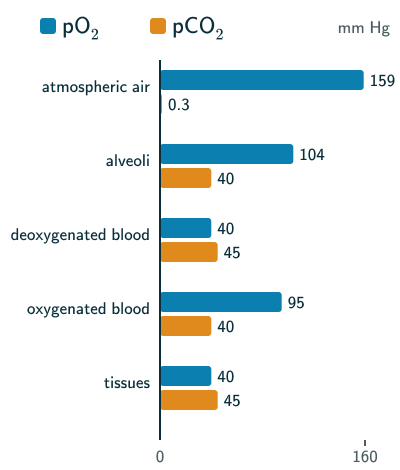
Why CO manages with a much smaller gradient: the solubility of CO is 20–25 times higher than that of O, so the amount of CO that can diffuse through the membrane per unit difference in partial pressure is much higher than for O (NCERT page 188).
Diffusion membrane of the alveoli
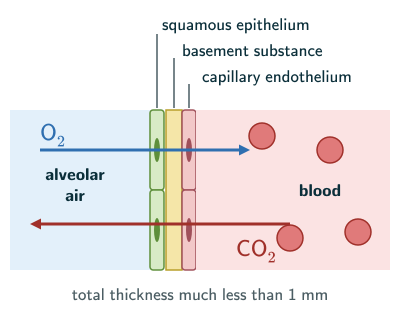
The diffusion membrane has three major layers (NCERT page 188, Figure 14.4):
- the thin squamous epithelium of the alveoli (see squamous epithelium);
- the basement substance, made of a thin basement membrane supporting the squamous epithelium and the basement membrane around the single layer of capillary endothelial cells;
- the endothelium of the alveolar capillaries.
Its total thickness is much less than a millimetre. This short distance favours diffusion between alveolar air and pulmonary capillary blood (page 188); exchange at body tissues occurs across a separate capillary interface.
Solved examples
Example 1: The gradients from NCERT Table 14.1
Using NCERT Table 14.1, find the initial partial pressure difference that drives (a) O from alveoli into deoxygenated blood, (b) O from oxygenated blood into tissues, (c) CO from tissues into blood, (d) CO from deoxygenated blood into alveoli.
Answer: (a) 104 − 40 = 64 mm Hg; (b) 95 − 40 = 55 mm Hg; (c) 45 − 40 = 5 mm Hg; (d) 45 − 40 = 5 mm Hg (NCERT page 187).
Example 2: Small gradient, enough CO
The CO gradient at the alveoli is only 5 mm Hg, against 64 mm Hg for O. How does enough CO still leave the blood?
Answer: 64 ÷ 5 is about 13, so the O gradient is about 13 times larger. But CO is 20–25 times more soluble than O, so much more CO diffuses per unit difference in partial pressure (NCERT page 188); its higher solubility helps explain efficient exchange despite a smaller gradient. These initial gradients do not remain constant along the capillary, and this comparison alone does not calculate the actual total amounts exchanged.
Example 3: Air against alveolar air (NCERT Exercise 5)
What will be the pO and pCO in the atmospheric air compared to those in the alveolar air? (i) pO lesser, pCO higher; (ii) pO higher, pCO lesser; (iii) pO higher, pCO higher; (iv) pO lesser, pCO lesser.
Answer: (ii). Atmospheric air has pO 159 mm Hg against 104 in the alveoli (higher), and pCO 0.3 mm Hg against 40 (lesser) (NCERT Table 14.1, page 187).
Example 4: Factors in diffusion
Name three factors that affect the rate of diffusion of gases in the lungs, and say how each favours exchange in the body.
Answer: the partial pressure gradient (O high in alveoli, low in tissues; CO the reverse); the solubility of the gas (CO 20–25 times more soluble than O); and the thickness of the membrane (much less than a millimetre) (NCERT pages 187–188).
Common mistakes to avoid
Common mistake
Thinking gases are pumped across the alveoli
O and CO cross by simple diffusion along partial pressure gradients; no pumping is involved (NCERT page 187).
Common mistake
Swapping the two blood values
Deoxygenated blood has pO 40 and pCO 45 mm Hg; oxygenated blood has pO 95 and pCO 40 (NCERT Table 14.1, page 187).
Common mistake
Calling CO less diffusible because its gradient is small
CO is 20–25 times more soluble than O, so more of it diffuses per unit pressure difference (NCERT page 188).
Quick revision summary
- Gases are exchanged at the alveoli and between blood and tissues by simple diffusion along pressure gradients; solubility and membrane thickness also matter.
- Partial pressure is the pressure of one gas in a mixture (pO, pCO). NCERT Table 14.1 (mm Hg): air 159/0.3, alveoli 104/40, deoxygenated blood 40/45, oxygenated blood 95/40, tissues 40/45.
- O moves alveoli → blood → tissues; CO moves tissues → blood → alveoli. CO is 20–25 times more soluble than O.
- The diffusion membrane has three layers, squamous epithelium, basement substance and capillary endothelium, and is much less than a millimetre thick.
Formula sheet
- alveoli: pO 104, pCO 40 mm Hg; tissues: pO 40, pCO 45 mm Hg
- deoxygenated blood: pO 40, pCO 45; oxygenated blood: pO 95, pCO 40
- atmospheric air: pO 159, pCO 0.3 mm Hg
- solubility of CO = 20–25 × that of O
- diffusion membrane: squamous epithelium + basement substance + endothelium
Questions students ask
Why is the pO in the alveoli lower than in atmospheric air?
Alveolar air has a lower pO than atmospheric air (NCERT Table 14.1) because each breath mixes a little fresh air into a much larger volume of air already in the lungs, while O keeps diffusing out of the alveoli into the blood and CO keeps diffusing in. This is a reasoned point from NCERT’s volumes: a normal breath is about 500 mL, while 2100–2300 mL stay in the lungs after a normal expiration (NCERT pages 186–187). Beyond NCERT, not all 500 mL reaches the alveoli as fresh air: roughly 150 mL is anatomical dead space in the usual adult example (StatPearls, “Physiology, Lung Dead Space”). The air is also humidified on the way in (NCERT page 185), and by Dalton’s law the added water vapour takes a share of the total pressure, leaving less for O.
How is the pO of atmospheric air worked out?
The pO of atmospheric air is oxygen’s share of the total air pressure: by Dalton’s law, the partial pressure of a gas is its fraction of the mixture × the total pressure. Dry air is 20.95 per cent oxygen (NASA, Earth Fact Sheet), and the pressure at sea level is about 760 mm Hg (NCERT Physics Class 11, Chapter 9), so pO = 0.2095 × 760 ≈ 159 mm Hg, the value in NCERT Table 14.1 (NCERT page 187). The same rule gives a pCO of about 0.3 mm Hg for air with about 420 parts per million of CO (NASA, as above).
What is the difference between partial pressure of oxygen and oxygen saturation?
Partial pressure of oxygen (pO) is the pressure that O contributes in a mixture of gases, also quoted for the O dissolved in blood, in mm Hg, while oxygen saturation is the percentage of haemoglobin’s oxygen-binding sites occupied by O. Haemoglobin-bound oxygen contributes to oxygen content, but not directly to the dissolved pO. The pO gradient is what drives diffusion at the alveoli and the tissues (NCERT pages 187–188), and the saturation that a given pO produces is read from the oxygen dissociation curve, the plot of percentage saturation of haemoglobin against pO (NCERT page 189). Because that curve is sigmoid, equal changes in pO do not give equal changes in saturation.
What is the difference between breathing and exchange of gases?
Breathing moves air into and out of the lungs, while exchange of gases is the diffusion of O and CO across membranes once the air is there. Breathing is muscular: the diaphragm and intercostal muscles create the pressure gradient that draws air in and lets it out (NCERT pages 185–186). Exchange of gases is passive diffusion along partial pressure gradients, at the alveoli and again between blood and tissues (NCERT page 187); in NCERT’s steps of respiration, breathing is step (i) and the two exchanges are steps (ii) and (iv) (page 185).
Practice questions
Try each question first, then open the answer to check your working.
-
Q1. What are the primary sites of exchange of gases?
Show answerHide answer
The alveoli (NCERT page 187).
-
Q2. Name the three layers of the diffusion membrane.
Show answerHide answer
The thin squamous epithelium of the alveoli, the basement substance and the endothelium of the alveolar capillaries (NCERT page 188).
-
Q3. What is the pCO of the tissues, according to NCERT Table 14.1?
Show answerHide answer
45 mm Hg (NCERT page 187).