HIV and AIDS
NCERT Class 12 Biology Chapter 7 Section 7.3
Quick answer
AIDS, the Acquired Immuno Deficiency Syndrome, is caused by HIV, a retrovirus with an RNA genome that spreads only through body fluids: by sexual contact, contaminated blood and blood products, shared needles and from an infected mother to her child, not by mere touch. In the body HIV enters macrophages and helper T-lymphocytes, where reverse transcriptase copies its RNA into DNA that joins the host’s DNA, and the steady fall in helper T-cells leaves the person unable to fight infections. ELISA is a widely used test, and as AIDS has no cure, prevention is the best option.
With your textbook
NCERT Biology (Class 12), Chapter 7 “Human Health and Disease”, Section 7.3 “AIDS”, pages 138–140.
Open the official NCERT chapter (PDF, 4.5 MB, ncert.nic.in) (opens in a new tab)
Checked against the 2026-27 reprint on .
What is AIDS?
AIDS
The word AIDS stands for Acquired Immuno Deficiency Syndrome.
NCERT Biology (Class 12), Section 7.3, page 138
- The name means a deficiency of the immune system, acquired during the lifetime of a person, so AIDS is not a congenital disease. ‘Syndrome’ means a group of symptoms (page 138).
- AIDS is caused by the human immunodeficiency virus (HIV) (page 138).
In plain words: HIV infects some of the very cells that organise the body’s defence. Over the years their number falls, and in the end the body cannot fight off infections it would normally beat. The group of symptoms that then appears is AIDS.
HIV, a retrovirus
- AIDS was first reported in 1981. NCERT notes that in the twenty-five years or so that followed it spread all over the world, killing more than 25 million people (page 138).
- HIV belongs to a group of viruses called retroviruses, which have an envelope enclosing an RNA genome (page 138).
- A retrovirus copies its RNA genome into DNA with the enzyme reverse transcriptase (page 140). Information then flows from RNA to DNA, the reverse of the usual direction in the central dogma (NCERT Section 5.1, pages 82–83).
How HIV spreads
Transmission of HIV infection generally occurs (page 138):
- by sexual contact with an infected person;
- by transfusion of contaminated blood and blood products;
- by sharing infected needles, as by people who take drugs intravenously;
- from an infected mother to her child through the placenta.
So the people at high risk are those who have multiple sexual partners, people who take drugs intravenously, individuals who need repeated blood transfusions, and children born to a mother with HIV (pages 138–139).
It is important to note that HIV/AIDS is not spread by mere touch or physical contact; it spreads only through body fluids.
NCERT Biology (Class 12), Section 7.3, page 139
- For this reason NCERT stresses that people with HIV/AIDS should not be isolated from family and society, for their physical and psychological well-being (page 139).
- There is always a time-lag between infection and the appearance of AIDS symptoms. It may vary from a few months to many years, usually 5–10 years (page 139).
- HIV is also one of the sexually transmitted infections of NCERT Chapter 3, which names the same routes through shared needles, blood transfusion and from mother to foetus (NCERT Section 3.4, page 47).
- Beyond the NCERT text: MedlinePlus (US National Library of Medicine, public domain) adds that HIV can also pass from mother to baby during childbirth or breastfeeding, besides during pregnancy.
When do people need repeated blood transfusions? NCERT asks this on page 139. Two examples from Chapter 4, with facts beyond the NCERT text from MedlinePlus: in thalassemia, an inherited anaemia, treatments include blood transfusions; in haemophilia, the missing clotting factor is replaced, in severe cases “on a regular basis”, and the replacement “may be made from donated human blood”: a blood product, as in NCERT’s route (b).
How HIV weakens the immune system
NCERT describes these steps (page 140):
- After getting into the body, the virus enters macrophages, where its RNA genome is copied into viral DNA by the enzyme reverse transcriptase.
- The viral DNA is incorporated into the host cell’s DNA and directs the infected cell to produce virus particles. The macrophages go on producing virus and so act like an HIV factory.
- At the same time HIV enters helper T-lymphocytes (TH), replicates and produces progeny viruses. The progeny viruses released into the blood attack other helper T-lymphocytes.
- This is repeated, so the number of helper T-lymphocytes falls progressively. During this period the person suffers bouts of fever, diarrhoea and weight loss.
- With fewer helper T-lymphocytes, the person suffers infections that could otherwise have been overcome: bacteria, especially Mycobacterium, viruses, fungi and even parasites like Toxoplasma. The patient becomes so immuno-deficient that he or she cannot fight these infections.
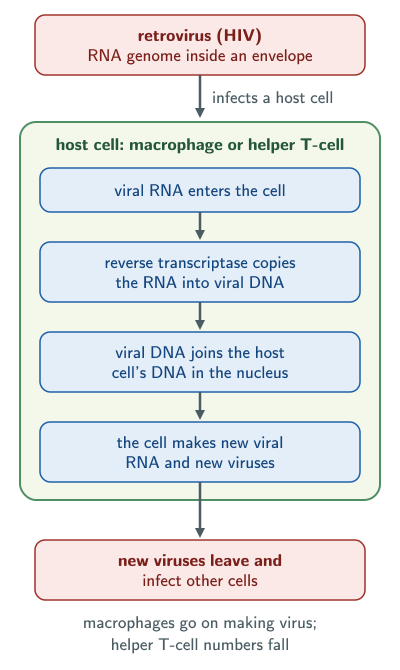
Why the loss of helper T-cells matters: T-cells do not secrete antibodies, but they help B-cells to produce them, and they mediate cell-mediated immunity (NCERT Section 7.2, page 135). As helper T-lymphocytes are lost, both kinds of acquired immune response weaken (our reasoning).
Diagnosis and treatment
- A widely used diagnostic test for AIDS is ELISA, the enzyme linked immuno-sorbent assay (page 140).
- NCERT says that treatment with anti-retroviral drugs is only partially effective: the drugs can prolong the life of the patient (page 140).
Reading note (page 140): NCERT adds that the drugs “cannot prevent death, which is inevitable”. Beyond the NCERT text, MedlinePlus (public domain) now puts it this way: “There is no cure for HIV infection”, but antiretroviral therapy (ART) “can make HIV infection a manageable chronic condition”. In an exam, give NCERT’s points: AIDS has no cure, and anti-retroviral drugs are only partially effective.
Prevention of AIDS
As AIDS has no cure, prevention is the best option.
NCERT Biology (Class 12), Section 7.3, page 140
- NCERT notes that HIV infection more often spreads through conscious behaviour patterns, not inadvertently as pneumonia or typhoid do, although infection of blood-transfusion patients or of newborns from their mothers may happen through poor monitoring. Hence the slogan “don’t die of ignorance” (page 140).
- In India the National AIDS Control Organisation (NACO) and non-governmental organisations (NGOs) educate people about AIDS, and WHO has started a number of programmes to prevent the spread of HIV (page 140).
- The steps NCERT lists (page 140):
- making blood from blood banks safe from HIV;
- using only disposable needles and syringes in public and private hospitals and clinics;
- free distribution of condoms;
- controlling drug abuse;
- advocating safe sex;
- promoting regular check-ups for HIV in susceptible populations.
- HIV infection or AIDS should not be hidden, since the infection may then spread to many more people. People with HIV/AIDS need help and sympathy instead of being shunned; NCERT calls it a problem that society and the medical fraternity must tackle together (page 140).
Solved examples
Example 1: Routes of transmission
What are the various routes by which the human immunodeficiency virus is transmitted? (NCERT Exercise 10, page 148.)
Answer: (a) sexual contact with an infected person; (b) transfusion of contaminated blood and blood products; (c) sharing infected needles, as in intravenous drug use; (d) from an infected mother to her child through the placenta. HIV is not spread by mere touch or physical contact, only through body fluids (NCERT pages 138–139).
Example 2: How HIV causes immune deficiency
By what mechanism does the AIDS virus cause deficiency of the immune system? (NCERT Exercise 11, page 148.)
Answer: HIV enters macrophages, where reverse transcriptase copies its RNA genome into viral DNA. The viral DNA is incorporated into the host cell’s DNA and directs the cell to make virus particles, so the macrophages act like an HIV factory. HIV also enters helper T-lymphocytes, replicates, and the progeny viruses attack more helper T-lymphocytes. Their number falls progressively, so the person cannot overcome infections such as those by Mycobacterium or Toxoplasma (NCERT page 140).
Example 3: Expanding the abbreviations
Expand AIDS, HIV and NACO. (NCERT Exercise 7 (c)–(e), page 148.)
Answer: AIDS: Acquired Immuno Deficiency Syndrome; HIV: Human Immunodeficiency Virus (NCERT prints ‘Immuno deficiency’); NACO: National AIDS Control Organisation (NCERT pages 138 and 140).
Common mistakes to avoid
Common mistake
Reading ‘not congenital’ as ‘never passed to a baby’
‘Not congenital’ means AIDS is not an inborn defect of the immune system: the deficiency is acquired through infection with HIV. An infected mother can still pass HIV to her child through the placenta, and that child’s immune deficiency is acquired too (reasoned from NCERT page 138).
Common mistake
Calling HIV a DNA virus
HIV is a retrovirus with an RNA genome inside an envelope. Its DNA copy is made inside the host cell by reverse transcriptase (NCERT pages 138 and 140).
Common mistake
Saying HIV attacks B-lymphocytes
HIV enters macrophages and helper T-lymphocytes. It is the number of helper T-lymphocytes that falls progressively (NCERT page 140).
Common mistake
Thinking HIV spreads by touch
HIV/AIDS is not spread by mere touch or physical contact; it spreads only through body fluids (NCERT page 139).
Quick revision summary
- AIDS: Acquired Immuno Deficiency Syndrome; the immune deficiency is acquired during life, not congenital; first reported in 1981.
- HIV is a retrovirus: an envelope enclosing an RNA genome. Spread: sexual contact, contaminated blood and blood products, shared needles, mother to child through the placenta; not by mere touch. Time-lag to symptoms: a few months to many years, usually 5–10 years.
- In the body: macrophages (an HIV factory), where reverse transcriptase makes viral DNA that joins the host’s DNA; helper T-lymphocytes fall progressively; fever, diarrhoea, weight loss; infections by Mycobacterium, viruses, fungi and Toxoplasma.
- Diagnosis: ELISA. Anti-retroviral drugs are only partially effective; there is no cure (beyond the NCERT text, MedlinePlus: ART can make HIV infection a manageable chronic condition).
- Prevention: safe blood, disposable needles and syringes, condoms, controlling drug abuse, safe sex, regular check-ups; NACO and NGOs educate; no isolation or shunning.
Formula sheet
- AIDS: Acquired Immuno Deficiency Syndrome
- HIV: retrovirus; envelope around an RNA genome
- viral RNA → viral DNA: reverse transcriptase
- HIV enters macrophages and helper T-cells
- time-lag to symptoms: usually 5–10 years
- diagnosis: ELISA
Questions students ask
Where did HIV come from?
Beyond the NCERT text, HIV came into people from viruses of African apes and monkeys: a review by de Groot and Bontrop (Retrovirology, 2013, CC BY) traces HIV-1 group M, the group that began the worldwide pandemic, to a simian immunodeficiency virus (SIV) of chimpanzees in Central Africa, and HIV-2, found mostly in West Africa, to an SIV of sooty mangabeys. In the review’s account SIV crossed into humans at least four separate times, giving HIV-1 its four groups, and gorillas are the likely source of two of them, O and P. NCERT’s account starts later, with the first report of AIDS in 1981 (page 138).
What is a CD4 count, and why does it fall in HIV infection?
Beyond the NCERT text, a CD4 count is the number of CD4 cells, the helper T-lymphocytes (TH), in a cubic millimetre of blood, and HIV.gov (2026) gives 500 to 1600 cells/mm for a healthy immune system. The count falls because these are the cells HIV seeks out: MeSH (US National Library of Medicine) says HIV selectively infects cells carrying CD4, a marker that acts as its receptor by binding the virus’s envelope protein, and calls the loss of these cells “the key element in the profound immunosuppression seen in HIV infection”. NCERT, without naming CD4, describes a progressive decrease in the number of helper T-lymphocytes (page 140).
Why can HIV not be cured by antiretroviral drugs?
HIV cannot yet be cured, and beyond the NCERT text the obstacle lies in a step NCERT describes, the incorporation of viral DNA into the host cell’s DNA (page 140). Matsuda and Maeda (International Journal of Molecular Sciences, 2024, CC BY) explain that in some CD4 T-cells, mostly resting memory cells, this built-in DNA stays silent, so the cell makes no viral RNA or protein and immune cells pass it by as uninfected. Antiretroviral drugs can push the virus in the blood too low to measure but cannot remove DNA already built into cells, and the virus is back within weeks if they stop; so treatment is lifelong, and with it people living with HIV can live long, healthy lives (CDC, 2025).
What is the difference between AIDS and hepatitis B?
AIDS and hepatitis B differ in what their viruses attack: HIV attacks helper T-lymphocytes, whose number falls progressively (page 140), whereas, beyond the NCERT text, hepatitis B is an inflammation of the liver caused by the hepatitis B virus (MedlinePlus, US National Library of Medicine). NCERT pairs the two on page 146: both viruses pass from person to person through shared needles and syringes, and both infections are chronic. Beyond the NCERT text too, MedlinePlus says that hepatitis B “can cause an acute (short-term) or chronic (long-term) infection”, while the CDC (2025) says of HIV: “Once people get HIV, they have it for life.”
What is the difference between HIV and AIDS?
HIV is the virus and AIDS the syndrome it can lead to: NCERT names HIV as the cause of AIDS (page 138), and by our reasoning the infection comes first, so a person can have HIV without having AIDS. Beyond the NCERT text, HIV.gov (2026) describes AIDS as a late stage of HIV infection, reached once the virus has badly damaged the immune system, and treats a CD4 count below 200 cells/mm, or one or more opportunistic infections at any count, as the point at which a person with HIV has progressed to AIDS. It adds that because HIV medicine, taken as prescribed, halts this progression, most people with HIV in the United States never reach AIDS.
Practice questions
Try each question first, then open the answer to check your working.
-
Q1. Which enzyme makes viral DNA from the RNA genome of HIV?
Show answerHide answer
Reverse transcriptase (NCERT page 140).
-
Q2. Name the two kinds of cells that HIV enters in the body.
Show answerHide answer
Macrophages and helper T-lymphocytes (NCERT page 140).
-
Q3. What does NCERT give as the usual time-lag between HIV infection and the appearance of AIDS symptoms?
Show answerHide answer
Usually 5–10 years; it may vary from a few months to many years (NCERT page 139).