Drug, alcohol and tobacco abuse
NCERT Class 12 Biology Chapter 7 Section 7.5
Quick answer
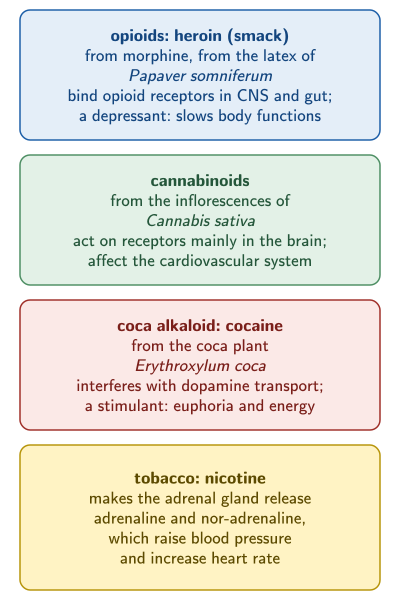
The drugs most commonly abused are opioids such as heroin, which bind opioid receptors in the central nervous system and gut, cannabinoids, which act on receptors mainly in the brain, and coca alkaloids such as cocaine, which interferes with dopamine transport; nicotine in tobacco raises blood pressure and heart rate through adrenaline. Repeated use raises the tolerance of the receptors and leads to addiction and dependence, with a withdrawal syndrome when use stops. Adolescence is a vulnerable phase, so NCERT stresses prevention through support, education, counselling and professional help.
With your textbook
NCERT Biology (Class 12), Chapter 7 “Human Health and Disease”, Section 7.5 “Drugs and Alcohol Abuse”, pages 142–147.
Open the official NCERT chapter (PDF, 4.5 MB, ncert.nic.in) (opens in a new tab)
Checked against the 2026-27 reprint on .
What is drug abuse?
Drug abuse
- Many plants, fruits and seeds with hallucinogenic properties have been used for hundreds of years in folk-medicine, religious ceremonies and rituals all over the globe (page 143). NCERT then defines abuse:
When these are taken for a purpose other than medicinal use or in amounts/frequency that impairs one’s physical, physiological or psychological functions, it constitutes drug abuse.
NCERT Biology (Class 12), Section 7.5, page 143
In plain words: the same substance can be a medicine or a problem. It becomes abuse when it is taken for something other than treatment, or so much or so often that it harms the body or the mind.
NCERT notes that surveys and statistics show the use of drugs and alcohol to be on the rise, especially among the youth, and that proper education and guidance would help young people protect themselves and follow healthy lifestyles (page 142).
The drugs commonly abused are opioids, cannabinoids and coca alkaloids. Most of them are obtained from flowering plants, and some from fungi (page 142).
Opioids
- Opioids are drugs that bind to specific opioid receptors in our central nervous system and gastrointestinal tract (page 142).
- Heroin, commonly called smack, is chemically diacetylmorphine, a white, odourless, bitter crystalline compound. It is obtained by acetylation of morphine, which is extracted from the latex of the poppy plant Papaver somniferum (pages 142–143). NCERT Figure 7.8 (page 142) shows the opium poppy.
- NCERT Figure 7.7 (page 142) shows the chemical structure of morphine. NCERT’s text cites it for heroin as well, since heroin is morphine acetylated (diacetylmorphine).
- Heroin is generally taken by snorting and injection. It is a depressant and slows down body functions (page 143).
- Morphine itself is a very effective sedative and painkiller, very useful in patients who have undergone surgery (page 143).
Cannabinoids
- Cannabinoids are a group of chemicals that interact with cannabinoid receptors, present principally in the brain (page 143).
- Natural cannabinoids are obtained from the inflorescences of the plant Cannabis sativa. Its flower tops, leaves and resin are used in various combinations to produce marijuana, hashish, charas and ganja (page 143).
- They are generally taken by inhalation and oral ingestion, and are known for their effects on the cardiovascular system (page 143).
- NCERT Figure 7.9 (page 143) shows the skeletal structure of a cannabinoid molecule, and Figure 7.10 the leaves of Cannabis sativa.
- NCERT adds that these days cannabinoids are also being abused by some sportspersons (page 143).
Coca alkaloids and other drugs
- Cocaine, the coca alkaloid, is obtained from the coca plant Erythroxylum coca, native to South America. It interferes with the transport of the neurotransmitter dopamine (page 143), one of the chemicals that carry signals across a synapse.
- Cocaine, commonly called coke or crack, is usually snorted. It has a potent stimulating action on the central nervous system, producing a sense of euphoria and increased energy. Excessive dosage causes hallucinations (page 143).
- Other well-known plants with hallucinogenic properties are Atropa belladonna and Datura; NCERT Figure 7.11 (page 143) shows a flowering branch of Datura.
- Drugs such as barbiturates, amphetamines and benzodiazepines, normally used as medicines to help patients cope with mental illnesses like depression and insomnia, are often abused (page 143).
NCERT slip (page 143): NCERT prints the species name as Atropa belladona. The accepted spelling is Atropa belladonna, with a double n (Integrated Taxonomic Information System, US government, public domain). In an exam, write Atropa belladonna; a question that copies NCERT’s spelling means the same plant.
Tobacco: smoking and chewing
- Tobacco has been used by human beings for more than 400 years. It is smoked, chewed or used as a snuff (page 144).
- Tobacco contains a large number of chemical substances, including nicotine, an alkaloid. Nicotine stimulates the adrenal gland to release adrenaline and nor-adrenaline into the blood, both of which raise blood pressure and increase heart rate (page 144).
- Smoking is associated with an increased incidence of cancers of the lung, urinary bladder and throat, bronchitis, emphysema, coronary heart disease, gastric ulcer and more. Tobacco chewing is associated with an increased risk of cancer of the oral cavity (page 144).
- Smoking increases the carbon monoxide (CO) content of the blood and reduces the concentration of haem-bound oxygen, causing oxygen deficiency in the body (page 144).
- NCERT also says that smoking paves the way to hard drugs (page 144).
- Cigarette packets carry a statutory warning that smoking is injurious to health. Knowing the dangers and the addictive nature of tobacco, the young and the old need to avoid these habits, and anyone addicted needs counselling and medical help to get rid of the habit (page 144).
Adolescence and drug or alcohol abuse
- Adolescence means both ‘a period’ and ‘a process’ during which a child becomes mature in attitudes and beliefs for effective participation in society. The period between 12–18 years of age may be thought of as adolescence, a bridge linking childhood and adulthood. It brings biological and behavioural changes and is a very vulnerable phase of mental and psychological development (page 144).
- Common causes that lead young people to drugs and alcohol (page 144):
- curiosity, the need for adventure and excitement, and experimentation;
- effects that might be perceived as benefits; later, use to escape facing problems;
- stress from pressure to excel in academics or examinations;
- the perception that it is ‘cool’ or progressive, which television, movies, newspapers and the internet also help to promote;
- unstable or unsupportive family structures, and peer pressure.
Addiction and dependence
- Addiction is a psychological attachment to certain effects, such as euphoria and a temporary feeling of well-being, associated with drugs and alcohol. These drive people to take them even when they are not needed, or even when their use becomes self-destructive (page 145).
- With repeated use, the tolerance level of the receptors in the body increases, so the receptors respond only to higher doses, leading to greater intake and addiction. Even a single use can be a fore-runner to addiction, and the addictive potential pulls the user into a vicious circle of regular use (page 145).
Dependence is the tendency of the body to manifest a characteristic and unpleasant withdrawal syndrome if regular dose of drugs/alcohol is abruptly discontinued.
NCERT Biology (Class 12), Section 7.5.2, page 145
- The withdrawal syndrome is characterised by anxiety, shakiness, nausea and sweating, which may be relieved when use is resumed. In some cases withdrawal symptoms can be severe and even life-threatening, and the person may need medical supervision (page 145).
- Dependence leads the person to ignore social norms to get funds, which results in many social adjustment problems (page 145).
Effects of drug and alcohol abuse
- Immediate effects: reckless behaviour, vandalism and violence. Excessive doses may lead to coma and death from respiratory failure, heart failure or cerebral hemorrhage. A combination of drugs, or drugs taken with alcohol, generally results in overdosing and even deaths (page 145).
- Warning signs among the youth: a drop in academic performance, unexplained absence from school or college, lack of interest in personal hygiene, withdrawal, isolation, depression, fatigue, aggressive and rebellious behaviour, deteriorating relationships with family and friends, loss of interest in hobbies, changes in sleeping and eating habits, and fluctuations in weight and appetite (page 145).
- Wider effects: a person who cannot get money for drugs or alcohol may turn to stealing, and the mental and financial distress can reach the whole family and friends (page 145).
- Infections: people who take drugs intravenously are much more likely to acquire serious infections like AIDS and hepatitis B, whose viruses pass from person to person through shared infected needles and syringes; both can also be transmitted through sexual contact or infected blood (page 146). Both are among the sexually transmitted infections of NCERT Chapter 3, which names the same routes (NCERT Section 3.4, page 47).
- Alcohol: its use during adolescence may lead to heavy drinking in adulthood. The chronic use of drugs and alcohol damages the nervous system and the liver (cirrhosis), and their use during pregnancy is known to adversely affect the foetus (page 146).
Reading note (page 146): NCERT calls AIDS and hepatitis B “chronic infections and ultimately fatal”. Beyond the NCERT text, MedlinePlus (US National Library of Medicine, public domain) notes that hepatitis B can be acute or chronic and that “People with an acute infection usually get better on their own without treatment”, and that treatment can make HIV infection a manageable chronic condition. NCERT’s point stands: shared needles spread serious infections. In an exam, give NCERT’s wording.
Misuse of drugs in sports
- Some sportspersons (mis)use narcotic analgesics, anabolic steroids, diuretics and certain hormones to increase muscle strength and bulk and to promote aggressiveness, and so increase athletic performance (page 146).
- Side effects of anabolic steroids (page 146):
- in females: masculinisation (features like males), increased aggressiveness, mood swings, depression, abnormal menstrual cycles, excessive hair growth on the face and body, enlargement of the clitoris, deepening of the voice;
- in males: acne, increased aggressiveness, mood swings, depression, reduction in the size of the testicles, decreased sperm production, potential for kidney and liver dysfunction, breast enlargement, premature baldness, enlargement of the prostate gland;
- in adolescents of either sex: severe facial and body acne, and premature closure of the growth centres of the long bones, which may result in stunted growth.
- These effects may be permanent with prolonged use (page 146).
- Beyond the NCERT text: MedlinePlus notes that “Anabolic steroids are synthetic (man-made) versions of testosterone”, the main male sex hormone, which fits the masculinising effects listed for females (our reasoning).
Prevention and control
- The age-old adage ‘prevention is better than cure’ holds true here. Habits such as smoking, taking drugs or alcohol are more likely to be taken up at a young age, so it is best to identify the situations that may push an adolescent towards them and to take remedial measures in time (page 146).
- Parents and teachers have a special responsibility. Parenting that combines high levels of nurturance with consistent discipline has been associated with a lowered risk of substance (alcohol, drugs, tobacco) abuse (page 146).
- The measures NCERT lists (pages 146–147):
- Avoid undue peer pressure: every child has his or her own choice and personality, which should be respected and nurtured; a child should not be pushed to perform beyond his or her threshold limits, in studies, sports or other activities.
- Education and counselling: to face problems and stresses, and to accept disappointments and failures as a part of life; and to channel the child’s energy into healthy pursuits like sports, reading, music, yoga and other extracurricular activities.
- Seeking help from parents and peers: help should be sought immediately, even from close and trusted friends, to get proper advice and to vent feelings of anxiety and guilt.
- Looking for danger signs: alert parents and teachers should look for the warning signs above; even friends who find someone using drugs or alcohol should bring it to the notice of parents or teachers, in the best interests of that person.
- Seeking professional and medical help: highly qualified psychologists, psychiatrists, and de-addiction and rehabilitation programmes help affected individuals, who, with sufficient effort and will power, can get rid of the problem completely and lead a normal and healthy life.
NCERT slip (page 147): NCERT prints ‘proper advise’ in measure (iii), a misprint of the noun ‘advice’; write ‘advice’ in an answer.
Solved examples
Example 1: Harmful effects
List the harmful effects caused by alcohol or drug abuse. (NCERT Exercise 14, page 148.)
Answer: immediate: reckless behaviour, vandalism and violence; excessive doses may cause coma and death from respiratory failure, heart failure or cerebral hemorrhage, especially with drugs combined or taken with alcohol. Longer term: damage to the nervous system and liver (cirrhosis); harm to the foetus if used in pregnancy; AIDS and hepatitis B through shared needles; stealing and social adjustment problems; mental and financial distress to family and friends (NCERT pages 145–146).
Example 2: Why the habit is hard to give up
Why is it that once a person starts taking alcohol or drugs, it is difficult to get rid of the habit? (NCERT Exercise 16, page 148.)
Answer: addiction: a psychological attachment to effects such as euphoria and a temporary feeling of well-being. With repeated use, the tolerance level of the receptors rises, so only higher doses work, and intake increases. Dependence follows: if the regular dose is stopped abruptly, an unpleasant withdrawal syndrome (anxiety, shakiness, nausea, sweating) appears, which may be relieved when use is resumed, so the person is pulled into a vicious circle of regular use. Severe withdrawal may need medical supervision (NCERT page 145).
Example 3: Matching drugs to sources
Match each drug to its source and its action: (a) heroin; (b) cocaine; (c) cannabinoids.
Answer: (a) heroin: acetylated morphine from the latex of the opium poppy, Papaver somniferum; binds opioid receptors; a depressant. (b) cocaine: from Erythroxylum coca; interferes with dopamine transport; a stimulant. (c) cannabinoids: from the inflorescences of Cannabis sativa; act on cannabinoid receptors, mainly in the brain, and affect the cardiovascular system (NCERT pages 142–143).
Common mistakes to avoid
Common mistake
Calling heroin a stimulant
Heroin is a depressant that slows down body functions. Cocaine is the one with a potent stimulating action on the central nervous system (NCERT page 143).
Common mistake
Mixing up addiction and dependence
Addiction is a psychological attachment to the effects of a drug. Dependence is the body’s tendency to show a withdrawal syndrome when the regular dose is stopped abruptly (NCERT page 145).
Common mistake
Linking tobacco only to lung cancer
NCERT associates smoking with cancers of the lung, urinary bladder and throat, and with bronchitis, emphysema, coronary heart disease and gastric ulcer; tobacco chewing raises the risk of cancer of the oral cavity (NCERT page 144).
Quick revision summary
- Drug abuse: taking a drug for a non-medicinal purpose, or in amounts or frequency that impair physical, physiological or psychological functions. Commonly abused: opioids, cannabinoids, coca alkaloids, mostly from flowering plants, some from fungi.
- Opioids bind opioid receptors in the CNS and gut; heroin (smack, diacetylmorphine) is acetylated morphine from the poppy’s latex, a depressant. Cannabinoids act on receptors mainly in the brain and affect the cardiovascular system. Cocaine interferes with dopamine transport, a stimulant; excess causes hallucinations. Atropa and Datura are hallucinogenic.
- Tobacco: nicotine releases adrenaline and nor-adrenaline (blood pressure and heart rate rise); smoking is associated with cancers, bronchitis, emphysema, heart disease and gastric ulcer, raises CO and lowers haem-bound oxygen; chewing, with oral cancer.
- Adolescence (12–18 years) is vulnerable: curiosity, perceived benefits, stress, the ‘cool’ image, family problems, peer pressure.
- Addiction: psychological attachment; tolerance rises. Dependence: withdrawal syndrome. Effects: violence, overdose deaths, cirrhosis, harm to the foetus, AIDS and hepatitis B by shared needles; anabolic steroids in sport.
- Prevention: avoid undue peer pressure, education and counselling, help from parents and peers, watching for danger signs, professional and medical help.
Formula sheet
- opioids: receptors in CNS and gut; heroin a depressant
- cannabinoids: receptors mainly in the brain
- cocaine: interferes with dopamine transport
- nicotine: adrenaline, nor-adrenaline released
- smoking: more CO, less haem-bound oxygen
- adolescence: 12–18 years
- dependence: withdrawal syndrome when stopped
Questions students ask
What is the difference between opioids and opiates?
Beyond the NCERT text, an opiate is an alkaloid of opium, from the poppy, or a derivative of one, that acts on opioid receptors, while “opioid” is the wider word for compounds that act like them at those receptors (MeSH, US National Library of Medicine). So every opiate is an opioid, but not every opioid is an opiate (our reasoning). NCERT uses only “opioids”, which it defines by their binding to specific opioid receptors (page 142), and by our reading its two examples, morphine and heroin, are opiates in the narrower sense too.
Does the body make its own opioids and cannabinoids?
Yes, beyond the NCERT text, the body makes its own chemicals for both kinds of receptor that NCERT names (pages 142–143): MeSH (US National Library of Medicine) defines opioid peptides as “the endogenous peptides with opiate-like activity”, in three major classes, the enkephalins, dynorphins and endorphins, and endocannabinoids as fatty acid derivatives that act on cannabinoid receptors though they differ in structure from the cannabinoids. MeSH adds that cannabinoid receptors may help to regulate the release of signalling molecules such as neurotransmitters. By our reasoning, the drugs act on receptors whose normal partners are the body’s own signalling molecules.
What is the difference between cannabinoids, THC and CBD?
“Cannabinoids” is NCERT’s name for a whole group of chemicals, those that interact with cannabinoid receptors (page 143), and beyond the NCERT text, THC and CBD are two of its members. NIDA (US National Institute on Drug Abuse, 2024) says the cannabis plant contains at least 125 cannabinoids, among them delta-9 tetrahydrocannabinol (THC), which is intoxicating and “can temporarily alter a person’s mood, thoughts, and perceptions”, and cannabidiol (CBD), which “is not intoxicating like THC”.
How do cannabinoids affect the cardiovascular system?
NCERT says only that cannabinoids are known for their effects on the cardiovascular system (page 143); beyond the NCERT text, NIDA (US National Institute on Drug Abuse, 2024) says that cannabis “can increase heart rate and blood pressure right after use”. NIDA finds the long-term picture less settled: stroke, heart attack and heart-rhythm problems have been linked with years of use in some studies, but it is not yet known whether cannabis itself is the cause or other factors are at work.
Is tobacco use counted as substance abuse?
Yes, NCERT counts tobacco use as substance abuse: discussing prevention, it writes of the “lowered risk of substance (alcohol/drugs/tobacco) abuse” (page 146), and it teaches tobacco within its section on drugs and alcohol abuse, noting its nicotine, an alkaloid, and its addictive nature (page 144). Beyond the NCERT text, the National Cancer Institute (US, fact sheet reviewed 2017) calls nicotine “the drug primarily responsible for a person’s addiction to tobacco products” and likens that addiction to the one produced by heroin and cocaine.
Practice questions
Try each question first, then open the answer to check your working.
-
Q1. Which drug is chemically diacetylmorphine, and how is it obtained?
Show answerHide answer
Heroin (smack), obtained by acetylation of morphine, which is extracted from the latex of the poppy plant (NCERT pages 142–143).
-
Q2. Where in the body are opioid receptors present?
Show answerHide answer
In the central nervous system and the gastrointestinal tract (NCERT page 142).
-
Q3. Name the four symptoms of the withdrawal syndrome that NCERT lists.
Show answerHide answer
Anxiety, shakiness, nausea and sweating (NCERT page 145).