Common diseases in humans
NCERT Class 12 Biology Chapter 7 Section 7.1
Quick answer
Common diseases in humans are caused by pathogens: bacteria cause typhoid, spread through contaminated food and water, and pneumonia, which fills the alveoli with fluid; viruses cause the common cold; protozoans cause malaria and amoebiasis; worms cause ascariasis and filariasis; and fungi cause ringworm. In malaria the parasite enters through the bite of a female mosquito, multiplies in liver cells and then in red blood cells, whose rupture releases haemozoin and brings recurring chill and fever. Hygiene, vector control, vaccines, antibiotics and other drugs prevent and control them.
With your textbook
NCERT Biology (Class 12), Chapter 7 “Human Health and Disease”, Section 7.1 “Common Diseases in Humans”, pages 130–134.
Open the official NCERT chapter (PDF, 4.5 MB, ncert.nic.in) (opens in a new tab)
Checked against the 2026-27 reprint on .
What causes common diseases in humans?
Pathogens
A wide range of organisms belonging to bacteria, viruses, fungi, protozoans, helminths, etc., could cause diseases in man.
NCERT Biology (Class 12), Section 7.1, page 130
- Such disease-causing organisms are called pathogens (page 130).
In plain words: many illnesses are caused by infectious agents, including cellular organisms and acellular viruses that get inside the body, or onto it, and multiply there. Each kind of germ or worm has its own way in, through food, water, air, a mosquito bite or touch, and blocking that way in is how we prevent the disease.
Pathogens and parasites
-
Most parasites are pathogens, because they harm the host by living in or on it (page 130).
-
Pathogens enter the body by various means, multiply and interfere with normal vital activities, causing morphological and functional damage (page 130).
-
They must adapt to life inside the host. Pathogens that enter the gut, for example, must survive the low pH of the stomach and resist the digestive enzymes (page 130).
-
Typhoid: the bacterium Salmonella typhi; spread through contaminated food and water.
-
Pneumonia: the bacteria Streptococcus pneumoniae and Haemophilus influenzae; spread through droplets or aerosols, or shared glasses and utensils.
-
Common cold: rhinoviruses (NCERT); spread through droplets or contaminated objects.
-
Malaria: the protozoan Plasmodium; spread by the bite of an infected female Anopheles.
-
Amoebiasis: the protozoan Entamoeba histolytica; spread through food and water contaminated by faeces, with houseflies as carriers.
-
Ascariasis: the roundworm Ascaris, a helminth; spread through contaminated water, vegetables and fruits.
-
Filariasis: the filarial worm Wuchereria, a helminth; spread by the bite of female mosquito vectors.
-
Ringworm: fungi of the genera Microsporum, Trichophyton and Epidermophyton; picked up from soil, or from the towels, clothes or comb of infected people.
(All from NCERT pages 130–133; later names and routes are labelled in the sections below.)
Bacterial diseases: typhoid and pneumonia
- Typhoid fever is caused by the bacterium Salmonella typhi. It usually enters the small intestine through contaminated food and water and migrates to other organs through the blood (page 130).
- Symptoms: sustained high fever (39–40 °C), weakness, stomach pain, constipation, headache and loss of appetite. In severe cases, intestinal perforation and death may occur. Typhoid fever could be confirmed by the Widal test (pages 130–131).
- Mary Mallon, nicknamed Typhoid Mary, was a cook and a typhoid carrier who spread typhoid for several years through the food she prepared (page 131).
- Pneumonia is caused by bacteria such as Streptococcus pneumoniae and Haemophilus influenzae. It infects the alveoli of the lungs, which fill with fluid, causing severe problems in respiration (page 131). Beyond the NCERT text: viruses and fungi can cause pneumonia too, though bacteria are the most common cause (MedlinePlus, Pneumonia).
- Symptoms: fever, chills, cough and headache; in severe cases the lips and finger nails turn gray to bluish. It spreads by inhaling the droplets or aerosols released by an infected person, or by sharing glasses and utensils with one (page 131).
- Other bacterial diseases: dysentery, plague and diphtheria (page 131).
A viral disease: the common cold
- NCERT: rhinoviruses cause the common cold; they “infect the nose and respiratory passage but not the lungs” (page 131); give this in an NCERT-based answer. Beyond the NCERT text: more than 200 respiratory viruses can cause colds, rhinoviruses being the most frequent, and complications of respiratory virus infections can include asthma attacks, bronchitis and pneumonia (CDC, About Common Cold).
- Symptoms: nasal congestion and discharge, sore throat, hoarseness, cough, headache and tiredness, which usually last for 3–7 days (page 131). Beyond the NCERT text: CDC says colds usually last less than a week (CDC, About Common Cold).
- Droplets from the coughs or sneezes of an infected person are inhaled directly, or passed on through contaminated objects such as pens, books, cups, doorknobs, computer keyboards or mice (page 131).
Malaria and the life cycle of Plasmodium
- Malaria is caused by Plasmodium, a tiny protozoan. Different species, P. vivax, P. malariae and P. falciparum, cause different types of malaria. Malignant malaria, caused by Plasmodium falciparum, is the most serious and can be fatal (page 131). Beyond the NCERT text: other species can also cause severe malaria; P. knowlesi, for example, causes both mild and severe disease (Wikipedia, “Plasmodium knowlesi”, facts in our words).
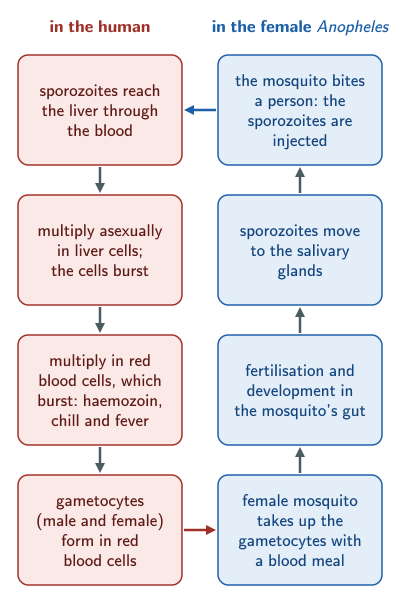
- Plasmodium enters the body as sporozoites, the infectious form, through the bite of an infected female Anopheles mosquito (page 131).
- The parasites first multiply in liver cells, then attack the red blood cells (RBCs), which rupture. The rupture releases a toxic substance, haemozoin, which is responsible for the chill and high fever recurring every three to four days (page 131); in an NCERT-based answer, name haemozoin. Beyond the NCERT text: haemozoin is the crystal into which the parasite locks the toxic haem left over from digesting haemoglobin; the fever is set off by all that a bursting red cell releases, the new merozoites with their waste products and cell fragments, and without treatment the fever can fall into a fixed cycle (Wikipedia, “Hemozoin” and “Malaria”, facts in our words).
- When a female Anopheles bites an infected person, the parasites enter the mosquito and develop further. They multiply to form sporozoites, which are stored in its salivary glands and injected at a later bite once development is complete (page 131).
- The malarial parasite needs two hosts, human and mosquito, to complete its life cycle; the female Anopheles is also the vector, the transmitting agent (page 131). NCERT Figure 7.1 (page 132) adds that sexual stages, the gametocytes, develop in the red blood cells, and that fertilisation and development take place in the mosquito’s gut.
NCERT slip (page 131): NCERT prints the second species as “P. malaria”; its name is Plasmodium malariae (Wikipedia, “Plasmodium malariae”, facts in our words). Write P. malariae.
Reading note (page 131): Beyond the NCERT text: P. malariae completes its cycle in red blood cells in about 72 hours (quartan fever), and P. vivax and P. falciparum in about 48 hours (tertian fever) (Wikipedia, “Plasmodium malariae”, facts in our words); P. knowlesi takes only about 24 hours (Wikipedia, “Plasmodium knowlesi”, facts in our words). Counted the old way, with the day of one attack as day 1, the 48- and 72-hour cycles fall on the third or the fourth day, which is NCERT’s “every three to four days” (our reasoning). In an exam, give NCERT’s ‘every three to four days’; a question that states 48 or 72 hours describes the same cycles.
Mosquito stages: Beyond the NCERT text: in the mosquito’s gut the gametocytes form male and female gametes, which fuse into a zygote; the zygote becomes a motile ookinete, which crosses the gut wall and grows into an oocyst on its outer side; the oocyst divides into many sporozoites, which migrate to the salivary glands. In a person, the parasites leaving the liver as merozoites go on to infect the red blood cells; in some species some parasites lie dormant in the liver instead, as hypnozoites, sometimes for over a year (Wikipedia, “Plasmodium”, facts in our words).
Protozoan and helminth diseases of the gut
- Entamoeba histolytica is a protozoan parasite in the large intestine that causes amoebiasis (amoebic dysentery). Symptoms: constipation, abdominal pain and cramps, and stools with excess mucus and blood clots (page 132; NCERT prints “mucous”, the adjective).
- Houseflies act as mechanical carriers: they carry the parasite from the faeces of an infected person to food and food products. Drinking water and food contaminated by faecal matter are the main source of infection (pages 132–133).
- Ascaris, the common roundworm, and Wuchereria, the filarial worm, are helminths that cause disease in humans (page 133).
- Ascaris, an intestinal parasite, causes ascariasis. Symptoms: internal bleeding, muscular pain, fever, anaemia and blockage of the intestinal passage. Its eggs, passed in the faeces of infected persons, contaminate soil, water and plants; a healthy person is infected through contaminated water, vegetables and fruits (page 133).
Filariasis and ringworm
- The filarial worms Wuchereria (W. bancrofti and W. malayi) cause a slowly developing chronic inflammation of the organs where they live for many years, usually the lymphatic vessels of the lower limbs. The disease is called elephantiasis or filariasis (NCERT Figure 7.2, page 133). The genital organs are often affected too, with gross deformities. The worms are passed on by the bite of female mosquito vectors (page 133).
- Reading note (page 133): Beyond the NCERT text: the second species was moved to a new genus in 1960 and is now Brugia malayi; Wuchereria now holds only W. bancrofti (Wikipedia, “Brugia malayi”, facts in our words). A third worm, Brugia timori, also causes the disease, now called lymphatic filariasis; most infected people have no symptoms, and only some develop the severe swelling called elephantiasis (Wikipedia, “Lymphatic filariasis”, facts in our words). For NCERT-based questions, NCERT’s names are expected.
- Ringworm, one of the most common infectious diseases, is caused by fungi of the genera Microsporum, Trichophyton and Epidermophyton (page 133).
- Symptoms: dry, scaly lesions on the skin, nails and scalp, with intense itching (NCERT Figure 7.3, page 133). Heat and moisture help these fungi grow, so they thrive in skin folds, as in the groin or between the toes. Ringworm is usually acquired from soil, or by using the towels, clothes or even the comb of infected people (page 133). Beyond the NCERT text: MedlinePlus adds that tinea infections such as ringworm can be caught “by touching an infected person, from damp surfaces such as shower floors, or even from a pet” (MedlinePlus, Tinea Infections, public domain).
Prevention and control
- Personal hygiene: keeping the body clean, and consuming clean drinking water, food, vegetables and fruits (page 133).
- Public hygiene: proper disposal of waste and excreta; periodic cleaning and disinfection of water reservoirs, pools, cesspools and tanks; and standard hygiene in public catering. These are essential where the pathogens travel through food and water, as in typhoid, amoebiasis and ascariasis (page 133).
- Air-borne diseases such as pneumonia and the common cold: also avoid close contact with infected persons or their belongings (pages 133–134).
- Vector-borne diseases such as malaria and filariasis: control or eliminate the vectors and their breeding places. Avoid stagnant water around homes, clean household coolers regularly, use mosquito nets, put fishes such as Gambusia, which eat mosquito larvae, into ponds, spray insecticides in ditches, drainage areas and swamps, and fit wire mesh to doors and windows (page 134). Beyond the NCERT text: where the mosquitofish (Gambusia) was released outside its home range, it has harmed native water life, and looking back, many of those releases may have been unwise (Wikipedia, “Mosquitofish”, facts in our words). NCERT adds that these precautions matter even more now that dengue and chikungunya, spread by Aedes mosquitoes, have become widespread in many parts of India (page 134).
- Vaccines and drugs: vaccination and immunisation programmes have eradicated smallpox, and vaccines have largely controlled polio, diphtheria, pneumonia and tetanus. Antibiotics and other drugs treat many infectious diseases (page 134). Beyond the NCERT text: the pneumonia vaccines can help prevent the pneumonia caused by pneumococcal bacteria or the flu virus, not every kind (MedlinePlus, Pneumonia); and antibiotics do not work on viral infections such as colds (MedlinePlus, Antibiotics).
Solved examples
Example 1: Which disease spreads which way?
Group these by how they spread: typhoid, malaria, common cold, ascariasis, filariasis, pneumonia.
Answer: through food and water: typhoid and ascariasis; through the air (droplets): the common cold and pneumonia; through mosquito vectors: malaria (female Anopheles) and filariasis (female mosquitoes) (NCERT pages 130–133).
Example 2: Why does malaria fever come and go?
Explain the recurring chill and high fever of malaria.
Answer: the parasites multiply inside red blood cells and burst them; the rupture releases haemozoin, a toxic substance, which causes the chill and high fever. As new rounds of red blood cells are infected and burst, the fever recurs every three to four days (NCERT page 131 and Figure 7.1, page 132). Beyond the NCERT text: the fever is a response to everything the bursting cells release, and without treatment it can fall into a fixed cycle (Wikipedia, “Malaria”, facts in our words).
Example 3: A typhoid carrier
How could Mary Mallon spread typhoid for years while she kept cooking?
Answer: she was a carrier: she carried Salmonella typhi, and the bacteria passed into the food she prepared. Typhoid spreads through contaminated food and water, so a cook who carries it can infect many people (NCERT pages 130–131).
Example 4: Two hosts
In the life cycle of Plasmodium, which stage enters a person, and which stage does the mosquito take up?
Answer: sporozoites enter a person with the bite of an infected female Anopheles; the mosquito takes up gametocytes with its blood meal, and fertilisation and development in its gut produce new sporozoites, which migrate to its salivary glands (NCERT page 131 and Figure 7.1, page 132). Beyond the NCERT text: an ookinete and then an oocyst form in between (Wikipedia, “Plasmodium”, facts in our words; see Mosquito stages above).
Common mistakes to avoid
Common mistake
Saying rhinoviruses infect the lungs in an NCERT answer
NCERT: rhinoviruses “infect the nose and respiratory passage but not the lungs”; pneumonia is the lung infection, in which the alveoli fill with fluid (NCERT page 131). Beyond the NCERT text: complications of respiratory virus infections can include pneumonia (CDC, About Common Cold).
Common mistake
Naming the male mosquito as the vector
Malaria is spread by the female Anopheles mosquito, and filariasis by female mosquito vectors (NCERT pages 131 and 133).
Common mistake
Calling ringworm a worm infection
Ringworm is caused by fungi (Microsporum, Trichophyton, Epidermophyton); the roundworm Ascaris causes ascariasis (NCERT page 133).
Common mistake
Calling *Haemophilus influenzae* a virus
Despite its name, Haemophilus influenzae is a bacterium; NCERT names it with Streptococcus pneumoniae as a cause of pneumonia (NCERT page 131). The common cold is viral, caused by rhinoviruses (NCERT page 131).
Quick revision summary
- Pathogens: disease-causing organisms (bacteria, viruses, fungi, protozoans, helminths); most parasites are pathogens.
- Bacterial: typhoid (food and water; 39–40 °C fever; Widal test; Typhoid Mary) and pneumonia (alveoli fill with fluid; droplets). Viral: common cold (rhinoviruses; NCERT: nose and respiratory passage, not the lungs; 3–7 days).
- Malaria: Plasmodium; sporozoites from the female Anopheles; liver cells, then RBCs; haemozoin causes chill and fever every three to four days; two hosts; P. falciparum causes malignant malaria.
- Gut: amoebiasis (Entamoeba histolytica; houseflies as carriers), ascariasis (Ascaris). Filariasis (Wuchereria; elephantiasis; female mosquitoes). Ringworm: fungi; dry, scaly, itchy lesions.
- Prevention: personal and public hygiene; avoid contact for air-borne diseases; control vectors and breeding places; vaccines (smallpox eradicated) and antibiotics.
Formula sheet
- typhoid: bacterium; food and water; Widal test
- pneumonia: bacteria; alveoli fill with fluid
- common cold: rhinoviruses; nose and respiratory passage, not the lungs (NCERT)
- malaria: protozoan; female mosquito; haemozoin, fever
- ringworm: fungi; dry, scaly, itchy lesions
- filariasis: filarial worm; lymphatic vessels of legs
Questions students ask
What is the difference between a pathogen and a parasite?
A pathogen is defined by causing disease and a parasite by living in or on a host that it harms: NCERT calls disease-causing organisms pathogens and says “most parasites are therefore pathogens as they cause harm to the host by living in (or on) them” (page 130). Beyond the NCERT text, CDC (2024) defines a parasite as “an organism that lives on or in a host organism and gets its food from or at the expense of its host”, and MeSH (US National Library of Medicine) notes that pathogenic bacteria, fungi and viruses are traditionally left out of the term. So Plasmodium and Ascaris are parasites as well as pathogens, while in that usage the typhoid bacterium is only a pathogen (our reading).
What is the difference between a pathogen and a vector?
A pathogen causes a disease, while a vector is the living carrier that transmits it: in malaria the pathogen is the protozoan Plasmodium and the vector, NCERT’s “transmitting agent”, is the female Anopheles mosquito (page 131), and in filariasis NCERT’s pathogens are the filarial worms Wuchereria and the vectors are female mosquitoes (page 133). Beyond the NCERT text, MeSH (US National Library of Medicine) defines disease vectors as “invertebrates or non-human vertebrates which transmit infective organisms from one host to another”. The female Anopheles is more than a carrier, though: Plasmodium needs both human and mosquito as hosts to complete its life cycle (page 131).
What is the difference between typhoid and malaria?
Typhoid is a bacterial disease caught from contaminated food and water, while malaria is a protozoan disease passed on by mosquitoes: in NCERT, the typhoid bacterium Salmonella typhi generally enters the small intestine and migrates to other organs through blood (page 130), whereas Plasmodium, brought by the bite of an infected female Anopheles, multiplies first in liver cells and then attacks red blood cells (page 131). Their fevers differ in NCERT’s account too: typhoid brings a sustained high fever of 39 to 40 °C (page 130), while malaria brings chill and high fever recurring every three to four days (page 131).
Is typhoid the same as enteric fever?
Beyond the NCERT text, typhoid is one of two enteric fevers: CDC’s Yellow Book (2025) uses enteric fever as the shared name for typhoid fever and paratyphoid fever, which different serotypes of Salmonella enterica cause (Typhi and Paratyphi), while MeSH (US National Library of Medicine) lists “Enteric Fever” as another name for typhoid fever. The name fits NCERT’s account of where typhoid begins (our reading): its bacterium, which NCERT calls Salmonella typhi, generally enters the small intestine through contaminated food and water (page 130).
Where does Plasmodium reproduce asexually, and where does fertilisation take place?
In NCERT Figure 7.1 (page 132), Plasmodium reproduces asexually in the human host, first in liver cells and then in red blood cells, where its sexual stages, the gametocytes, also develop, while fertilisation takes place in the mosquito. The figure places fertilisation and development in the mosquito’s gut, and NCERT’s text names that mosquito as the female Anopheles (page 131).
Practice questions
Try each question first, then open the answer to check your working.
-
Q1. Which test does NCERT name for confirming typhoid fever?
Show answerHide answer
The Widal test: NCERT says typhoid fever could be confirmed by it (pages 130–131).
-
Q2. Which toxic substance causes the chill and high fever of malaria, and where does it come from?
Show answerHide answer
Haemozoin, released when infected red blood cells rupture (NCERT page 131). Beyond the NCERT text: the fever is a response to all that the bursting cells release, the new merozoites with their waste products and cell fragments (Wikipedia, “Malaria”, facts in our words), so haemozoin is not the only trigger (our reasoning).
-
Q3. Why are houseflies important in amoebiasis?
Show answerHide answer
They are mechanical carriers: they carry the parasite from the faeces of an infected person to food and food products (NCERT pages 132–133).