Human Genome Project
NCERT Class 12 Biology Chapter 5 Section 5.9
Quick answer
The Human Genome Project ran from 1990 to 2003 and established a human reference sequence through international sequencing and analysis. NCERT’s gene counts, SNP totals and cost calculation are historical textbook figures, not current database totals or actual expenditure. Later assemblies closed additional gaps, with a complete Y chromosome reported in 2023.
With your textbook
NCERT Biology (Class 12), Chapter 5 “Molecular Basis of Inheritance”, Section 5.9 “Human Genome Project”, pages 102–105.
Open the official NCERT chapter (PDF, 4.1 MB, ncert.nic.in) (opens in a new tab)
Checked against the 2026-27 reprint on .
What was the Human Genome Project?
The Human Genome Project (HGP)
- It is the sequence of bases in DNA that determines the genetic information of an organism; if two individuals differ, their DNA sequences should differ at least at some places. These assumptions led to the quest for the complete DNA sequence of the human genome (page 102). Beyond the NCERT text: not every difference between two people lies in their DNA; diet, environment, lifestyle and social context also contribute to a person’s uniqueness (NHGRI, Human Genomic Variation fact sheet).
- Once DNA could be isolated and cloned and sequenced simply and fast, a very ambitious project of sequencing the human genome was launched in 1990 (page 102).
Human Genome Project (HGP) was called a mega project.
NCERT Biology (Class 12), Section 5.9, page 102
In plain words: the HGP set out to read the whole human DNA sequence, about three billion letters, find the genes in it and store everything in databases. It took 13 years and needed new computer methods to handle the data.
Why a mega project?
NCERT gives the scale in numbers (page 102):
- The human genome has approximately 3 × 10 bp. At the estimated starting cost of 3 US dollars per bp, this illustrative calculation gives 9 billion US dollars; it is not the documented project expenditure.
- Typed in books of 1000 pages with 1000 letters a page, NCERT states 3300 books, corresponding to its 3.3 × 10-base haploid approximation rather than all DNA in a diploid cell.
- The enormous data needed high-speed computers for storage, retrieval and analysis, and the HGP was closely linked with the rapid development of a new area of biology, bioinformatics.
Reading note (page 102): with the paragraph’s own 3 × 10 bp, the books come to 3 × 10 ÷ (1000 × 1000) = 3000. NCERT’s 3300 matches its haploid human content of 3.3 × 10 bp (NCERT page 80), one set of chromosomes; a diploid cell, which has 6.6 × 10 bp (NCERT page 90), would fill about 6600 (our arithmetic). In an exam that asks for NCERT’s figure, give 3300. Beyond the NCERT text: NHGRI’s fact sheet gives an initially projected cost of 3 billion US dollars, based on a planned length of 15 years, and says most agree that this rough amount is close to the accurate number (NHGRI, Human Genome Project Fact Sheet); NCERT’s 9 billion dollars is an illustrative calculation, not the actual spending.
Goals of the HGP
NCERT lists these goals (page 102):
- identify all the approximately 20 000–25 000 genes in human DNA;
- determine the sequences of the 3 billion chemical base pairs that make up human DNA;
- store this information in databases;
- improve tools for data analysis;
- transfer related technologies to other sectors, such as industries;
- address the ethical, legal and social issues (ELSI) that may arise from the project.
- The HGP was a 13-year project coordinated by the US Department of Energy and the National Institutes of Health (NCERT prints “National Institute of Health”; the name is plural, as on the NHGRI fact sheet). The Wellcome Trust (UK) became a major partner, and Japan, France, Germany, China and others contributed. It was completed in 2003 (page 102).
- Knowing how DNA varies between individuals can lead to new ways to diagnose, treat and someday prevent the thousands of disorders that affect humans (pages 102–103).
- Many non-human model organisms have also been sequenced, such as bacteria, yeast, Caenorhabditis elegans (a free-living, non-pathogenic nematode), Drosophila (the fruit fly) and plants (rice and Arabidopsis); their sequences help in health care, agriculture, energy production and environmental remediation (page 103).
Beyond the NCERT text: the US National Human Genome Research Institute’s fact sheet (public domain) says that the 2003 sequence covered about 92 per cent of the human genome, with fewer than 400 gaps, and that the 2022 Telomere-to-Telomere (T2T) assembly closed gaps for the autosomes and X chromosome. That assembly did not include a Y chromosome; a complete human Y sequence was reported in 2023. “Complete” refers to a particular reference assembly, not every human variant.
Methodologies: ESTs, annotation, BAC and YAC
The HGP used two major approaches (page 103):
- Expressed Sequence Tags (ESTs): identifying all the genes that are expressed as RNA (page 103). Beyond the NCERT text: an EST is a short stretch read from a cDNA copy of an expressed RNA, used to find gene transcripts (Wikipedia, “Expressed sequence tag”, facts in our words).
- Sequence annotation: the blind approach of sequencing the whole genome, coding and non-coding, and later assigning functions to different regions (page 103).
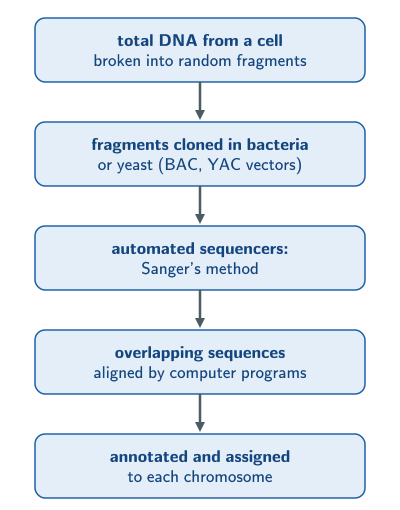
How the sequencing was done (pages 103–104):
- The total DNA of a cell was isolated and broken into random, relatively small fragments, because there are technical limits to sequencing very long pieces of DNA.
- The fragments were cloned in suitable hosts, bacteria and yeast, using vectors called BAC (bacterial artificial chromosomes) and YAC (yeast artificial chromosomes). Cloning amplified each fragment so that it could be sequenced easily.
- The fragments were sequenced in automated DNA sequencers working on the principle of a method developed by Frederick Sanger, who is also credited with a method to determine the amino acid sequences of proteins.
- The sequences were arranged using overlapping regions, which needed overlapping fragments; alignment was humanly impossible, so specialised computer programs were developed.
- The sequences were then annotated and assigned to each chromosome. The sequence of chromosome 1 was completed only in May 2006, the last of the 24 human chromosomes (22 autosomes, X and Y) to be sequenced (pages 103–104). The 24 are the different kinds of human chromosome, not the number in one cell (our reading).
- Genetic and physical maps were made using polymorphism of restriction endonuclease recognition sites and repetitive DNA called microsatellites.
Salient features of the human genome
Historical NCERT figures, not a current genome catalogue. NCERT lists these observations (page 104); gene counts, gene-length definitions, assemblies and variant databases have changed:
- The human genome contains 3164.7 million bp.
- The average gene has 3000 bases, but sizes vary greatly: the largest known human gene, dystrophin, has 2.4 million bases.
- The total number of genes is estimated at 30 000, much lower than previous estimates of 80 000 to 140 000. In an NCERT-based answer to this list, give 30 000 (see the reading note below). Almost all (99.9 per cent) nucleotide bases are exactly the same in all humans.
- The functions of over 50 per cent of the discovered genes are unknown.
Less than 2 per cent of the genome codes for proteins.
NCERT Biology (Class 12), Section 5.9.1, page 104
- Repeated sequences make up a very large part of the genome: stretches repeated many times, sometimes hundreds to thousands of times. They are thought to have no direct coding function, but they shed light on chromosome structure, dynamics and evolution.
- Chromosome 1 has the most genes (2968) and the Y the fewest (231).
- About 1.4 million locations with single-base DNA differences, SNPs (single nucleotide polymorphisms, pronounced “snips”), have been identified. They promise to change how disease-associated sequences are located on chromosomes and how human history is traced.
Reading note (pages 102 and 104): NCERT’s goals speak of approximately 20 000–25 000 genes, while its list of features gives an estimate of 30 000. These are historical estimates, not two current biological totals. NHGRI now describes approximately 20 000 protein-coding genes; non-coding RNA genes are an additional category. The old 3000-base average, “largest known” claim, chromosome gene counts, unknown-function percentage and 1.4-million-SNP tally should also be read as historical textbook statements rather than current database facts.
Applications and future challenges
- Deriving meaningful knowledge from the sequences will define research for decades and will need the expertise of tens of thousands of scientists in the public and private sectors (page 104).
- One of the greatest impacts may be a radically new approach to research: instead of one or a few genes at a time, whole-genome sequences and new high-throughput technologies let researchers study all the genes in a genome, all the transcripts in a tissue, organ or tumour, or how tens of thousands of genes and proteins work together in networks (pages 104–105).
Solved examples
Example 1: A mega project (NCERT Exercise 12)
Why is the Human Genome Project called a mega project?
Answer: because of its international scale, large sequencing effort and computing needs. The genome has about 3 × 10 bp; at the starting estimate of 3 US dollars per bp it would cost about 9 billion dollars; typed in 1000-page books of 1000 letters a page, NCERT gives 3300 such books for the DNA of a single human cell (page 102), which matches 3.3 × 10 bases (3 × 10 bases would fill 3000); and the data needed substantial computing and accelerated bioinformatics. The cost and book-count statements here are NCERT’s illustrative figures, not actual expenditure or a diploid-cell total. It was a 13-year international effort, completed in 2003 (NCERT page 102).
Example 2: The cost
Check NCERT’s cost: 3 × 10 bp at 3 US dollars per bp.
Answer: 3 × 10 × 3 = 9 × 10 dollars, that is 9 billion US dollars (NCERT page 102).
Example 3: How much of the genome codes for protein?
Using NCERT’s figures, at most how many base pairs of the human genome code for proteins?
Answer: less than 2 per cent of 3164.7 million bp: 0.02 × 3164.7 million ≈ 63.294 million bp as a strict upper threshold (the actual value is less than this) (NCERT page 104; our arithmetic). The rest includes the large share of repeated sequences.
Example 4: Bioinformatics (NCERT Exercise 14 d)
Briefly describe bioinformatics.
Answer: bioinformatics is the area of biology that uses high-speed computers to store, retrieve and analyse biological data. It grew rapidly with the HGP, whose enormous amount of sequence data needed such devices, and whose overlapping fragments could be aligned only by specialised computer programs (NCERT pages 102–103).
Common mistakes to avoid
Common mistake
Calling BAC and YAC the hosts
The hosts were bacteria and yeast; BAC and YAC (bacterial and yeast artificial chromosomes) were the vectors (NCERT page 103).
Common mistake
Mixing up ESTs and sequence annotation
The EST approach focused on identifying the genes expressed as RNA; the sequence-annotation approach sequences the whole genome first and assigns functions to regions later (NCERT page 103).
Common mistake
Saying most of the genome codes for proteins
Less than 2 per cent of the human genome codes for proteins; repeated sequences make up a very large part of it (NCERT page 104).
Quick revision summary
- The HGP, launched in 1990 and completed in 2003 (13 years), sequenced the human genome; a mega project involving roughly 3 billion bases and extensive computation. NCERT’s 9-billion-dollar calculation is illustrative; NHGRI gives an initially projected cost of 3 billion dollars.
- Goals: identify the genes, sequence the 3 billion base pairs, store and analyse the data, transfer technology, address ELSI.
- Methods: ESTs and sequence annotation; random fragments cloned in BAC and YAC vectors (bacteria and yeast hosts); Sanger’s method in automated sequencers; computer alignment of overlaps; chromosome 1 finished last, in May 2006.
- Historical NCERT feature list (not current counts): 3164.7 million bp; average gene 3000 bases, dystrophin 2.4 million; about 30 000 genes; 99.9 per cent identical between people; under 2 per cent codes for proteins; many repeats; chromosome 1 has most genes (2968), Y fewest (231); 1.4 million SNPs.
Formula sheet
- HGP: 1990–2003 (13 years)
- NCERT historical genome figure: 3164.7 million bp
- NCERT illustrative cost: 3 dollars/bp × 3 billion bp = 9 billion dollars
- NCERT historical gene-length figures: average 3000; dystrophin 2.4 million
- under 2 per cent codes for proteins
- NCERT historical counts: chromosome 1 = 2968 genes; Y = 231
- NCERT historical SNP tally: 1.4 million sites
Questions students ask
What is the difference between an SNP and a mutation?
A mutation is any change in the DNA sequence, while an SNP is a common single-base variant: NCERT defines mutation as “a phenomenon which results in alteration of DNA sequences” (Chapter 4, page 72) and SNPs as locations of single-base DNA differences (page 104). A new single-base change is a point mutation (Chapter 4, page 72), and an inheritable variant counts as a DNA polymorphism only above a population frequency of 0.01 (page 106). Beyond the NCERT text, MedlinePlus sets a similar bar for SNPs: at least 1 per cent of a population.
Why was the Human Genome Project completed ahead of schedule?
The Human Genome Project, launched in 1990, was completed in 2003 as a 13-year project (NCERT page 102), and beyond the NCERT text that was two years earlier than planned: the US National Human Genome Research Institute (NHGRI) says it had been expected to take 15 years, to 2005, and finished early partly because it set out to develop better technology, greatly improving the Sanger sequencing method it relied on. By 1998, with all the major goals of its earlier five-year plan met, a new plan already set 2003 for finishing the human sequence, and the consortium announced completion on 14 April 2003 (NHGRI fact sheet and timeline, public domain).
How was the public Human Genome Project different from Celera’s?
Beyond the NCERT text, which describes only the publicly funded project, the human genome was also sequenced separately by the company Celera Genomics, and the two efforts worked in different ways. The public effort, an international consortium, cloned DNA fragments in vectors such as BAC and YAC (NCERT page 103); beyond the NCERT text, it released its draft sequence freely and published it in Nature in February 2001 (Lander and colleagues, 2001; NHGRI timeline). Celera instead applied whole-genome shotgun sequencing to DNA from five people, published in Science that same month, and its assembly also drew on the public project’s data (Venter and colleagues, 2001).
Practice questions
Try each question first, then open the answer to check your working.
-
Q1. Which vectors were used to clone DNA fragments in the HGP, and in which hosts?
Show answerHide answer
BAC (bacterial artificial chromosomes) in bacteria and YAC (yeast artificial chromosomes) in yeast (NCERT page 103).
-
Q2. Which gene does NCERT’s historical list call the largest known, and what size does it give?
Show answerHide answer
Dystrophin, at 2.4 million bases (NCERT page 104).
-
Q3. What does ELSI stand for in the goals of the HGP?
Show answerHide answer
The ethical, legal and social issues that may arise from the project (NCERT page 102).