Origin of life
NCERT Class 12 Biology Chapter 6 Section 6.1
Quick answer
Life’s exact origin remains unresolved, but microbial evidence extends back at least about 3.5 billion years. Pasteur refuted ordinary spontaneous generation under contamination-controlled conditions; Miller’s 1953 experiment produced amino acids under a proposed early-earth model. Neither experiment established the complete pathway from non-living chemistry to cells.
With your textbook
NCERT Biology (Class 12), Chapter 6 “Evolution”, Section 6.1 “Origin of Life”, pages 110–112.
Open the official NCERT chapter (PDF, 12.7 MB, ncert.nic.in) (opens in a new tab)
Checked against the 2026-27 reprint on .
How did life on earth begin?
Origin of life
- Evolutionary biology is the study of the history of life forms on earth. To understand it, we need the context of how the earth, the stars and the universe itself evolved (page 110).
The origin of life is considered a unique event in the history of universe.
NCERT Biology (Class 12), Section 6.1, page 110
Beyond the NCERT text (our reading): this quotation reflects NCERT’s framing. We do not know whether life originated only once in the universe, and its exact origin on Earth remains unresolved.
In plain words: the earth formed from the debris of a much older universe, its early surface and air were very different from today’s, and the first living things are thought to have arisen slowly from non-living chemicals, first as large organic molecules and much later as cells living in water.
The universe and the early earth
- Looking at stars is, in a way, looking back in time: stellar distances are measured in light years, and NCERT says the light we see started its journey millions of years back, from trillions of kilometres away (page 110).
NCERT slip (page 110): NCERT’s two figures do not fit together. A light-year is about 9 trillion km, so trillions of kilometres is only a few years of light travel. The next closest star after the Sun is about 4.3 light-years away, and the other stars we see with our eyes are farther, some thousands of light-years away (NASA Space Place, What Is a Light-Year?; public domain). NCERT’s idea holds: we see each star as it was when its light left it. In an exam, keep NCERT’s point that seeing stars is looking back in time.
- The universe is almost 13.8 billion years old and is made of huge clusters of galaxies, which contain stars and clouds of gas and dust. The Big Bang theory attempts to explain its origin; NCERT says it talks of a singular huge explosion unimaginable in physical terms. The universe expanded and cooled, hydrogen and helium formed, and the gases condensed under gravitation into galaxies (page 111). Beyond the NCERT text: NASA describes the universe as beginning as a single point that then expanded and stretched, and it is still stretching (NASA Space Place, What Is the Big Bang?; public domain).
- NCERT’s simplified early-earth account: the earth formed about 4.5 billion years ago in the solar system of the Milky Way. It had no atmosphere at first. Water vapour, methane, carbon dioxide and ammonia released from the molten mass covered the surface (page 111).
- In NCERT’s account, UV rays from the sun split water into hydrogen and oxygen; the lighter hydrogen escaped. Oxygen combined with ammonia and methane to form water, CO2 and other compounds, and the ozone layer formed. As the earth cooled, water vapour fell as rain and filled the depressions, forming the oceans (page 111).
- Life appeared about 500 million years after the earth formed, almost four billion years ago (page 111). Beyond the NCERT text: the exact origin date is uncertain; evidence of microbial life extends back at least about 3.5 billion years (Wikipedia, “Earliest known life forms”, facts in our words), substantially earlier than the textbook’s separate 2-billion-year date for first cells.
Beyond the NCERT text: the make-up of the early atmosphere is not pinned down by evidence; recent models favour a weakly reducing atmosphere, mainly carbon dioxide and nitrogen rather than the methane and ammonia in Miller’s flask, so his gas mixture is a model, not a verified reconstruction (Wikipedia, “Miller–Urey experiment”, facts in our words). Oxygen built up in the air only around the Great Oxidation Event, about 2.4 billion years ago (Wikipedia, “Geologic time scale”, facts in our words), so a protective ozone layer, which forms from oxygen, came long after life began (our reasoning). Do not read NCERT’s compressed ozone sequence as established pre-life chronology.
Panspermia and spontaneous generation
- Some scientists believe that life came from outer space. Early Greek thinkers thought units of life called spores were transferred to different planets, including the earth; this idea, panspermia, is still a favourite of some astronomers (page 111).
- For a long time it was also believed that life came from decaying and rotting matter such as straw and mud: the theory of spontaneous generation (page 111).
Louis Pasteur by careful experimentation demonstrated that life comes only from pre-existing life.
NCERT Biology (Class 12), Section 6.1, page 111
- He showed that in pre-sterilised flasks, life did not come from killed yeast, while in another flask open to air, new living organisms arose from the “killed yeast”. Spontaneous generation was dismissed once and for all, but this did not explain how the first life form arose (page 111).
- Beyond the NCERT text: in Pasteur’s best-known version, the bent neck of a swan-neck flask let air in but stopped dust from settling into the sterilised broth, which stayed free of growth; when particles reached the broth, it soon clouded. Growth came from microbes carried in, not from dead matter turning into life (Wikipedia, “Spontaneous generation”, facts in our words).
Chemical evolution: Oparin, Haldane and Miller
- Oparin of Russia and Haldane of England proposed that the first form of life could have come from pre-existing non-living organic molecules (such as RNA and protein), and that the formation of life was preceded by chemical evolution: the formation of diverse organic molecules from inorganic constituents (page 111).
- The conditions on the early earth were high temperature, volcanic storms and a reducing atmosphere containing CH4, NH3 and other gases (page 111). Beyond the NCERT text: this is a model of the early atmosphere (see the note above).
- In 1953, the American scientist S.L. Miller created similar conditions on a laboratory scale. He passed an electric discharge through a closed flask containing CH4, H2, NH3 and water vapour, and observed the formation of amino acids. In similar experiments others observed the formation of sugars, nitrogen bases, pigments and fats (page 111).
- Analysis of meteorites revealed similar compounds, suggesting that similar processes occur elsewhere in space. With this limited evidence, chemical evolution was more or less accepted (page 111).
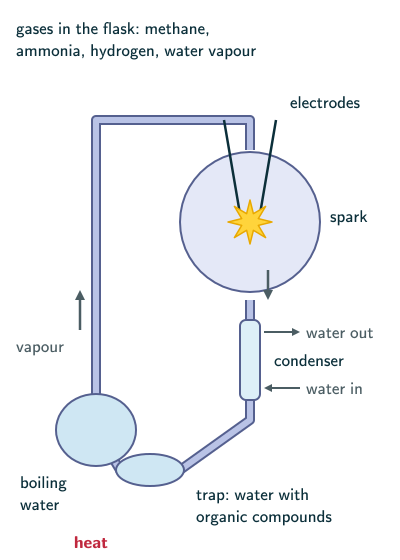
NCERT slip (page 111): NCERT says the flask was at 800 °C. Its own Figure 6.1 (page 112) shows the water vapour coming from boiling water, and in Miller’s apparatus the water in a small flask was boiled so that vapour entered the gas flask, where a continuous spark passed, with a condenser beyond (Wikipedia, “Miller–Urey experiment”, facts in our words); neither supports a temperature of 800 °C. The original amino-acid paper was published in 1953. In a question built on NCERT’s line, the expected answer is 800 °C; otherwise describe the apparatus as in the figure. Producing organic molecules demonstrated a possible chemical step, not the creation of a living cell.
The first forms of life
- NCERT: “We have no idea about how the first self replicating metabolic capsule of life arose” (page 111). Beyond the NCERT text: the step from non-life to life has not been observed, and an earlier RNA world and lipid protocells are among the hypotheses being investigated (Wikipedia, “Abiogenesis”, facts in our words); proteins and polysaccharides alone are not established self-replicators.
- NCERT’s sequence: the first non-cellular forms of life could have originated about 3 billion years back, and the first cellular forms did not possibly originate till about 2000 million years ago; these were probably single cells, and all life forms were in water (pages 111–112). In an NCERT-based answer, give these dates. Beyond the NCERT text: microbial evidence from about 3.5 billion years ago implies much older cells (Wikipedia, “Earliest known life forms”, facts in our words).
- This version, that the first form of life arose slowly through evolutionary forces from non-living molecules, is accepted by the majority (page 112).
- NCERT slip (page 112): NCERT calls this version “a biogenesis”; the term for life arising from non-living matter is abiogenesis, while biogenesis is the opposite idea, that life comes only from life, as Pasteur showed (Wikipedia, “Miller–Urey experiment” and “Spontaneous generation”, facts in our words). Write abiogenesis. Beyond the NCERT text: Pasteur’s experiments did not rule out ancient abiogenesis under different conditions, and Miller did not prove a complete origin-of-life pathway.
Solved examples
Example 1: When did life appear?
The earth formed about 4.5 billion years ago and life appeared 500 million years later. About how long ago did life appear?
Answer: 4.5 billion − 0.5 billion = 4.0 billion years ago, which is NCERT’s “almost four billion years back” (NCERT page 111).
Example 2: Pasteur against spontaneous generation
How did Louis Pasteur’s experiment disprove spontaneous generation?
Answer: in pre-sterilised flasks, no life arose from killed yeast; in a flask open to air, living organisms appeared on the killed yeast. Life comes only from pre-existing life (NCERT page 111): the organisms came from life already present, carried in from the air, not from the dead matter itself (reasoned from NCERT page 111). Beyond the NCERT text: in the swan-neck version, the bent neck let air in but kept particles out, and the broth stayed free of growth until particles reached it; this did not settle how life first originated (Wikipedia, “Spontaneous generation”, facts in our words).
Example 3: What Miller’s experiment showed
What did Miller’s experiment set out to test, and what did it show?
Answer: it tested Oparin and Haldane’s idea of chemical evolution, that organic molecules could form from inorganic constituents under early-earth conditions. An electric discharge in a closed flask of CH4, H2, NH3 and water vapour produced amino acids; similar experiments gave sugars, nitrogen bases, pigments and fats (NCERT page 111). Beyond the NCERT text: it did not create cells, and it used a model of the early atmosphere, not a verified one (our reading; see the note on the early atmosphere).
Common mistakes to avoid
Common mistake
Thinking Pasteur explained how the first life arose
Pasteur showed that life comes only from pre-existing life and so dismissed spontaneous generation; how the first life form arose remained unanswered (NCERT page 111).
Common mistake
Putting oxygen in the early atmosphere Miller copied
The early atmosphere was reducing, with CH4 and NH3; Miller’s flask held CH4, H2, NH3 and water vapour, with no free oxygen (NCERT page 111). Beyond the NCERT text: that reducing atmosphere is a model, not a verified reconstruction (see the note on the early atmosphere).
Common mistake
Mixing up NCERT’s dates for the first life and the first cells
NCERT places the first non-cellular forms about 3 billion years ago and the first cells only about 2000 million years ago (NCERT pages 111–112). Beyond the NCERT text: microbial evidence reaches back at least about 3.5 billion years (Wikipedia, “Earliest known life forms”, facts in our words), so NCERT’s first-cell date is not the modern timeline; in an NCERT-based answer, give NCERT’s dates.
Quick revision summary
- The universe is about 13.8 billion years old and Earth about 4.5 billion; NCERT’s Big Bang: a singular huge explosion, then expansion and cooling.
- Life appeared about 4 billion years ago, 500 million years after the earth formed (NCERT). First non-cellular life about 3 billion years ago; first cells about 2000 million years ago, single-celled and in water (NCERT). Beyond the NCERT text: the exact origin date is uncertain, and microbial evidence reaches at least about 3.5 billion years ago.
- Pasteur’s flasks showed that life comes only from pre-existing life and dismissed spontaneous generation (NCERT); panspermia proposes transfer of life and does not explain its ultimate origin.
- Oparin and Haldane: chemical evolution of organic molecules from inorganic ones in a reducing atmosphere. Miller (1953): electric discharge in CH4, H2, NH3 and water vapour gave amino acids (NCERT). Beyond the NCERT text: these address possible chemical steps, not an experimentally completed creation of life.
Formula sheet
- universe: about 13.8 billion years
- earth: about 4.5 billion years
- life appeared: about 4 billion years ago (NCERT)
- Miller 1953: electric discharge → amino acids
- first cells: about 2000 million years ago (NCERT); microbial evidence: at least about 3.5 billion years ago
Questions students ask
What is the difference between chemical evolution and biological evolution?
Chemical evolution is the making of the first organic molecules from non-living matter, while biological evolution is the change of living forms that followed: NCERT defines chemical evolution as the “formation of diverse organic molecules from inorganic constituents” (page 111), which most scientists believe came before the first cellular forms of life (page 126). Biological evolution by natural selection, NCERT says, “would have started when cellular forms of life with differences in metabolic capability originated on earth” (page 118). By our reading, the first acts on molecules before life exists, the second on living populations.
Why is Miller’s experiment called the Miller–Urey experiment?
Beyond the NCERT text, Miller’s experiment is called the Miller–Urey experiment because Stanley Miller did it as a graduate student of Harold Urey at the University of Chicago, testing the hydrogen-rich early atmosphere that Urey had described in a lecture in the autumn of 1952 (Schopf 2024, Life, CC BY). Urey then verified the results, and Miller’s paper in Science appeared in 1953 (same source). NCERT names only “S.L. Miller, an American scientist” and gives the year 1953 (page 111).
What are the theories of the origin of life in Class 12 Biology?
NCERT Class 12 Biology describes three ideas about how life itself began: panspermia, spontaneous generation, and chemical evolution followed by the slow rise of the first life from non-living molecules (Section 6.1, pages 111–112). For the origin of today’s species it adds the religious theory of special creation (Section 6.2, page 112). By our reading, two of the three stand on opposite sides of the evidence NCERT gives: spontaneous generation failed Pasteur’s test, while chemical evolution is backed by Miller’s experiment and similar ones (page 111).
Practice questions
Try each question first, then open the answer to check your working.
-
Q1. Which gases did Miller put in his closed flask?
Show answerHide answer
CH4, H2, NH3 and water vapour (NCERT page 111).
-
Q2. What is panspermia?
Show answerHide answer
The idea that units of life, called spores, were transferred to different planets, including the earth, so that life came from outer space; it is still a favourite idea of some astronomers (NCERT page 111).
-
Q3. Name the two scientists who proposed chemical evolution, and their countries.
Show answerHide answer
Oparin of Russia and Haldane of England (NCERT page 111).