Adaptive radiation
NCERT Class 12 Biology Chapter 6 Section 6.4
Quick answer
Adaptive radiation is the evolution of different species in a given geographical area starting from a point and radiating to other habitats, as in Darwin’s finches and the Australian marsupials. NCERT calls more than one adaptive radiation in an isolated area, representing different habitats, convergent evolution, as when placental mammals resemble marsupials (placental wolf and Tasmanian wolf). Beyond NCERT, convergence means similar features evolving independently in different lineages.
With your textbook
NCERT Biology (Class 12), Chapter 6 “Evolution”, Section 6.4 “What is Adaptive Radiation?”, pages 116–118.
Open the official NCERT chapter (PDF, 12.7 MB, ncert.nic.in) (opens in a new tab)
Checked against the 2026-27 reprint on .
What is adaptive radiation?
Adaptive radiation
This process of evolution of different species in a given geographical area starting from a point and literally radiating to other areas of geography (habitats) is called adaptive radiation.
NCERT Biology (Class 12), Section 6.4, page 117
In plain words: the descendants of one ancestral form spread into different habitats and, adapting to each, split into several new species, through branching evolution; geographic spread alone is not enough.
Beyond the NCERT text, the definition in use: adaptive radiation combines common ancestry, diversification and ecological differences; it need not happen on one island, as Darwin’s finches show (Wikipedia, “Darwin’s finches”, facts in our words).
Darwin’s finches
- On his journey Darwin went to the Galapagos Islands, where he saw an amazing diversity of creatures. Small black birds, later called Darwin’s finches, amazed him: there were many varieties of finches on the same island (pages 116–117).
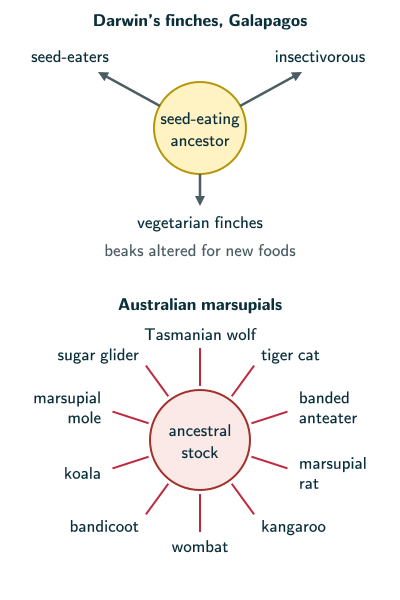
- He conjectured that all the varieties evolved on the island itself. From the original seed-eating features, many other forms with altered beaks arose, enabling them to become insectivorous and vegetarian finches (NCERT Figure 6.5, page 117).
- Beyond the NCERT text: the finches are thought to descend from a single ancestral species that reached the islands, and they diversified across the Galapagos archipelago, with food differing between islands (Wikipedia, “Darwin’s finches”, facts in our words).
- Darwin’s finches are one of the best examples of adaptive radiation (page 117).
Australian marsupials
- Another example is the Australian marsupials, a group of mammals that includes the kangaroo: a number of marsupials, each different from the others, evolved from an ancestral stock, all within the Australian island continent (page 117).
- NCERT Figure 6.6 (page 117) names the Tasmanian wolf, tiger cat, banded anteater, marsupial rat, kangaroo, wombat, bandicoot, koala, marsupial mole and sugar glider.
Placental mammals and marsupials: convergent evolution
- NCERT: when more than one adaptive radiation appeared to have occurred in an isolated geographical area (representing different habitats), one can call this convergent evolution (pages 117–118). Give this definition in an NCERT-based answer.
- Beyond the NCERT text: biologists speak of convergent evolution when distantly related lineages each evolve similar features on their own, features their common ancestor did not have (Wikipedia, “Convergent evolution”, facts in our words). So several radiations in one region do not by themselves establish convergence; the similar features are what count.
- Placental mammals also show adaptive radiation, evolving into varieties each of which appears “similar” to a corresponding marsupial: for example, the placental wolf and the Tasmanian wolf (marsupial) (NCERT Figure 6.7, page 118).
- NCERT Figure 6.7 pairs them: mole and marsupial mole; anteater and numbat (anteater); mouse and marsupial mouse; lemur and spotted cuscus; flying squirrel and flying phalanger; bobcat and Tasmanian tiger cat; wolf and Tasmanian wolf (page 118).
Reading note (page 118): NCERT writes “Placental mammals in Australia”, but the placental animals in its Figure 6.7 are mostly from outside Australia; the lemur, for example, is found only on Madagascar (Wikipedia, “Lemur”, facts in our words). The comparison is between Australian marsupials and placental mammals elsewhere that live in similar habitats, and the resemblance concerns particular traits, not identical ecology or anatomy. Learn the pairs as NCERT gives them.
Solved examples
Example 1: One example of adaptive radiation (NCERT Exercise 8)
Describe one example of adaptive radiation.
Answer: Darwin’s finches on the Galapagos Islands: from the original seed-eating finches, many other forms with altered beaks arose, enabling them to become insectivorous and vegetarian finches, and Darwin conjectured that all the varieties evolved on the island itself (NCERT pages 116–117). Beyond the NCERT text: they descend from one ancestral species and diversified across the archipelago, and it is this diversification into ecological roles, not simply migration, that makes it adaptive radiation (Wikipedia, “Darwin’s finches”, facts in our words).
Example 2: Human evolution and adaptive radiation (NCERT Exercise 9)
Can we call human evolution adaptive radiation?
Answer: in NCERT’s account, Homo sapiens arose in Africa, moved across continents and developed into distinct races (page 125), not into different species; all living humans belong to one species, so the spread of modern humans is not a radiation into new species. Beyond the NCERT text: human evolution was branching, with several extinct hominin lineages, not a single ladder from Ramapithecus to us, and whether a particular ancient diversification counts as adaptive radiation depends on evidence for ecological divergence. NHGRI describes race as “a social construct used to group people” and notes more genetic variation within self-identified racial groups than between them (NHGRI Talking Glossary, “Race”), so human populations are not discrete biological races.
Example 3: Divergent or convergent?
Darwin’s finches arose from one ancestral form; the Tasmanian wolf resembles the placental wolf. Which shows divergence and which convergence?
Answer: the finches show divergence: one ancestral form gave rise to many different forms (adaptive radiation). The Tasmanian wolf and the placental wolf show convergence: distantly related groups, marsupial and placental mammals, evolved similar forms in similar habitats (NCERT pages 117–118).
Common mistakes to avoid
Common mistake
Thinking Darwin’s finches came from different ancestors
Darwin conjectured that all the varieties of finches evolved on the island itself, from an original seed-eating form (NCERT page 117). Beyond the NCERT text: they share one ancestral species and radiated across the archipelago; movement between islands is compatible with common ancestry (Wikipedia, “Darwin’s finches”, facts in our words).
Common mistake
Taking the Tasmanian wolf for a placental mammal
The Tasmanian wolf is a marsupial; it only resembles the placental wolf (NCERT page 118).
Quick revision summary
- Adaptive radiation: the evolution of different species in a given geographical area from one starting point, radiating into other habitats.
- Darwin’s finches (Galapagos): from the original seed-eating form, forms with altered beaks became insectivorous and vegetarian.
- Australian marsupials evolved from an ancestral stock within the island continent: Tasmanian wolf, kangaroo, koala, wombat and others.
- NCERT: more than one adaptive radiation in an isolated geographical area, representing different habitats, can be called convergent evolution, as in placental mammals and marsupials with similar forms, such as the placental wolf and the Tasmanian wolf. Beyond NCERT: convergence means distantly related lineages evolving similar features separately.
Formula sheet
- adaptive radiation: one point → many habitats
- Darwin’s finches: seed-eating → insects, plants
- Australian marsupials: one ancestral stock
- placental wolf ~ Tasmanian wolf: convergent
Questions students ask
Are marsupials found only in Australia?
No, beyond the NCERT text, marsupials are not found only in Australia: living marsupials are “restricted to the Americas, mostly South America, and to Australasia”, and over 200 of their nearly 350 living species are Australasian (May-Collado and others 2015, PeerJ, CC BY). North of Mexico the only marsupial is the Virginia opossum (US National Park Service). NCERT’s example is the adaptive radiation of the marsupials of Australia (page 117).
What is the difference between marsupials and placental mammals?
Beyond the NCERT text, marsupials differ from placental mammals in how their young develop: marsupials give birth to undeveloped young and then feed them on milk for a long time (May-Collado and others 2015, PeerJ, CC BY), in the Virginia opossum and the kangaroo inside a pouch (US National Park Service). In placental mammals, by our reading, the young develop further inside the mother’s uterus, joined to her through a placenta, as NCERT describes for humans (Chapter 2, page 37).
Is the Tasmanian wolf extinct?
Yes, the Tasmanian wolf of NCERT Figure 6.7 is extinct: NCERT Chapter 13 lists the thylacine of Australia among recent extinctions (page 221), and, beyond the NCERT text, ‘Tasmanian wolf’ is a common name for the thylacine, Thylacinus cynocephalus (Rovinsky and others 2021, BMC Ecology and Evolution, CC BY). May-Collado and others (2015, PeerJ, CC BY) call it “the extinct Tasmanian wolf” and date the end of its family, the Thylacinidae, to 1936.
Practice questions
Try each question first, then open the answer to check your working.
-
Q1. Where did Darwin observe the finches that showed adaptive radiation?
Show answerHide answer
On the Galapagos Islands (NCERT page 116).
-
Q2. Name the marsupial that corresponds to the placental flying squirrel in NCERT Figure 6.7.
Show answerHide answer
The flying phalanger (NCERT Figure 6.7, page 118).
-
Q3. What change in Darwin’s finches let new forms become insectivorous and vegetarian?
Show answerHide answer
Their beaks were altered (NCERT page 117).